
Why ADA Compliant Parking Lot Striping Is a Legal Requirement — Not an Option
ADA compliant parking lot striping is the system of painted markings, access aisles, symbols, and signage that makes parking lots legally accessible to people with disabilities under the Americans with Disabilities Act.
Here’s what it requires at a glance:
| Requirement | Standard |
|---|---|
| Minimum accessible spaces | 1 for every 1-25 total spaces |
| Accessible space width | 96 inches minimum |
| Access aisle width (car) | 60 inches minimum |
| Van-accessible aisle width | 96 inches minimum |
| Van vertical clearance | 98 inches minimum |
| Sign height | 60 inches minimum to bottom of sign |
| Maximum slope | 1:48 (about 2%) |
| Van-accessible ratio | At least 1 of every 6 accessible spaces |
The ADA was passed in 1990. The current enforceable rules come from the 2010 ADA Standards for Accessible Design. These aren’t suggestions — they’re federal law.
For property managers and business owners in the DFW Metroplex, this matters in a very practical way. When you restripe or resurface your lot, you’re legally required to bring your accessible spaces up to current standards. Fines for non-compliance can start at $75,000 for a first violation and reach $150,000 for repeat offenses — on top of potential lawsuits.
But beyond the legal risk, it’s also about who can access your business. Faded lines, missing signs, or incorrectly sized spaces can make your parking lot unusable for customers with mobility challenges.
This guide walks you through everything: how many spaces you need, exact dimensions, signage rules, slope limits, and what triggers a compliance obligation when you maintain or update your lot.
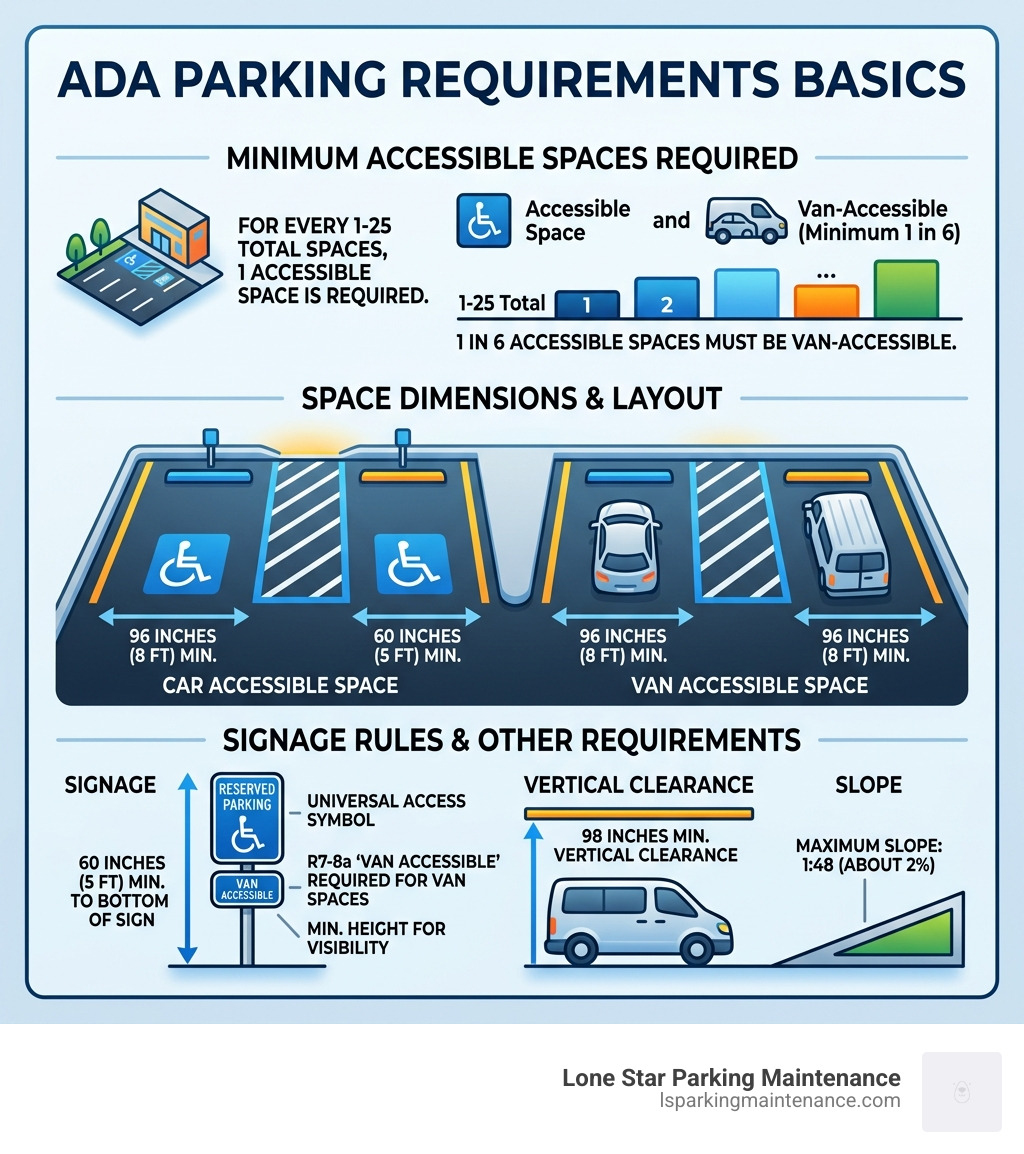
Understanding ADA Compliant Parking Lot Striping Requirements
When we talk about ada compliant parking lot striping, we aren’t just talking about slapping some blue paint on the asphalt. It is a comprehensive “scoping” process. Federal standards require that every parking facility on a site be calculated separately. If you have a parking garage and a surface lot, you don’t just add the totals together; you calculate the requirements for each individual structure.
The goal is simple: provide the shortest accessible route from the parking space to the building entrance. If your building has multiple accessible entrances, the ADA spaces must be dispersed so that they are located near each entrance. You can’t just bunch them all up in the far corner of the lot because it’s easier to paint there!
According to the ADA Compliance Brief: Restriping Parking Spaces, even the simple act of restriping your lot is considered a “readily achievable” barrier removal. This means if you are repainting your lines, you must bring the lot up to 2010 standards.
Calculating the Minimum Number of Spaces
The number of accessible spots you need is strictly tied to the total capacity of your lot. Here is how the math breaks down for standard commercial facilities:
| Total Parking Spaces | Minimum Number of Accessible Spaces |
|---|---|
| 1 to 25 | 1 (Must be Van Accessible) |
| 26 to 50 | 2 |
| 51 to 75 | 3 |
| 76 to 100 | 4 |
| 101 to 150 | 5 |
| 151 to 200 | 6 |
| 201 to 300 | 7 |
| 301 to 400 | 8 |
| 401 to 500 | 9 |
| 501 to 1000 | 2% of total |
| 1001 and over | 20, plus 1 for every 100 over 1000 |
Crucially, at least one out of every six accessible spaces must be “van accessible.” If you only have one accessible spot (because your lot has 25 or fewer spaces), that one spot must be van accessible.
Special Requirements for Healthcare and Residential Facilities
Standard retail or office buildings follow the table above, but healthcare facilities have much stricter rules because their visitors are more likely to have mobility challenges.
- Hospital Outpatient Facilities: 10% of patient and visitor parking spaces must be accessible.
- Rehabilitation and Outpatient Physical Therapy Facilities: 20% of patient and visitor parking spaces must be accessible.
For residential facilities, the requirements depend on the type of housing and the number of units designed for mobility access. In these cases, accessible parking must be dispersed among the various types of residential parking provided (such as surface lots vs. garages).
Technical Specifications for Accessible Parking Spaces
Precision is everything in ada compliant parking lot striping. If a stall is even a few inches too narrow, it can prevent a wheelchair lift from deploying correctly, creating a safety hazard and a legal liability.
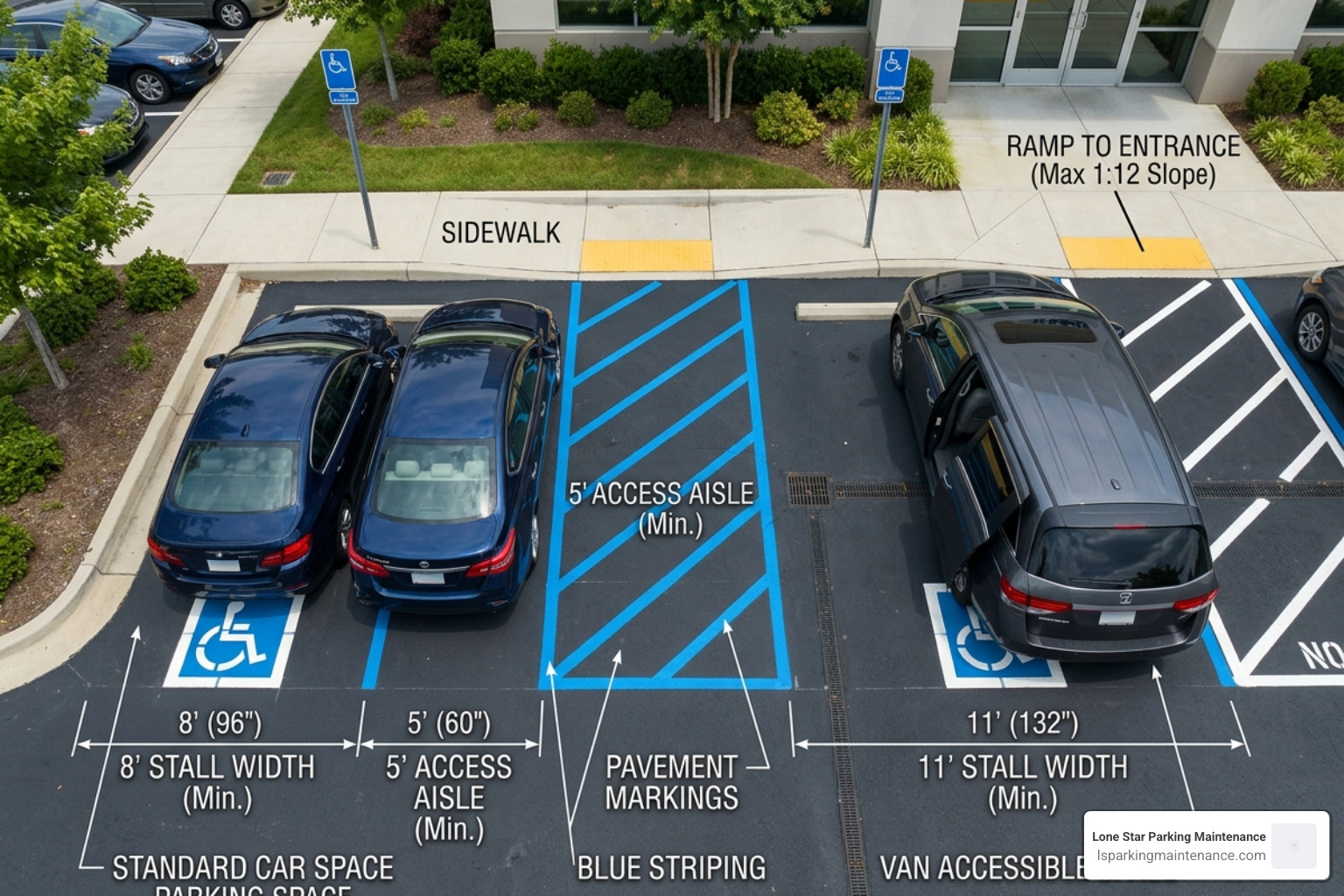
Dimensions for ADA Compliant Parking Lot Striping
There are two main types of spaces we install at Lone Star Parking Maintenance:
- Car-Accessible Spaces: These must be at least 96 inches (8 feet) wide and have an adjacent access aisle that is at least 60 inches (5 feet) wide.
- Van-Accessible Spaces: You have two options here. You can make the parking space 132 inches (11 feet) wide with a 60-inch (5-foot) aisle, OR you can keep the space at 96 inches (8 feet) wide but increase the access aisle to 96 inches (8 feet).
Access aisles must extend the full length of the parking space. Two parking spaces can share a single access aisle, except in the case of angled parking. In angled layouts, the access aisle must be located on the passenger side of the vehicle so the lift can deploy into a safe, marked area.
Before we start the engine on our striping machines, we always recommend proper lot prep. You can find more details on this in our guide: How do I prepare my parking lot for striping?
Surface and Slope Standards
A beautiful paint job won’t save you if the ground is crooked. The ADA is very strict about slopes. Both the parking space and the access aisle must be nearly level, with a maximum slope of 1:48 (2.08%) in all directions. This ensures that a wheelchair won’t roll away while a person is trying to get into or out of their vehicle.
The surface must also be firm, stable, and slip-resistant. This is why we emphasize cleaning the lot before work begins. Dirt, gravel, and oil spots prevent paint from bonding and create trip hazards. If your lot is currently covered in grime, you might wonder: Is pressure wash preparation necessary when striping or re-striping parking lots? The answer is almost always yes for a long-lasting, compliant finish.
Finally, don’t forget vertical clearance. For van-accessible spaces, there must be at least 98 inches of clear height for the vehicle to enter, park, and exit. This includes the vehicular route to the space itself.
Signage and Marking Standards for ADA Compliance
Signs are the “voice” of your parking lot. They tell drivers where they can and cannot park, and they provide essential information for those with disabilities.
Vertical Signage Requirements
Every accessible space must be identified by a sign featuring the International Symbol of Access (ISA)—the familiar wheelchair icon. These signs must be mounted so that the bottom edge of the sign is at least 60 inches (5 feet) above the finished grade. This ensures the sign is visible even when a tall SUV is parked in the spot.
For van-accessible spots, the sign must specifically include the phrase “Van Accessible.” In Texas, we also have to be mindful of state-specific wording for tow-away zones and fine amounts, which are often required to be posted at the entrance of the lot or at each individual space. These signs must be permanently mounted on posts or building walls; you cannot simply paint the symbol on the ground and call it a day.
For a deeper look at how we handle these installations, check out our parking lot striping services page.
Access Aisle Hatching and Markings
The access aisle is a “no parking” zone. To prevent people from mistakenly parking their motorcycles or small cars there, the aisle must be marked with diagonal “hatching” or cross-hatching.
While the federal ADA standards don’t mandate a specific color for the paint, the industry standard is high-contrast blue for the boundaries and the ISA symbol. Many property owners also choose to have “NO PARKING” painted within the access aisle to provide extra clarity. The lines of the hatching should be spaced closely enough to make it obvious that the area is not a parking stall.
Maintenance and the Impact of Restriping on Compliance
One of the most common questions we get at Lone Star Parking Maintenance is: “Do I really have to change my layout if I’m just repainting the lines?”
The short answer is: Yes.
If you are performing “normal maintenance,” like filling a few cracks or patching a pothole, you don’t necessarily have to trigger a full ADA overhaul. However, resurfacing (adding a new layer of asphalt) or restriping (painting a new layout) are considered alterations. When you alter the lot, you are legally required to provide accessible spaces to the maximum extent feasible.
Faded lines are one of the most common reasons for ADA violations. If a driver can’t see the boundaries of the access aisle, they might park in it, blocking a van’s wheelchair lift. We generally recommend restriping every 18 to 24 months in high-traffic DFW lots to keep everything crisp and compliant.
Regular maintenance like parking lot sealing and crack filling helps protect your investment and keeps the surface smooth for wheelchair users.
Common Compliance Pitfalls and How to Avoid Them
Even with the best intentions, it’s easy to make mistakes. Here are the “Big Four” pitfalls we see in the DFW area:
- Faded or Missing Markings: If the blue paint is grey and the ISA symbol is peeling, you are out of compliance.
- Incorrect Slopes: Many lots have “built-in” slopes for drainage that exceed the 1:48 limit. This often requires professional leveling or relocating the ADA spaces.
- Signage Height: Signs mounted too low are easily blocked by vehicles or can become a head-strike hazard for pedestrians.
- Obstructions in the Route: If a customer has to wheel themselves behind a row of parked cars to get to the door, the route is not compliant. The path should be direct and safe.
Professional ADA Compliant Parking Lot Striping in DFW
Navigating federal ADA standards alongside the Texas Accessibility Standards (TAS) can be a headache. Texas often has its own specific requirements that go above and beyond federal minimums.
At Lone Star Parking Maintenance, we live and breathe these codes. We don’t just “paint lines”; we design layouts that protect you from liability and make your property welcoming to everyone. Whether you have a small boutique lot or a massive commercial garage, we ensure your project is done right the first time.
Ready to secure your lot? Get a quote for your project today.
Frequently Asked Questions about ADA Parking
Does resurfacing my parking lot require me to bring it up to ADA standards?
Yes. The Department of Justice considers resurfacing an “alteration” of the facility. This triggers the requirement to provide accessible parking spaces as outlined in the 2010 Standards. If you are laying down new asphalt or a significant sealcoat, you must ensure your striping and signage meet current laws.
What is the difference between car-accessible and van-accessible spaces?
The primary difference is the width of the access aisle and the vertical clearance. Van-accessible spaces require a wider aisle (96 inches) or a wider stall (132 inches) to accommodate wheelchair lifts that deploy from the side of a van. They also require 98 inches of vertical clearance and a specific “Van Accessible” sign.
Are there exceptions for small parking lots with four or fewer spaces?
There is a small “signage exception” for very tiny lots. If a parking lot has four or fewer total spaces (including accessible ones), you still must provide the accessible space and access aisle, but you are not required to install the vertical sign. However, the space must still be van-accessible in its dimensions.
Conclusion
Providing ada compliant parking lot striping is about more than avoiding a $75,000 fine. It is about safety, inclusion, and professional integrity. A well-marked lot tells your customers that you care about their experience from the moment they pull onto your property. It reduces your liability, prevents accidents, and keeps your business running smoothly.
Don’t leave your compliance to chance or to a “low-bid” contractor who doesn’t know the difference between a 60-inch and a 96-inch aisle. Trust the experts who understand the DFW landscape and the technical nuances of the law.
If you’re ready to upgrade your facility, contact us for a consultation. We’ll help you navigate the requirements and provide professional parking lot striping that stands the test of time.