
Why Concrete Grinding Parking Lots Is a Smart Business Decision
Concrete grinding parking lots is a proven surface restoration method that removes raised edges, smooths uneven slabs, and eliminates trip hazards — without tearing out and replacing your entire lot.
Quick answer: What does concrete grinding do for a parking lot?
- Removes surface irregularities like faulting, raised joints, and rough patches
- Eliminates trip hazards that create liability exposure
- Restores skid resistance and improves traction for vehicles and pedestrians
- Prepares the surface for sealers, coatings, or restriping
- Costs far less than full concrete replacement
- Completes in 1–3 days with minimal disruption to your business
If you manage a commercial property in the DFW Metroplex, your parking lot takes a beating. Heavy traffic, Texas heat, freeze-thaw cycles, and years of use all add up. Cracks form. Slabs shift. Joints start to fault — where one slab sits higher than the next.
Those small problems become big ones fast.
An uneven parking lot isn’t just an eyesore. It’s a slip-and-fall waiting to happen. It can damage customers’ vehicles, trigger ADA compliance issues, and send the message that your property isn’t well cared for.
The good news? You often don’t need a full replacement. Concrete grinding is one of the most cost-effective tools in parking lot maintenance — and when done right, it can add years of life to your existing surface.
The Essentials of Concrete Grinding Parking Lots
When we talk about concrete grinding parking lots, we are referring to a precise pavement restoration technique. It isn’t just “sanding down” the floor; it’s a controlled engineering process that uses industrial-grade equipment to shave off high spots and level out the driving surface.
In the DFW area, our soil is notorious for shifting. This movement causes “faulting,” which is a fancy way of saying one concrete slab has pushed higher than its neighbor. These vertical offsets are more than just a bumpy ride; they are major trip hazards. Grinding corrects these irregularities, improving the overall ride quality and texture of the pavement.
One of the biggest perks of grinding is texture enhancement. Over time, concrete can become polished and slippery, especially when wet. The grinding process restores friction and skid resistance, making the lot safer for both vehicles and pedestrians. According to the Diamond Grinding Pad Progression for Concrete Prep: Complete Guide, the right sequence of diamond tools can take a rough, dangerous surface and turn it into a perfectly profiled floor ready for heavy use.
Professional Equipment and Diamond Tooling
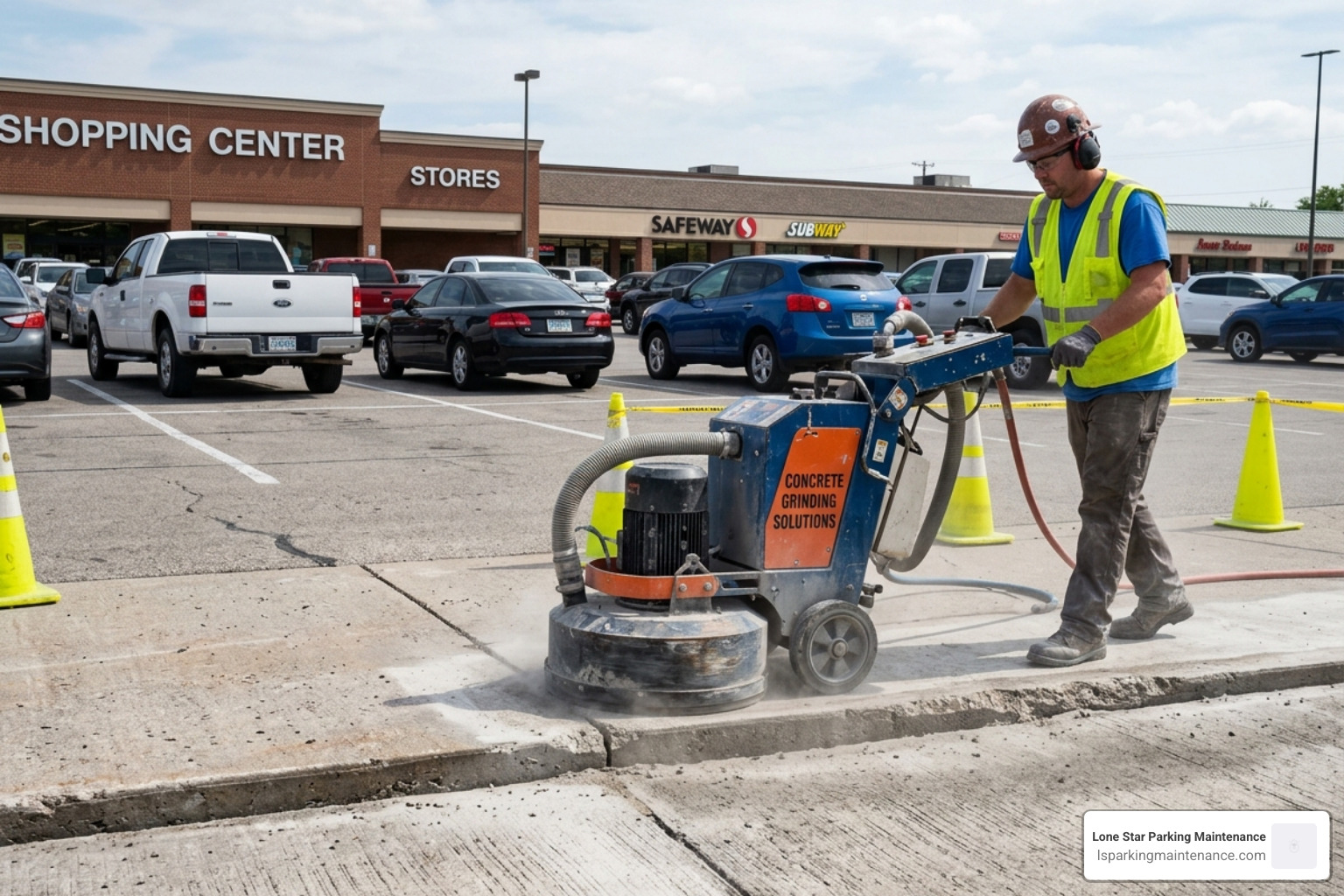
To get these results, we don’t just use any old tool. Professional concrete grinding parking lots requires heavy-duty planetary grinders. These machines feature multiple spinning heads that rotate in opposite directions, ensuring a flat, swirl-free finish.
We often utilize specialized attachments, such as Red Diamond heads. A single set of these high-performance attachments can cover an estimated 8,000 square feet, making them incredibly efficient for large commercial lots. The choice of tooling depends on the concrete’s hardness:
- Metal Bond Diamonds: Used for the initial heavy removal of high spots and “laitance” (that weak, dusty top layer of concrete).
- Resin Bond Diamonds: Used for refining the surface if a smoother finish is required for specific coatings.
How the Grinding Process Works
The magic happens through abrasive action. Industrial diamonds embedded in the metal segments of the grinding discs literally chew through the top layer of the concrete. This process eliminates surface contaminants and “laitance,” which is essential because Concrete Floor Grinding & Surface Prep: Why It Makes or Breaks Your Floor notes that over 80% of flooring failures are caused by poor surface preparation.
By the time we’re done, the concrete has a “CSP” (Concrete Surface Profile) that is ideal for mechanical adhesion. If you plan on following up with Parking Lot Sealing and Crack Filling, this ground profile ensures the sealant actually sticks and lasts for years.
When to Choose Grinding Over Other Repair Methods
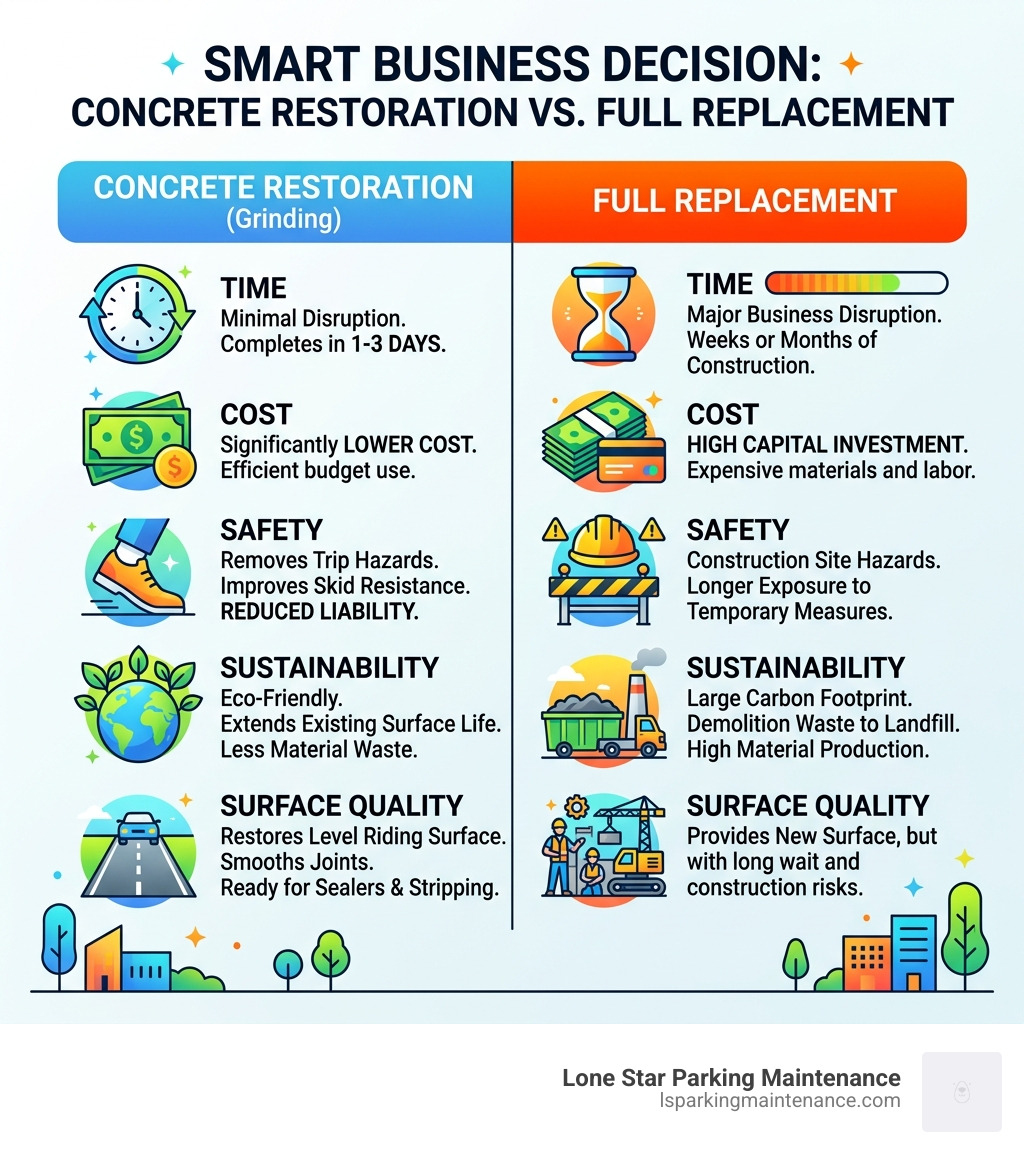
Property managers often ask us: “Should I grind it, lift it, or replace it?” The answer depends on the severity of the damage. For minor depressions and “lipped” joints, grinding is almost always the winner because it’s fast and budget-friendly.
| Feature | Concrete Grinding | Full Replacement | Polyjacking/Lifting |
|---|---|---|---|
| Cost | Low ($) | Very High ($$$$) | Moderate ($$) |
| Downtime | 1–3 Days | 7–14 Days | 1 Day |
| Best For | Raised joints, trip hazards | Structural failure | Sunken slabs |
| Longevity | Permanent removal of high spot | 20+ years | Long-term (if soil is stable) |
If you have a slab that has sunk several inches due to soil washout or burrowing animals (those pesky North Texas gophers!), you might need a combination of lifting (polyjacking) and grinding. However, if the issue is just a raised edge at a joint or a doorway, grinding is the most surgical and cost-effective approach.
Concrete Grinding Parking Lots for ADA Compliance
This is where concrete grinding parking lots becomes a legal necessity. The Americans with Disabilities Act (ADA) is very specific: any vertical change in level over 1/4 inch is considered a trip hazard and must be addressed.
We focus on:
- Sidewalk Transitions: Ensuring the path from the car to the front door is seamless.
- Entrance Leveling: Grinding down thresholds so wheelchairs can pass without a jarring “thump.”
- Slope Correction: Adjusting the “run” and “cross-slope” to meet strict accessibility standards.
By proactively grinding these hazards, you aren’t just being a good neighbor—you’re protecting your business from expensive liability lawsuits.
Identifying the Root Causes of Damage
Grinding fixes the symptom, but as experts, we also look for the cause. In the DFW Metroplex, common culprits include:
- Poor Drainage: Water pooling near joints softens the subgrade, causing slabs to tilt.
- Freeze-Thaw Cycles: Even in Texas, the occasional hard freeze causes soil to expand and contract, shifting the concrete.
- Heavy Traffic: Delivery trucks and garbage bins put immense pressure on slab edges.
- Burrowing Animals: Moles and groundhogs can hollow out the earth beneath your lot, leading to “voids” and sinking.
The Step-by-Step Process and Site Preparation
We know that closing your parking lot is a headache. That’s why we aim for a 1–3 day timeline for most repair jobs. Preparation is the key to making this happen smoothly.
Before the grinders ever touch the pavement, we recommend a thorough Parking Lot Power Washing. This removes grease, oil, and dirt, allowing us to see every crack and fault clearly.
Site Setup Checklist:
- Notifications: Alert tenants and customers at least 48–72 hours in advance.
- Alternative Parking: Clearly mark where people should park during the 1–3 day window.
- Signage: We use safety cones, caution tape, and “Business Open” signs to keep traffic flowing safely.
- Timing: For office buildings, we often schedule work on weekends. For apartments, weekdays are usually best when residents are at work.
If you have more questions about how we handle specific lot types, check out our FAQs.
Safety and Environmental Controls
Grinding concrete creates a lot of dust—and that dust contains silica, which is a big “no-no” for health and safety. We take this seriously. We use high-powered HEPA vacuums attached directly to our grinders to capture dust at the source, ensuring we stay in full compliance with OSHA standards.
We also follow Best Management Practices (BMPs) for residue disposal. As outlined in the Chapter 4: Construction Details, Section 42: Groove and Grind Concrete guidelines, we ensure that no concrete “slurry” or dust enters your storm drains. This protects the local DFW water supply and keeps your property clean.
Common Mistakes to Avoid
Don’t let an amateur take a grinder to your lot. We’ve seen plenty of “DIY” or “cheap” jobs go wrong. Common mistakes include:
- Over-Grinding: Taking too much off can weaken the structural integrity of the slab.
- Ignoring the Soil: Grinding a slab that is still sinking is like putting a band-aid on a broken leg. You have to stabilize the base first.
- Skipping Grit Levels: This leaves deep scratches in the concrete that trap dirt and look unprofessional.
- Improper Equipment: Using a small handheld grinder for a large lot results in a wavy, uneven surface.
Cost Factors and Long-Term Maintenance
How much does it cost? While every lot is different, concrete grinding parking lots is significantly cheaper than a full overhaul. A full-lot restoration or resurfacing can run anywhere from $5,000 to $12,000+, whereas targeted grinding and patching often fall in the $2,000 to $4,500 range.
Factors that influence your quote:
- Square Footage: The total area that needs leveling.
- Severity of Faulting: How deep we have to grind to make the joint flush.
- Concrete Hardness: Harder aggregates take more time and specialized diamond tooling.
- Mobilization: The logistics of getting heavy machinery to your specific DFW location.
Maintaining Your Concrete Grinding Parking Lots
Once your lot is smooth, you want to keep it that way. Proactive maintenance is the secret to avoiding another repair bill in two years.
According to the How to Maintain your Concrete Parking Lot guide, joint sealants are your first line of defense. These sealants have a design life of 5 to 10 years and prevent water from getting under the slabs. We also recommend:
- Annual Cleaning: Sweeping and power washing to prevent debris from clogging joints.
- Penetrating Sealers: These soak into the concrete to protect against freeze-thaw damage.
- Restriping: After grinding, your lines might be faded. Fresh Parking Lot Striping makes the whole lot look brand new.
Learn more About Us and our commitment to using top-quality materials for every DFW project.
Improving Drainage and Smoothness
Water is the enemy of concrete. If your lot has “bird baths” (standing water), it’s only a matter of time before the subgrade fails. Grinding can often help redirect water toward catch basins. In some cases, we might recommend catch basin repair or the use of pervious concrete to allow water to drain through the surface rather than sitting on top of it. This reduces hydroplaning and keeps your customers’ feet dry!
Frequently Asked Questions about Parking Lot Grinding
How long does the concrete grinding process take for a commercial lot?
Most projects are completed in 1 to 3 days. Because there is no “cure time” like there is with new concrete, you can often drive on the surface the same day the work is finished.
Is concrete grinding a permanent fix for sunken slabs?
Grinding is a permanent removal of the high spot. However, if the underlying soil is still shifting or washing away, the slabs may continue to move. We always assess the subgrade to ensure grinding is the right long-term solution.
How much does concrete grinding cost compared to full replacement?
Grinding typically saves property owners 50% to 70% compared to the cost of ripping out and replacing concrete slabs. It is one of the highest-ROI maintenance tasks you can perform.
Conclusion
At Lone Star Parking Maintenance, we take pride in helping DFW business owners keep their properties safe, compliant, and looking sharp. From the initial assessment to the final sweep, we bring industry-leading standards to every concrete grinding parking lots project.
Don’t wait for a trip-and-fall accident to happen. A smooth, well-maintained parking lot tells your customers that you care about their safety and their experience from the moment they pull onto your property.
Ready to smooth out those bumps and protect your investment?
Lone Star Parking Maintenance Serving the DFW Metroplex with Excellence https://www.lsparkingmaintenance.com/