
Why Getting the Recommended Lumens for Parking Lot Right Is a Safety Issue
The recommended lumens for parking lot lighting depend on the type of facility and its security needs. Here’s a quick reference:
| Parking Lot Type | Lumens Per Fixture | Foot-Candles |
|---|---|---|
| Residential / Small | 12,000 – 18,000 lm | 0.2 fc minimum |
| Basic Commercial | 20,000 – 30,000 lm | 0.2 – 2.0 fc |
| High-Traffic Retail | Up to 7,500 lm (small fixtures) / 30,000+ lm (shoebox) | 0.5 – 3.6 fc |
| High-Security Zones | 10,000 – 20,000 lm | 0.5 fc minimum |
| Parking Structures | Higher output required | 5.0 fc |
Picture this: a dimly lit parking garage late at night. It’s a classic horror movie setup — and for good reason. Poorly lit parking areas aren’t just unsettling. They’re genuinely dangerous.
Inadequate lighting causes accidents, creates blind spots for security cameras, and makes pedestrians vulnerable. For property managers and business owners in the DFW Metroplex, the stakes are real.
The good news? Getting your lighting right isn’t complicated once you understand a few key numbers.
Lumens measure the total visible light a fixture puts out. The right lumen level depends on your lot’s size, use, pole height, and local safety standards set by organizations like the Illuminating Engineering Society (IES). Using watts alone to judge brightness — like many property owners still do — leads to under-lit lots or wasted energy.
This guide breaks it all down so you can make confident, code-compliant decisions.
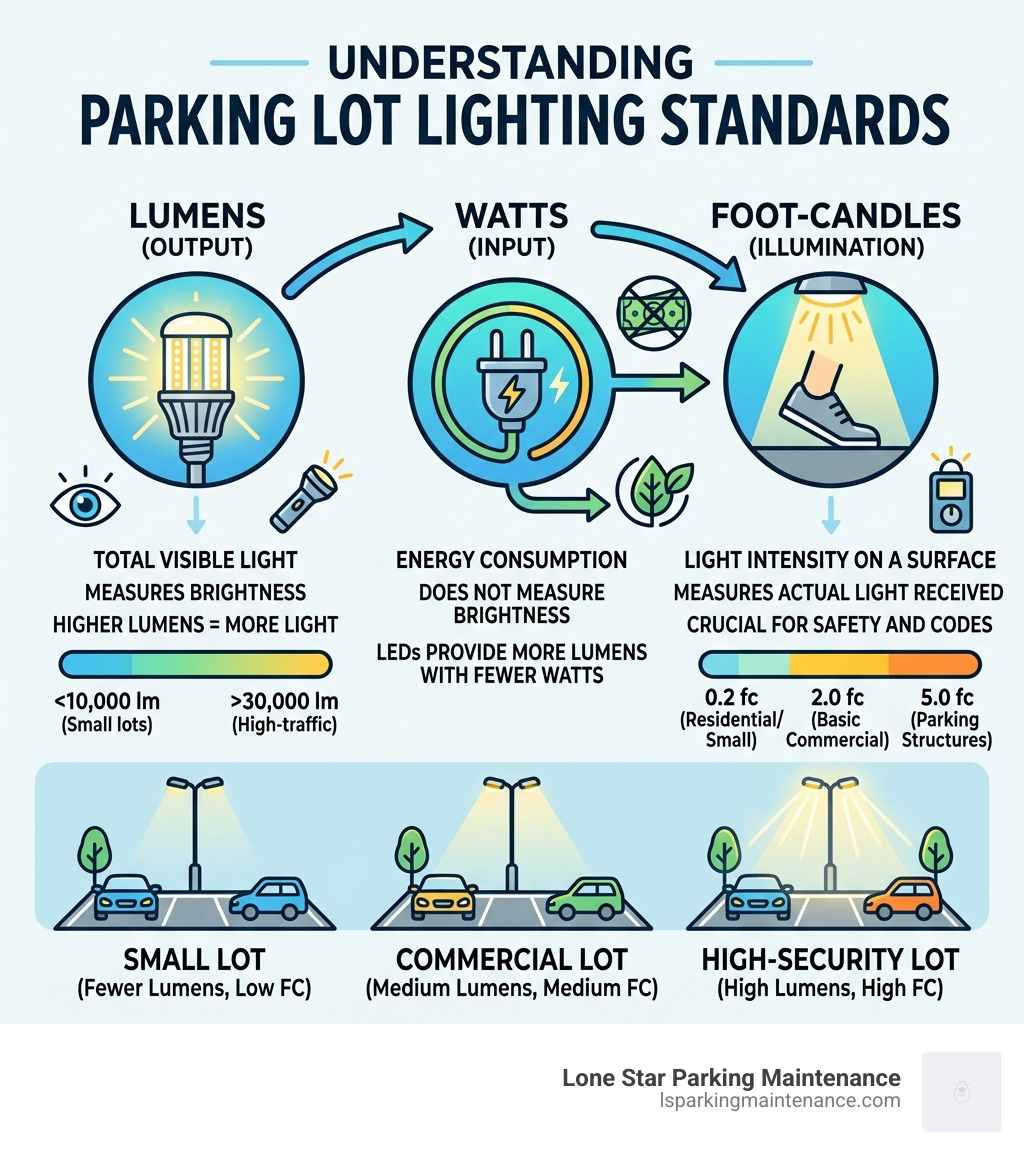
Understanding Lumens vs. Watts in Modern Lighting
For decades, we all bought light bulbs based on “watts.” If you wanted a brighter light, you grabbed a 100-watt bulb instead of a 60-watt one. But here’s the thing: watts don’t measure brightness. They measure energy consumption—essentially, how much juice the light is pulling from the grid.
In the modern world of LED technology, the old “wattage” rule has gone out the window. Today, we focus on lumens. Lumens represent the actual amount of visible light emitted by a source. When we talk about the recommended lumens for parking lot projects, we are looking at the “output” rather than the “input.”
Luminous Efficacy: The Secret Sauce
Think of it like a car’s fuel efficiency. If a traditional Metal Halide (MH) fixture and a new LED fixture both put out 20,000 lumens, the LED might use only 150 watts while the MH fixture gulps down 400 watts. This ratio of lumens to watts is called “luminous efficacy.” Modern LEDs in the DFW area typically achieve 118 to 140 lumens per watt, making them the clear winner for any commercial facility.
Why Photometric Brightness Matters
When determining How Many Lumens Are Needed for a Parking Lot?, we also have to consider how the human eye perceives light. Older High-Pressure Sodium (HPS) lights give off a yellow, dingy glow. Even if the lumen count is high, the “photometric brightness” feels lower because the color rendering is poor. LEDs provide a crisp, white light that makes everything from license plates to faces much easier to see.
IESNA Standards and Recommended Lumens for Parking Lot Safety
The Illuminating Engineering Society (IES), often referred to as IESNA, is the gold standard for lighting guidelines in North America. They don’t just guess how much light you need; they use science to determine the minimum levels required to prevent crime and accidents.
Foot-Candles: The Measure of Ground Light
While lumens measure what comes out of the fixture, “foot-candles” (fc) measure how much light actually hits the ground. One foot-candle is defined as one lumen per square foot.
| Activity Level | IES Recommended Foot-Candles (Avg) | Uniformity Ratio (Max:Min) |
|---|---|---|
| High (Retail, Hospitals) | 3.6 fc | 15:1 |
| Medium (Office Parks) | 2.4 fc | 20:1 |
| Low (Industrial, Storage) | 0.8 fc | 20:1 |
Uniformity Ratios: No More Dark Corners
One of the biggest mistakes we see in DFW parking lots isn’t a lack of total light—it’s poor distribution. If you have one super-bright spot directly under a pole and pitch-black shadows twenty feet away, you have a “uniformity” problem.
The IES recommends a uniformity ratio of 20:1 for standard lots and 15:1 for high-security areas. This means the brightest spot shouldn’t be more than 15 or 20 times brighter than the darkest spot. High uniformity is actually more important for security than raw brightness because it eliminates the “hiding spots” that trespassers love.
Horizontal vs. Vertical Illuminance
- Horizontal Illuminance: This is the light on the pavement. It helps drivers see lane markings and pedestrians see trip hazards.
- Vertical Illuminance: This is the light on people’s faces and the sides of cars. This is critical for CCTV cameras and personal safety. IES guidelines often suggest a minimum of 0.5 to 1.0 vertical foot-candles for high-security zones.
For more information on these technical requirements, check out these FAQs on Parking Lot Lighting Standards. At Lone Star Parking Maintenance, we specialize in Parking Lot Lighting that meets these exact IES standards to keep your liability low and your safety high.
Calculating Total Lumen Requirements by Lot Size and Activity
How do you actually figure out how many fixtures to buy? You don’t want to overspend on electricity, but you certainly don’t want a “horror movie” lot.
The Simple Calculation Method
A common rule of thumb for a standard commercial lot is to aim for about 20 to 30 lumens per square foot. For high-traffic retail, you might jump up to 50 or even 100 lumens per square foot.
The Formula:
Total Lumens = Total Square Footage × Desired Foot-Candles × 10
(Note: The “10” is a multiplier that accounts for light loss factors like dirt on the lens and the natural dimming of bulbs over time.)
Example: A 10,000 Square Foot Office Lot
If you have a medium-sized lot (10,000 sq ft) and you want 3 foot-candles of light:
- 10,000 sq ft × 3 fc = 30,000.
- 30,000 × 10 = 300,000 total lumens.
- If you use 20,000-lumen LED fixtures, you would need about 15 fixtures.
Activity Levels Matter
- Residential/Small Lots: Usually need 12,000 to 18,000 lumens per fixture.
- Commercial/Medium Lots: Typically require 20,000 to 30,000 lumens per fixture.
- High-Traffic Retail: These lots often need the big guns—fixtures pushing 30,000 to 70,000 lumens—to ensure shoppers feel safe returning to their cars at night.
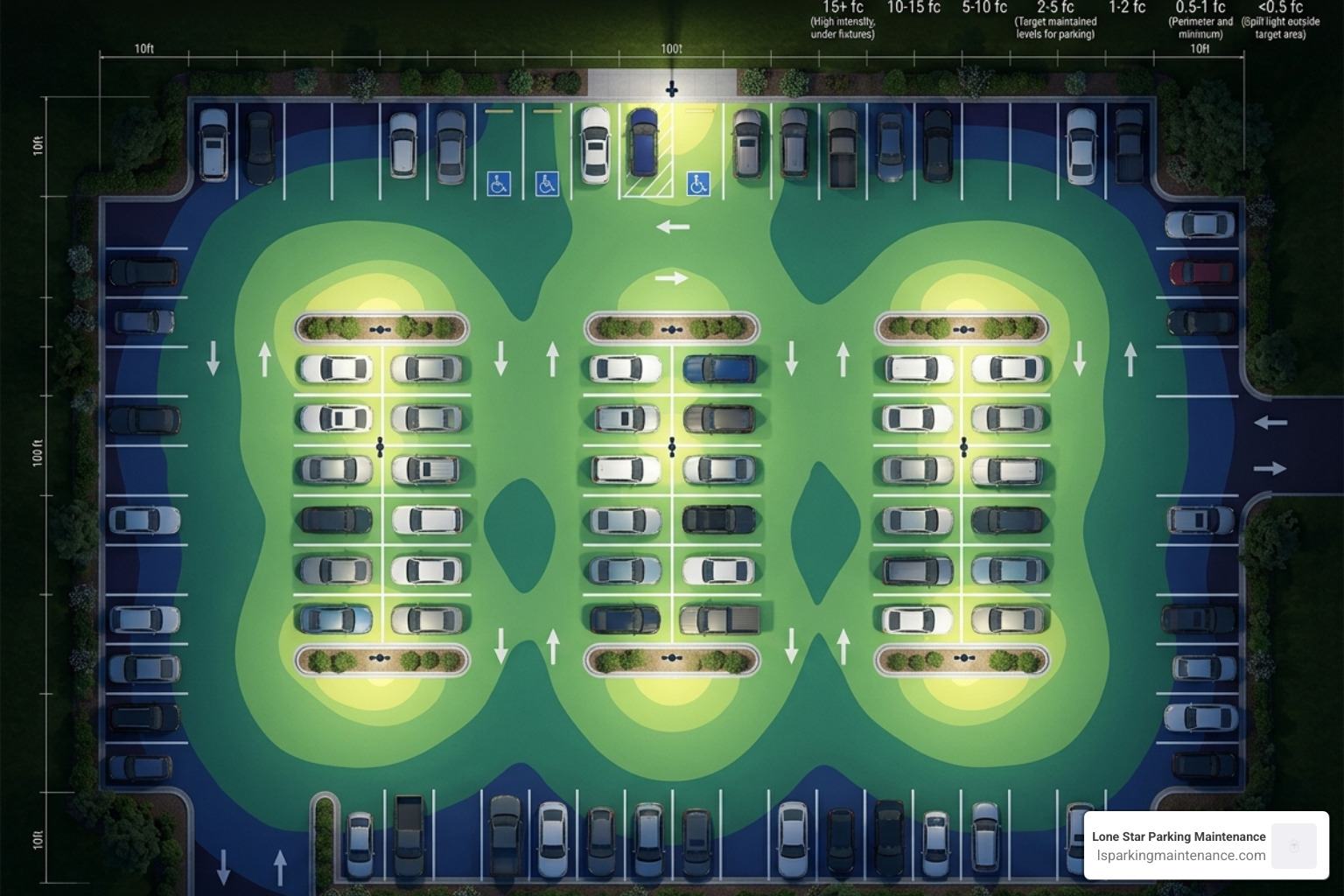
Choosing the Right Fixtures: Pole Height and Distribution
The height of your poles dictates how many lumens you need per fixture. If your pole is short, a high-lumen bulb will create blinding glare. If your pole is tall, a low-lumen bulb won’t even reach the ground.
Recommended Lumens by Pole Height
- 15-20 Feet: 12,000 to 18,000 lumens. Space these poles about 20-30 feet apart.
- 20-25 Feet: 20,000 to 30,000 lumens. Space these poles about 30-40 feet apart.
- 25-35 Feet: 30,000 to 70,000 lumens. Space these poles 40-50 feet apart.
Light Distribution Types (Optics)
Not all light shines in a circle. In the lighting world, we use “Distribution Types” to describe the shape of the light pattern:
- Type III: Known as “Forward Throw.” This is perfect for poles located on the perimeter of the lot. it pushes the light forward into the parking area rather than wasting it on the neighbor’s property.
- Type IV: A wider forward throw, often used for wall-mounted fixtures.
- Type V: A circular, symmetrical pattern. This is the best choice for poles located in the center of a large parking lot.
Using the wrong distribution is a recipe for light pollution and unhappy neighbors. If you’re unsure about your current setup, you might ask, Can you help with parking lot lighting installation? The answer is a resounding yes! We can help design a layout that maximizes every lumen.
Retrofitting vs. New LED Installations
If you have old 400W Metal Halide fixtures that look like they belong in a 1980s stadium, you have two choices: retrofit or replace.
The Problem with “Corn Cob” Bulbs
You’ve probably seen those big LED bulbs that look like a giant ear of corn. While they are cheap and easy to screw into old fixtures, we generally advise against them for commercial lots. They often suffer from “thermal issues” (they get too hot in enclosed fixtures) and poor light distribution. Because the old fixture’s reflector was designed for a different type of bulb, a corn cob often wastes half its light inside the housing.
The Benefits of Integrated LED Luminaires
A new, integrated LED fixture is designed from the ground up to dissipate heat and throw light exactly where it’s needed.
- Longevity: Most new LED fixtures are rated for 50,000 to 100,000 hours. In the DFW area, where lights run about 12 hours a day, that’s over 20 years of maintenance-free light!
- ROI: Upgrading from 400W Metal Halide to 150W LED typically saves about 60% on energy costs. In many cases, the fixtures pay for themselves in less than two years.
Curious about what we carry? Check out What types of parking lot lights do you install? to see the modern options available for your facility. And remember, even the best LEDs need a check-up occasionally. You can learn more about How often should parking lot lights be maintained? to keep your warranty valid and your lot bright.
Advanced Features for Efficiency and Compliance
Modern parking lot lighting is “smart.” We aren’t just turning switches on and off anymore.
Sensors and Photocells
- Photocells: These “dusk-to-dawn” sensors ensure your lights only come on when it’s actually dark, accounting for cloudy days or seasonal changes in Texas.
- Motion Sensors: In lower-traffic areas, you can use bi-level dimming. The lights stay at 20% brightness to save energy but pop up to 100% the moment they detect a car or pedestrian. This is a great deterrent for trespassers who don’t want to be “spotted.”
Emergency Lighting and NFPA 101
The National Fire Protection Association (NFPA) has strict rules for parking structures and exit paths. NFPA 101 requires emergency lighting to activate within 10 seconds of a power failure and provide at least 90 minutes of illumination at an average of 1 foot-candle. This ensures that if the grid goes down in Dallas, your customers can still find their way out safely.
Color Temperature and CRI
- 4000K (Neutral White): This is the sweet spot for most parking lots. It’s bright and clear without being “blue.”
- 5000K (Cool White): Often used in high-security areas like banks or car dealerships because it provides the highest visual acuity for cameras.
- CRI (Color Rendering Index): Always aim for a CRI of 80 or higher. A high CRI ensures that a red car looks red, not brown, which is vital for police reports and general safety.
Frequently Asked Questions
What is the recommended lumens for parking lot security?
For enhanced security, you should aim for a minimum of 0.5 foot-candles on the ground and a uniformity ratio of 15:1. This usually translates to about 20,000 to 30,000 lumens per fixture for a standard commercial lot. High-security zones like ATMs or pharmacies may require 1.0 foot-candle or more.
How many lumens are needed per fixture based on pole height?
As a general rule:
- 15 ft pole: 12,000 lumens.
- 20 ft pole: 18,000 – 22,000 lumens.
- 25-30 ft pole: 30,000 – 50,000 lumens. Higher poles require more lumens because light intensity drops off significantly as the distance increases.
What is the best color temperature for the recommended lumens for parking lot projects?
We typically recommend 4000K for most DFW businesses. It provides a clean, professional look that is easy on the eyes. 5000K is excellent for high-security, but it can sometimes contribute to “light trespass” issues with neighboring residential properties due to its higher blue-light content.
Conclusion
Navigating recommended lumens for parking lot standards can feel like a lot of math, but it’s the foundation of a safe property. Whether you’re managing a small retail strip in Plano or a massive industrial complex in Fort Worth, the right lighting protects your people, your property, and your bottom line.
At Lone Star Parking Maintenance, we don’t just change bulbs. We provide comprehensive parking facility care, from striping and sealing to professional lighting design. We are committed to the safety and satisfaction of our neighbors across the DFW Metroplex.
If you’ve noticed flickering lights, dark corners, or skyrocketing energy bills, don’t wait for an accident to happen. What should I do if I notice a problem with my parking lot lighting? Reach out to the pros.
Ready to see your property in a whole new light? Schedule a Parking Lot Lighting Assessment with us today, and let’s make sure you’re never left in the dark.