
Why Pavement Patch Repair Matters for Your Parking Lot
Pavement patch repair is the process of removing damaged asphalt or concrete and replacing it with fresh material to restore a safe, smooth surface. Done right, it stops small problems from becoming expensive failures.
Here’s the quick answer on how to patch pavement correctly:
- Identify the damage – pothole, crack, spalling, or alligator cracking
- Choose your repair type – partial-depth or full-depth patch
- Pick the right material – cold patch, hot mix asphalt, or concrete mix
- Prepare the surface – clean, dry, square off edges, apply tack coat
- Fill and compact – place material in 1-3 inch lifts, compact firmly
- Cure before opening – allow proper curing time before traffic returns
Parking lots take a beating. Heavy vehicles, Texas heat, freeze-thaw cycles, and water infiltration all chip away at the surface over time. A single ignored pothole can grow into a full base failure — and that turns a $200 patch job into a $5,000 dig-out.
For property managers and business owners in the DFW Metroplex, the stakes are real. A cracked or rutted lot creates liability risks, drives away customers, and signals neglect to anyone pulling in.
The good news? Most pavement damage can be fixed effectively with the right materials and technique — whether you’re managing a DIY repair or overseeing a contractor.
This guide walks you through everything: patch types, materials, tools, step-by-step application, and the mistakes that cause patches to fail within weeks.
Understanding Pavement Patch Repair Types
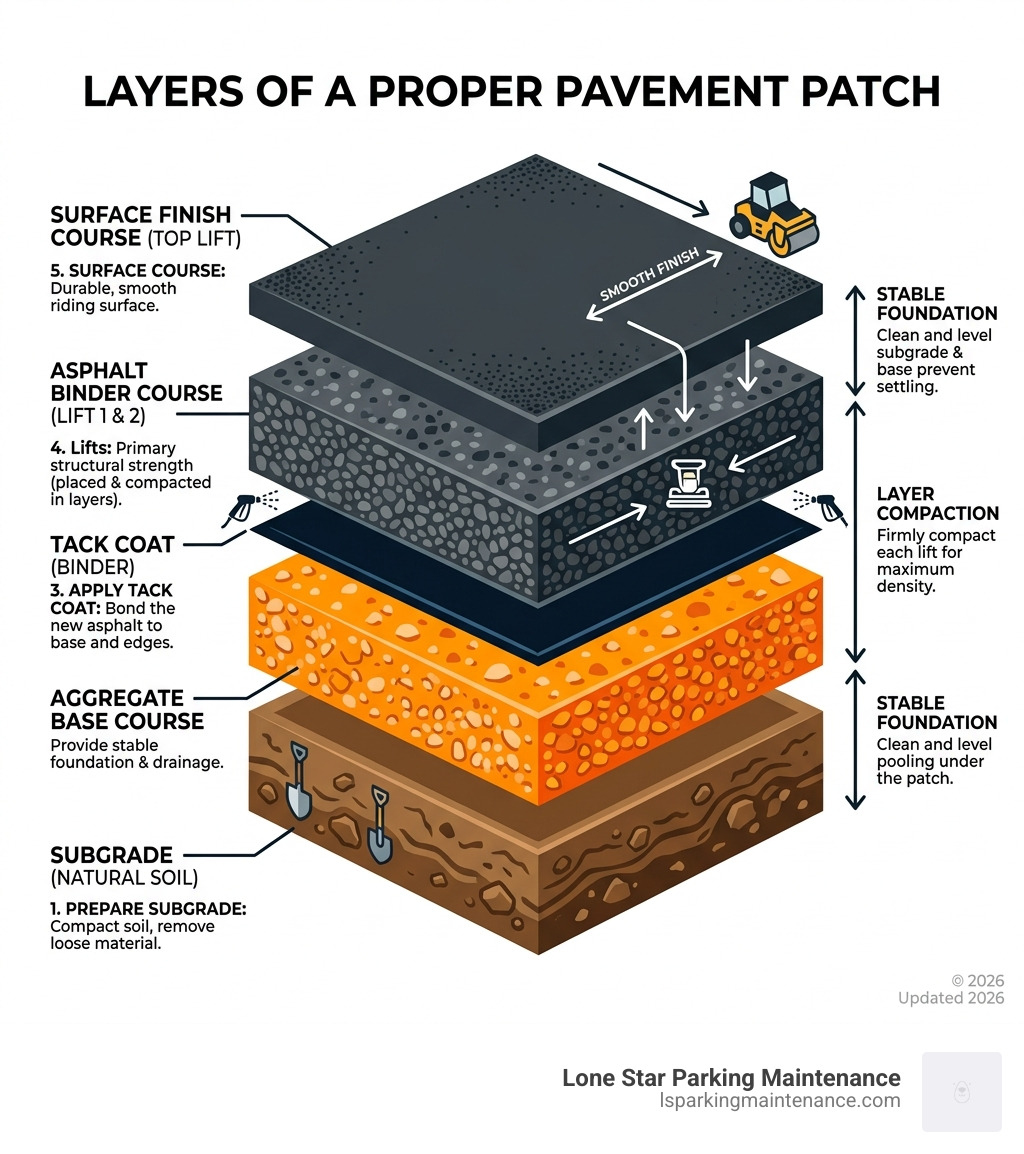
Before you grab a shovel, we need to talk about what’s actually happening under the surface. Not all holes are created equal. In HMA Patching (Hot Mix Asphalt), we generally categorize repairs into two main buckets: full-depth and partial-depth.
Full-depth patches are the “heavy hitters.” These are necessary when the damage isn’t just on the surface but extends all the way down to the subgrade. If you see “alligator cracking”—those interconnected cracks that look like reptile skin—it usually means the base layer has failed. To fix this, we have to dig out the entire structure, stabilize the dirt or stone underneath, and rebuild from the bottom up.
Partial-depth patches are for surface-level drama. This includes things like raveling (where the top stones are coming loose), shallow ruts, or “spalling” in concrete. For PCC Patching (Portland Cement Concrete), partial-depth repairs usually focus on the upper one-third to one-half of the slab.
Choosing the Right Material for Pavement Patch Repair
The material you choose depends on your budget, the weather, and how fast you need to get cars back on the lot.
- Hot Mix Asphalt (HMA): This is the gold standard for permanent repairs. It’s applied hot (usually over 275°F) and becomes incredibly dense and durable once compacted. However, it requires specialized equipment and is usually only available when asphalt plants are running.
- Cold Patch Asphalt: This is the “go-to” for DIY and emergency winter repairs. It stays flexible in the bag and hardens through evaporation or compaction. Brands like QPR or Quikrete Commercial Grade are popular because they can be used in damp conditions.
- Water-Activated Patches: Products like Aquaphalt or Quick Patch H2O are game-changers. You pour them in, add water, and they set up into a permanent, hard surface in about an hour. They are more expensive but offer professional-grade durability for a DIY effort.
| Feature | Hot Mix Asphalt | Cold Patch Asphalt | Water-Activated Patch |
|---|---|---|---|
| Durability | Permanent | Temporary/Semi-Perm | Permanent |
| Ease of Use | Difficult (Requires Heat) | Very Easy | Easy (Add Water) |
| Traffic Ready | Once Cooled | Usually Immediate | 1 Hour |
| Best For | Large Professional Jobs | Emergency/Small Holes | High-Quality DIY |
Temporary vs. Permanent Solutions
In the industry, we often talk about the “throw-and-roll” method. This is where you literally throw cold patch into a hole and roll over it with a truck tire. While surprisingly effective for a quick fix, it’s rarely a permanent solution. For a pavement patch repair to last years rather than weeks, you need a “semi-permanent” approach: squaring the edges, cleaning the debris, and using proper compaction tools.
Essential Tools and Materials for the Job
You can’t fix a parking lot with a garden trowel. If you want professional results, you need the right gear.
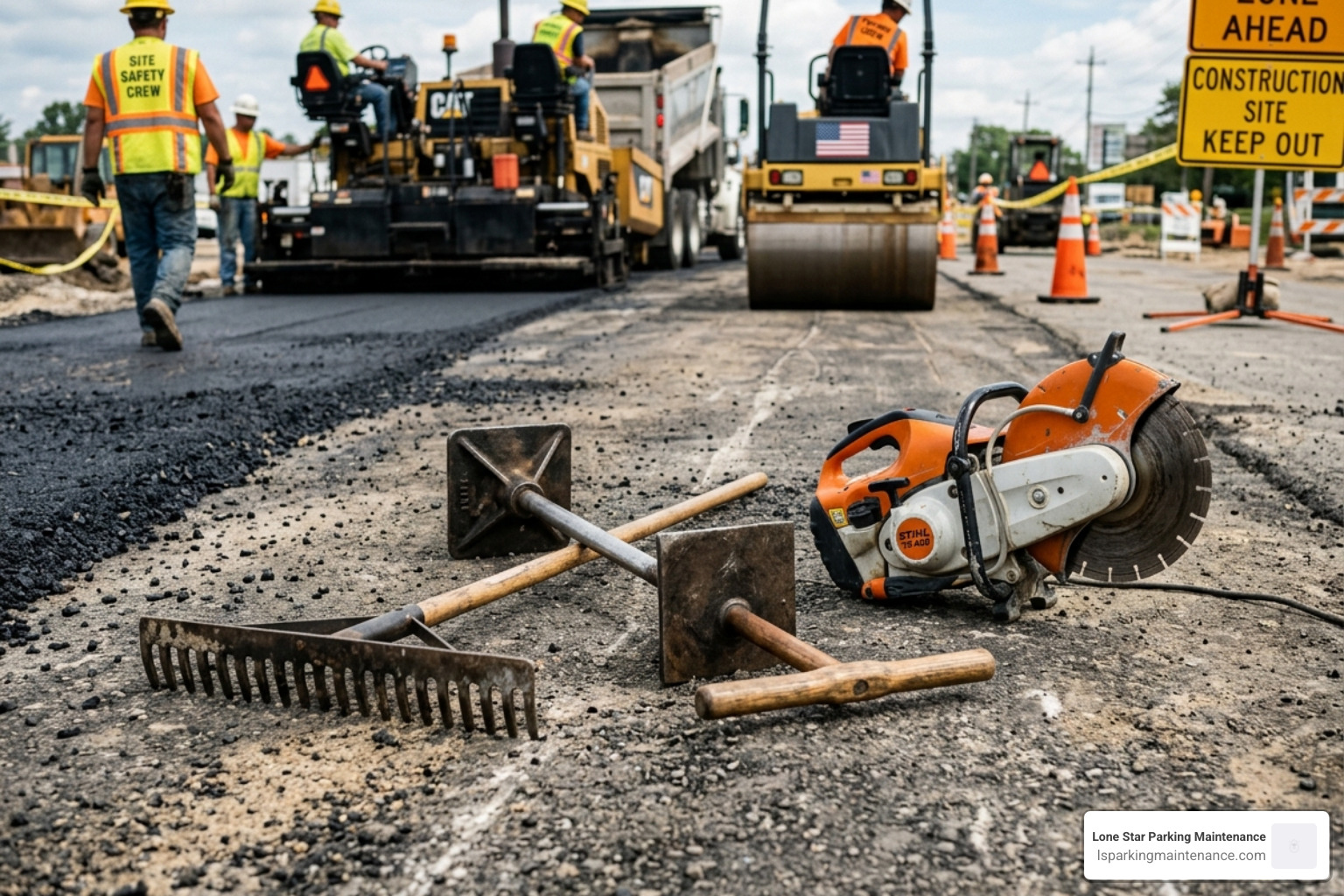
- Marking & Cutting: Use a chalk line or spray paint to mark your repair area. A masonry saw or jackhammer is essential for creating clean, vertical edges.
- Cleaning: A stiff-bristle broom, a leaf blower, or even a pressure washer (if you have time to let it dry) is needed to remove every bit of dust.
- Compaction: For small holes, a hand tamper works. For anything larger than a few square feet, you really want a plate compactor or a small vibratory roller.
- Bonding: A tack coat (asphalt emulsion) acts like glue, ensuring the new patch sticks to the old pavement.
Pro Tip on Coverage: A standard 50 lb bag of asphalt patch typically yields about 0.5 cubic feet. This will cover approximately 6 square feet if you are applying it at a 1-inch thickness. If your pothole is 4 inches deep, you’re going to need four times as much material!
Step-by-Step Guide to Asphalt Pavement Patch Repair
Ready to get your hands dirty? Follow this process to ensure your patch doesn’t pop out the first time a delivery truck drives over it.
Preparing the Surface for Pavement Patch Repair
Preparation is 90% of the job. If you skip this, your patch will fail.
- Square It Off: Don’t just fill a round hole. Use a saw or jackhammer to cut a square or rectangular perimeter around the damage. This provides vertical faces for the new material to butt against.
- Dig It Out: Remove all loose asphalt and unstable base material. If you see mud or wet clay, you have to keep digging until you hit solid ground.
- Clean and Dry: Sweep out all dust. Use a leaf blower to get the fine particles out. If there’s standing water, mop it up or use a torch to dry the area.
- Kill the Weeds: If grass was growing in the crack, apply a potent weed killer. Roots can easily push through new asphalt.
- Tack Coat: Brush a thin, even layer of asphalt tack coat on the bottom and—critically—the vertical sides of the hole.
If you aren’t sure if your damage requires a full patch or just a simpler fix, check out our guide on How do I know if my parking lot needs crack filling?.
Application and Compaction Techniques
Once the hole is prepped, it’s time to fill.
- The Lift Method: Never fill a 6-inch deep hole in one go. Apply the material in “lifts” of 1 to 3 inches. Compact each layer before adding the next. This ensures there are no air pockets at the bottom.
- The Crown Effect: When you reach the final layer, overfill the hole slightly so the material is mounded in the center. This is called a “crown.”
- Compaction: Start compacting from the outside edges and work your way toward the center. As you compact, that “crown” will be pressed down until it is flush with the surrounding pavement.
- Seal the Edges: For a pro finish, use a liquid crack filler or a specialized edge seal to “glue” the seam where the new patch meets the old asphalt. This prevents water from seeping into the joint.
Best Practices for Concrete Pavement Patch Repair
Concrete is a different beast. While asphalt is flexible, concrete is rigid. When we perform Concrete Pavement Repair, we are often dealing with spalling (surface chipping) or joint failure.
For partial-depth concrete repairs, the goal is to fix the upper one-third of the slab.
- Sounding: Tap the concrete around the damage with a hammer or steel rod. A “hollow” thud means the concrete is delaminated (separated) underneath, even if it looks okay on top. You must remove all delaminated areas.
- Bonding Agents: Concrete doesn’t like sticking to old concrete. You’ll need a cementitious bonding grout or an epoxy adhesive to ensure the patch stays put.
- Load Transfer: For full-depth repairs, we often drill holes into the existing slab and insert dowel bars. These steel rods allow the slabs to share the weight of traffic without moving independently and cracking the patch.
Managing Joints and Cracks
One of the biggest mistakes in concrete repair is “bridging” a joint. If your patch crosses an expansion joint, you must re-establish that joint using a joint insert or by sawing the joint back into the wet concrete. If you don’t, the natural expansion of the slabs will crush your new patch.
Understanding the benefits of crack filling is vital here; keeping water out of the sub-base is the only way to prevent your concrete from shifting and cracking again.
Curing and Finishing
Concrete takes time to gain strength.
- High-Early-Strength Mixes: If you’re in a hurry, use a “high-early” mix that can handle traffic in 4 to 24 hours.
- Moisture Retention: Concrete cures through a chemical reaction, not just drying. Apply a curing compound or cover the patch with wet burlap to keep the moisture in while it hardens.
- Texture: Use a broom to match the finish of the surrounding concrete so it isn’t a slipping hazard when wet.
Common Mistakes and Maintenance Tips
Even the pros make mistakes. Here are the “deadly sins” of pavement patch repair:
- Feather-Edging: This is when you try to taper the patch material to a very thin edge at the surface. These thin edges will break off within days. Always have a vertical edge of at least 1 inch.
- Poor Compaction: If the patch sinks after a week, it wasn’t compacted enough. You should be able to jump on the patch without it moving.
- Patching Over Wet Surfaces: Water acts as a lubricant and a barrier. If the hole is wet, the tack coat won’t stick, and your patch will eventually “float” out of the hole.
- Ignoring the Temperature: Most cold patches shouldn’t be applied if it’s below freezing unless the product specifically says “all-weather.”
Once your patches are done, the best way to protect your investment is through Parking Lot Sealing and Crack Filling. A good sealcoat acts like sunblock for your pavement, slowing down the oxidation that makes asphalt brittle and prone to cracking.
Frequently Asked Questions about Pavement Repair
How long does a cold patch take to cure?
Most standard cold patches stay somewhat flexible for weeks. However, they are usually “traffic-ready” immediately because the weight of cars actually helps continue the compaction process. Water-activated patches cure much faster, usually within 1 hour.
Can I use asphalt patch on a concrete driveway?
Technically, yes. Cold patch asphalt will stick to concrete if the area is clean and a tack coat is used. However, it will look like a black spot on a grey surface. For a permanent, aesthetic fix, a concrete-specific repair mortar is better.
What is the best weather for patching pavement?
For hot mix asphalt, you want warm, dry days (above 50°F). For cold patches, you can work in cooler temperatures, but avoid applying them during active rain or snow unless you are using a specialized “wet-fix” product like QPR.
Conclusion
A well-maintained parking lot is more than just “curb appeal”—it’s a sign of a well-run business and a commitment to safety. Whether you are tackling a few potholes yourself or managing a large facility in the DFW Metroplex, understanding the mechanics of pavement patch repair ensures you get the most life out of your asphalt.
At Lone Star Parking Maintenance, we pride ourselves on using top-quality materials and industry-standard techniques to keep Texas parking lots in peak condition. From precision striping to durable pothole repairs, we help you navigate the challenges of North Texas weather and traffic.
Don’t let a small crack turn into a major liability. Request a quote for Parking Lot Sealing and Crack Filling today and let our team of experts restore the safety and functionality of your pavement.