
Your Parking Lot Storm Drain Does More Than You Think
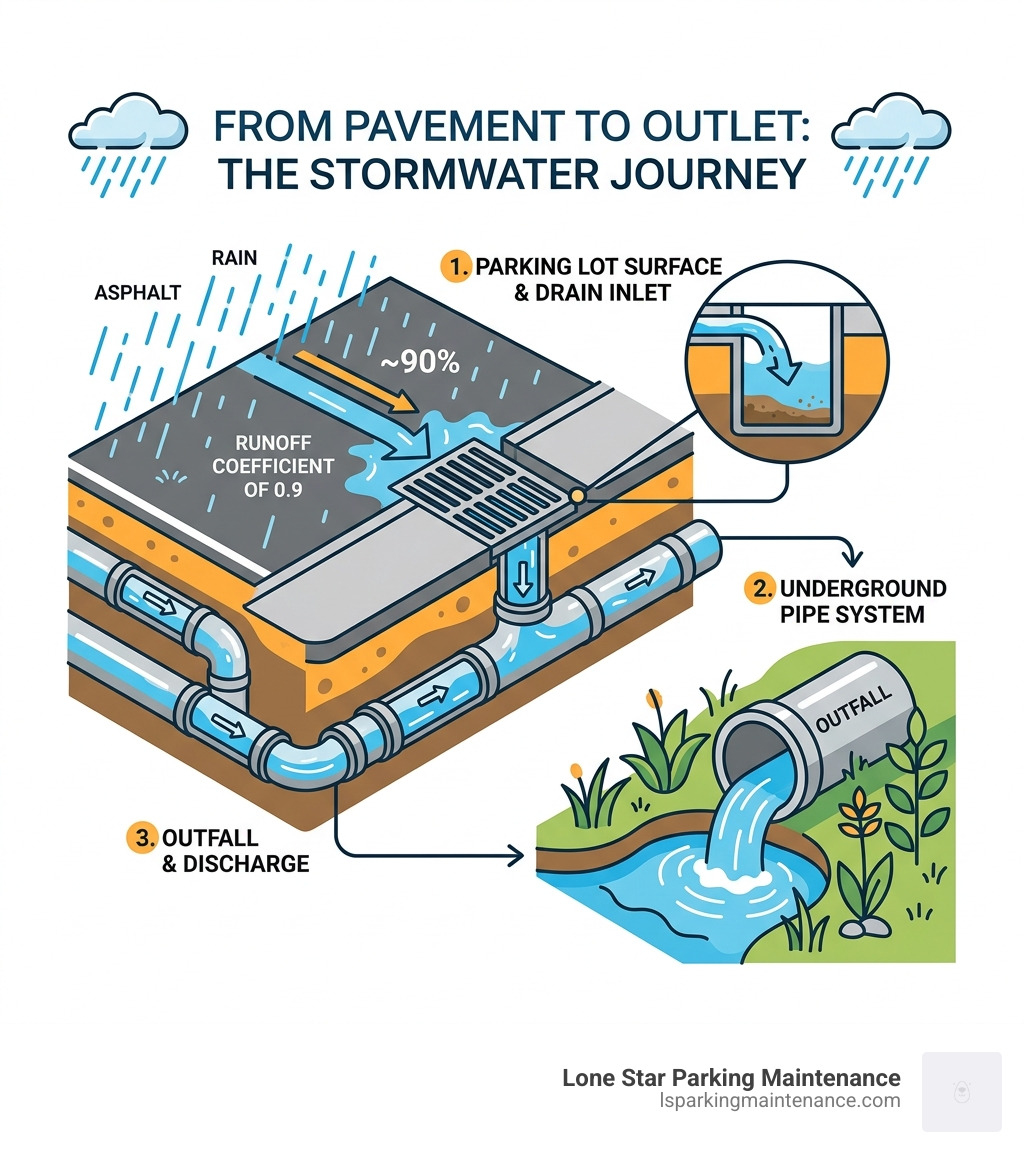
A parking lot storm drain is the system that collects, channels, and redirects rainwater away from your pavement — protecting your asphalt, your customers, and your property value. Here’s a quick overview of what you need to know:
- What it does: Captures surface runoff through inlets (catch basins, trench drains, or French drains) and moves it safely off-site
- Why it matters: Without it, standing water destroys asphalt, weakens the subgrade, creates slip hazards, and invites mosquitoes
- Key components: Grates and inlets → catch basins → underground pipes → outfall or detention
- Warning signs it’s failing: Ponding water, foul odors, gurgling sounds, or sinkholes near drain grates
- Who needs to care: Any commercial property owner or manager — especially in the DFW Metroplex, where intense storm events can dump several inches of rain in a single hour
Most people don’t think about their parking lot drainage until something goes wrong. Then, suddenly, three parking stalls are underwater on a Monday morning and customers are stepping into ankle-deep puddles just to reach your front door.
That scenario isn’t just an inconvenience. It’s a liability.
Paved surfaces like asphalt parking lots have a runoff coefficient of around 0.9 — meaning roughly 90% of rainfall that hits the surface becomes runoff. That water has to go somewhere. If your drainage system can’t handle it, your pavement pays the price.
In the DFW Metroplex, this is especially critical. North Texas storm events can be sudden, intense, and unforgiving. A drainage system that’s undersized, clogged, or poorly graded can go from “fine” to “failed” in a single storm season.
The good news? A well-designed and properly maintained storm drain system can protect your parking lot for decades — and it doesn’t have to be complicated to understand.
Why Effective Drainage is Essential for Commercial Properties
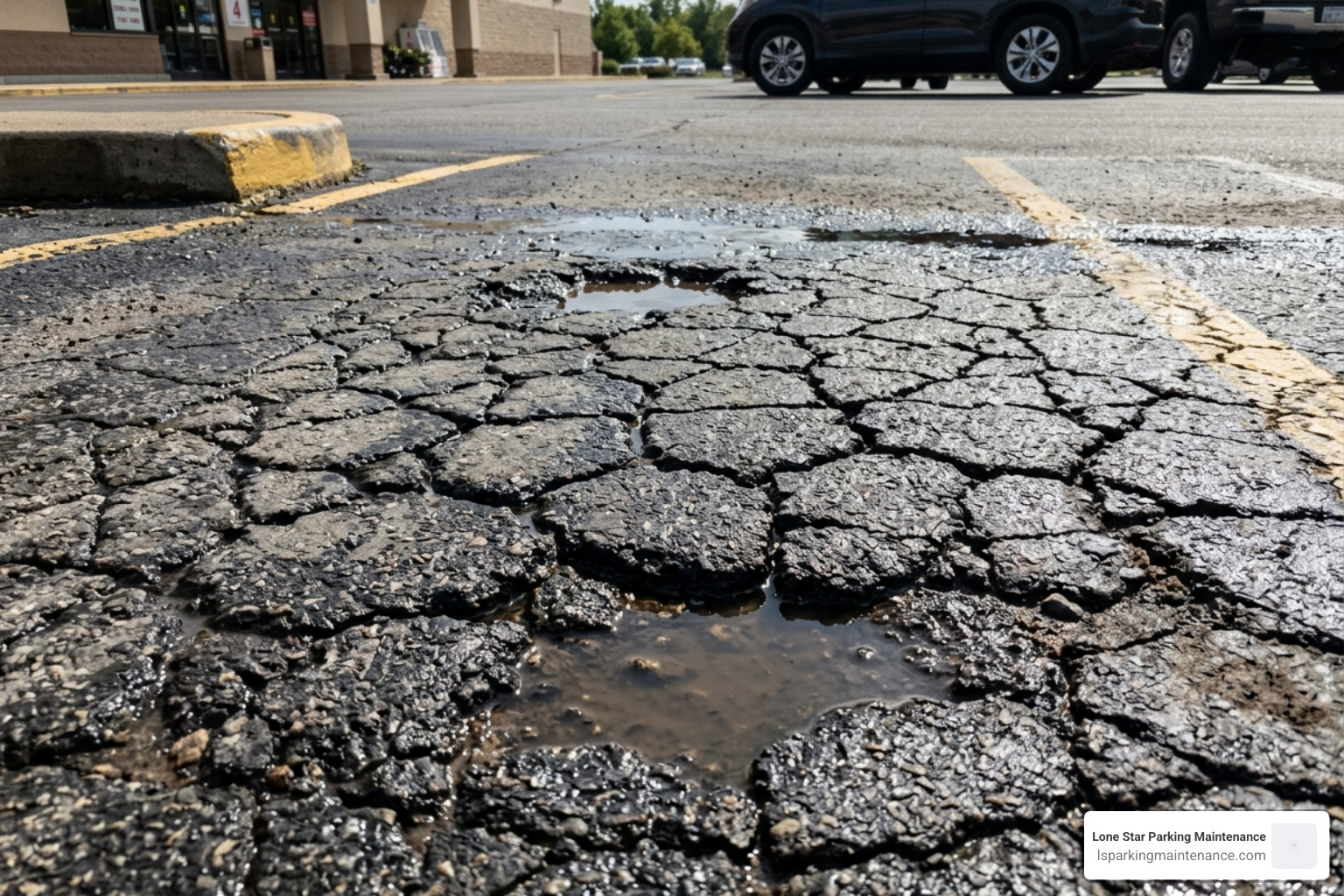
We often tell our clients in Dallas and Fort Worth that water is the number one enemy of asphalt. While asphalt is durable, it is also porous to a degree. When a parking lot storm drain fails to do its job, water sits on the surface. This “ponding” isn’t just an eyesore; it’s a slow-motion wrecking ball for your investment.
Asphalt Deterioration and Subgrade Saturation
When water pools on your lot, it begins to seep into the tiny pores and cracks in the asphalt. Over time, this liquid works its way down to the subgrade—the soil and gravel foundation that actually supports the weight of the vehicles. Once that subgrade becomes saturated, it loses its structural integrity. It turns into a soft “sponge.” When a heavy truck drives over that soft spot, the pavement flexes beyond its limit, leading to “alligator cracking” or even sudden pavement collapse.
Liability and Safety
Beyond the structural damage, poor drainage is a massive liability. Standing water creates slip-and-fall hazards for pedestrians. In the winter months here in North Texas, even a thin layer of ponding water can flash-freeze into “black ice,” leading to fender-benders or serious injuries. Proper drainage is essentially an insurance policy for your property.
Property Health and Value
Neglected drainage leads to other headaches, too. Stagnant water is a prime breeding ground for mosquitoes, which can become a nuisance for your tenants and customers. Furthermore, poor drainage can lead to soil erosion that damages your landscaping or, worse, allows water to intrude into your building’s foundation.
To keep your lot in top shape, we often recommend parking lot sealing and crack filling to ensure water stays on top of the pavement where the drains can catch it, rather than soaking into the base layers.
Signs of a Failing Parking Lot Storm Drain
You don’t need a degree in civil engineering to spot a drainage problem. Keep an eye out for these “cries for help” from your parking lot:
- Ponding water: If water sits for more than 30 minutes after the rain stops, you have a problem.
- Waterline staining: Look for dark rings or silt deposits on the pavement or curbs; these show where water has been sitting.
- Sulfur odors: A “rotten egg” smell usually means organic debris is rotting inside a clogged catch basin.
- Gurgling sounds: If your drains “burp” or gurgle during a storm, the air is struggling to escape because the pipes are restricted.
- Sinkholes: If you see a dip in the pavement near a drain grate, the soil underneath may be washing away through a collapsed pipe.
Regular parking lot power washing can help clear surface debris that leads to these clogs, but if you see a sinkhole, it’s time for a professional inspection.
Main Types of Parking Lot Storm Drain Systems
Not every parking lot is built the same, which means the drainage solutions shouldn’t be either. Depending on your lot’s size, traffic volume, and the “lay of the land,” we utilize several different types of systems.
Standard and Concrete-Encased Catch Basins
The catch basin is the “workhorse” of the industry. It’s essentially a vertical box buried underground with a grate on top. Its job is to “catch” heavy sediment and trash at the bottom while allowing the cleaner water to flow out through a pipe near the top.
For high-traffic commercial areas in DFW, we often see concrete-encased basins. These are reinforced to handle the massive weight of delivery trucks and constant vehicle turning without shifting or cracking.
Linear Trench Drains and Slot Drains
If your parking lot is relatively flat or you need to protect a specific area—like a building entrance or a loading dock—a trench drain is often the best bet. These are long, narrow “channels” that intercept “sheet flow” (water moving across the surface in a wide layer).
A modern variation is the Parking Lot & Parking Garage Drainage system known as a slot drain. These are grate-less and very slim, making them highly durable and ADA-compliant since there are no heavy grates for high heels or wheelchair wheels to get caught in. They are also excellent for parking garages where height clearance is an issue.
French Drains and Permeable Pavers
For areas where you want a more “natural” look, French drains use perforated pipes buried in a bed of gravel to move water underground. On the other hand, permeable pavers allow water to soak through the pavement itself and into the ground below. These are great for meeting environmental regulations regarding runoff volume.
| System Type | Installation Cost | Flow Capacity | Best Use Case |
|---|---|---|---|
| Catch Basin | Moderate | High | General lot drainage / sediment trapping |
| Trench Drain | Higher | Very High | Building perimeters / flat areas |
| French Drain | Lower | Moderate | Landscaped edges / low spots |
| Permeable Pavers | Highest | Moderate | Eco-friendly / runoff reduction |
Properly marked stalls via parking lot striping help direct traffic away from these sensitive drainage areas, ensuring they don’t take unnecessary abuse from heavy vehicles.
Engineering Principles for Stormwater Management
Designing a parking lot storm drain isn’t guesswork; it’s math. Engineers use something called the Rational Formula (Q=CIA) to determine how much water a lot will produce during a storm.
- Q: Peak runoff rate.
- C: Runoff coefficient (how much water “bounces” off the surface). Asphalt is usually 0.9.
- I: Rainfall intensity (how hard it’s coming down).
- A: The area of the parking lot.
In Texas, we typically design for a “2-year storm event” as a minimum, but high-value commercial properties often design for 10-year events to ensure they stay dry even during North Texas “gully washers.” We follow guidelines like those found in Section 5: Storm Drain Inlets – Texas Department of Transportation to ensure every inlet is sized correctly for the expected flow.
Optimal Slopes and Gutter Grades
Gravity is our best friend in drainage. For water to move, the pavement must have a slope.
- Ideal Slope: Between 1% and 5% (1 to 5 feet of drop for every 100 feet of distance).
- Minimum Slope: 0.4% is the absolute “floor” to prevent ponding.
- Gutter Grades: Curbs and gutters should have a minimum grade of 0.5% to keep water moving toward the parking lot storm drain.
Maintenance Strategies to Prevent System Failure
A drainage system is only as good as its last cleaning. Over time, catch basins fill up with “sludge”—a nasty mix of sand, asphalt fines, rubber bits from tires, and trash. If that sludge reaches the level of the outlet pipe, your system stops working.
Professional Cleaning and Inspections
We recommend a “hydro-vac” approach for cleaning. This involves a high-pressure water jet to break up hardened debris and a powerful vacuum to suck it all out. This is much safer and more effective than trying to “shovel out” a basin.
Regular maintenance should also include:
- Pipe Jetting: Clearing out the underground lines that connect your basins.
- Grate Repair: Ensuring grates aren’t bent or broken, which could be a trip hazard.
- Joint Sealing: Making sure the area where the concrete drain meets the asphalt is sealed to prevent water from getting underneath.
While we’re out checking your parking lot lighting to keep your property safe at night, it’s a great time to do a quick visual check of your drain grates to ensure they aren’t covered in autumn leaves or wind-blown trash.
Maintaining Your Parking Lot Storm Drain
For most DFW properties, a bi-annual maintenance schedule is best.
- Spring: Clear out the sand and salt left over from winter de-icing.
- Fall: Clear out leaves and debris before the heavy winter rains arrive.
Frequently Asked Questions
How much slope is required for a commercial parking lot?
To keep water moving and prevent those annoying “birdbaths” (small puddles), a minimum slope of 0.4% is required. However, we generally aim for 1% to 2% in our designs. This ensures that even if there are minor settlements in the pavement over time, the water will still find its way to the parking lot storm drain.
How long do French drains and catch basins last?
When built with reinforced concrete and high-quality HDPE (plastic) piping, a catch basin system can easily last 30 years or more. French drains also have a similar lifespan of about 30 years, provided they are wrapped in geotextile fabric to prevent dirt from clogging the gravel. The key to this longevity is regular cleaning—if you let a basin stay full of wet sludge, the constant moisture can eventually degrade the structure.
What are the most common causes of storm drain flooding?
In our experience in the DFW Metroplex, the “Big Three” causes are:
- Clogged Grates: Simple trash or lawn clippings covering the top of the drain.
- Sediment Buildup: The basin is full of dirt, so there’s no room for water.
- Undersized Piping: The system was built for a smaller lot, and subsequent expansions have overwhelmed the original pipes.
Conclusion
Your parking lot storm drain might be underground and out of sight, but it should never be out of mind. It is the silent guardian of your asphalt, preventing the cracks, potholes, and structural failures that lead to expensive “mill and pave” projects.
At Lone Star Parking Maintenance, we understand the unique challenges that North Texas weather poses to commercial properties. From the intense heat that expands your asphalt to the sudden storms that test your drainage, we are here to help. Whether you need a simple cleaning, a structural reset of a failing catch basin, or a quote for parking lot sealing and crack filling to keep your pavement waterproof, our team is committed to safety, top-quality materials, and your total satisfaction.
Don’t wait for the next DFW thunderstorm to find out your drains are clogged. Give your “unsung hero” the attention it deserves today.