
Your Parking Lot Is the First Thing Customers See — Here’s What to Do About It
Resurfacing asphalt parking lots is the process of applying a fresh 1.5–2 inch layer of hot-mix asphalt over an existing, structurally sound surface — restoring smoothness, safety, and appearance without the cost of full replacement.
Quick answer for property managers:
| Question | Answer |
|---|---|
| What is resurfacing? | A new asphalt overlay applied over existing pavement |
| When is it needed? | Every 12–20 years, or when 15–30% of the surface shows cracking |
| How much does it cost? | $1–$3 per sq ft (vs. $4–$10 for full repaving) |
| How long does it last? | Adds 8–15 years to your parking lot’s lifespan |
| How long is the lot closed? | Typically 1–3 days |
Your parking lot is often the very first impression a customer, tenant, or visitor has of your property. Cracked pavement, faded stripes, and rough surfaces don’t just look bad — they signal neglect, create liability risks, and can drive people away before they even reach your door.
The good news? You probably don’t need to tear it all out and start over.
For most commercial parking lots in the DFW Metroplex, resurfacing is the smart middle ground. It’s significantly cheaper than full repaving, far more effective than sealcoating alone, and — when done right — gives your lot years of reliable, safe, professional-looking service.
This guide walks you through everything: how resurfacing works, when to do it, what it costs, and how to make sure it lasts.
Understanding Asphalt Parking Lot Resurfacing vs. Other Methods
When we talk about fixing a parking lot, the terminology can get a bit confusing. Is it a repair? A sealcoat? A repave? In the industry, we call resurfacing asphalt parking lots an “overlay.”
Think of your parking lot like a house. Sealcoating is like a fresh coat of paint on the siding—it looks great and protects the surface. Resurfacing is like putting on a brand-new roof. Full replacement is like tearing the house down to the foundation and rebuilding.
The key to a successful resurfacing project is the sub-base stability. If the rock and soil underneath your asphalt are shifting or collapsing, a new layer of asphalt won’t help; it will just crack along with the old one. However, if your foundation is solid but the surface looks like a spiderweb of cracks, resurfacing is the perfect restoration tool.
We often utilize a technique called milling before resurfacing. This involves grinding down the top layer of old asphalt so the new layer sits flush with existing curbs and sidewalks. This is much more effective than simple patching, which only fixes isolated holes. To understand why surface protection is so vital before you reach this stage, you might ask, Why is Parking Lot Sealing Important?
| Service Type | Typical Cost (Per Sq Ft) | Expected Lifespan | Primary Purpose |
|---|---|---|---|
| Sealcoating | $0.15 – $0.30 | 2 – 4 Years | Protection & Aesthetics |
| Resurfacing | $1.00 – $3.00 | 8 – 15 Years | Structural Renewal |
| Full Repave | $4.00 – $10.00 | 15 – 25 Years | Total Reconstruction |
Distinguishing Resurfacing from Sealcoating
It is common for property owners to hope a sealcoat will fix their deep cracks. Unfortunately, sealcoating is purely preventative maintenance. It’s a thin liquid layer that acts like sunscreen, shielding the asphalt from UV rays, water, and oil spills. It does not add structural strength.
How Long Does Parking Lot Sealing Last? Usually, about 2 to 4 years in our Texas heat. If your lot has “alligator cracks” (small, interconnected cracks that look like reptile skin), sealcoating will only highlight them. Resurfacing, on the other hand, adds a structural lift of 1.5 to 2 inches of hot-mix asphalt, physically reinforcing the lot.
Resurfacing vs. Full Pavement Replacement
When do we tell a DFW business owner that resurfacing isn’t enough? It usually comes down to the 25-35% rule. If more than a third of your parking lot has deep structural failure—meaning the foundation itself has given way—resurfacing is a waste of money.
A professional assessment is crucial here. We look for “pumping,” where water and mud are forced up through cracks when a car drives over, indicating a failed base. If the base is gone, you need a full replacement. But if the damage is mostly on the surface, resurfacing asphalt parking lots offers massive cost-effectiveness, saving you 40-60% compared to a total tear-out.
When is Resurfacing Asphalt Parking Lots the Right Choice?
Asphalt doesn’t last forever. Even with the best maintenance, a professionally paved lot usually hits a 15-25 year cycle where the liquid binder in the asphalt has oxidized so much that it becomes brittle.
In the DFW Metroplex, our extreme summer heat followed by occasional freezes can accelerate this. When the surface becomes brittle, it cracks, allowing water to seep into the base. This leads to standing water and drainage issues, which are the #1 enemies of asphalt. Beyond aesthetics, a crumbling lot is a major liability; tripping hazards and vehicle damage can lead to expensive insurance claims. Resurfacing brings your lot back up to modern safety standards.
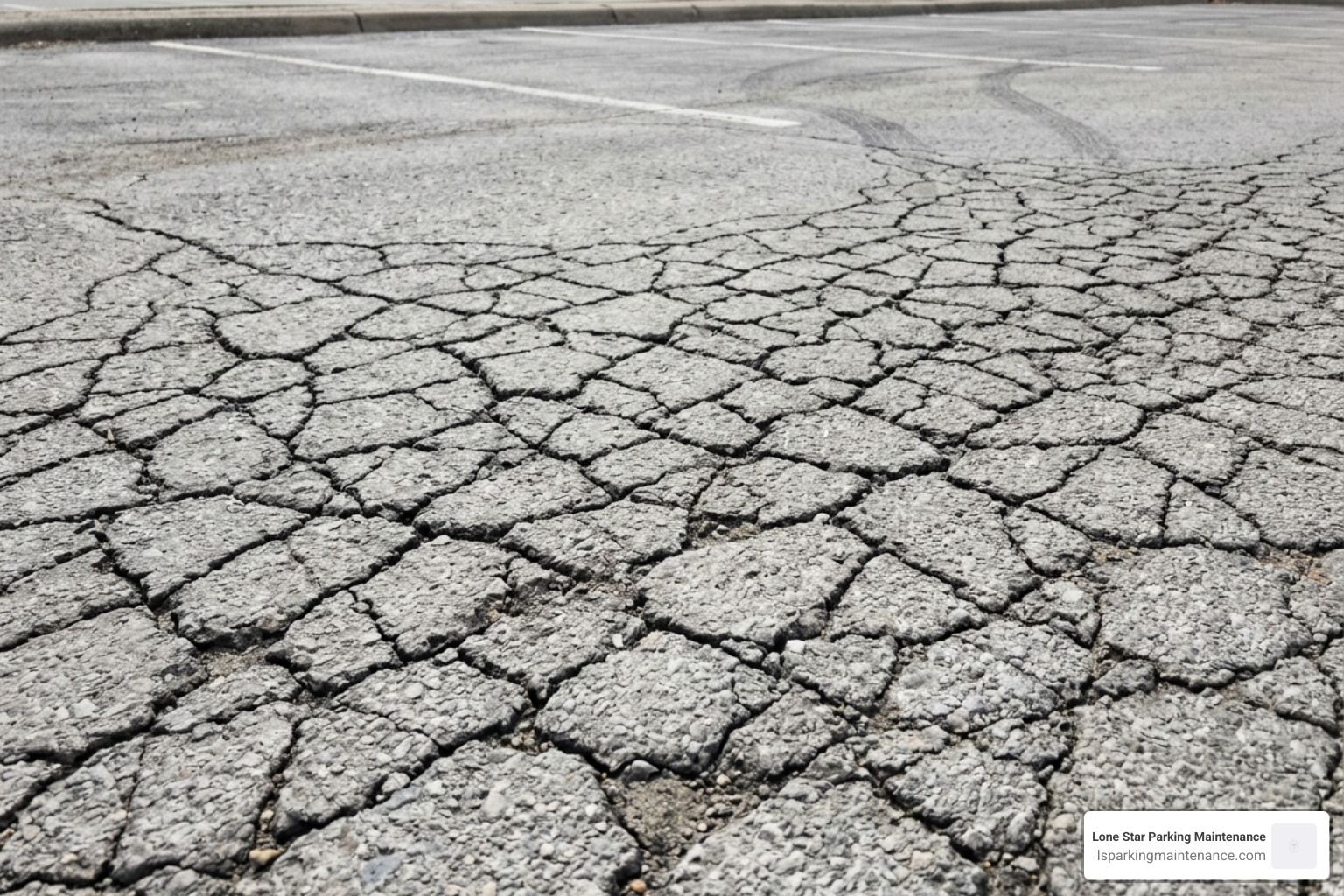
Signs Your Business Needs Resurfacing Asphalt Parking Lots
How do you know it’s time to call us for an overlay? Look for these “red flags”:
- Alligator Cracks: Extensive, interconnected cracking across large sections of the lot.
- Recurring Potholes: If you’re patching the same hole every six months, the surrounding surface has failed.
- Raveling: This is when the “rocks” in the asphalt start coming loose, leaving a rough, pitted surface.
- Faded Appearance: A dull gray color means the protective oils are gone.
- Standing Water: Low spots or “birdbaths” that don’t drain after a Texas downpour.
If you aren’t sure if your cracks are deep enough for an overlay, check out our guide on How to Know if Your Parking Lot Needs Crack Filling.
The Best Time of Year for Resurfacing Asphalt Parking Lots
Timing is everything. For resurfacing asphalt parking lots, we follow the 50°F rule. Asphalt is a “hot mix” material, meaning it needs to stay hot to be compacted properly. If the air or ground temperature is below 50°F, the asphalt cools too quickly, preventing a proper “thermal bond” between the old and new layers.
In North Texas, our optimal window is typically late spring through early fall. While we can work in the winter during our frequent warm spells, scheduling during stable, warm weather ensures the best compaction and long-term durability.
The Professional Resurfacing Process: From Milling to Striping
Resurfacing is a precision engineering project, not just a “pour and smooth” job.
Step-by-Step Execution and Downtime
- Milling & Surface Prep: We use a milling machine to shave off the top 1.5–2 inches of old asphalt. This ensures the new layer doesn’t sit too high against sidewalks.
- Cleaning: We perform thorough Parking Lot Power Washing Services or heavy-duty sweeping. Dust is the enemy of adhesion.
- Repairing the Base: Before the new asphalt goes down, we handle Parking Lot Sealing and Crack Filling Services for any deep fissures.
- Tack Coat: This is a “glue” layer of liquid asphalt that ensures the new overlay bonds permanently to the old surface.
- Asphalt Application: We lay a 1.5–2 inch overlay of fresh hot-mix asphalt.
- Compaction: Using heavy rollers, we compact the asphalt to a 92-96% density. This is what makes the surface waterproof and durable.
Downtime: Most businesses can return to full operation within 48-72 hours. We often work in sections to keep your business open during the process.
Final Touches: Striping and Compliance
A black lot is just a canvas; it isn’t a parking lot until it’s striped. Once the asphalt has cooled, we provide professional Parking Lot Striping Services.
This isn’t just about looks. You must follow The Essential Guide to ADA Compliant Parking Lot Striping and adhere to the official ADA Standards for Accessible Design to avoid federal fines and ensure accessibility. We also ensure fire lanes are clearly marked and traffic flow is optimized for safety.
Cost Analysis and Expected Lifespan of an Overlay
Budgeting for resurfacing asphalt parking lots is one of the best moves a property manager can make. On average, you can expect to pay between $1 and $3 per square foot.
Compared to the $4 to $10 per square foot for a full replacement, resurfacing offers a massive Return on Investment (ROI). By spending a fraction of the cost now, you extend the life of your asset by another decade or more. If you’ve been proactive with Benefits of Crack Filling, your resurfacing costs will likely be on the lower end because the base will be in better shape.
Factors Affecting Resurfacing Pricing
No two lots are the same. Several factors influence the final quote in the DFW market:
- Lot Size: Larger lots often get a lower price per square foot due to mobilization efficiencies.
- Surface Condition: If we have to do extensive “patching” before the overlay, the price goes up.
- Milling Depth: Removing more old material increases labor and disposal costs.
- Drainage Correction: If we need to use laser-guided graders to fix “birdbaths,” it adds to the complexity.
- Mobilization: The distance and ease of access for our heavy machinery.
Maximizing Your 8-15 Year Investment
A resurfaced lot can last up to 15 years if you treat it right.
- Sealcoat Early: We recommend your first sealcoat 6–12 months after resurfacing, then every 2–3 years after.
- Weight Limits: Keep heavy delivery trucks on designated reinforced paths.
- Regular Cleaning: Removing dirt and debris prevents moisture from being trapped on the surface.
- Sustainability: We often use Recycled Asphalt Pavement (RAP), which is better for the environment and helps keep costs down without sacrificing quality.
Frequently Asked Questions about Parking Lot Maintenance
How do I choose a reliable paving contractor?
In Texas, anyone with a truck can call themselves a “paving expert.” To protect your investment, look for a contractor who is fully licensed and insured. Ask for local DFW references and ensure they use high-quality hot-mix asphalt, not “cold patch” for large areas. A reliable contractor will provide a detailed estimate that includes milling, cleaning, and striping.
Can you resurface over existing cracks?
Yes, but you shouldn’t just “pave over” them. If you don’t treat deep cracks first, they will “reflect” through the new layer within a year—a process called reflection cracking. We perform crack sealing and base repairs before the overlay to ensure the new surface stays smooth.
How does resurfacing impact parking lot drainage?
Resurfacing is the best time to fix drainage. We use laser-guided sloping to ensure water runs toward catch basins and away from your building. By adjusting the grade during the overlay process, we can eliminate those annoying puddles that plague older lots.
Conclusion
Resurfacing asphalt parking lots is the most effective way to breathe new life into your DFW property. It saves money, improves safety, and makes your business look professional and inviting.
At Lone Star Parking Maintenance, we are the DFW Metroplex experts in keeping your pavement in top shape. From the initial structural assessment to the final ADA-compliant stripe, we use top-quality materials and industry-leading standards to ensure your lot lasts for years to come.
Don’t wait for a small crack to become a massive pothole. Get a Free Quote for Services today and let us help you protect your investment.