
What Are ADA Parking Requirements? A Quick Answer
ADA parking requirements are federal rules that tell businesses, governments, and nonprofits how many accessible parking spaces to provide — and exactly how to build, mark, and sign them.
Here’s what you need to know at a glance:
| Total Parking Spaces | Required Accessible Spaces | Van-Accessible Spaces |
|---|---|---|
| 1 – 25 | 1 | 1 |
| 26 – 50 | 2 | 1 |
| 51 – 75 | 3 | 1 |
| 76 – 100 | 4 | 1 |
| 101 – 150 | 5 | 1 |
| 151 – 200 | 6 | 1 |
| 201 – 300 | 7 | 2 |
| 301 – 400 | 8 | 2 |
| 401 – 500 | 9 | 2 |
| 501 – 1,000 | 2% of total | 1 per 6 accessible |
| 1,001+ | 20 + 1 per 100 over 1,000 | 1 per 6 accessible |
Key rules in brief:
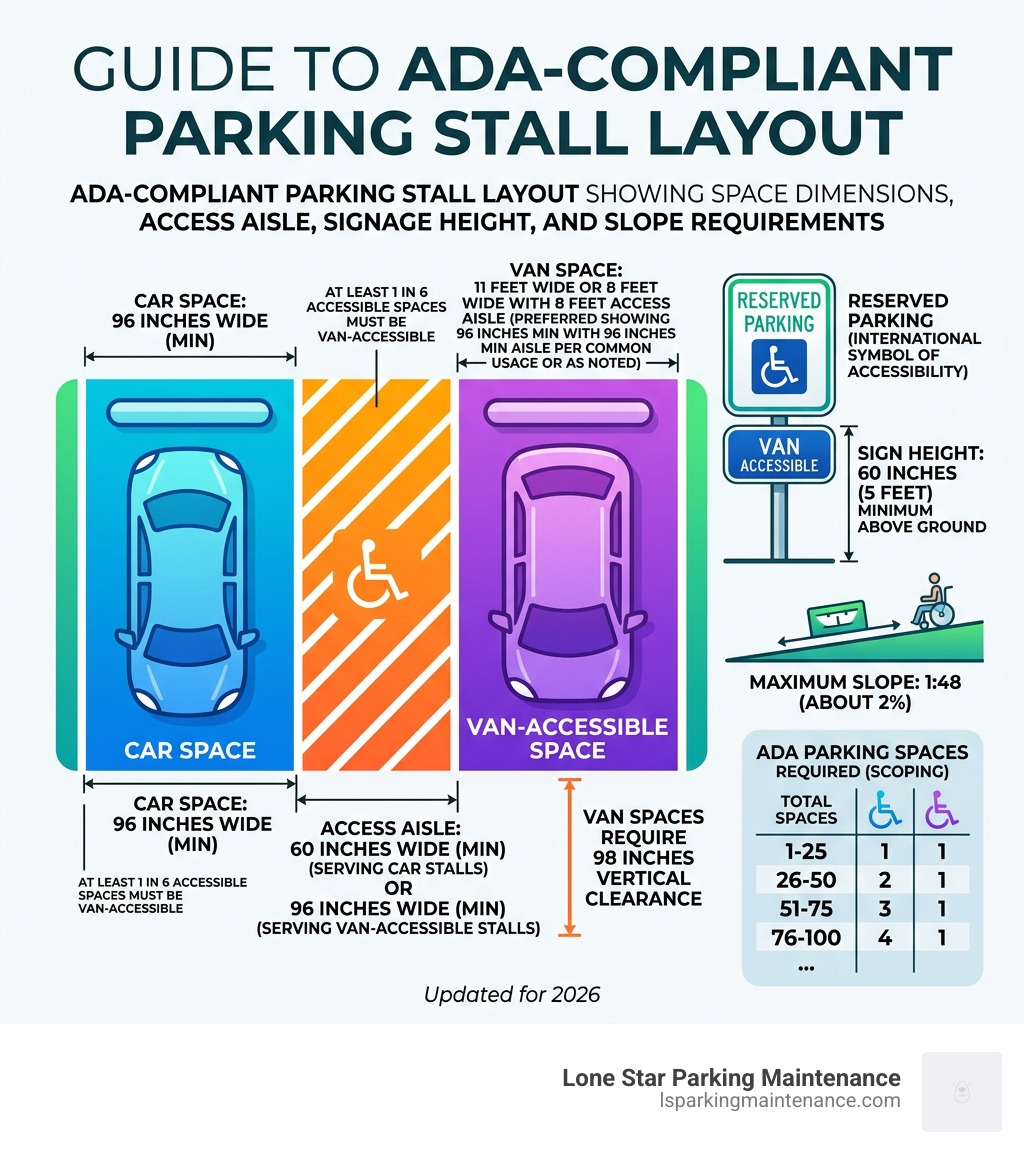
- At least 1 in every 6 accessible spaces must be van-accessible
- Spaces must be on the shortest accessible route to the building entrance
- Car spaces must be 96 inches wide with a 60-inch access aisle
- Van spaces need 98 inches of vertical clearance
- Signs must be mounted at least 60 inches above the ground
- Maximum slope is 1:48 (about 2%)
For property managers and business owners in the DFW Metroplex, staying on top of these rules is more than just a legal obligation — it’s a real day-to-day challenge. Faded stripes, cracked pavement, and missing or damaged signage can quietly push your lot out of compliance without you realizing it.
Here’s a useful way to think about why this matters: 75% of able-bodied drivers say they’d simply climb through a window or use the opposite door if a car parked too close to them. For a wheelchair user, that’s not an option. Accessible parking spaces — and the striped access aisles next to them — aren’t just lines on pavement. They’re the difference between access and exclusion.
The rules come from the Americans with Disabilities Act (ADA), signed into law in 1990. The current standards, updated by the Department of Justice in 2010, set the minimum requirements for all public accommodations under Title III — which includes virtually every commercial parking lot.
This guide covers everything: the exact dimensions, signage rules, special cases like medical facilities, and what triggers a compliance obligation when you restripe or resurface your lot.
Understanding Federal ADA Parking Requirements
Navigating ada parking requirements can feel like a major planning challenge, but the core philosophy is simple: providing equal access. The Department of Justice (DOJ) enforces these standards to ensure that individuals with disabilities have the same opportunities to visit shops, offices, and public buildings as anyone else.
Scoping and the 1-to-25 Ratio
“Scoping” is the technical term for determining how many accessible spots you need. As shown in our opening table, the number is based on the total number of parking spaces provided in each specific parking facility. It is important to note that you calculate this per lot or garage, not as a site-wide total. For smaller lots, the ratio is roughly one accessible space for every 25 total spaces.
The Van-Accessible Ratio: The 1-out-of-6 Rule
One of the most common mistakes we see in the DFW area is forgetting the “1-out-of-6” rule. For every six accessible parking spaces, at least one must be van-accessible. If you only have one accessible space total (as is common in lots with 25 or fewer spots), that single space must be van-accessible. You can find more detailed breakdowns of these ratios at the ADA National Network.
Location and Dispersion
It isn’t enough to just have the right number of spots; they have to be in the right place. ADA standards require these spaces to be located on the shortest accessible route from the parking area to the building entrance.
If your facility has multiple accessible entrances, the spaces should be dispersed. This means you can’t tuck all the handicap spots in one corner if there are three different doors people use to enter. They also must be placed on level ground to ensure safety for those using ramps or lifts.
Technical Specifications for Accessible Spaces and Aisles
When we get down to the actual striping and layout, precision is everything. A few inches can be the difference between a compliant lot and a potential fine.
Dimensions and ADA Parking Requirements for Stalls
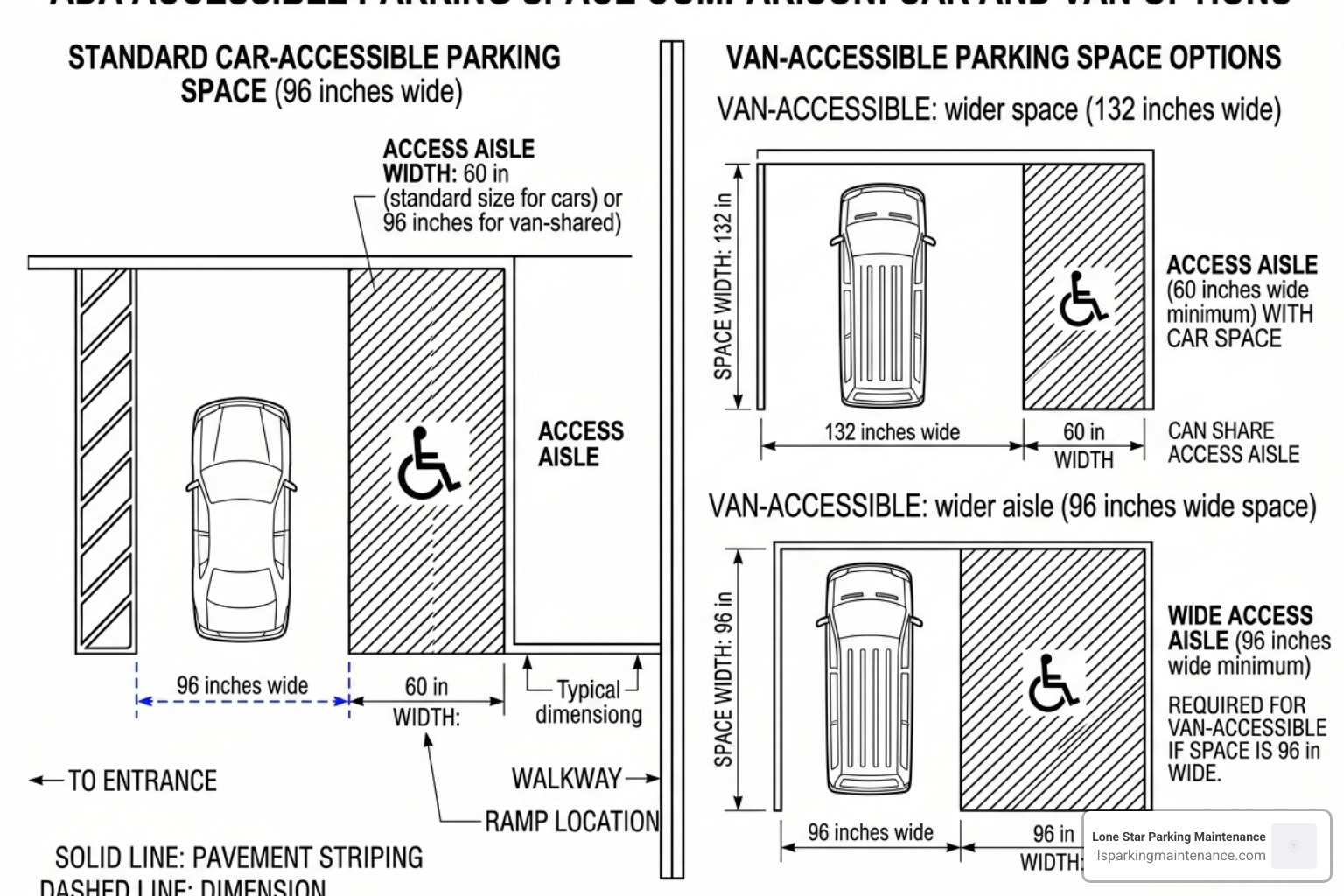
Standard car-accessible spaces must be at least 96 inches (8 feet) wide. However, van-accessible spaces have two configuration options:
- Option One: A space at least 132 inches (11 feet) wide with a 60-inch (5-foot) access aisle.
- Option Two: A space at least 96 inches (8 feet) wide with a 96-inch (8-foot) access aisle.
Most property owners prefer the 132-inch space because it provides more room for the vehicle itself, but both are legal under the Chapter 5: Parking Spaces guidelines.
Access Aisles and Shared Spaces
Access aisles are the striped “no-parking” zones next to the stalls. These aisles must extend the full length of the parking space. In many cases, two accessible spaces can share a single access aisle, which helps maximize your total parking capacity. However, if you use angled parking, the aisle must be located on the passenger side of the van-accessible space, as that is where most wheelchair lifts operate.
Slope and Surface Requirements
The surface of the parking space and the access aisle must be firm, stable, and slip-resistant. Most importantly, the slope cannot exceed 1:48 (2.08%) in any direction. This ensures that a wheelchair won’t roll away while a person is trying to get in or out of their vehicle.
Vertical Clearance
For van-accessible spaces, you must maintain a minimum vertical clearance of 98 inches. This applies not just to the parking space itself, but also to the entire vehicular route leading to and from that space. This is a critical consideration for parking garages in Dallas and Fort Worth.
Signage and Marking Standards for Compliance
Signs are the “voice” of your parking lot. They tell drivers where they can and cannot park, and they must be highly visible.
The International Symbol of Accessibility (ISA)
All accessible spaces must be identified by a sign showing the International Symbol of Accessibility (the well-known wheelchair icon). These signs should typically be blue and white to provide high visual contrast.
Mounting Height and Placement
According to Chapter 5: General Site and Building Elements, signs must be mounted so that the bottom edge of the sign is at least 60 inches (5 feet) above the ground. This ensures the sign is visible even when a tall SUV or van is parked in the spot.
Van-Accessible Designation
If a space is designated for vans, it must have an additional sign or “van accessible” label mounted below the ISA. This is vital for informing drivers that the extra-wide aisle is there for a reason.
No-Parking Hatch Marks
Access aisles must be clearly marked to discourage people from parking in them. While the ADA doesn’t mandate a specific color (though blue or white is standard), the markings should be spaced closely enough to make it obvious that the area is not a parking spot. We use high-quality, durable paint to ensure these hatch marks stay bright and visible through the Texas heat and rain.
Special Requirements for Medical and Existing Facilities
Not all buildings are treated equally under the ADA. Facilities that serve people with mobility issues have much higher requirements.
Medical Facilities: The 10% and 20% Rules
If you manage a medical facility, your ada parking requirements are significantly higher:
- Hospital Outpatient Facilities: 10% of patient and visitor parking must be accessible.
- Rehabilitation and Physical Therapy Centers: 20% of patient and visitor parking must be accessible.
These rules apply specifically to facilities that specialize in treating mobility-related conditions. If you’re unsure which category your DFW medical office falls into, it’s always safer to aim for the higher percentage.
The Safe Harbor Provision
There is a “Safe Harbor” rule for existing facilities. If your parking lot was built or altered before March 15, 2012, and it complied with the 1991 ADA Standards, you might not be required to upgrade to the 2010 Standards until you decide to make a change (like restriping or resurfacing). You can read more about these nuances on ADA.gov.
How Alterations Trigger ADA Parking Requirements
The most important thing for DFW property owners to understand is that restriping is considered an alteration. When you repaint the lines in your lot, you are legally required to bring the accessible spaces up to the 2010 Standards.
This is because restriping is considered “readily achievable” — it’s a low-cost way to improve access. However, routine maintenance like patching a few potholes or cleaning the lot does not trigger these requirements. For a deeper dive into what counts as an alteration, check out the ADA Compliance Brief: Restriping Parking Spaces.
Frequently Asked Questions about ADA Parking
How many accessible spaces are required for a lot with 50 spots?
For a lot with 50 total spaces, you are required to have two accessible spaces. At least one of those two must be van-accessible. Following the scoping table in the 2010 Standards is the best way to ensure you aren’t leaving your business vulnerable to complaints or fines.
Do small parking lots with 4 or fewer spaces need signs?
This is a common “gotcha.” If your parking lot has four or fewer total spaces, you still must provide at least one van-accessible space. However, you do not need to post a sign for that space. The goal is to provide the access without requiring a small mom-and-pop shop to install a permanent post if they only have three or four spots. The access aisle and proper dimensions are still required!
What is the maximum slope allowed for handicap parking?
The maximum slope is a 1:48 ratio, which is about a 2.08% grade. This applies to the parking space and the access aisle in all directions. While a perfectly flat lot is ideal for drainage, it’s rarely possible, so we aim for that 2% sweet spot that allows water to run off without creating a hazard for wheelchair users.
Conclusion
Managing a parking lot in the DFW Metroplex involves a lot of moving parts. Between the heat, the traffic, and the ever-evolving legal landscape, it’s easy for compliance to slip through the cracks. But keeping your lot up to code isn’t just about avoiding a $200+ fine per infraction — it’s about making sure every customer, client, and employee can get into your building safely.
At Lone Star Parking Maintenance, we take the guesswork out of ada parking requirements. Whether you need a full compliance audit, fresh striping, or new signage, we bring top-quality materials and a deep commitment to safety to every job. We understand the specific needs of North Texas property owners and are here to ensure your lot is organized, attractive, and fully compliant.
If you’re ready to refresh your lot and ensure you’re meeting all federal and local standards, we’re here to help. Learn more about our professional parking lot striping services and let’s get your facility up to speed.