
Your Restaurant’s Parking Lot Is the First Thing Customers Judge
Restaurant parking lot sealing is one of the most cost-effective ways to protect your asphalt, extend its lifespan, and keep your property looking sharp for every customer who pulls in.
Here’s a quick look at what you need to know:
| Topic | Key Fact |
|---|---|
| How often to seal | Every 24–26 months (every 2 years for busy restaurant lots) |
| Cost range | $0.22–$0.38 per sq. ft. ($11,000–$19,000 for a 50,000 sq. ft. lot) |
| Lifespan with sealing | 20–30 years vs. roughly half that without |
| Can you stay open? | Yes — work is done in sections or after hours |
| Cure time | Foot traffic: 24 hrs / Vehicles: 48–72 hrs |
| Best time to seal | Spring or fall, temps above 50°F, no rain for 48 hrs |
Your parking lot takes a beating every single day. Delivery trucks, idling engines dripping oil, Texas sun baking the surface, and heavy foot traffic all chip away at your asphalt faster than you might think.
And here’s the thing most restaurant owners don’t consider — your parking lot is the first impression your customers get. Before they see your menu, smell your food, or meet your staff, they’re already forming an opinion based on what they’re walking across.
A cracked, faded, oil-stained lot signals neglect. A clean, freshly sealed lot signals that you care about the details.
Regular sealing doesn’t just improve looks. It blocks UV damage, resists oil penetration, keeps water from seeping into cracks, and can double the life of your pavement compared to leaving it untreated.
This guide walks you through everything — the process, the timing, the costs, and how to do it all without shutting your restaurant down for a single day.
Why Restaurant Parking Lot Sealing is a Critical Investment
When we talk to restaurant owners in the DFW Metroplex, we often use a simple analogy: sealcoating is like the wax on a car or the sealant on a high-end granite countertop. Without it, the “raw” material is exposed to the elements, and in North Texas, those elements are brutal.
Fighting the Texas Sun and Oxidation
Asphalt is a mixture of rock (aggregate) and a sticky binder called bitumen. The sun’s ultraviolet rays are the primary enemy of bitumen. Through a process called oxidation, the UV rays break down the chemical bonds in the asphalt, causing it to lose its plasticity. When asphalt loses its flexibility, it becomes brittle and begins to “ravel”—that’s when you see those little loose stones and “dust” on the surface. Restaurant parking lot sealing acts as a sunscreen, blocking those UV rays and keeping the binder flexible.
Resistance to Oil Spills and Chemicals
Restaurants deal with a unique set of challenges. Between delivery vans, idling Uber Eats drivers, and kitchen grease being tracked out on the shoes of staff, your lot is a magnet for oils. Petroleum products like motor oil and gasoline are chemically similar to asphalt binder. When they sit on unsealed asphalt, they actually dissolve the binder, leading to soft spots and eventually potholes. A high-quality sealcoat provides a layer of armor that prevents these chemicals from penetrating the surface.
Water Infiltration and the Pothole Cycle
Why is parking lot sealing important? The short answer is water. Even small hairline cracks allow water to seep into the subgrade. In our region, even though we don’t have the harsh winters of the north, we still experience temperature fluctuations that cause the ground to shift. When water weakens the base under the asphalt, the weight of a vehicle causes the surface to collapse, creating a pothole. Sealcoating fills the tiny surface voids, acting as a waterproof barrier.
Liability Reduction and Property Value
A well-maintained lot isn’t just about “curb appeal”—it’s about safety. Potholes and uneven surfaces are significant tripping hazards. By keeping the surface smooth and well-marked, you significantly reduce your liability risks. Furthermore, a “Five Star” appearance increases the perceived value of your property. If your parking lot looks like a million bucks, customers are more likely to believe the food inside is worth the price.
Choosing the Right Materials for Restaurant Parking Lot Sealing
Not all sealants are created equal. Depending on your restaurant’s specific needs and environmental goals, we look at several options.
- Coal Tar vs. Asphalt Emulsion: Coal tar has traditionally been the industry standard for commercial lots because it is highly resistant to gas and oil spills. However, asphalt emulsion is becoming more popular because it is easier to work with and has fewer odors—a big plus for restaurants with outdoor seating.
- Rubberized Additives: We often use additives like Tarmax (typically at a 4% rate) to enhance the durability and flexibility of the sealer. This helps the coating withstand the heavy “stop-and-turn” traffic common in busy drive-thrus.
- Sand for Traction: For restaurant lots, we always recommend adding sand to the mix. This provides a non-slip surface for customers walking to the door, especially during those sudden Texas rainstorms.
- Bio-based and Sustainable Options: For “Green” restaurants, bio-based sealers (often soy-based) are an excellent choice. These are petroleum-free, carbon-negative, and can even help your building qualify for LEED credits. They penetrate deep (0.75 to 1.25 inches) into the asphalt to rejuvenate it rather than just sitting on top.
What types of sealants do you use for parking lot sealing? We tailor our selection based on your lot’s age, traffic volume, and your specific business goals.
The Step-by-Step Process of Professional Maintenance
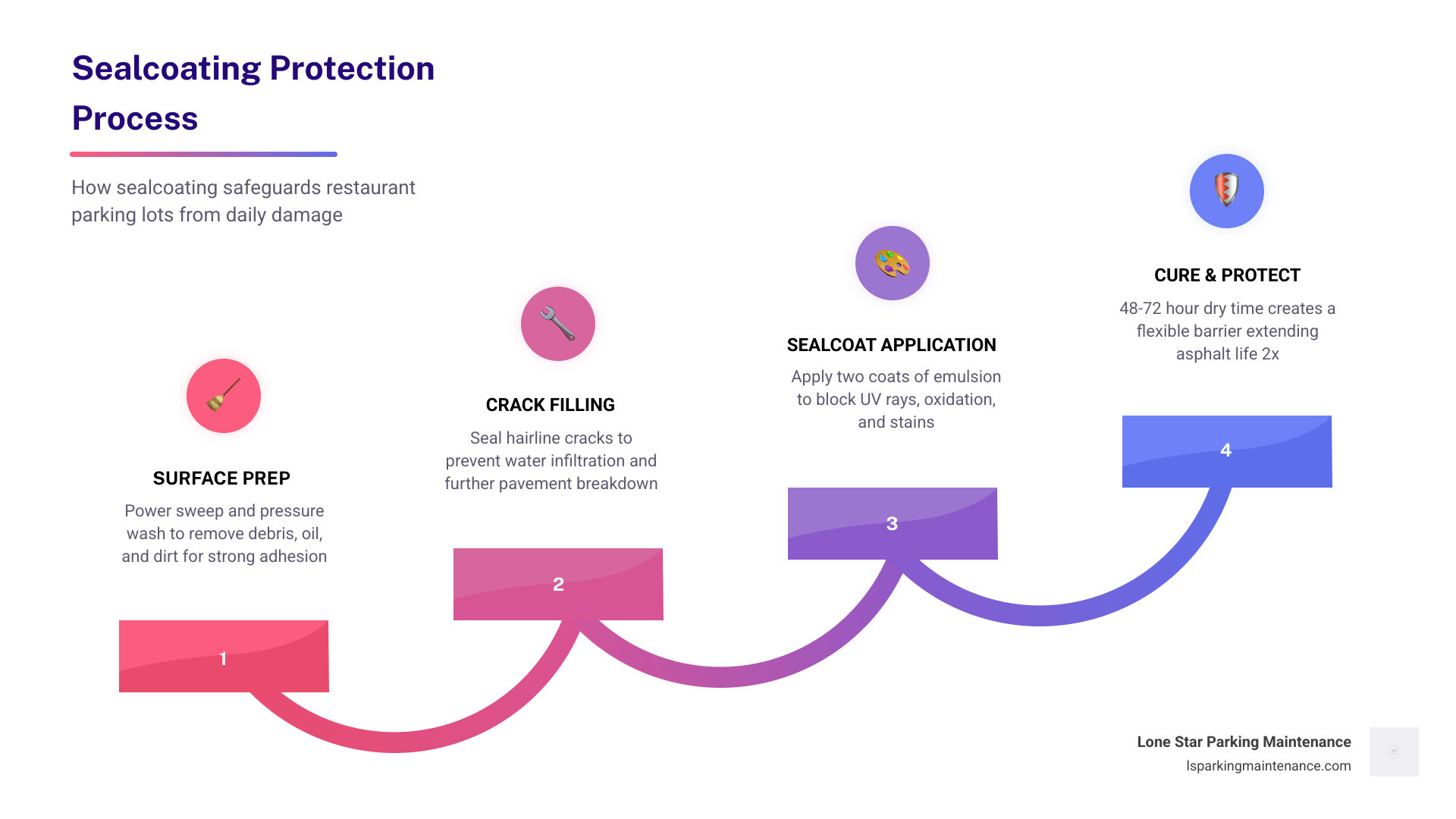
A great sealcoating job is 90% preparation. You can’t just pour sealer over a dirty lot and expect it to stick. It would be like trying to paint a dusty wall—it just won’t end well.
1. Surface Preparation and Cleaning
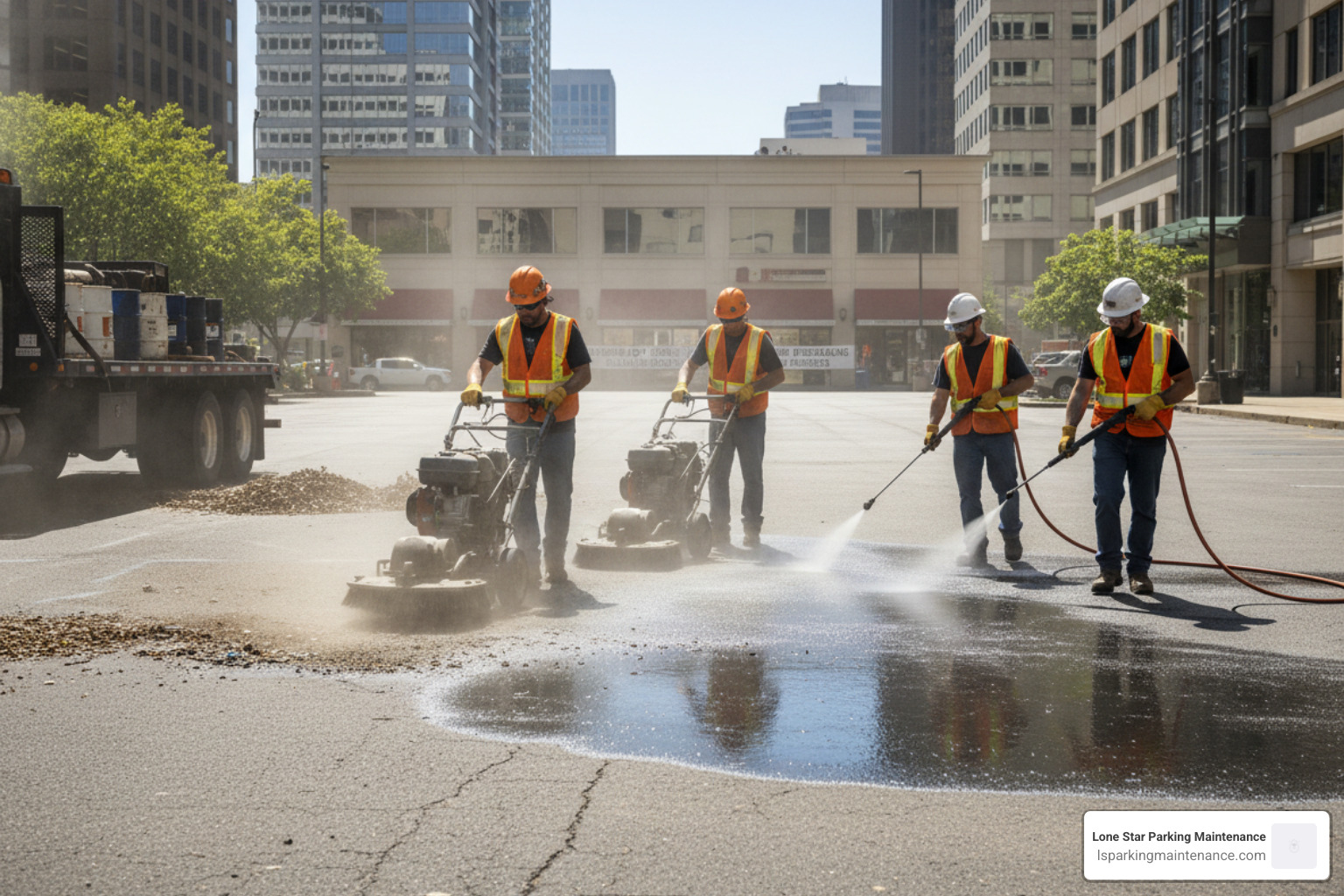
First, we perform a deep clean. This involves power sweeping to remove heavy debris and often pressure washing areas with heavy oil or grease buildup. We have to ensure the asphalt is “thirsty” and ready to bond with the sealer. If there are heavy oil saturated spots, we apply specialized oil spot primers to ensure the sealcoat doesn’t peel away later.
2. Crack Filling and Repair
Before the first drop of sealer hits the ground, we must address structural issues. Parking Lot Sealing and Crack Filling go hand-in-hand. Sealcoating is not a crack filler. We use a hot-applied rubberized sealant for cracks (usually those 1/4 inch or wider) to prevent water from reaching the base. If you have “alligator cracking” or deep potholes, these must be patched with fresh asphalt first.
3. The Two-Coat Application
For a commercial restaurant lot, a single coat is rarely enough. We apply two coats of premium commercial-grade sealer. The first coat is often “squeegeed” on to ensure it’s worked into the pores of the asphalt, while the second coat is sprayed to provide a uniform, beautiful finish.
4. Minimal Business Disruption
We understand that if your lot is closed, you aren’t making money. We specialize in staged work. We can seal half the lot on a Monday and the other half on a Tuesday, or work in sections so that you always have parking available for your guests. Clear communication with your team ensures that we don’t block your delivery bays or drive-thru lanes during peak hours.
Beyond the Surface: Essential Add-ons for Restaurant Parking Lot Sealing
Once the sealcoat is dry, your lot is a blank black canvas. This is the time to make it functional and safe.
- Precision Line Striping: Fresh, crisp white or yellow lines make your lot look organized. It also maximizes your parking capacity—nothing wastes space like faded lines that lead to “creative” parking by customers.
- ADA Compliance: Ensuring you have the correct number of handicapped spaces, properly marked with the international symbol of accessibility, is a legal requirement under the Americans with Disabilities Act (ADA). We make sure your lot meets all DFW and federal codes to avoid hefty fines.
- Fire Lanes and Directional Arrows: Especially for restaurants with drive-thrus, clear directional arrows prevent traffic jams and “fender benders.” Fire lanes must be clearly marked in red to comply with local fire marshal codes.
- Wheel Stops and Speed Bumps: If your lot has seen better days, your old concrete wheel stops might be cracked. We can install new industrial rubber or plastic wheel stops—which are often more durable and cost-effective than concrete—to protect your landscaping and sidewalks.
Timing and Frequency: When Does Your Lot Need a Refresh?
How do you know it’s time to call us? You don’t want to wait until the lot is falling apart, but you also don’t want to seal it more often than necessary.
The 24-26 Month Rule
For a typical commercial property, the National Asphalt Pavement Association suggests sealing every 2 to 4 years. However, because restaurants experience much higher traffic volumes and more chemical exposure (oils/grease), we generally recommend a restaurant parking lot sealing interval of every 24 to 26 months.
Signs Your Lot is “Thirsty”
- The Gray Out: New asphalt is deep black. As it oxidizes, it turns a dull, light gray. This is the most obvious sign that the binder is wearing thin.
- Hairline Cracks: If you see a “spiderweb” of tiny cracks, it’s a cry for help. Sealing now can stop these from turning into wide cracks or potholes. How do I know if my parking lot needs crack filling? If the cracks are wider than a pencil, you definitely need filling before sealing.
- Standing Water: If water is no longer “beading” on the surface but instead soaking in or pooling in small depressions, your protection is gone.
- Faded Lines: If your customers can’t tell where one parking spot ends and the next begins, it’s time for a refresh.
How long does parking lot sealing last? In the DFW climate, you can expect 2 to 3 years of peak performance, though extreme heat and heavy delivery truck traffic can shorten that window.
The Weather Window
In Texas, we have to be strategic. Sealcoating requires pavement temperatures to be at least 50°F and rising. We also need a 48-hour window with no rain forecast to allow the material to cure properly. Spring and Fall are typically the “Goldilocks” seasons for our crews.
Budgeting for Maintenance: Costs and Long-Term ROI
Let’s talk numbers. Many owners see maintenance as an “expense,” but it’s actually a massive cost-saving measure.
The Cost of Sealing
For a typical commercial lot, sealcoating generally costs between $0.22 and $0.38 per square foot.
- Sealcoating (50,000 sq. ft.): $11,000 – $19,000
- Crack Sealing: Usually priced by the linear foot ($1.00 – $3.00). A typical 50k sq. ft. lot might need $1,500 – $5,000 in crack work.
- Total Maintenance Package: This includes cleaning, crack filling, two coats of sealer, and restriping.
Comparing the Alternatives
If you neglect your lot, you eventually face two choices: Resurfacing (Milling and Paving) or Total Replacement.
- Sealcoating: ~$0.30/sq. ft.
- Resurfacing: ~$2.00 – $3.00/sq. ft.
- Total Replacement: ~$5.00 – $10.00/sq. ft.
The ROI of “Five Star” Maintenance
A properly maintained asphalt structure can last 20 to 30 years. An untreated lot often begins to fail structurally within 10 to 12 years. By spending a few cents per square foot every couple of years, you are effectively deferring a six-figure repaving bill for decades. What are the benefits of crack filling? It’s the single most effective way to prevent the formation of potholes, which are the most expensive “small” repairs to fix.
Frequently Asked Questions about Restaurant Parking Lot Sealing
Can my restaurant stay open during the sealcoating process?
Absolutely. We are experts at “the dance.” We can section off your lot so that 50% remains open at all times. For 24-hour diners or high-volume spots, we often work in the very early morning hours or on your slowest weekdays. We use clear signage, caution tape, and traffic cones to ensure your customers and staff stay safe and don’t accidentally drive onto wet sealer.
How long does it take for the sealer to dry before cars can park?
Cure time depends heavily on DFW humidity and temperature.
- Foot Traffic: Usually safe within 24 hours.
- Vehicle Traffic: We recommend waiting 48 to 72 hours for the sealer to fully harden. If you open the lot to cars too early, you risk “power steering marks” where tires turn and scuff the soft sealer, or worse, tracking the black material into your restaurant’s dining room (and your carpet won’t thank you for that!).
When is sealcoating no longer an option for my parking lot?
Sealcoating is a preventative treatment, not a curative one. It won’t fix a lot that is already falling apart.
- The 25% Rule: If more than 25% of your lot is covered in “alligator cracks” (small, interconnected cracks that look like reptile skin), sealcoating is just a cosmetic “band-aid.” At this point, the subgrade has failed.
- Deep Potholes: If your lot is more “crater” than “pavement,” you likely need milling and a new asphalt overlay.
- Structural Failures: If the pavement is sinking or heaving significantly, sealcoating will not stop the movement.
If your lot has reached this stage, we’ll be honest with you. We’d rather tell you that you need a repair than take your money for a sealcoat job that will peel off in six months because the underlying asphalt is too weak.
Conclusion
At Lone Star Parking Maintenance, we know that your DFW restaurant is more than just a building—it’s your livelihood. We take pride in helping local business owners protect their investments and provide a safe, welcoming environment for their guests. From the first power sweep to the final stripe of a handicap space, our commitment to top-quality materials and industry standards ensures your parking lot stays in “Five Star” condition.
Don’t wait for the Texas sun to turn your asphalt into a gravel pit. Schedule your professional parking lot assessment with us today and let’s make sure your first impression is a lasting one.