
Why Your Parking Lot Light Post Is More Than Just a Pole
A parking lot light post is one of the most important investments you can make for your commercial property. The right pole keeps your lot safe, well-lit, and compliant — the wrong one leads to dark corners, liability risks, and costly replacements.
Here’s a quick look at what makes a parking lot light post the right fit:
| Factor | What to Look For |
|---|---|
| Height | 15-30 ft for most commercial lots |
| Material | Steel (most common), aluminum, or fiberglass |
| Shape | Square (easier mounting) or round (better wind resistance) |
| Fixture type | LED kits with 50,000-100,000+ hour lifespan |
| Mounting | Anchor base (commercial standard) or direct burial |
| Wind rating | Engineered for local wind zones; up to 180 MPH for specialized poles |
| Certifications | UL listed, DLC Premium, IP65 rated |
For DFW property managers, a poorly lit parking lot isn’t just an eyesore — it’s a safety hazard and a liability. Good lighting deters crime, guides drivers and pedestrians, and signals that your property is well-maintained.
The good news: modern LED parking lot light poles are more capable, longer-lasting, and more cost-effective than ever. Whether you’re doing a new installation or upgrading old fixtures, choosing the right post matters.
This guide breaks down everything you need to know — materials, heights, spacing, mounting options, and more — so you can make a confident, informed decision.
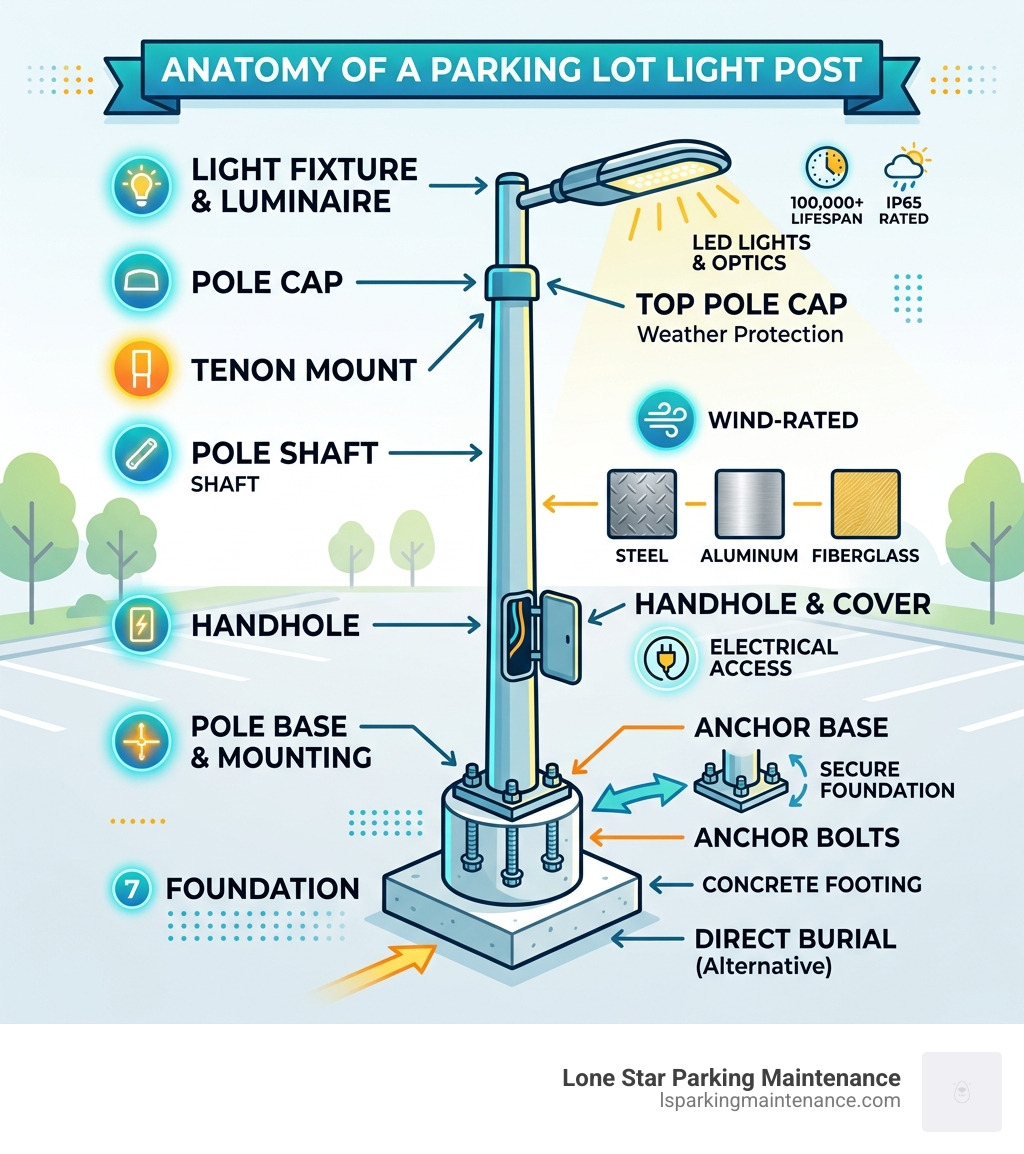
Choosing the Right Material for Your Parking Lot Light Post
When we talk about a parking lot light post, the material it’s made of is its literal backbone. In the DFW Metroplex, we need materials that can handle the Texas heat, occasional heavy storms, and the test of time. Most commercial properties choose between steel, aluminum, and fiberglass.
| Feature | Steel Poles | Aluminum Poles | Fiberglass Poles |
|---|---|---|---|
| Durability | High (Heavy-duty) | Moderate | Moderate to High |
| Corrosion Resistance | Moderate (Needs Galvanization) | High (Naturally Rust-proof) | Excellent (Non-corrosive) |
| Wind Resistance | Excellent | Moderate | High (Flexible) |
| Average Cost | $600 – $1,000 | Higher than Steel | Highest |
| Best Use Case | Standard Commercial Lots | Coastal/Humid Areas | Highly Corrosive Areas |
Steel
Steel is the industry heavyweight. It is the most common choice for commercial parking lots because it offers the best strength-to-price ratio. Most steel poles are made from 11-gauge or 7-gauge hot-rolled steel. To prevent rust, these poles undergo hot-dip galvanization, a process where the steel is submerged in molten zinc. This creates a protective layer that can withstand the elements for decades. For example, a Car Park 12m Lamp Steel Parking Lot Light Pole is a classic example of a robust, galvanized structure designed for high-traffic areas.
Aluminum
Aluminum is lighter and naturally resistant to corrosion. While it doesn’t have the raw structural “heft” of steel, it’s a great choice if you are worried about rust or if the pole is being installed in a location where weight is a factor. However, in North Texas, where wind loads can be significant, steel remains the more popular choice for taller applications.
Fiberglass
Fiberglass poles are non-conductive and won’t rust, making them favorites for coastal regions. While they are more expensive, they are incredibly durable. However, for most DFW business owners, a high-quality galvanized steel pole provides the best long-term value.
Square vs. Round Pole Profiles
The shape of your parking lot light post isn’t just about looks—it affects how you mount your lights and how the pole handles the wind.
- Square Poles: These are the “bread and butter” of commercial lighting. Because they have flat sides, it is much easier to mount multiple fixtures (like a 4-light setup) using standard brackets. They provide a modern, clean look that fits well with retail centers and office parks. You can find these in common heights like 20 ft 25 ft 30 Foot Light Pole Square Parking Lot Poles, which are standard for most medium-to-large lots.
- Round Poles: These are often chosen for their aesthetic appeal and superior wind resistance. Because they have no flat faces, wind flows around them more easily, reducing “drag.” They are common in parks, pathways, or areas where a softer architectural look is desired.
Understanding Wind Ratings and EPA
In the lighting world, we use a term called EPA (Effective Projected Area). This isn’t a government agency; it’s a measurement of how much wind force a pole and its attached lights will catch.
If you put a massive, heavy light fixture on a thin pole in a high-wind zone, you’re asking for trouble. Most commercial poles are engineered for specific wind zones. In Texas, we generally look for poles rated for at least 90-110 MPH, though specialized steel poles can withstand up to 180 MPH.
The “gauge” of the steel matters here too. A 11-gauge steel pole is standard for most commercial lots, while a 7-gauge steel pole is much thicker and used for high-wind areas or when carrying heavy equipment like multiple large floodlights.
Determining Height and Spacing for Optimal Coverage
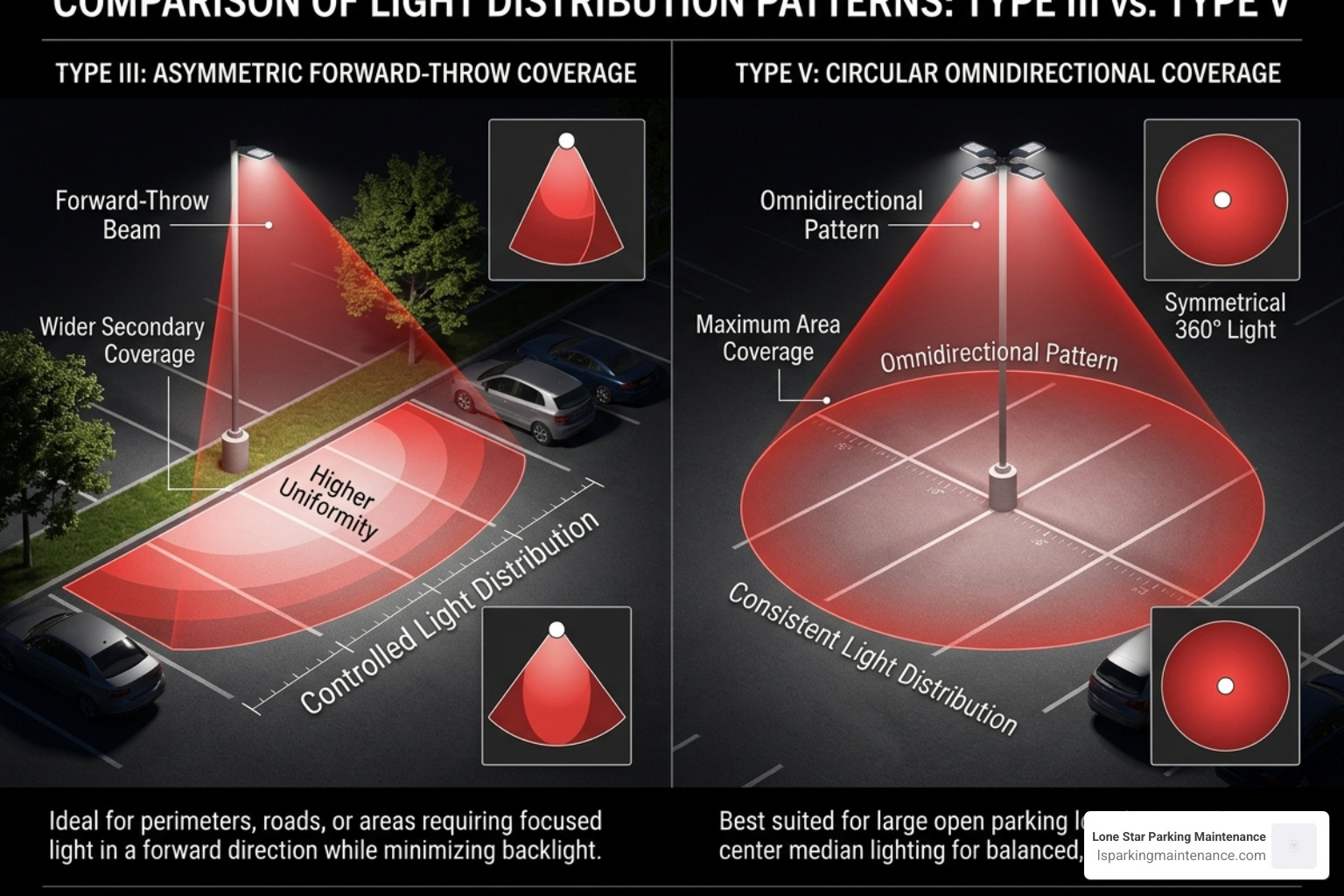
Getting the height right is a balancing act. If the pole is too short, you’ll have “hot spots” of blinding light and dark shadows in between. If it’s too tall, you’re wasting energy and potentially causing light pollution for your neighbors.
Choosing the Right Height
Most parking lot light post installations fall between 15 and 30 feet:
- 15-20 Feet: Ideal for smaller retail lots, apartment complexes, and pedestrian walkways.
- 25-30 Feet: The standard for larger commercial lots, auto dealerships, and industrial facilities. These taller poles allow for a broader “throw” of light, meaning you need fewer poles to cover the same area.
For more technical details on how we plan these layouts, check out our parking lot lighting services.
Calculating Pole Spacing
We don’t just guess where the poles go. We use photometric plans, which are computer-generated models that show exactly how the light will hit the ground.
- Overlap: You want the light from one pole to slightly overlap with the next. This eliminates shadows where “bad actors” might hide and ensures drivers can see pedestrians clearly.
- Uniformity Ratio: This is the ratio of the brightest spot to the darkest spot. A good parking lot usually aims for a 10:1 or better ratio to ensure the human eye doesn’t have to constantly adjust to different light levels.
If you’re wondering about the logistics of putting these in the ground, we have more info on how we help with parking lot lighting installation.
Essential Components and Mounting Options
A parking lot light post is an assembly of several specialized parts. Knowing these terms will help you speak “lighting-ese” when planning your project.
Mounting Hardware
- Anchor Base: This is the most common commercial mounting style. The pole has a heavy steel plate at the bottom that bolts onto large anchor bolts embedded in a concrete foundation.
- Direct Burial: The pole is placed directly into a deep hole and backfilled with soil or concrete. This is more common for residential street lights or rural areas.
- Tenons and Slipfitters: A tenon is a small “stub” at the top of the pole. A slipfitter is the part of the light fixture that “slips” over that tenon.
- Bullhorns: These are brackets that allow you to mount two, three, or even four lights on a single pole.
You can find a wide variety of these Pole Light Accessories and other Lighting Poles & Mountings to customize your setup.
Fixed vs. Adjustable LED Kits
When buying a parking lot light post, you often have the choice between a “fixed” kit or an “adjustable” one.
- Fixed Kits: The light is mounted at a set angle. These are great because they have fewer moving parts and require almost zero maintenance once installed. They provide a clean, professional look, like this Exterior Commercial LED Parking Lot and Area Post Light.
- Adjustable Kits: These allow you to aim the light after it’s installed. These are useful if you have a specific area (like a loading dock or a sign) that needs extra focus.
Installation and Maintenance Best Practices
Installing a parking lot light post isn’t a DIY project for a Saturday afternoon. It involves heavy machinery, high-voltage electricity, and structural engineering.
- The Foundation: We typically excavate 4 to 8 feet deep, depending on the pole height and local soil conditions. A “Sonotube” form is set, electrical conduit is run, and concrete is poured with the anchor bolts perfectly positioned.
- Curing: The concrete needs to cure (usually 24-72 hours) before the pole is mounted.
- Leveling: We use “leveling nuts” under the pole base to ensure the post is perfectly vertical before tightening the top nuts.
Maintenance is Key
Even the best LED lights need a check-up. We recommend inspecting your poles at least twice a year. Look for:
- Loose bolts or base covers.
- Signs of rust or chips in the powder coating.
- Bird nests or debris blocking the light sensors.
For a deeper dive, see our FAQ on how often parking lot lights should be maintained or what to do if you notice a problem with your lighting.
Protective Measures for Longevity
In a busy parking lot, the biggest threat to your light pole isn’t the wind—it’s a distracted driver in a SUV.
We highly recommend using protective pole covers or concrete bollards around the base of your poles. These act as a “shield” that absorbs the impact of a low-speed collision, saving you from a $2,000 pole replacement. We offer specialized protective pole covers and curb stop installation to keep your investment safe.
Frequently Asked Questions
What is the standard height for a parking lot light post?
For most commercial properties in the DFW area, the standard height is 15 to 25 feet. Smaller lots or pathways usually stick to 15-20 feet to keep the light “human-scaled,” while large shopping centers or warehouses use 25-30 foot poles to maximize coverage. If you’re curious about what we typically use, check out what types of parking lot lights we install.
Can I retrofit an existing parking lot light post with LED?
Absolutely! This is one of the most cost-effective upgrades you can make. You don’t usually need to replace the entire pole. We can often install LED retrofit kits or replace the old “shoebox” fixture with a modern LED version using a slipfitter adapter. This can reduce your energy consumption by 60-80% almost overnight.
What certifications should I look for in a light pole?
Safety and efficiency are non-negotiable. Look for these three:
- UL/cULus Listing: Ensures the electrical components meet strict safety standards.
- DLC Premium: This certification means the light is highly energy-efficient and may qualify you for utility rebates.
- IP65/IP66 Rating: This tells you how well the fixture is protected against dust and water (essential for Texas thunderstorms!).
Conclusion
At the end of the day, a parking lot light post is a silent guardian of your property. It provides the visibility your customers need to feel safe and the security your business needs to thrive. From choosing the right 11-gauge steel to ensuring your spacing provides perfect uniformity, every detail matters.
At Lone Star Parking Maintenance, we’ve spent years serving the DFW Metroplex, ensuring that local businesses stay bright and safe. Whether you need a brand-new installation, a modern LED retrofit, or protective covers to keep your poles standing tall, we’re here to help.
Ready to brighten up your property? Contact us for expert parking lot lighting solutions today, and let’s make your lot the safest one on the block!