
Why Proper Parking Lot Drainage is a Non-Negotiable Investment
When we talk to property owners in the DFW area, we often describe a high-quality drainage system as an insurance policy. You hope you never have to think about it, but when the clouds open up over Dallas, you’ll be glad it’s there. Proper parking lot drainage isn’t just about avoiding a few puddles; it is the single most important factor in determining how long your pavement lasts.
Pavement Lifespan and Durability
The math is simple but brutal. A parking lot with adequate drainage and standard maintenance can easily last 25 years. However, a lot with standing water and poor runoff management often requires a full-depth reconstruction in just 10 to 12 years. By neglecting drainage, you are essentially cutting your investment’s life in half. Water is the primary enemy of asphalt; it penetrates the surface, softens the subgrade, and causes the structural layers to shift and fail under the weight of vehicles.
Liability and Safety
Safety is our top priority at Lone Star Parking Maintenance. Standing water leads to hydroplaning, which can cause accidents in your lot. In the winter, those same puddles turn into “black ice,” creating significant slip-and-fall liabilities. Proper grading and drainage ensure that pedestrians can walk from their cars to your front door without navigating an obstacle course of mini-lakes.
Stormwater Management and Compliance
Beyond the physical pavement, there is a legal side to water. Most municipalities in Texas regulate runoff under the National Pollutant Discharge Elimination System (NPDES), which is tied to the federal Clean Water Act. Commercial properties are often required to have a Stormwater Pollution Prevention Plan (SWPPP). Stormwater Management and Compliance ensures that you aren’t just dumping oil-slicked water into the local ecosystem. If your lot causes “sheet flow” (a wall of water) to flood an adjacent property or a public road, you could face municipal fines or private lawsuits.
Common Problems and Warning Signs of Poor Drainage
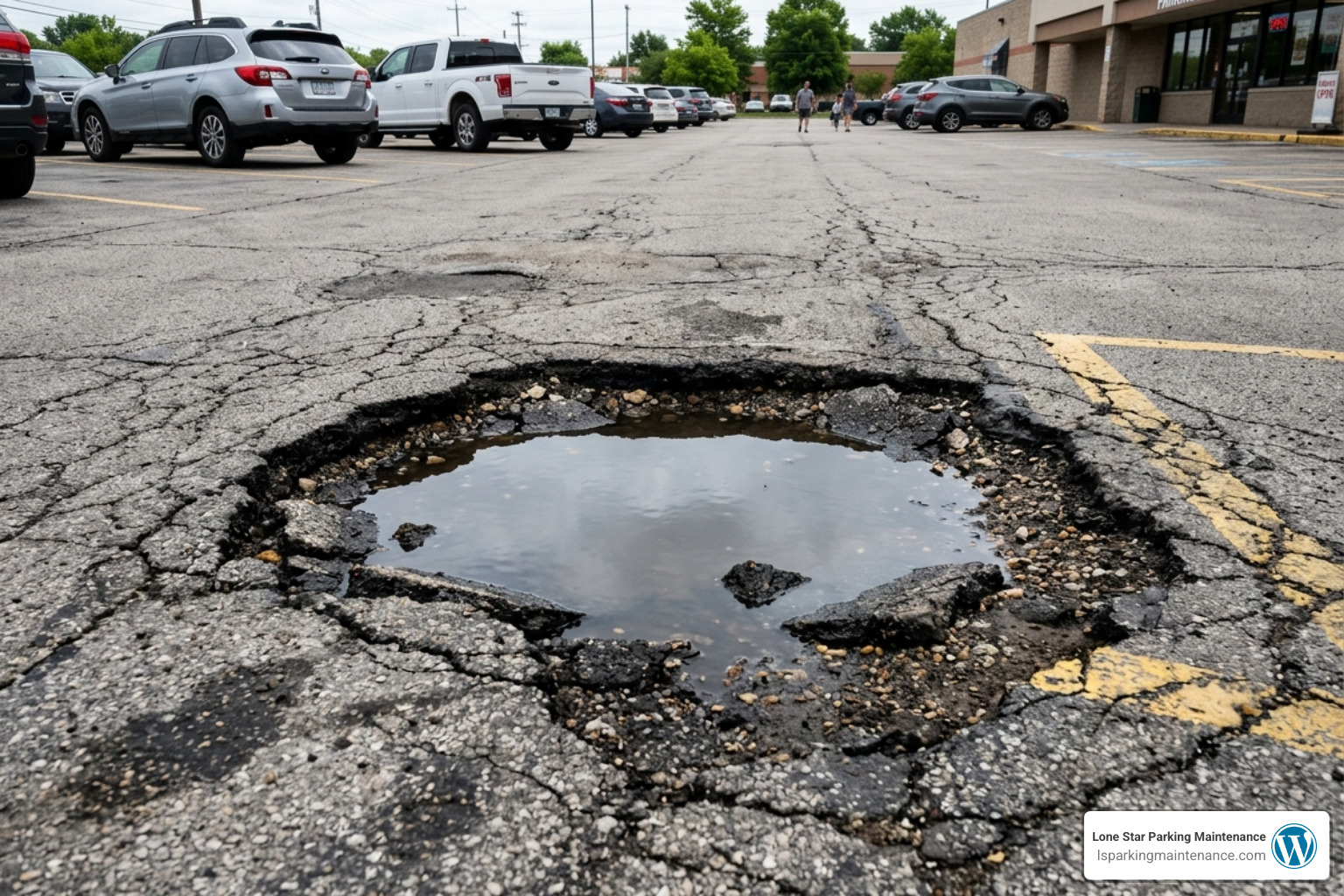
How do you know if your lot is in trouble? Sometimes the signs are obvious, like an ankle-deep pond in front of a store entrance. Other times, the damage is happening silently beneath the surface.
- Pooling Water (Birdbaths): If you see standing water persisting for more than 24 hours after a rain event, you have a drainage problem. These “birdbaths” indicate a low spot in the grading or a clogged drain.
- Alligator Cracking: This is a series of interconnected cracks that look like the skin of a reptile. It’s a classic sign of structural failure caused by a saturated subbase.
- Base Erosion: When water gets under the asphalt, it washes away the stone and soil that support the pavement. This leads to depressions and, eventually, collapses.
- Foundation Runoff: If your lot is sloped toward your building rather than away from it, you risk foundation damage and basement flooding.
- Texas-Specific Stress: Our DFW climate is unique. The intense Texas heat expands asphalt, opening up tiny cracks. When the rain follows, water enters those cracks. If we hit a sudden freeze, that water expands, shattering the pavement from the inside.
Essential Components of an Effective Parking Lot Drainage System
A functional system is more than just a hole in the ground. It is a network of components designed to capture, filter, and move water.
Catch Basins
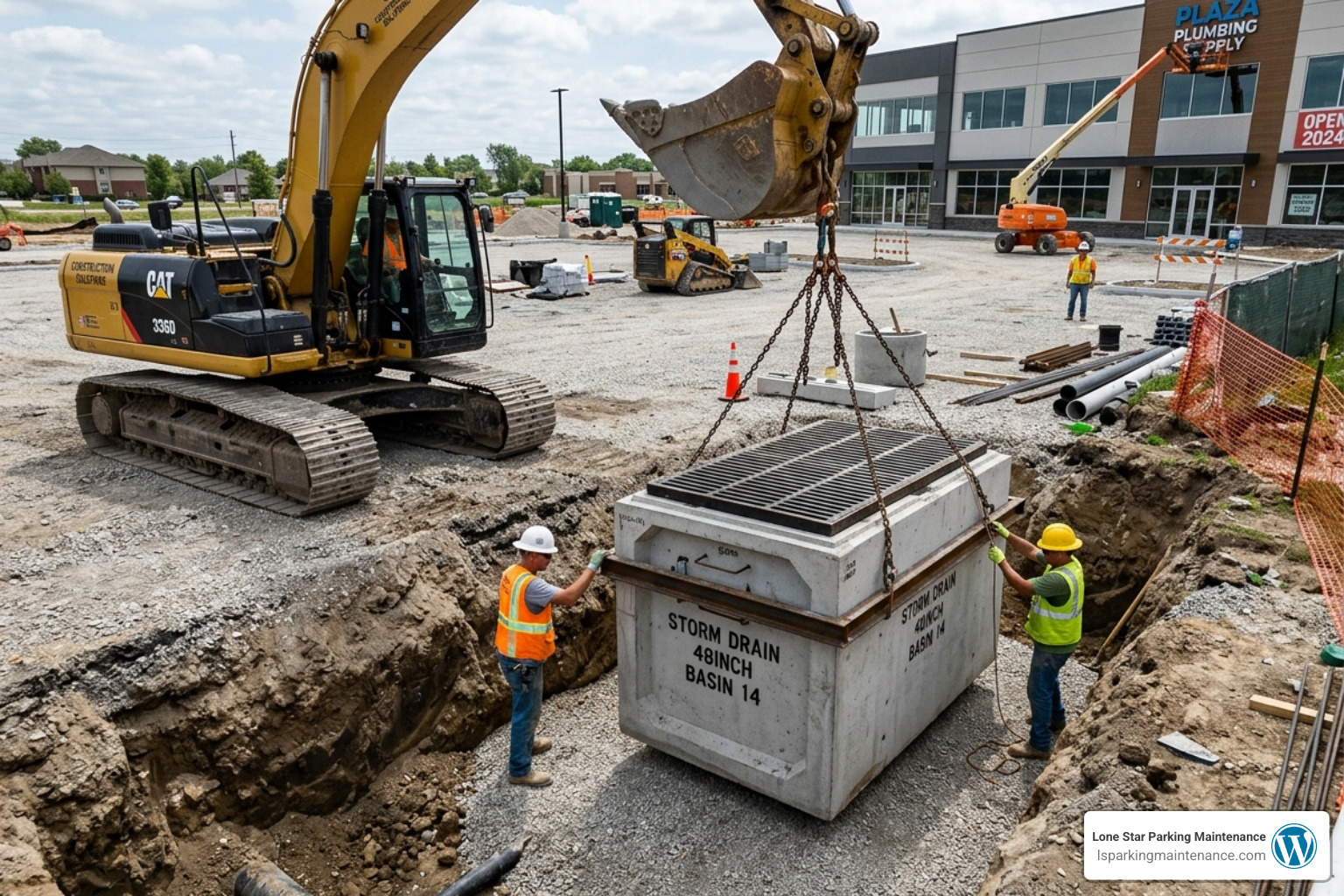
These are the workhorses of most commercial lots. A catch basin (or storm inlet) features a grate at the surface and a “sump” area at the bottom. The sump allows heavy sediment and debris to settle at the bottom so that only relatively clean water flows out into the municipal sewer pipes. For heavy-duty areas like truck routes, we recommend concrete-encased basins for maximum durability.
Trench Drains
While catch basins are “point drains,” trench drains are linear. These are long, narrow grates often placed at the bottom of a slope or in front of a building. They are excellent for intercepting “sheet flow” across large flat surfaces. When choosing these, Trench drain design and load considerations are vital. You must ensure the grates have the correct load rating—usually Class D400 (88,000 lbs) for areas with delivery trucks—to prevent them from buckling.
French Drains (Drainage Tiles)
If your lot has a high water table or stays soggy even when it hasn’t rained, you may need a French drain. This consists of a perforated pipe buried in a trench filled with clean stone and wrapped in filter fabric. It pulls groundwater away from the pavement’s subbase to keep the foundation dry.
Designing for Performance: Slopes, Calculations, and LID Solutions
Engineering a parking lot requires precise math. We use the Rational Formula (Q=CIA) to determine how much water a lot will produce during a storm.
- Q: Peak runoff rate
- C: Runoff coefficient (asphalt is usually 0.9, meaning 90% of rain stays on the surface)
- I: Rainfall intensity (based on local NOAA Atlas 14 data)
- A: The area of the lot in acres
The Golden Rules of Sloping
To prevent ponding, we follow strict industry standards for grading:
- Recommended Slope: 1% to 5% for paved surfaces.
- Absolute Minimum: 0.4% (anything flatter requires specialized underground storm sewers).
- Gutter Slope: Minimum 0.5% to keep water moving toward the inlets.
Traditional vs. Sustainable Drainage
Modern design is shifting toward Low Impact Development (LID). Instead of just “piping it away,” LID focuses on treating water on-site.
| Feature | Traditional Gray Infrastructure | Low Impact Development (LID) |
|---|---|---|
| Primary Goal | Rapid removal via pipes | Infiltration and filtration |
| Components | Catch basins, concrete pipes | Bioswales, permeable pavers |
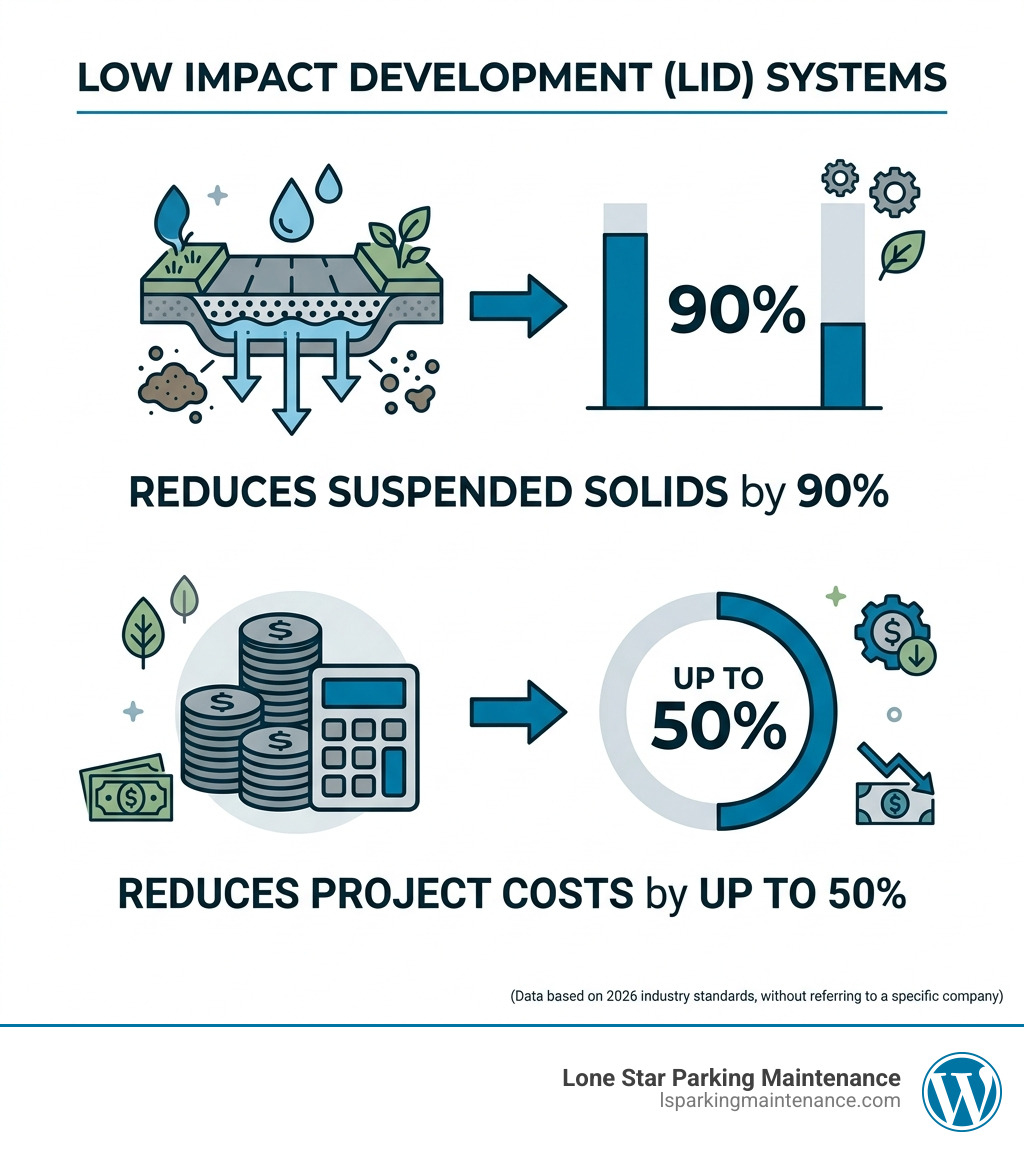
| Runoff Volume | High | Reduced by 80-100% |
| Water Quality | Poor (carries oils/metals) | High (filtered by soil/plants) |
| Lifecycle Cost | Higher due to pipe repairs | 15-50% lower project costs |
Sustainable Parking Lot Drainage: LID and Green Infrastructure
In the DFW Metroplex, green infrastructure is becoming a popular way to meet regulatory requirements while saving money.
- Permeable Pavers: These allow water to flow through the surface into a stone reservoir below. They can reduce runoff by nearly 100%.
- Bioswales and Rain Gardens: These are landscaped areas designed to catch and filter runoff. They provide an 80-90% reduction in suspended solids and help recharge our local groundwater.
Maintenance Strategies to Prevent Drainage Failure
Even the best-designed system will fail if it’s neglected. We’ve seen catch basins so full of trash and leaves that they were effectively sealed shut, leading to massive flooding during a standard Texas thunderstorm.
Annual Inspections and Debris Removal
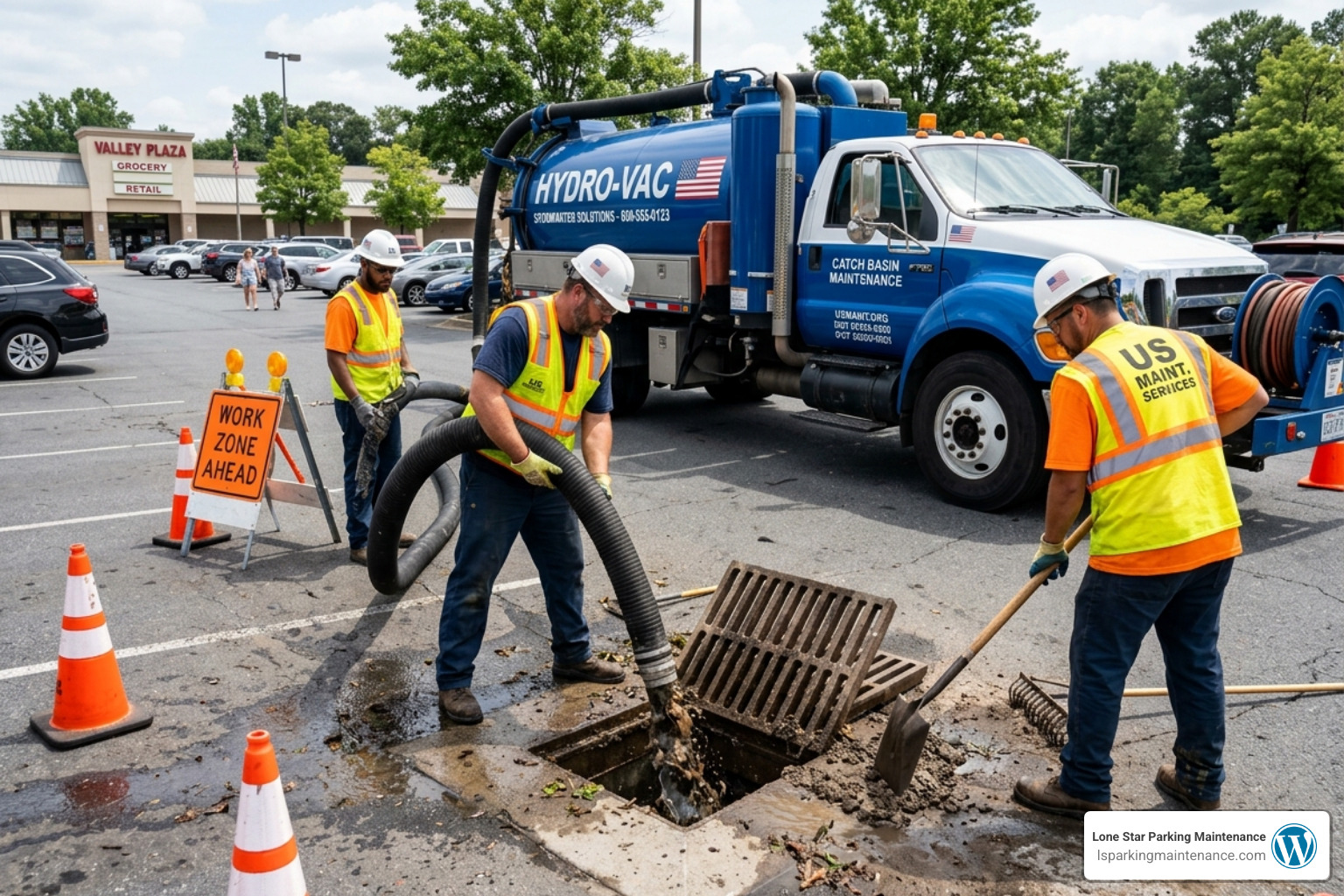
At a minimum, you should have your drainage system inspected once a year. We recommend doing this in the fall (to clear out leaves) and the spring (to clear out sediment and winter debris). If your catch basins reach 50% sediment capacity, their efficiency drops off a cliff.
Sealing and Crack Filling
Drainage and surface maintenance go hand-in-hand. Water that enters a crack is water that isn’t reaching your drain—and that water is actively destroying your subbase. More info about parking lot sealing and crack filling can help you understand how a protective sealcoat acts as a waterproof barrier, forcing water to stay on the surface where your drains can handle it.
Professional Maintenance Tasks
- Camera Inspections: Every 5 to 7 years, we recommend a camera inspection of your underground outlet pipes to check for collapses or root intrusions.
- Pressure Washing: Keeping the surface clean prevents dirt and oil from clogging the pores of permeable systems or the grates of trench drains.
- Hurricane/Storm Season Prep: In Texas, we get heavy “rain bombs.” Clearing your inlets before the spring storm season can prevent an emergency flood.
The Role of Professional Maintenance in Parking Lot Drainage
Semi-annual cleaning and professional oversight can prevent over 90% of non-structural drainage failures. By keeping your drains clear and your asphalt sealed, you ensure that water remains a managed resource rather than a destructive force.
Frequently Asked Questions about Parking Lot Drainage
What is the ideal slope for a commercial parking lot?
The “sweet spot” is between 1% and 2%. This is steep enough to move water efficiently but flat enough that it doesn’t feel like a hill to pedestrians or people in wheelchairs. The absolute minimum for asphalt is 0.4%, but we generally recommend at least 1% to account for natural pavement settling over time.
How often should catch basins be cleaned?
Annual cleaning is the standard. However, if your lot has heavy tree cover or you use sand for traction during winter “ice-pocalypses,” you should move to a semi-annual schedule. Always check your basins after a major storm to ensure no large debris is blocking the outflow.
Can permeable pavers handle heavy vehicle traffic?
Yes, but they must be specifically load-rated. While permeable pavers are excellent for standard parking stalls and reduce runoff by 80-100%, high-traffic “drive aisles” or heavy truck loading zones are often better served by traditional asphalt with a 1-2% slope directed toward heavy-duty trench drains.
Conclusion
At Lone Star Parking Maintenance, we know that a great parking lot is built from the ground up—and that starts with how you handle water. Whether you are managing a retail center in Dallas or an industrial lot in Fort Worth, your parking lot drainage system is the backbone of your property’s longevity.
Don’t wait for the next DFW downpour to find out your drains are clogged or your grading is off. From precision striping that guides traffic around drainage features to expert sealcoating that keeps water out of your subbase, we are committed to top-quality materials and safety. Protect your investment and ensure a smooth, dry experience for every customer. For More info about parking lot sealing and crack filling or to schedule a comprehensive drainage inspection, reach out to us today. We’re here to keep your lot looking great and draining even better.