
What You Need to Know About ADA Van Accessible Parking Requirements
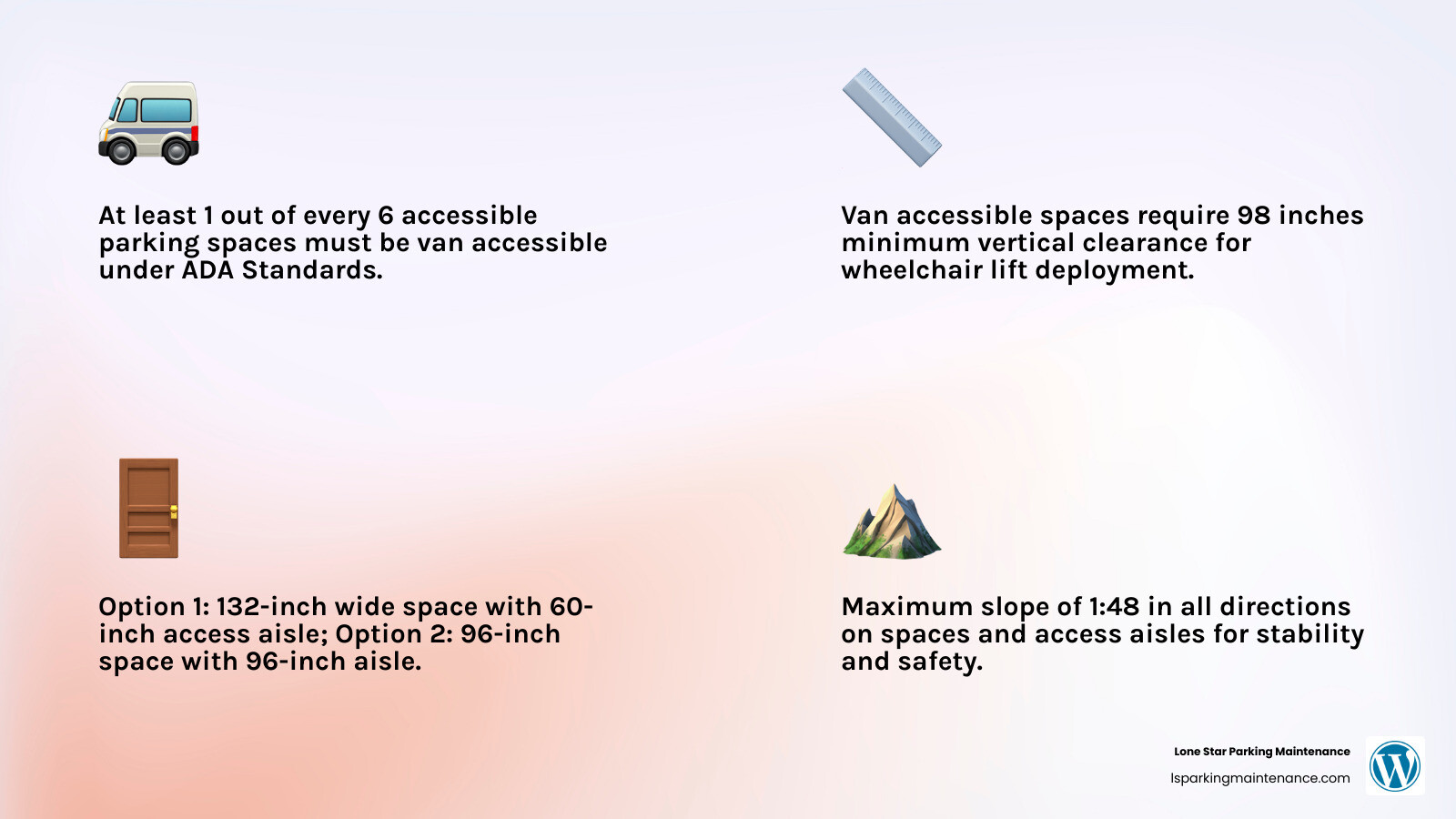
ADA van accessible parking requirements mandate that at least 1 out of every 6 accessible parking spaces must be van accessible — with specific dimensions, clearance, signage, and surface standards set by the 2010 ADA Standards for Accessible Design.
Here’s a quick summary of the key rules:
| Requirement | Standard |
|---|---|
| Van accessible ratio | 1 of every 6 accessible spaces |
| Option 1 space width | 132 inches wide + 60-inch access aisle |
| Option 2 space width | 96 inches wide + 96-inch access aisle |
| Vertical clearance | 98 inches minimum |
| Max slope | 1:48 in all directions |
| Sign height | 60 inches minimum to bottom of sign |
| Required signage | International Symbol of Accessibility + “Van Accessible” |
Whether you manage a strip mall, office park, or medical facility in the DFW Metroplex, getting these details wrong can mean legal exposure — and real barriers for people who depend on van lifts and ramps to get around.
Here’s a striking fact: 75% of able-bodied people say they’d simply climb through a window or the opposite door if a car parked too close to them — but that’s not an option for a wheelchair user. That’s exactly why van accessible spaces exist, and why the rules around them are so specific.
This guide breaks down every requirement you need — space dimensions, ratios, signage, surface standards, and what triggers compliance in existing lots.
Scoping and Ratio for ADA Van Accessible Parking Requirements
When we look at a parking lot, the first question we always ask is: “How many spaces do we actually need?” Under the 2010 ADA Standards, the number of accessible spaces is determined by the total number of parking spots in each individual facility. It isn’t just about the total number of cars; it’s about ensuring that a fair portion of those spots can accommodate everyone.
The “1-in-6 rule” is the golden rule for ada van accessible parking requirements. For every six accessible spaces (or fraction of six), at least one must be van accessible. If you only have one accessible space in your entire lot, that one space must be van accessible.
General Scoping Table
According to Accessible Parking Spaces | ADA.gov, the following table outlines the minimum requirements for most commercial and public facilities as of April 2026:
| Total Parking Spaces | Minimum Accessible Spaces | Minimum Van-Accessible Spaces |
|---|---|---|
| 1 to 25 | 1 | 1 |
| 26 to 50 | 2 | 1 |
| 51 to 75 | 3 | 1 |
| 76 to 100 | 4 | 1 |
| 101 to 150 | 5 | 1 |
| 151 to 200 | 6 | 1 |
| 201 to 300 | 7 | 2 |
| 301 to 400 | 8 | 2 |
| 401 to 500 | 9 | 2 |
| 501 to 1000 | 2% of total | 1/6 of accessible total |
| 1001 and over | 20, plus 1 for every 100 over 1000 | 1/6 of accessible total |
Medical Facilities: Higher Standards
Medical facilities have much stricter requirements because their visitors are more likely to need mobility assistance.
- Hospital Outpatient Facilities: 10% of patient and visitor parking must be accessible.
- Rehabilitation and Physical Therapy Facilities: 20% of patient and visitor parking must be accessible.
In both cases, the 1-in-6 rule still applies to the resulting number of accessible spaces to determine the van requirement.
Employee Parking
Don’t forget the staff! The ADA doesn’t distinguish between visitor and employee parking when it comes to the number of spaces required. If you have a dedicated employee lot, it must meet the same scoping requirements. We always recommend calculating these separately if the lots are physically distinct to ensure compliance across the entire DFW property.
Requirements for Small Parking Lots
If your lot is very small—meaning 4 or fewer total spaces—you are still required to provide one van-accessible space. However, there is a small “break” in the rules: you don’t necessarily have to post the “Reserved” sign. This allows the space to be used by anyone, though the physical dimensions (the wide space and the aisle) must still be present to accommodate a van if one arrives.
Multi-Level Garages and Multiple Facilities
In the DFW Metroplex, we see plenty of multi-level garages. The Chapter 5: Parking Spaces guidelines clarify that you must calculate the required spaces for each parking facility separately. You can’t just group all the accessible spaces for three different lots into one corner of the property unless it actually provides better or equal access to the building entrances.
In multi-level garages, you have the option to group all van-accessible spaces on one level. This is often a smart move to manage vertical clearance issues (which we’ll get into shortly).
Technical Specifications: Dimensions and Vertical Clearance
One of the most common mistakes we see is a “handicap” spot that is wide enough for a car but completely useless for a van with a side-loading ramp. Vans need extra room to deploy those ramps and enough “headroom” to actually get into the spot.
The 98-Inch Rule
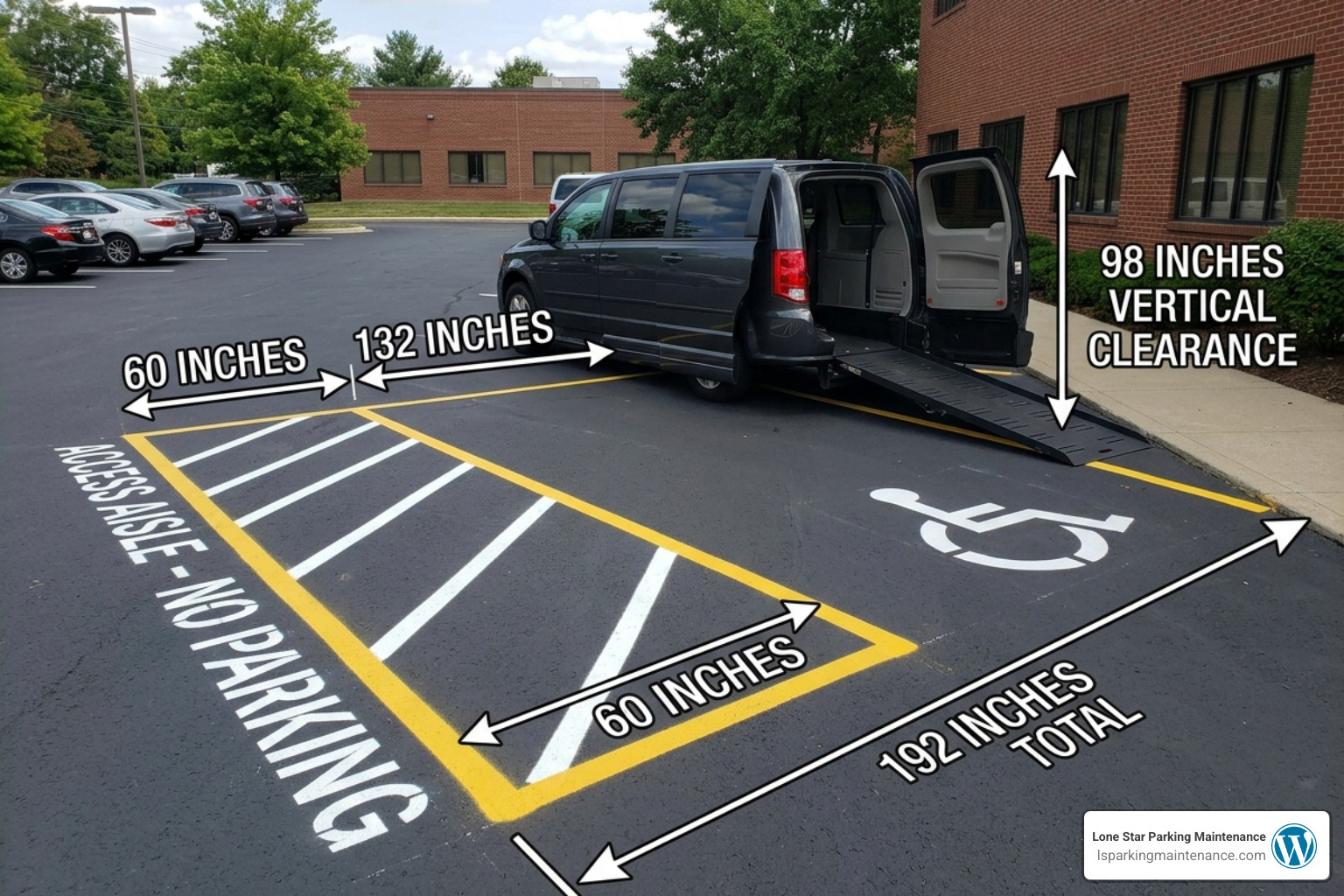
All van-accessible spaces, their associated access aisles, and the entire vehicular route leading to them must have at least 98 inches of vertical clearance. This ensures that high-top vans can navigate the lot without hitting hanging signs, pipes, or ceiling beams in a garage.
Option 1: Wide Space for ADA Van Accessible Parking Requirements
This is the most common configuration for a van-accessible stall.
- Space Width: 132 inches (11 feet).
- Access Aisle Width: 60 inches (5 feet).
- Total Footprint: 192 inches (16 feet).
This design provides a massive 11-foot-wide stall, which gives the van driver plenty of room to maneuver before even considering the 5-foot aisle for the ramp.
Option 2: Wide Aisle for ADA Van Accessible Parking Requirements
Sometimes, it’s easier to keep the parking stalls uniform and make the aisles wider.
- Space Width: 96 inches (8 feet).
- Access Aisle Width: 96 inches (8 feet).
- Total Footprint: 192 inches (16 feet).
The total footprint is the same as Option 1, but the “extra” three feet are moved from the parking space into the access aisle. This is often preferred because that 8-foot aisle can be shared between two spaces (one van-accessible and one standard accessible), saving valuable square footage in your lot.
Surface, Slope, and Location Standards
Location is everything. The ADA requires that accessible spaces be located on the shortest accessible route from the parking area to the building entrance. If your building has multiple entrances, the accessible spaces should be dispersed so they are near each one.
The 1:48 Slope Limit
The ground must be almost perfectly level. The maximum allowable slope in any direction for an accessible space or access aisle is 1:48 (approximately 2%). If the slope is any steeper, a wheelchair user might struggle to keep their chair from rolling while trying to get in or out of their vehicle. We always suggest aiming for a 1.5% slope during construction to account for natural settling and pavement wear over time.
Surface Requirements
The surface must be “firm, stable, and slip-resistant.” While asphalt and concrete are the standards, this also applies to temporary event parking. If you’re setting up a temporary lot on grass for a DFW festival, the grass must be cut very short, and the ground must be firm enough that a wheelchair won’t sink. Gravel and loose sand are generally big no-nos.
For more on the specifics of the painting process, check out The Essential Guide to ADA Compliant Parking Lot Striping.
Access Aisle Requirements
The access aisle is the “no parking” zone next to the stall. It must be marked—usually with diagonal hatch marks—to discourage people from parking there.
- Length: The aisle must extend the full length of the parking space.
- Level: It must be at the same level as the parking space (no curbs or stairs).
- No Obstructions: You cannot place bollards, light poles, or trash cans inside the marked access aisle.
Signage and Maintenance for Compliance
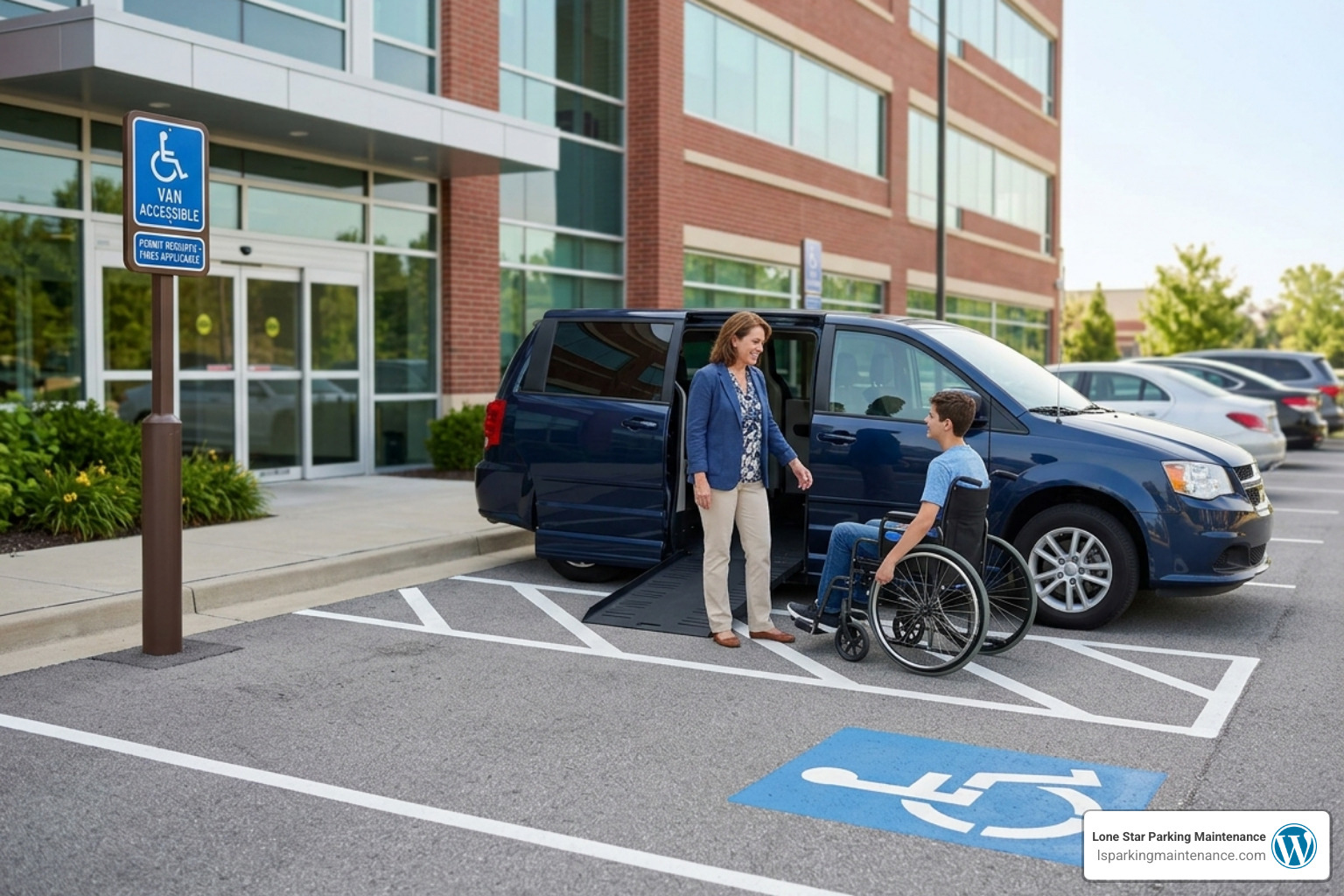
A space isn’t “accessible” if people don’t know it’s reserved. Every accessible space must be identified by a sign showing the International Symbol of Accessibility (the person in a wheelchair).
For van-accessible spots, the sign must also include the phrase “Van Accessible.”
Mounting Height
The sign must be mounted at a height of at least 60 inches (5 feet) from the ground to the bottom of the sign. Why so high? So that the sign is still visible even when a tall van is parked right in front of it. In some cases, like in garages where people walk in front of the signs, they may need to be mounted at 80 inches to provide enough “headroom” for pedestrians.
Restriping and Alterations
According to the ADA Compliance Brief: Restriping Parking Spaces | ADA.gov, restriping your lot is considered an “alteration.” This means that even if your lot was built in 1985, the moment you put fresh paint down, you are required to bring the accessible spaces up to the 2010 Standards.
Existing Facilities and Safe Harbor
There is a “Safe Harbor” provision. If your lot was built or altered between 1991 and 2010 and it complied with the 1991 ADA Standards, you don’t necessarily have to change it yet—unless you decide to restripe or resurface the lot. Once you start an alteration, the “Safe Harbor” ends, and you must follow the newest ada van accessible parking requirements.
Frequently Asked Questions about ADA Van Parking
Can two parking spaces share one access aisle?
Yes! This is a great way to save space. Two parking spaces can share a single 60-inch or 96-inch access aisle. However, there is one big catch: angled parking. If the spaces are angled, the access aisle must be on the passenger side of the van (where the lift is). Because of how cars pull into angled spots, shared aisles usually only work for perpendicular (90-degree) parking.
What are common ADA parking violations?
We see these mistakes all the time in the DFW Metroplex:
- Built-up curb ramps: Ramps that protrude into the access aisle, creating a tripping hazard and a slope that exceeds 1:48.
- Missing signage: Having the paint on the ground but no vertical sign.
- Insufficient vertical clearance: Low-hanging pipes in garages that prevent vans from reaching the designated spots.
- Faded markings: If the hatch marks are gone, people will park in your access aisles, blocking ramp deployment.
Does resurfacing a lot trigger new ADA requirements?
Absolutely. Resurfacing (adding a new layer of asphalt) or reconfiguration is a major alteration. Even simple restriping is usually considered a “readily achievable” barrier removal. If you are touching the pavement with a machine or a paintbrush, it’s time to check your compliance.
Conclusion
Navigating ada van accessible parking requirements might seem like a headache, but it’s a vital part of making your business or facility welcoming to everyone. From the 1-in-6 ratio to the 98-inch vertical clearance, these rules ensure that people with disabilities have the same access to your services as everyone else.
At Lone Star Parking Maintenance, we pride ourselves on helping DFW Metroplex property owners stay ahead of the curve. We use top-quality materials and strictly adhere to industry standards to ensure your lot is safe, beautiful, and fully compliant with 2026 regulations. Whether you need a complete restripe or just a few new signs, we’re here to help.