
Is Your DFW Parking Lot Ready for an Overlay?
Overlay asphalt repairs DFW property owners rely on are one of the most cost-effective ways to restore worn pavement — without the expense or disruption of tearing everything out and starting over.
Here’s a quick snapshot of what you need to know:
| Factor | Asphalt Overlay | Full Replacement |
|---|---|---|
| Cost | $3–$7 per sq ft | 30–40% more expensive |
| Timeline | 1–2 days | Several weeks |
| Best for | Surface wear, minor cracks, fading | Base failure, alligator cracking |
| Lifespan added | 8–15 years | New pavement life |
| Foundation removed? | No | Yes |
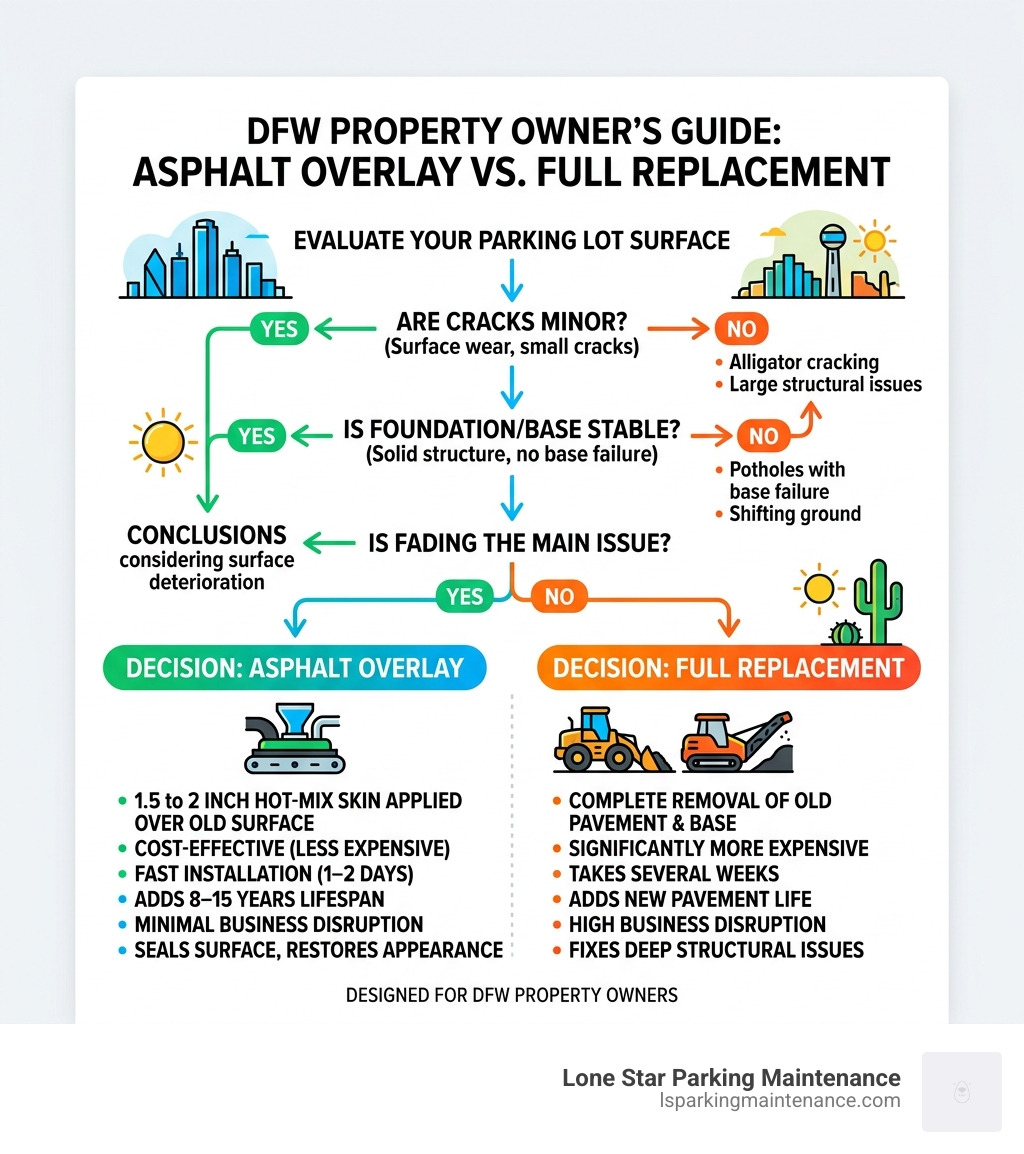
If your parking lot shows fading, minor cracking, or surface deterioration — but the base underneath is still solid — an overlay is almost certainly your best option. It’s faster, cheaper, and far less disruptive to your business.
But not every pavement qualifies. Overlays only work when the foundation is stable. Applying new asphalt over a failing base is like painting over a cracked wall — the problems will come back, often worse.
This guide covers everything DFW property managers and business owners need to make the right call: what overlays are, when they work, how they’re installed, what they cost, and how to make them last.
What Are Overlay Asphalt Repairs in DFW?
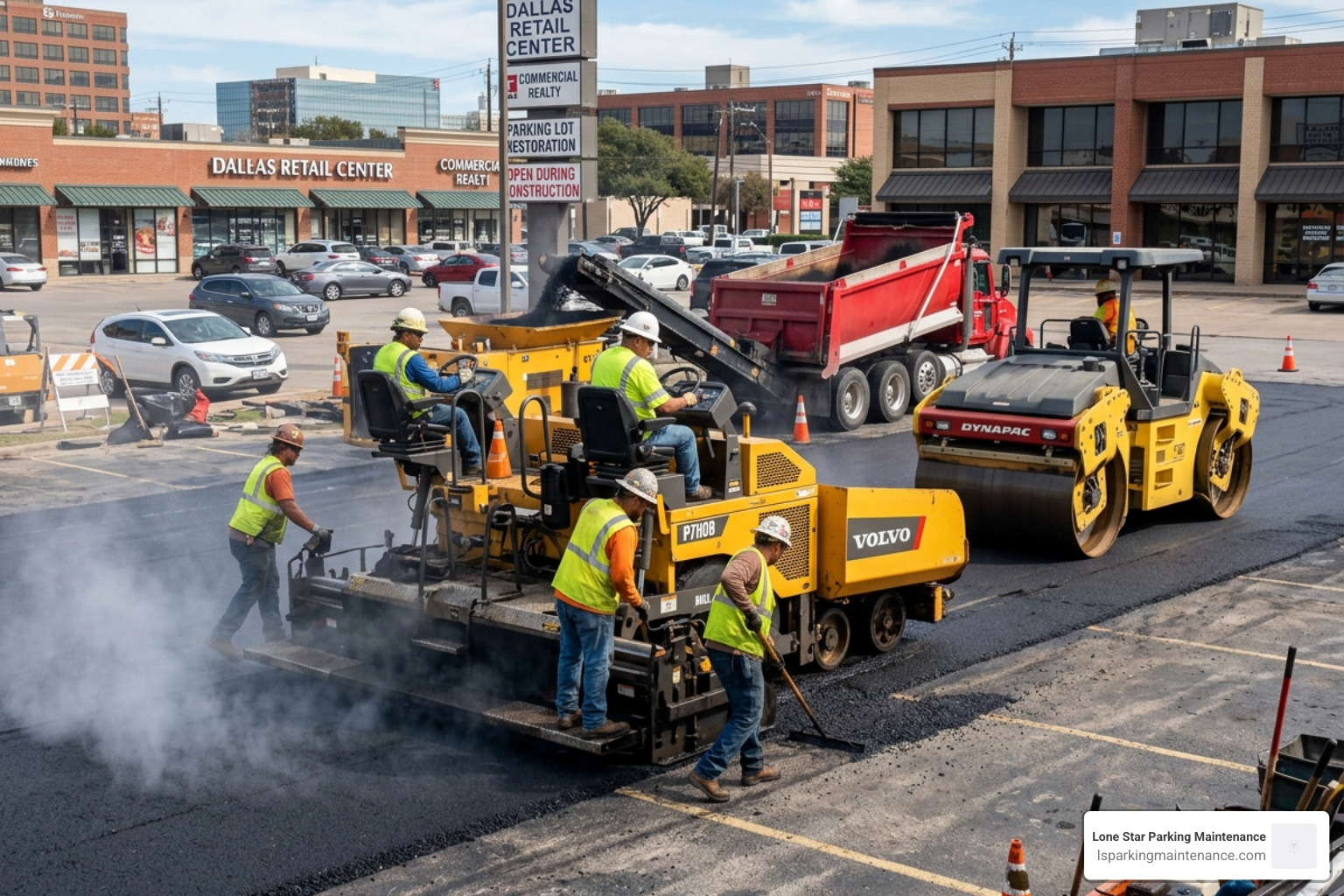
When we talk about overlay asphalt repairs DFW businesses need, we are describing a specific pavement restoration technique. Instead of digging up the entire parking lot or driveway, we apply a fresh “skin” of hot-mix asphalt over the existing surface. This new layer is typically between 1.5 to 2 inches thick.
Think of it as a structural facelift. We aren’t just making the lot look dark and new again; we are adding a protective layer that binds to the old surface, sealing up minor imperfections and providing a smooth, durable driving area. In the industry, this is often called “resurfacing.”
Understanding the Difference Between Overlay and Full Replacement
The biggest question we get is: “Why can’t I just overlay everything?” The answer lies in the structural integrity of your sub-base.
A full-depth replacement involves excavating the asphalt and the gravel base underneath. This is a massive undertaking that can take weeks and costs significantly more. In contrast, an overlay preserves the existing foundation. Because we aren’t hauling away tons of base material and starting from scratch, an overlay is typically 30–40% less expensive than a full replacement.
Furthermore, the speed of installation is a game-changer for DFW businesses. While a full tear-out might shutter your storefront for a week or more, we can often complete an overlay in just one or two days.
Why Milling is Essential for Overlay Asphalt Repairs DFW
You might have seen large machines “chewing” up the top layer of a road before a paving crew arrives. That’s milling, and it’s a critical step in a professional overlay.
Milling involves removing the top 1 to 3 inches of the existing asphalt surface. Why do we do this instead of just paving right over the top?
- Elevation Maintenance: If we keep adding layers of asphalt, the parking lot eventually becomes higher than the curbs, sidewalks, and drainage grates. This creates massive tripping hazards and “lip” issues.
- Drainage Slopes: Milling allows us to re-establish the proper “fall” or slope of the lot so water flows toward the drains rather than pooling in the middle of your driving lanes.
- Better Bonding: A milled surface is rough and clean, which provides a much better “grip” for the new asphalt to bond to, preventing the layers from separating later.
When is an Asphalt Overlay the Right Choice?
Choosing the right repair method is about timing. If you wait too long, the damage penetrates the base, and an overlay won’t save you. If you act early, you can save thousands of dollars.
Signs Your Pavement Needs an Overlay
We generally recommend an overlay for pavements that are less than 20 years old and show “superficial” damage. This includes:
- Fading and Oxidation: When your asphalt turns from black to a dull grey, it has lost its flexible oils and is becoming brittle.
- Minor Cracking: Small cracks (less than a quarter-inch wide) that haven’t yet turned into structural “alligator” patterns.
- Raveling: When the tiny stones in the asphalt start to come loose, making the surface feel like sandpaper.
- Aesthetic Decline: If your business depends on curb appeal, a fresh overlay provides that “brand new” look that attracts customers.
As a rule of thumb, if the visible damage affects less than 30% of the total surface area and the ground underneath feels solid, you are a prime candidate for an overlay.
Identifying Structural Failures and Base Issues
Sometimes, an overlay is just a “band-aid on a broken leg.” We won’t recommend an overlay if we see signs of base failure. If the foundation is shifting or water has saturated the soil underneath, the new asphalt will crack in the exact same spots within months. This is called “reflection cracking.”
Signs that you need a full replacement or deep base repair instead of a simple overlay include:
- Alligator Cracking: Interconnected cracks that look like the scales of an alligator. This is a tell-tale sign of a failed foundation.
- Deep Potholes: If the holes are deep enough to show the gravel base or dirt underneath.
- Subterranean Issues: Collapsed drainpipes or underground springs that cause the pavement to sink.
- Shifting Soil: Common in North Texas, our expansive clay soils can cause the ground to heave, requiring more than just a surface fix.
The Step-by-Step Process of Overlay Asphalt Repairs DFW
A successful overlay isn’t just “dump and roll.” It requires a meticulous process to ensure the new layer sticks and lasts for a decade or more.
The Role of Base Repair in Successful Projects
Before the new asphalt goes down, we have to fix the “weak spots.” If there is a specific area with a pothole or a soft spot, we perform a base repair. This might involve pulverizing the existing damaged asphalt, adding new aggregate layers, and stabilizing the ground. By fixing these isolated “hot spots” first, we ensure the overlay has a uniform, strong platform to sit on. This prevents those localized failures from ruining your new surface.
The Installation Workflow
- Cleaning: We use industrial blowers and sweepers to remove every bit of dust and debris. Asphalt won’t stick to dirt.
- Tack Coat: This is the “glue.” We spray a liquid asphalt emulsion over the old surface. This is non-negotiable for a long-lasting bond.
- Hot-Mix Installation: We lay the new asphalt at temperatures between 275°F and 300°F.
- Compaction: While the mix is still hot, heavy rollers compact the asphalt to the correct density. This removes air pockets and makes the surface water-resistant.
- Quality Check: We verify the drainage and the “tie-ins” (where the new asphalt meets the concrete or existing roads).
Minimizing Business Disruption During Installation
We know that a closed parking lot means lost revenue. That’s why we specialize in rapid turnaround. Most overlay asphalt repairs DFW projects can be completed in 1–2 days.
To keep your business running, we often use “phased scheduling.” We might pave the back half of your lot on Monday and the front half on Tuesday, ensuring your customers always have a place to park. While you can usually walk on the new surface within 24 hours, we recommend keeping heavy truck traffic off for 48-72 hours to allow the mix to fully cure and harden.
Costs, Lifespan, and Maintenance in the North Texas Climate
In the DFW Metroplex, our asphalt has to survive 100-degree summers and sudden ice storms. This extreme temperature swing causes asphalt to expand and contract, which is why professional installation is so important.
How Much Does it Cost?
On average, an asphalt overlay in Dallas-Fort Worth costs between $3 to $7 per square foot. This price includes the cleaning, minor repairs, materials, and labor. Factors that can push the price toward the higher end include:
- The need for extensive milling.
- The number of “tie-ins” to existing concrete.
- The complexity of the lot (lots of curves or tight corners).
- Current oil prices (since asphalt is a petroleum product).
How Long Does a DFW Asphalt Overlay Last?
With proper care, a commercial overlay in North Texas typically lasts 8 to 15 years. In high-traffic areas like shopping centers or warehouse loading docks, you might see a lifespan closer to 10 years. In quieter office parks, it can easily push past 15.
The “silent killer” of DFW asphalt is UV exposure. The Texas sun bakes the oils out of the pavement, making it brittle. This is why maintenance is the secret to getting your money’s worth.
Essential Maintenance to Extend Pavement Life
You wouldn’t buy a new car and never change the oil, right? Your new overlay needs similar attention:
- Sealcoating: We recommend applying a sealcoat about 12 months after your overlay, and then every 3-4 years after that. This acts like sunblock for your parking lot.
- Crack Sealing: If you see a small crack, seal it immediately. This prevents water from getting under the new overlay and freezing, which is what causes potholes.
- Routine Inspections: A quick walk-through once a year can catch minor issues before they become $10,000 problems.
Frequently Asked Questions about DFW Asphalt Overlays
How much does an asphalt overlay cost in Dallas-Fort Worth?
Most property owners should budget between $3 and $7 per square foot. For a standard 10,000-square-foot lot, you’re looking at an investment of roughly $30,000 to $70,000, which is significantly cheaper than the $100,000+ required for a full reconstruction.
Can an overlay fix deep potholes or foundation shifts?
No. An overlay is a surface treatment. If you have deep foundation shifts or “sinkholes,” we must perform a “cut and patch” repair to fix the base before the overlay is applied. If we just pave over a shifting foundation, the new surface will crack within a single season.
How does the DFW climate impact the need for asphalt overlays?
The North Texas climate is particularly harsh on asphalt. Our intense heat causes “thermal expansion,” and our heavy spring rains can seep into tiny cracks. This cycle of expanding, contracting, and water intrusion makes regular resurfacing a necessity for DFW property owners who want to avoid total pavement failure.
Conclusion
Investing in overlay asphalt repairs DFW is a smart move for any property manager looking to balance budget with long-term durability. By choosing an overlay, you extend the life of your pavement by a decade or more, improve safety for your visitors, and dramatically boost your property’s curb appeal.
At Lone Star Parking Maintenance, we are committed to providing the DFW Metroplex with top-quality materials and professional service that meets the highest industry standards. Whether you manage a small retail lot in Plano or a massive industrial facility in Fort Worth, we prioritize your safety and satisfaction.
Don’t wait until a small crack becomes a major liability. Request a quote for professional DFW pavement maintenance today, and let us help you protect your investment with a smooth, durable surface that lasts.