
What Does Sealcoating Actually Cost? Here’s the Quick Answer
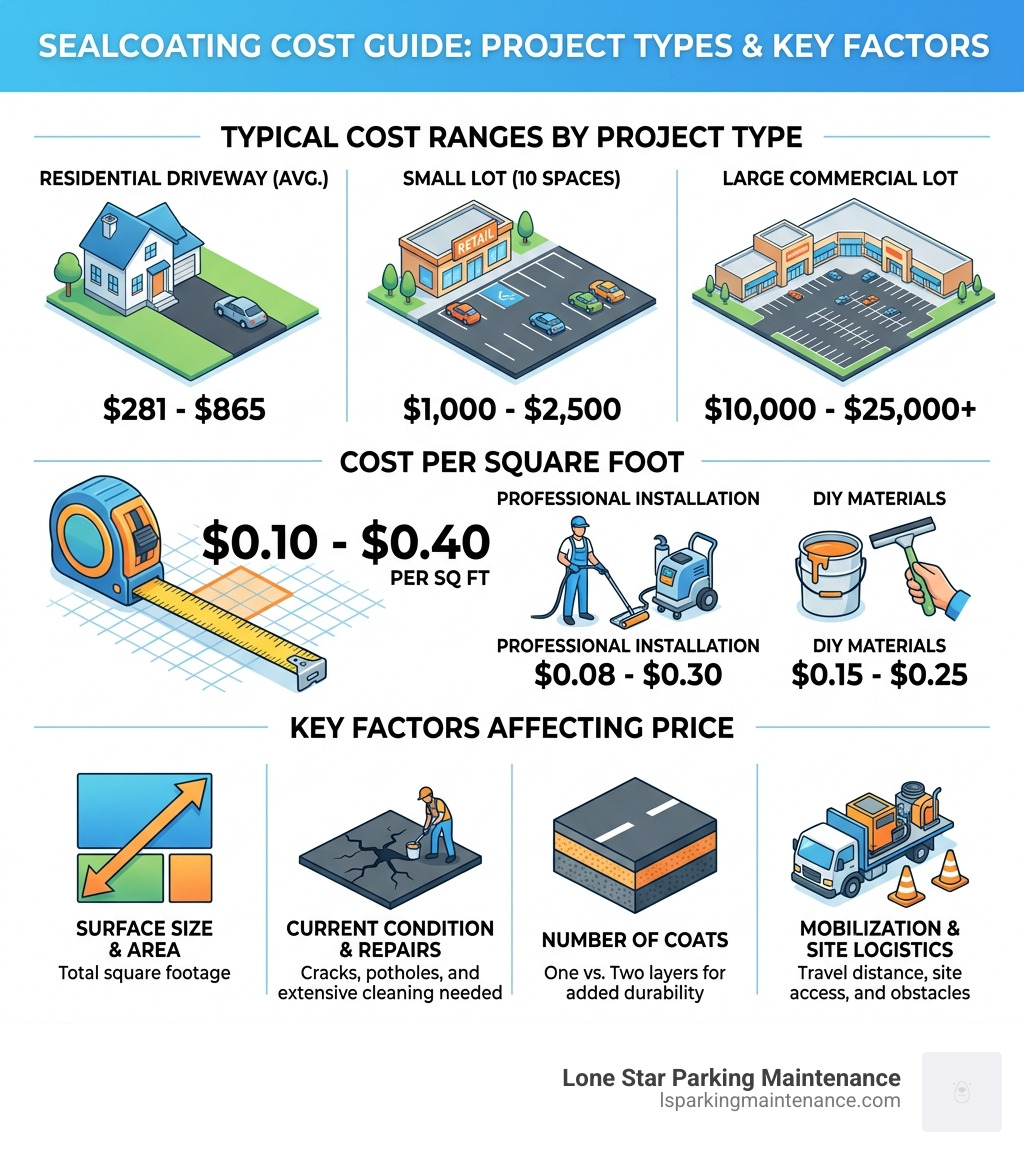
Sealcoating cost typically runs between $0.10 and $0.40 per square foot, depending on your surface size, location, and material type. Here’s a fast breakdown:
| Project Type | Typical Cost Range |
|---|---|
| Residential driveway (avg.) | $281 – $865 |
| Per square foot (professional) | $0.08 – $0.30 |
| Per square foot (DIY materials) | $0.15 – $0.25 |
| Commercial parking lot | $0.10 – $0.22 per sq ft |
| Small lot (10 spaces) | ~$1,000 – $2,500 |
| Large commercial lot | $10,000 – $25,000+ |
For most DFW property managers and business owners, a professionally sealed parking lot or driveway lands somewhere between a few hundred and a few thousand dollars — a fraction of what repaving costs.
Here’s the thing: the cost of not sealcoating is almost always higher than the cost of doing it.
Unsealed asphalt lasts around 12 years under normal conditions. With regular sealcoating every 2 to 3 years, that same surface can last up to 36 years. A $300 sealcoat job today can prevent a $5,000 repaving bill a few years from now.
Sealcoating protects against UV rays, oxidation, water penetration, oil spills, and the kind of heat stress the Texas sun delivers every summer. It also turns faded, cracked gray pavement back into clean, fresh-looking blacktop — which matters a lot when your parking lot is the first thing customers see.
This guide breaks down every cost factor so you can plan your budget with confidence.
Breaking Down the Sealcoating Cost Per Square Foot
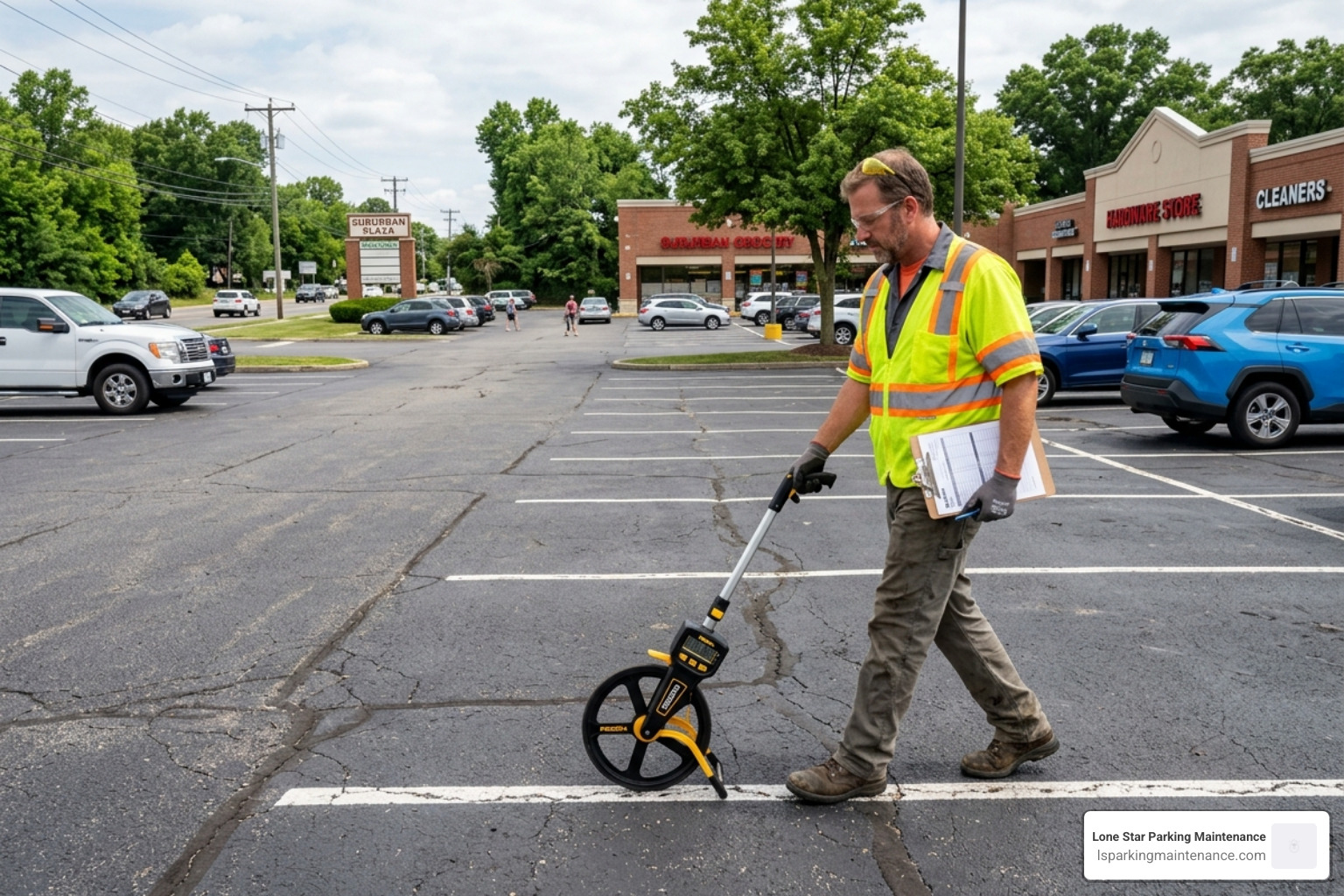
When we talk about sealcoating cost, the most accurate way to measure it is by the square foot. This allows us to account for the massive difference between a small suburban driveway and a sprawling retail parking lot in the DFW Metroplex.
On average, professional sealcoating ranges from $0.08 to $0.30 per square foot for the application itself. However, the “all-in” price often fluctuates based on the total area. For example, a larger commercial project might see a lower price per square foot because the fixed costs—like moving equipment to the site (mobilization)—are spread across a bigger surface.
In Texas, we see a wide range of pricing. While national averages sit around $500 to $600 for residential jobs, a comprehensive Texas project can range from $940 to $3,950 depending on the complexity and local labor rates. We always recommend looking at the Parking Lot Seal Coating Costs for Asphalt : 2025 Pricing Guide to see how these commercial scales tip the scales on pricing.
Residential Driveway Sealcoating Cost
For the average homeowner, a residential driveway (typically around 600 to 1,000 square feet) will cost about $570 on average. We generally see quotes ranging from $281 to $865.
If you are looking at it from a material-only perspective, you might pay between $0.15 and $0.25 per square foot, but this doesn’t include the specialized tools or the back-breaking labor required to get a smooth, professional finish. A standard two-car driveway (roughly 400-600 square feet) can often be sealed for $100 to $280 for the sealant alone, but adding professional labor and prep work can bring that total closer to the $500 mark.
Why spend this money every few years? It’s about more than just looks. More info about why sealing is important highlights how this thin protective layer—about the thickness of a credit card—acts as a sacrificial barrier, taking the hit from the sun and rain so your expensive asphalt doesn’t have to.
Commercial Parking Lot Sealcoating Cost
Commercial projects are a different beast entirely. We typically price these between $0.10 and $0.22 per square foot. While the rate is lower than residential, the total investment is higher because of the sheer volume of material needed and the logistical challenges of keeping a business open during the process.
For a small commercial lot with about 10 to 30 spaces, you can expect to pay between $1,000 and $2,500. For larger facilities, like shopping centers or office complexes with 200+ spaces, the cost can easily exceed $10,000. These projects often require high-traffic durability additives and multiple coats to withstand the constant turning of heavy vehicles.
The type of sealant used also plays a role here. More info about sealant types explains why we choose specific industrial-grade products for commercial lots compared to what you might find at a big-box home improvement store.
Key Factors Influencing Your Total Investment
No two asphalt surfaces are identical, which is why a “flat rate” rarely works in our industry. Several variables can push your sealcoating cost up or down.
- Surface Condition: If your asphalt is “gray and thirsty,” it will soak up more sealant, requiring more material. If it’s riddled with cracks, those need to be addressed first.
- Number of Coats: While one coat is sometimes sufficient for low-traffic residential areas, two coats are the industry standard for durability, especially in the harsh Texas heat.
- Mobilization: This is the cost of getting the crew, the trucks, and the materials to your location. For very small jobs, we often have to charge a minimum fee to cover these expenses.
- Accessibility: Is the lot easy to get to? Are there lots of islands, curbs, or tight corners that require hand-brushing instead of a spray application? Irregular shapes take more time and, therefore, more labor.
For a deeper dive into these variables, check out How Much Does It Cost to Seal an Asphalt Driveway? [2026 Data].
Preparation and Repair Expenses
You can’t just pour sealant over a dirty or broken driveway and expect it to stick. Preparation is often the most time-consuming part of the job.
- Cleaning: We use high-powered blowers and sometimes professional power washing to remove dirt and debris. Professional power washing can cost between $0.27 and $0.39 per square foot.
- Oil Spot Priming: Asphalt is petroleum-based. If you have oil or gas leaks from cars, the new sealer won’t bond to those spots. We have to treat them with a specialized primer first.
- Crack Filling: This is the most critical prep step. More info about crack filling benefits shows how filling cracks prevents water from reaching the base layer of your pavement. If you’re wondering if your lot is ready, More info about identifying crack filling needs can help you spot the warning signs.
Material Selection and Quality
The “juice” you choose matters. Not all sealants are created equal, and the price reflects that.
- Asphalt Emulsion: The most common choice in the DFW area. It’s eco-friendly, has low VOCs, and provides a deep black finish. Costs around $0.08 to $0.10 per square foot for the material.
- Coal Tar: Historically popular for its resistance to oil spills, but it’s being phased out or banned in many areas due to health and environmental concerns. It’s generally the cheapest option.
- Latex Acrylic: A premium option that dries fast and lasts a long time. It can cost $0.20 to $0.25 per square foot but is excellent for high-traffic or damaged surfaces.
- Eco-Friendly Sealants: Products like BioSealCoat are non-toxic and have the lowest environmental impact, though they come with a higher upfront cost (around $0.38 per square foot).
Typically, one gallon of sealcoat covers 80 to 100 square feet. When buying in bulk, a 5-gallon bucket will cover roughly 400 to 500 square feet.
DIY vs. Professional Sealcoating: Which Saves More?
It’s the age-old question: “Can I just do this myself and save some cash?” The short answer is yes, you can save on labor, but you might lose on quality and longevity.
Professional labor for sealcoating averages about $1.15 per square foot. While that might seem high, it includes the expertise of a crew that knows how to handle the materials and the specialized equipment needed for an even coat. More info about professional sealing services details the difference between a DIY bucket-and-squeegee job and a professional industrial spray application.
The True Cost of DIY
If you decide to go the DIY route, your primary sealcoating cost will be materials and your own time. Expect to spend about $150 to $200 on tools alone, excluding the sealant.
Here is a quick list of what you’ll need to buy or rent:
- High-pressure washer (Rental: $50–$120/day)
- Stiff-bristle asphalt broom or squeegee
- Large mixing stick or industrial drill mixer
- Oil spot primer
- Crack filler and a pour pot
- The sealant itself (multiple 5-gallon buckets)
- Safety gear (gloves, old boots, eye protection)
The biggest risk with DIY is application thickness. If you apply it too thin, it won’t protect the asphalt. If you apply it too thick, it will crack and peel (a process called “alligatoring”). Professionals use pressurized spray systems that ensure an even, optimal coat every time.
Professional Advantages and Profitability
Hiring a professional team like us provides a level of “set it and forget it” peace of mind. Professional sealcoaters can earn an average of $125 per hour, which reflects the efficiency and quality of the work.
The long-term ROI of hiring a pro is significant. Because we use industrial-grade materials that aren’t usually available at retail stores, the seal lasts longer. A DIY job might need to be redone every year, whereas a professional application in the DFW area typically lasts 2 to 3 years. When you factor in the cost of your own time—often 8 to 12 hours for a standard driveway—the “savings” of DIY start to disappear. Plus, most professionals offer a warranty on their work, something you won’t get if you do it yourself!
Maximizing Your Investment: When and Why to Sealcoat
In the DFW Metroplex, our asphalt takes a beating. The intense Texas sun causes “oxidation,” which is a fancy way of saying the sun bakes the oils out of the asphalt. This makes the pavement brittle, gray, and prone to cracking.
Sealcoating is essentially sunscreen for your pavement. It locks in those vital oils and provides a waterproof seal. Regular maintenance can extend the life of your pavement by 3 times, taking a surface that would normally fail in 12 years and pushing its lifespan to 36 years. More info about how long sealing lasts explains the variables that affect this timeline, such as traffic volume and weather.
Best Timing and Weather Conditions
Timing is everything. For the sealant to bond correctly, the temperature needs to be at least 50°F and rising. In North Texas, our best windows are usually during the spring and fall.
- Temperature: Ideally between 50°F and 90°F.
- Rain: We need a clear 24-hour window after application. If it rains before the sealer cures, it can wash the material right off the lot and into the drains—a costly and messy mistake.
- Curing Time: You should stay off the surface for at least 24 to 48 hours. For commercial lots, we often phase the work over weekends or nights to minimize the impact on your business.
- New Asphalt: If you just had new asphalt laid, wait at least 6 to 12 months before sealing. The new pavement needs time to “cure” and allow its initial oils to evaporate.
Signs Your Asphalt Needs Attention
How do you know it’s time to budget for that sealcoating cost? Your pavement will tell you.
- Color Change: If your once-black pavement is now a light, chalky gray, the oxidation process is well underway.
- Hairline Cracks: Small, “spiderweb” cracks are the first sign of structural stress. Sealing now can stop them from turning into potholes.
- Water Penetration: If water is soaking into the asphalt rather than beading up and running off, your protective layer is gone.
- Raveling: This is when the tiny stones in the asphalt start to come loose and create a “sandy” feel on the surface.
We recommend a maintenance cycle of every 2 to 3 years for most DFW properties to keep the surface in peak condition.
Frequently Asked Questions about Sealcoating Costs
How much does it cost to seal a 1,000 sq ft driveway?
On average, a 1,000-square-foot driveway will cost about $569 for a professional application. This includes basic cleaning, minor crack filling, and one to two coats of high-quality sealant. If the driveway is in poor condition or requires extensive repairs, that price can climb toward $1,150.
Does the number of coats double the price?
Not exactly. While a second coat does require more material, the “mobilization” and “preparation” costs are already covered in the first coat. Adding a second coat usually adds about 30% to 50% to the total project cost, rather than doubling it. For high-traffic areas, that extra investment is well worth it for the added durability.
Is sealcoating cheaper than repaving?
Absolutely. Sealcoating costs roughly $0.15 to $0.25 per square foot, while repaving (asphalt overlay) can cost $2.00 to $5.00 per square foot or more. In fact, sealcoating is generally less than one-tenth the cost of a full repave. It is the most cost-effective maintenance tool in your arsenal.
Conclusion
Investing in your asphalt today is the smartest way to avoid massive expenses tomorrow. Whether you are managing a commercial facility in Dallas or maintaining a residential driveway in Fort Worth, understanding the sealcoating cost helps you make an informed decision for your property.
At Lone Star Parking Maintenance, we pride ourselves on using top-quality materials and sticking to the highest industry standards. We understand the unique challenges of the DFW Metroplex climate and are committed to safety and customer satisfaction on every job.
Don’t wait until those tiny cracks turn into expensive potholes. Seal the deal on your asphalt maintenance today and let us help you protect your investment for decades to come.