
What ADA Compliance for Parking Lots Actually Requires
ADA compliance for parking lots is a federal legal requirement that affects nearly every commercial property, government facility, and public accommodation in the United States — including businesses across the DFW Metroplex.
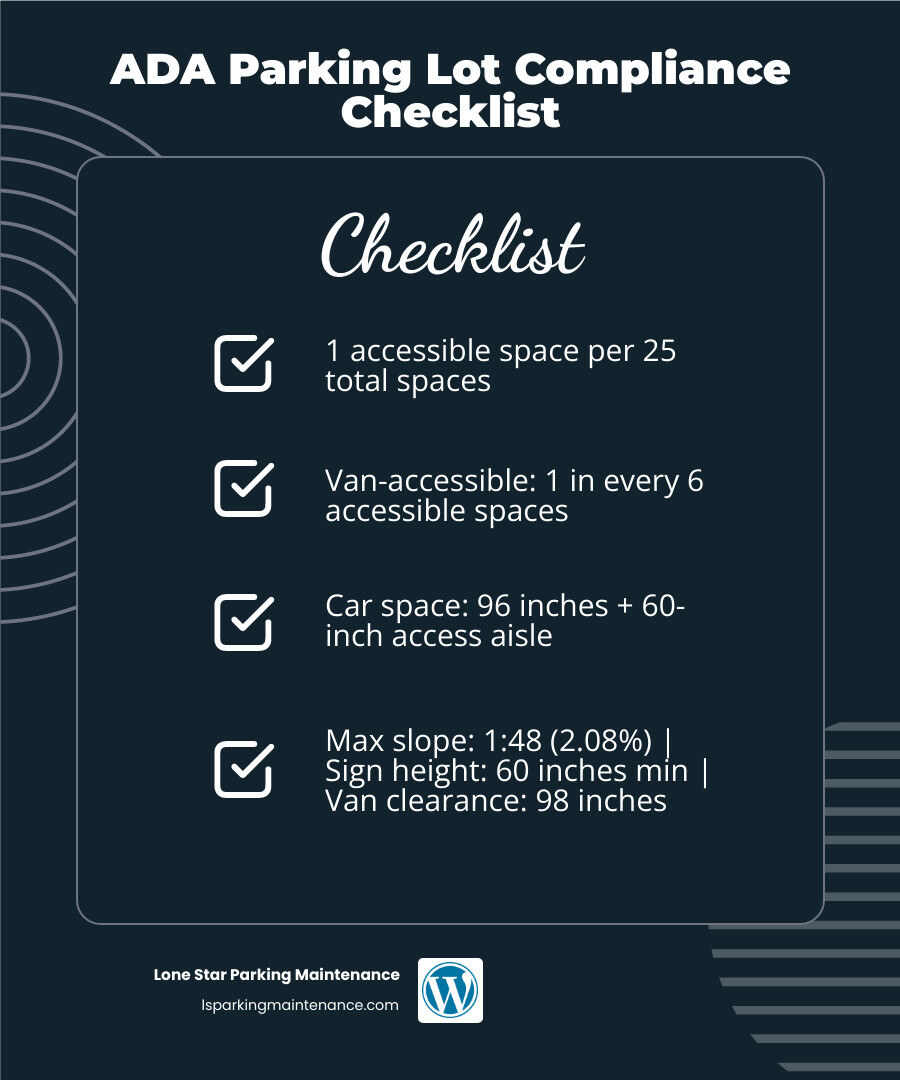
Here’s a quick overview of what’s required:
| Requirement | Key Standard |
|---|---|
| Accessible spaces | Based on total lot size (1 per 25 spaces as a general rule) |
| Van-accessible spaces | At least 1 in every 6 accessible spaces |
| Space width (car) | Minimum 96 inches + 60-inch access aisle |
| Space width (van) | 132 inches + 60-inch aisle, OR 96 inches + 96-inch aisle |
| Surface slope | Maximum 1:48 (2.08%) in all directions |
| Sign height | At least 60 inches above ground (to bottom of sign) |
| Vertical clearance (van) | Minimum 98 inches |
| Enforcement | U.S. Department of Justice (DOJ) |
| First violation fine | Up to $75,000 |
The Americans with Disabilities Act was signed into law in 1990. It guarantees people with disabilities equal access to public life. For parking lots, the rules are spelled out in the 2010 ADA Standards for Accessible Design, which set the current minimum requirements for everything from space dimensions to signage height.
Title III of the ADA covers private businesses open to the public — restaurants, retail stores, medical offices, gyms, and more. Title II covers state and local government facilities. If your property has a parking lot and serves the public, these rules almost certainly apply to you.
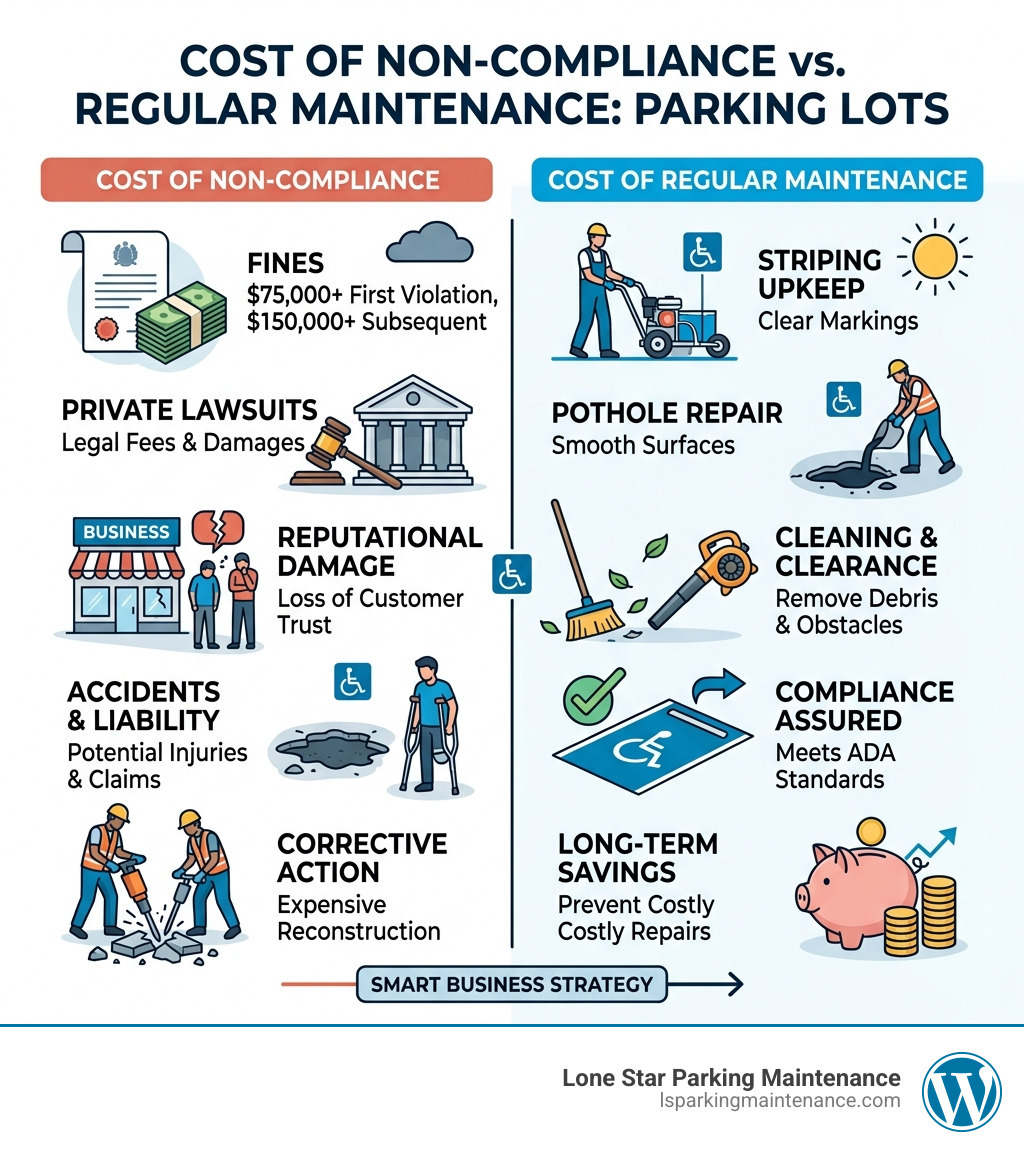
The stakes are real. Non-compliance can mean DOJ fines starting at $75,000 for a first violation, rising to $150,000 for repeat violations — plus exposure to individual and class-action lawsuits.
The good news? Most of the requirements come down to proper striping, correct dimensions, and the right signage. It’s very manageable when you know exactly what to do.
Understanding the Basics of ADA Compliance for Parking Lots
Navigating federal regulations can feel like trying to drive through Dallas during rush hour—confusing and potentially stressful. However, understanding ada compliance for parking lots starts with knowing which rules apply to you. The primary authority is the U.S. Department of Justice (DOJ), which enforces the ADA.
While the ADA is a federal law, here in the DFW Metroplex, we also have to keep an eye on the TEXAS ACCESSIBILITY STANDARDS (TAS). Often, state and local building codes can be even stricter than federal ones. If there is a difference between the two, you must follow the one that provides the most access for individuals with disabilities.
Two main “Titles” of the ADA affect our local properties:
- Title II: Applies to state and local government entities (like city halls or public parks).
- Title III: Applies to public accommodations and commercial facilities (like your favorite BBQ joint, a retail center, or a private office building).
The goal of these regulations is simple: ensure that every person, regardless of mobility, has a clear and safe path from their vehicle to your front door. For more detailed technical reading, you can always check out the official Accessible Parking Spaces | ADA.gov resource.
Calculating Required Spaces for ADA Compliance for Parking Lots
You can’t just pick a lucky number for your accessible spaces. The ADA uses a “scoping table” to determine exactly how many spots you need based on the total number of parking spaces in each facility. It is important to note that you must calculate the requirements for each parking lot or garage separately, rather than totaling all spaces on a site.
Here is the general breakdown for standard commercial lots:
| Total Parking Spaces in Lot | Minimum Number of Accessible Spaces |
|---|---|
| 1 to 25 | 1 |
| 26 to 50 | 2 |
| 51 to 75 | 3 |
| 76 to 100 | 4 |
| 101 to 150 | 5 |
| 151 to 200 | 6 |
| 201 to 300 | 7 |
| 301 to 400 | 8 |
| 401 to 500 | 9 |
| 501 to 1,000 | 2% of total |
| 1,001 and over | 20, plus 1 for every 100 over 1,000 |
The Van-Accessible Ratio: Out of these accessible spaces, at least one in every six must be van-accessible. If your lot is small and only requires one accessible space, that single space must be van-accessible.
Special Requirements for Medical and Residential Facilities
If you manage a healthcare facility or a residential complex in North Texas, the math changes. These facilities often require a higher percentage of accessible parking because their visitors are more likely to need them.
- Hospital Outpatient Facilities: 10% of patient and visitor parking must be accessible.
- Rehabilitation Centers and Physical Therapy Facilities: 20% of patient and visitor parking must be accessible. This is because these facilities specifically serve people with mobility impairments.
- Residential Facilities: For apartment complexes, at least 2% of the parking spaces provided for residents must be accessible. If you provide visitor parking, that follows the standard scoping table above.
Technical Dimensions and Surface Requirements

When it comes to ada compliance for parking lots, size definitely matters. A space that is too narrow prevents a person using a wheelchair from safely exiting their vehicle. We follow the The Essential Guide to ADA Compliant Parking Lot Striping to ensure every line we paint is exactly where it needs to be.
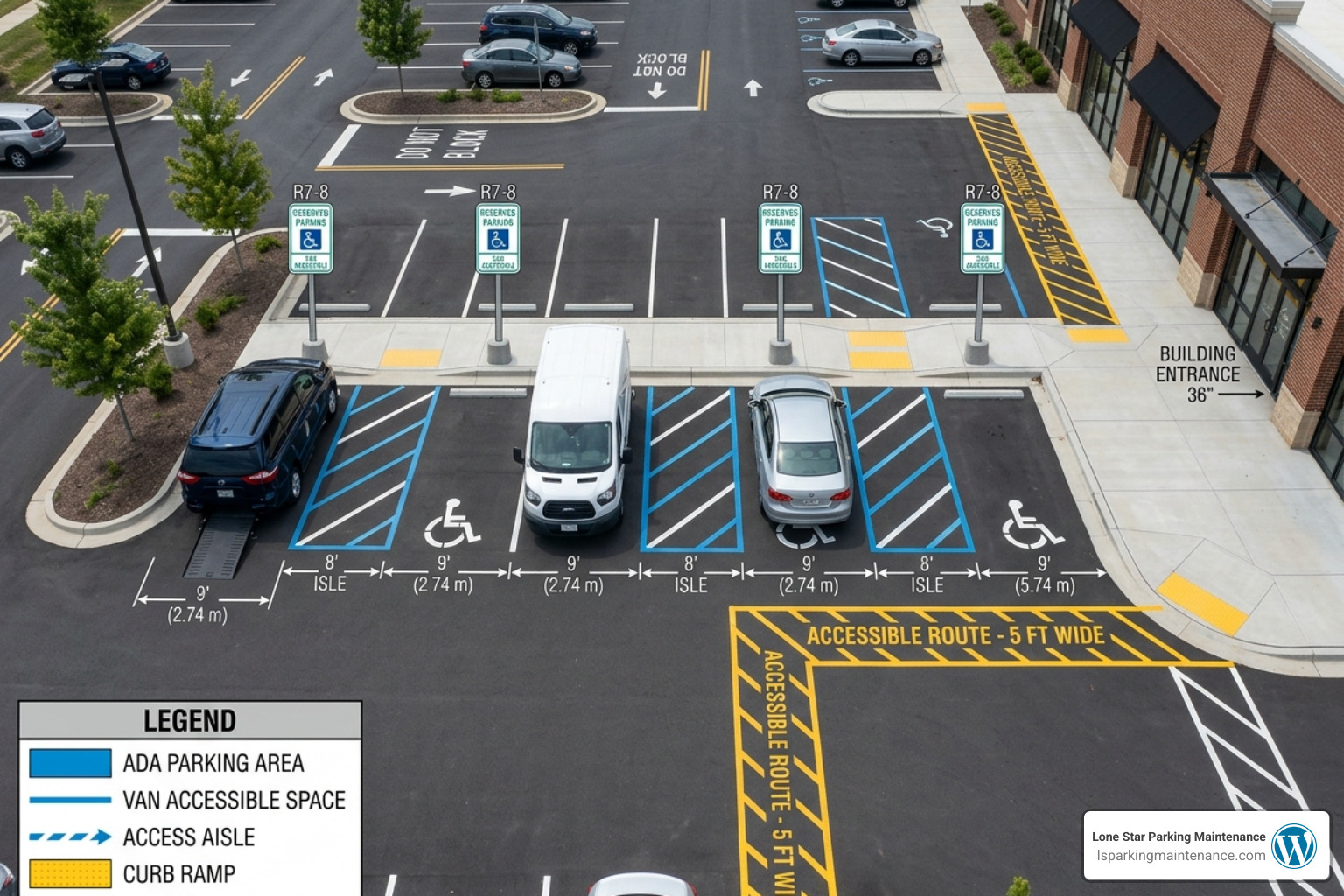
Car-Accessible Spaces: These must be at least 96 inches (8 feet) wide. They must also have an adjacent access aisle that is at least 60 inches (5 feet) wide.
Van-Accessible Spaces: Vans need more room for side-mounted lifts. You have two options here:
- Option A: A space at least 132 inches (11 feet) wide with a 60-inch (5-foot) access aisle.
- Option B: A space at least 96 inches (8 feet) wide with a wider 96-inch (8-foot) access aisle.
Most property owners prefer Option B because it allows two spaces to share one large 8-foot access aisle, which saves valuable real estate in the lot.
Surface Conditions and Slope Standards
A parking space can be the perfect width, but if it’s built on a steep hill or covered in loose gravel, it’s useless to someone in a wheelchair. The ADA requires that all accessible spaces and access aisles be “firm, stable, and slip-resistant.”
- The 1:48 Rule: The slope of an accessible space and its access aisle cannot exceed 1:48 (about 2.08%) in any direction. This ensures that a wheelchair won’t roll away while the user is trying to get in or out of the car.
- Level Surfaces: There should be no changes in level greater than 1/4 inch. If a lot is unpaved (like a temporary grass or dirt lot for a DFW event), the surface must still be firm and stable enough to support a wheelchair without it sinking.
Vertical Clearance and Accessible Routes
Van-accessible spaces aren’t just about width; they’re also about height. Vans with lifts or raised roofs need a minimum of 98 inches of vertical clearance. This clearance must extend from the entrance of the parking facility, along the vehicular route, to the parking space, and all the way to the exit.
Once the driver is out of the car, they need a clear “accessible route” to the building.
- Width: The route must be at least 36 inches wide.
- Ramps: If there’s a curb, you need a ramp. The maximum slope for these ramps is 1:12.
- Shortest Path: The accessible spaces must be located on the shortest accessible route to the building’s entrance.
If you’re worried your current layout doesn’t meet these marks, check out More info about parking lot striping services for how we can help reconfigure your lot.
Signage and Strategic Location Standards
Signage is the most visible part of ada compliance for parking lots. Without it, non-disabled drivers might take up the spots your customers need. Under the ADA Compliance Brief: Restriping Parking Spaces | ADA.gov guidelines, every accessible space (with a few exceptions for very small lots) must be identified by a sign showing the International Symbol of Accessibility (ISA).
Mounting Heights and Visibility
The height of the sign is critical. If it’s too low, a parked SUV will hide it from other drivers.
- 60-Inch Minimum: Signs must be mounted so that the bottom edge of the sign is at least 60 inches (5 feet) above the ground.
- Van Designation: Van-accessible spaces must have an additional sign or “van accessible” text added to the ISA sign.
- Surface Decals: While we often paint the ISA symbol on the pavement (it looks great and helps with visibility!), the ADA says pavement decals cannot replace the required post-mounted or wall-mounted signs.
Strategic Placement Near Entrances
You can’t just stick the accessible spots in the back corner of the lot to keep them out of the way. They must be placed on the shortest travel distance to the accessible entrance.
- Multiple Entrances: If your building has multiple accessible entrances (like a large retail mall in Frisco or Plano), the accessible spaces must be dispersed among those entrances.
- Garages: In multi-level parking structures, you can cluster van-accessible spaces on one level to accommodate the 98-inch vertical clearance requirement, provided they still lead to an accessible entrance.
- User Convenience: Safety and security are key. These spots should be well-lit and located where users don’t have to travel behind parked cars if possible.
Rules for Existing Lots and Restriping
If your building was built in the 1970s, you aren’t off the hook. The ADA requires businesses to remove architectural barriers in existing facilities when it is “readily achievable.” This means if a change is easily accomplishable without much difficulty or expense, you have to do it.
The Restriping Trigger: Restriping a parking lot is considered one of the most “readily achievable” actions a business can take. Because the cost of paint and labor is relatively low compared to major construction, the DOJ expects you to bring your lot into compliance with the 2010 Standards every time you Parking Lot Striping.
Safe Harbor Provision: If you brought your lot into full compliance with the older 1991 ADA Standards before March 15, 2012, you may not have to upgrade to the 2010 Standards immediately. This is called “Safe Harbor.” However, as soon as you perform an “alteration” (like resurfacing or resealing), you must move to the 2010 Standards.
Maintenance and ADA Compliance for Parking Lots
Compliance isn’t a “one and done” task. You have a continuing obligation to maintain your accessible features.
- Pothole Repair: A deep pothole in an access aisle can be a major hazard for someone using a walker or cane.
- Clearance: In the rare event of a North Texas ice storm or heavy leaf fall, you must clear snow, ice, and debris from accessible spaces and routes.
- Striping Upkeep: Faded lines lead to confusion and blocked access. Regular maintenance ensures your lot remains safe and legally compliant.
For those managing commercial properties, we also recommend checking More info about fire lane maintenance to ensure your emergency access is as clear as your disability access.
Penalties and Enforcement Mechanisms
We hate to be the bearer of bad news, but the “sweat” in “breaking a sweat” usually comes from the fines. The Department of Justice takes these rules seriously.
- Fines: Civil penalties can reach $75,000 for a first violation and $150,000 for subsequent ones.
- Lawsuits: Beyond government fines, businesses are vulnerable to private lawsuits. In many cases, “drive-by” lawsuits occur where individuals identify non-compliant lots and file claims immediately.
- Audits: Professional compliance audits are the best way to catch errors before a process server shows up at your door.
Frequently Asked Questions
Are there exceptions for small parking lots?
Yes, but only for signage. If your parking lot has four or fewer total spaces, you still must provide a van-accessible space with the correct dimensions and a level surface. However, you are not required to post a sign identifying the space as reserved. This allows small businesses to remain accessible without losing a designated spot if no one with a disability is currently using it.
Does restriping a lot trigger full ADA compliance?
Absolutely. As we mentioned earlier, the DOJ considers restriping an “alteration” and a “readily achievable” barrier removal. When you lay down new paint, you are legally required to follow the 2010 Standards for the number of spaces, their dimensions, and their location.
What is the difference between car and van accessible spaces?
The main difference is width and clearance. While a car space is 8 feet wide with a 5-foot aisle, a van space needs either a wider 11-foot space or a wider 8-foot aisle to accommodate wheelchair lifts. Van spaces also require 98 inches of vertical overhead room, whereas car spaces do not have a federal height requirement (though local codes may vary).
Conclusion
Mastering ada compliance for parking lots doesn’t have to be a headache. By focusing on accurate calculations, precise striping dimensions, and high-visibility signage, you create a welcoming environment for all customers while protecting your business from costly legal trouble.
At Lone Star Parking Maintenance, we’ve spent years helping property managers across the DFW Metroplex navigate these standards. Whether you need a fresh coat of paint, a new set of signs, or a complete lot reconfiguration to meet the 2010 Standards, we’re here to help. We use top-quality materials and adhere to the strictest industry standards to ensure your lot is safe, durable, and fully compliant.
Master your property’s accessibility with Lone Star Parking Maintenance today and let us take the “sweat” out of your next maintenance project!