
Strategic Planning for Commercial Parking Lot Design
When we sit down to begin a commercial parking lot design project in the DFW Metroplex, we don’t just start painting lines. Effective design begins with a “big picture” strategy. You have to account for the physical characteristics of the land, the weight of the vehicles that will traverse it, and the legal framework of the local municipality.
Initial planning involves a careful balance of three factors: safety, convenience, and cost-effectiveness. For instance, a retail center in Plano has very different needs than a distribution warehouse in Fort Worth. A retail lot needs high turnover and easy pedestrian access, while an industrial lot needs thick pavement and wide turning radii for 80,000-pound semi-trucks.
Key factors we consider during the planning phase include:
- Traffic Volume: How many cars will enter and exit during peak hours?
- Vehicle Types: Are we designing for compact cars, SUVs, or heavy-duty delivery trucks?
- Entry and Exit Points: These must be placed far enough from busy intersections to prevent traffic backing up into the street.
- Soil Subgrade: In North Texas, our expansive clay soils can be a nightmare for pavement. Testing the soil strength is non-negotiable.
For a deeper dive into the architectural side of things, check out this resource on How to Design a Commercial Parking Lot.
Conducting a Thorough Site Analysis and Survey
Before the first bulldozer moves a clod of dirt, a comprehensive site analysis is required. This isn’t just about measuring the perimeter; it’s about understanding the “personality” of the land.
We look at topography to see how water will naturally flow. If the lot is too flat, water sits and rots the asphalt; if it’s too steep, you create a slip hazard for pedestrians. We also locate all underground utilities—water, gas, electric, and fiber optics—to ensure our grading won’t cause a neighborhood-wide blackout.
Geological constraints and environmental regulations also play a role. If there are protected trees or specific runoff requirements, these must be integrated into the site plan from day one to avoid “surprises” during the permitting phase.
Navigating Local Zoning and Permitting Requirements
Every city in the DFW Metroplex has its own “rulebook” for commercial parking lot design. Ignoring these is a recipe for expensive fines and construction delays.
Zoning ordinances typically dictate:
- Setback Lines: How far the pavement must be from the property line (often 30 feet from a street right-of-way).
- Landscaping Percentages: Most ordinances require at least 1% to 2%, though we recommend 10% for a professional look.
- Capacity Limits: Some cities mandate a minimum number of spots based on your building’s square footage (e.g., one spot per 200–300 square feet of retail).
- Stormwater Permits: You must prove that your new lot won’t flood the neighbor’s property.
Optimizing Stall Angles and Traffic Flow Efficiency
Efficiency is the name of the game. A well-designed layout maximizes the number of cars you can fit while making it easy for drivers to find a spot without getting frustrated. We generally recommend rectangular layouts with rows parallel to the longest side of the lot. This configuration minimizes “dead space” and keeps traffic moving in a predictable pattern.
| Feature | 45-Degree Angle | 60-Degree Angle | 90-Degree (Perpendicular) |
|---|---|---|---|
| Space Efficiency | Moderate | High | Highest |
| Ease of Entry | Easiest | Easy | Difficult |
| Aisle Type | One-Way | One-Way/Two-Way | Two-Way |
| Aisle Width | 10–12 Feet | 14–18 Feet | 24 Feet |
| Best Use | High Turnover | General Retail | All-Day/Employee |
Maximizing Capacity with 90-Degree Commercial Parking Lot Design
If your goal is to fit the maximum number of cars into a tight space—such as an employee lot for a corporate headquarters—90-degree (perpendicular) parking is usually the winner.
Standard dimensions for these stalls are typically 9 feet wide by 18 or 19 feet long. Because drivers have to make a sharp turn to enter these spots, you need wider traffic lanes—usually 24 feet for two-way traffic. This allows two SUVs to pass each other safely while a third vehicle is backing out. To keep these spots looking sharp and organized, professional Parking Lot Striping is essential.
Enhancing Turnover with Angled Commercial Parking Lot Design
For “in-and-out” businesses like convenience stores, banks, or fast-food restaurants, angled parking (45 or 60 degrees) is often superior.
Angled stalls are much easier to pull into, which reduces the time a driver spends idling in the aisle. This creates a “one-way” flow, which is inherently safer because it eliminates the risk of head-on collisions in the aisles. One-way lanes for angled parking can be as narrow as 10 to 12 feet, which can actually save space in some lot configurations despite the stalls themselves being “longer” on the diagonal.
Engineering for Durability: Pavement, Drainage, and ADA Standards
A parking lot is only as good as what’s underneath it. We’ve seen plenty of lots in Dallas that look great for six months, then turn into a topographical map of the moon because the subgrade wasn’t compacted correctly.
For longevity, the subgrade must be compacted to 95% of its maximum density. On top of that, we place an aggregate base (at least 4 inches thick). The asphalt thickness itself depends on the load. While 3 to 4 inches might work for a church parking lot, a loading dock area needs 6 to 8 inches of full-depth asphalt to prevent rutting. For more on heavy-duty specs, see these Truck Parking Lot Design Standards.
Implementing Effective Drainage Systems
Water is the “arch-nemesis” of asphalt. When water seeps into the base, it softens the ground, leading to potholes and “alligator cracking.”
A proper commercial parking lot design must include a minimum slope of 2% (or 1/4 inch per foot). This ensures water moves toward catch basins or bioswales rather than pooling in the middle of a driving lane. If your lot currently has “birdbaths” (standing water), you likely need Parking Lot Sealing and Crack Filling to prevent further structural damage.
Meeting Federal and Local Accessibility Requirements
ADA (Americans with Disabilities Act) compliance isn’t a suggestion—it’s federal law. In Texas, the penalties for non-compliance are steep, and the requirements are very specific.
Accessible stalls must:
- Be located on the shortest accessible route to the building entrance.
- Feature a 60-inch (5-foot) wide access aisle for cars, or a 96-inch (8-foot) aisle for vans.
- Be marked with the international symbol of accessibility (the blue wheelchair logo).
- Have a “level” surface (slopes no steeper than 1:48 in any direction).
For a complete breakdown, read The Essential Guide to ADA Compliant Parking Lot Striping.
Integrating Safety and Aesthetics: Lighting, Signage, and Landscaping
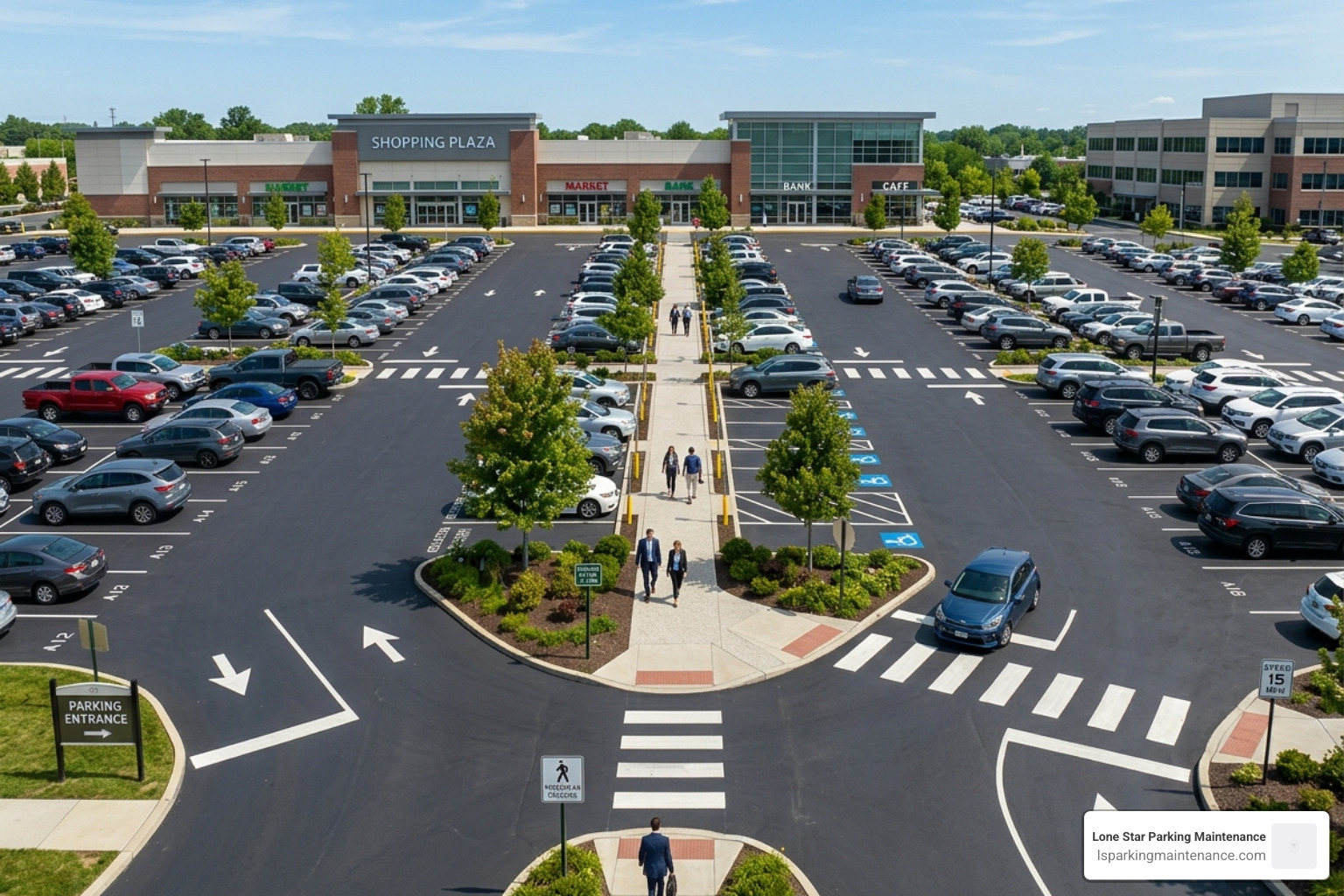
Once the structural engineering is settled, we focus on the “user experience.” A lot that feels safe and looks attractive will naturally draw more customers.
Landscaping isn’t just for show; it can be used to guide traffic and break up “seas of asphalt.” We recommend native Texas plants like Oregon Grape or Salal, which can handle our summer heat without needing constant watering. Tree-planting strips should be at least 5 feet wide to allow for healthy root growth without buckling the nearby pavement.
Enhancing Security with Modern Lighting Solutions
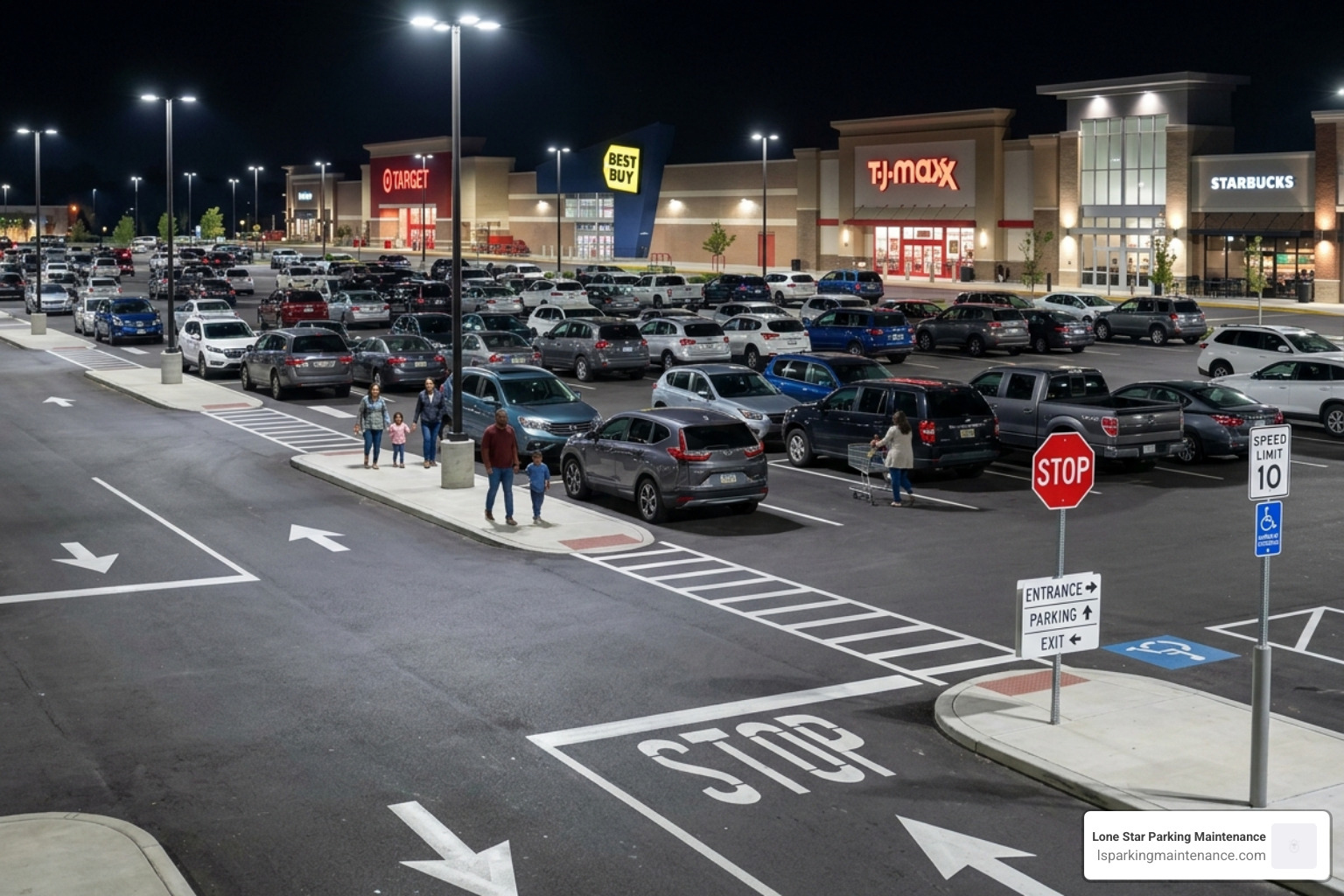
Nothing says “stay away” like a dark, flickering parking lot. Good lighting is a major crime deterrent and a massive liability reducer.
We advocate for LED fixtures for three reasons: they use less energy, they last longer, and they provide “uniform coverage.” You want a light level of 1 to 5 foot-candles across the lot, ensuring there are no dark corners where someone could trip or a vehicle could be broken into. To minimize “light pollution” for nearby residential neighbors, we use shielded fixtures that aim the light downward. Learn more about our Parking Lot Lighting services.
Improving Wayfinding through Strategic Signage and Striping
Wayfinding is the art of telling people where to go without them having to ask. This includes directional arrows painted on the ground, stop signs at intersections, and clearly marked Fire Lanes.
We also use physical “traffic calmers” like speed bumps and bollards to protect pedestrians and building facades. To keep your poles and curbs looking fresh (and to prevent bumper damage), we offer Protective Pole Covers and Curb Stop Installation.
Future-Proofing with Modern Technology and Sustainable Features
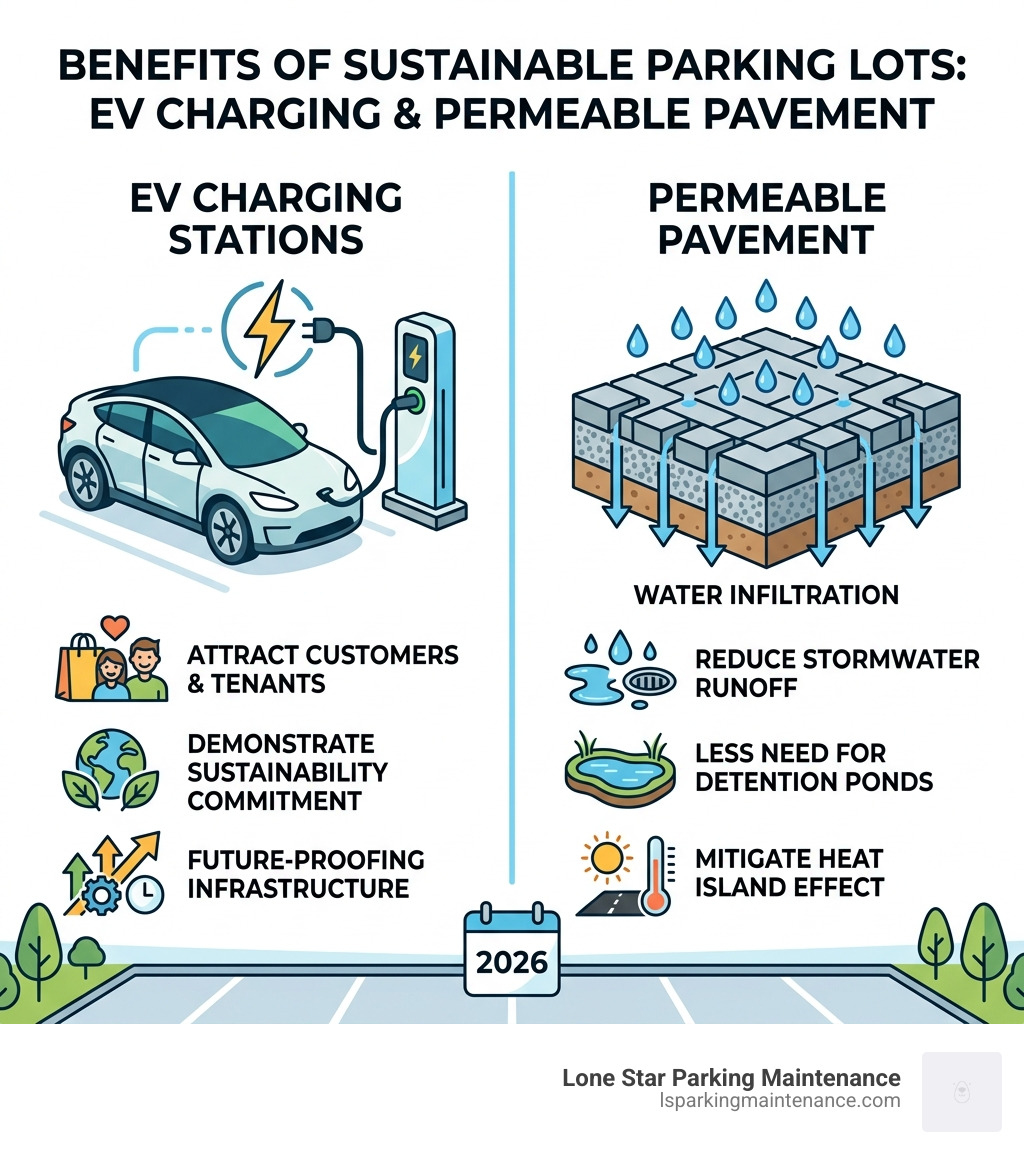
The “parking lot of the future” is already here. If you’re designing a lot today in the DFW area, you have to think about the next 10 to 20 years.
- EV Charging Stations: With electric vehicle adoption skyrocketing, having dedicated charging stalls is a huge draw for high-end tenants and customers.
- Permeable Pavers: These allow water to soak directly into the ground, reducing the need for expensive detention ponds.
- Smart Sensors: These can tell customers exactly how many spots are open via a mobile app, reducing frustration and circling.
- Heat Island Mitigation: Using lighter-colored concrete or reflective coatings can keep your lot significantly cooler during a Texas August.
Frequently Asked Questions about Commercial Parking Lot Design
What is the standard size for a commercial parking stall?
In most commercial applications, a standard 90-degree parking stall is 9 feet wide by 18 or 19 feet long. If you are trying to maximize space in a lot that serves mostly small vehicles, you can designate a section for “Compact” cars, which are typically 7.5 feet wide by 15 feet long.
How many ADA spaces are required for a large lot?
The number of required accessible spaces depends on the total number of spots in your lot.
- 1 to 25 spots: 1 space
- 301 to 400 spots: 8 spaces
- 501 to 1000 spots: 2% of the total
- 1000+ spots: 20 spaces, plus 1 for every 100 spaces over 1000.
What is the best slope for effective drainage?
We recommend a minimum slope of 2% (which is a 1/4-inch drop for every foot of distance). This is the “sweet spot” that allows water to move quickly enough to prevent pooling but remains flat enough to be safe for wheelchairs and pedestrians.
Conclusion
Mastering commercial parking lot design is about more than just pouring asphalt and painting lines; it’s about creating a safe, durable, and welcoming entrance for your business. Whether you are building from scratch or redesigning an existing facility in the DFW Metroplex, every detail—from the subgrade compaction to the brightness of your LED lights—affects your bottom line.
At Lone Star Parking Maintenance, we specialize in the entire lifecycle of your parking facility. We understand the unique challenges of Texas soil and the strict local codes of our North Texas cities. From professional striping and safety signage to long-term sealing and repairs, we are committed to keeping your lot safe, compliant, and looking its absolute best.
Don’t let a poorly designed lot drive customers away. Request a consultation for parking lot services today, and let us help you master the art of the perfect layout.