
Why Your Parking Lot Is Costing You More Than It Should
LED upgrades parking lots are one of the fastest ways to cut operating costs, improve safety, and boost your property’s curb appeal — all at the same time.
Here’s a quick summary of the key benefits:
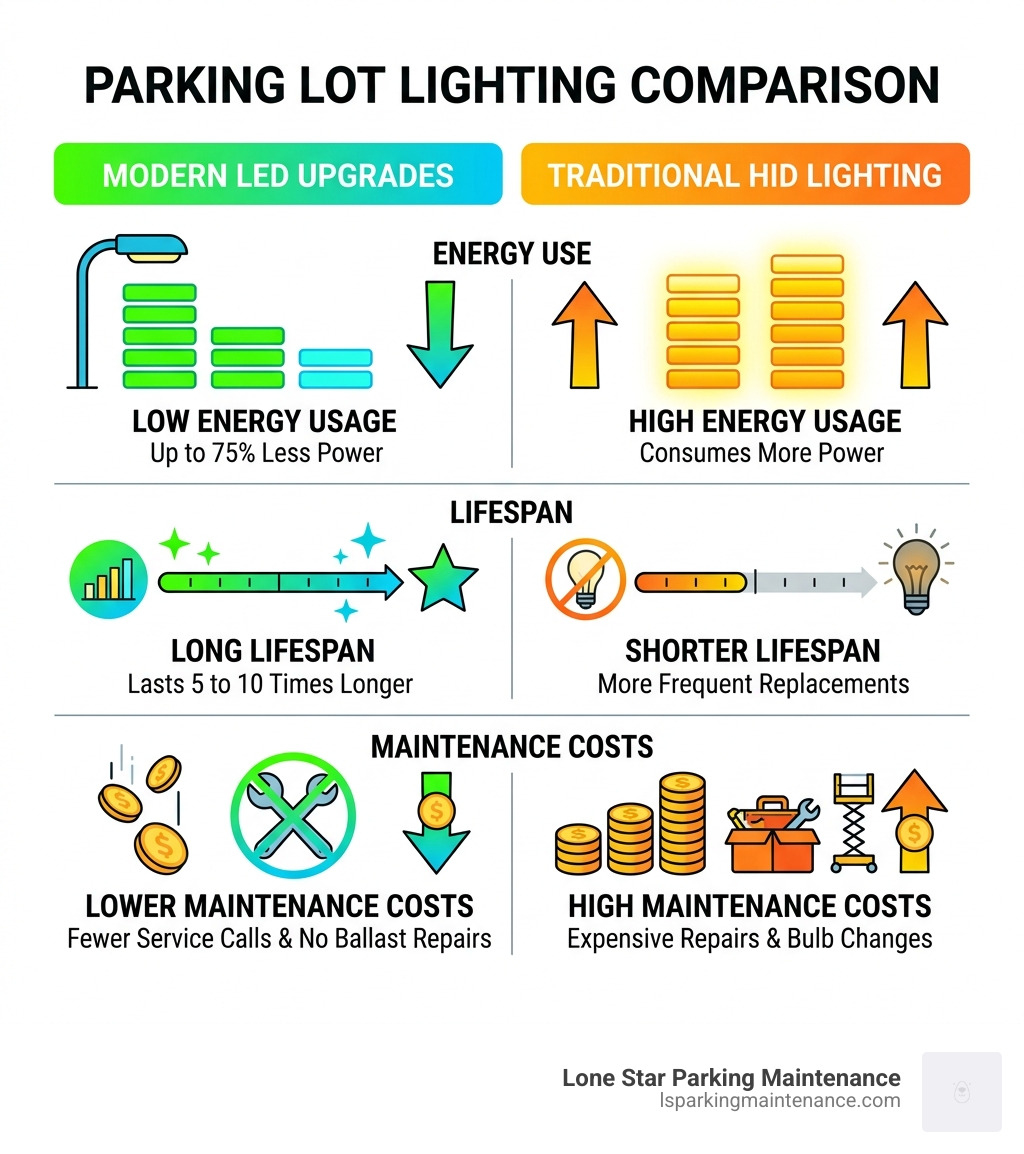
- Energy savings: LEDs use up to 75% less energy than traditional metal halide (MH) or high-pressure sodium (HPS) fixtures
- Longer lifespan: Quality LED fixtures last 50,000 to 100,000 hours — 5 to 10 times longer than conventional bulbs
- Lower maintenance costs: No ballasts to replace, fewer service calls, and no expensive lift rentals just to swap a bulb
- Better visibility: Uniform, shadow-free light improves safety for drivers and pedestrians alike
- Faster ROI: Many properties see payback periods of just 2 to 5 years, with utility rebates cutting upfront costs even further
If your DFW parking lot still runs on aging HID fixtures, you’re paying a steep and unnecessary premium every single month.
Traditional parking lot lighting can use up to three times more energy than LED alternatives. And when those old bulbs start dimming — which HPS and MH lamps do halfway through their lifespan — you’re paying full price for half the light.
The good news? The technology to fix all of this is proven, widely available, and more affordable than most property managers expect.
Why LED Upgrades for Parking Lots are the Smartest Business Move
When we talk to property managers across the DFW Metroplex, the conversation usually starts with the electric bill. But LED upgrades parking lots offer so much more than just a lower monthly payment. It is about transforming a liability—an expensive, dim, high-maintenance lighting system—into a high-performing asset.
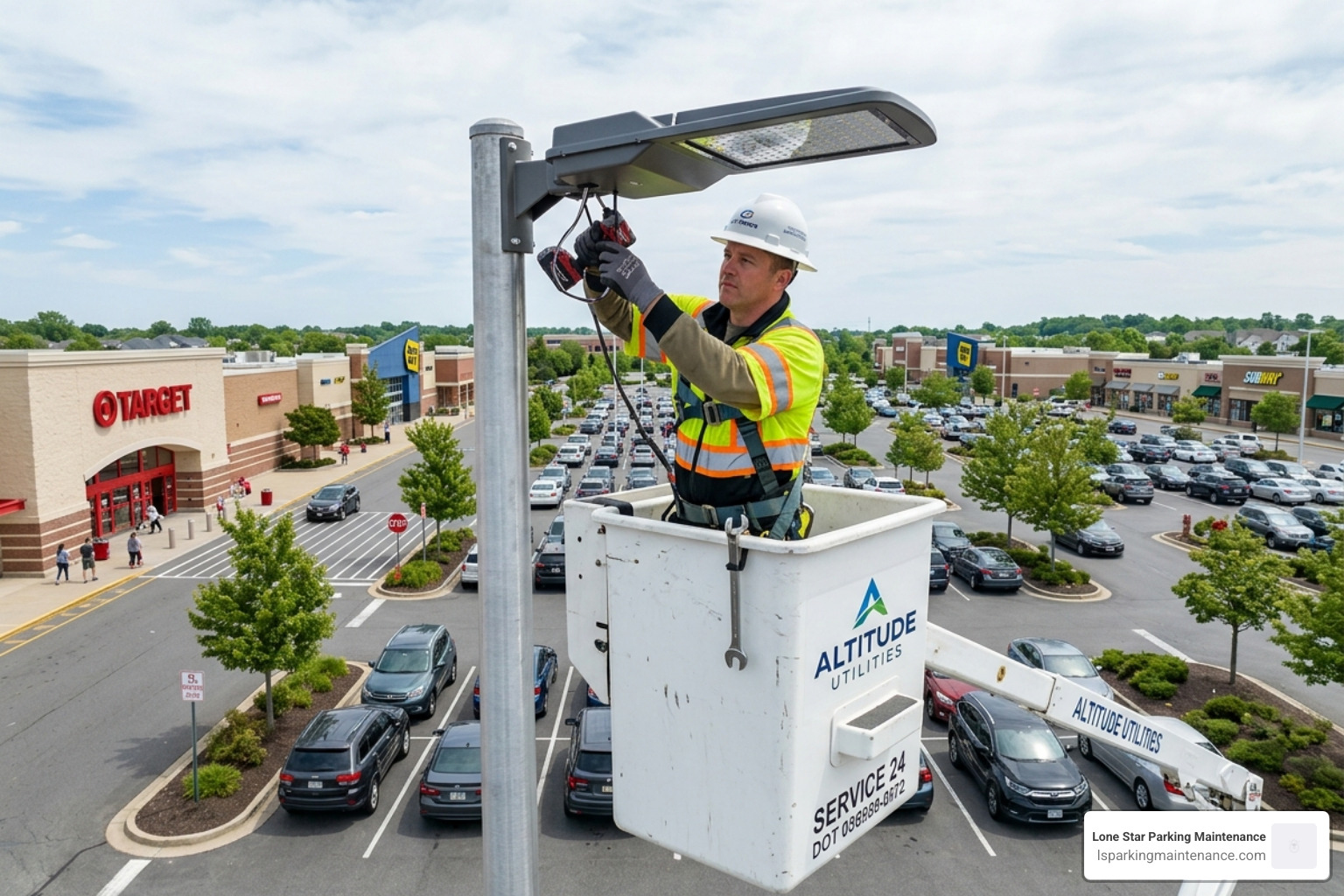
Think about the last time you saw a technician in a bucket truck working on your lot. Between the labor, the lift rental, and the cost of specialized bulbs and ballasts, a single repair can easily cost more than a brand-new LED fixture. By switching to LED, you effectively delete those recurring headaches from your calendar.
For a deeper dive into the logistics of a transition, check out this Parking Lot Lighting Upgrade Guide | HyLite LED Lighting.
Maximizing Safety with LED Upgrades for Parking Lots
Safety is the number one priority for any facility manager. A dimly lit parking lot is an invitation for trouble, whether it’s a trip-and-fall accident or something more serious. Traditional High-Intensity Discharge (HID) lights often create “pools” of light directly under the pole, leaving dangerous dark spots in between.
Our Parking Lot Lighting services focus on creating uniform illumination. LEDs are directional, meaning we can aim the light exactly where it needs to go. This eliminates shadows and glare, making it much easier for drivers to see pedestrians and for pedestrians to feel secure. Furthermore, the high quality of LED light improves facial recognition on security footage—a massive win for loss prevention and site security.
Long-Term Savings from LED Upgrades for Parking Lots
If you like keeping your money rather than handing it over to the utility company, you’ll love LEDs. You can Switch To LED Parking Lot Lights | National LED and see an immediate energy cut of up to 75%.
Traditional 400W metal halide bulbs actually draw about 458W when you factor in the ballast. A 150W LED fixture can produce the same (or better) amount of usable light. Over a year of “dusk-to-dawn” operation, those savings add up to thousands of dollars. Plus, because LEDs don’t use ballasts—the component most likely to fail in an old fixture—your operational costs for repairs drop to nearly zero. With a 100,000-hour lifespan, you could go over 20 years without needing to touch that light again.
Choosing the Right LED Parking Lot Lights: Technical Specifications
Choosing a light isn’t just about picking the highest wattage anymore. In LED upgrades parking lots, we look at “lumens per watt.” Modern LEDs are incredibly efficient, often delivering 130 to 165 lumens for every watt consumed.
| Feature | LED Fixture | Metal Halide (MH) | High-Pressure Sodium (HPS) |
|---|---|---|---|
| Energy Use | Low (100W-300W) | High (400W-1000W) | High (400W-1000W) |
| Lifespan | 50k – 100k Hours | 10k – 20k Hours | 12k – 24k Hours |
| Color Quality | Excellent (CRI 70-80+) | Fair (CRI 60) | Poor (CRI 20-30) |
| Light Loss | Minimal over time | Loses 50% quickly | Significant dimming |
| Instant On? | Yes | No (Warm-up time) | No (Warm-up time) |
When selecting your color temperature (measured in Kelvin), 5000K is the “gold standard” for DFW parking lots. It provides a crisp, cool white light that mimics daylight, keeping people alert and improving visibility. If your lot is adjacent to a residential area, we might suggest 3000K or 4000K to reduce glare and keep the neighbors happy.
Understanding Beam Angles and Light Distribution
Not all light is thrown in the same direction. The industry uses IESNA standards to describe how light spreads:
- Type III-M: This is the most common for parking lots. It’s a “forward throw” pattern meant to be mounted on the perimeter to push light out into the driving lanes.
- Type V-VS: This provides a circular or square pattern of light all around the pole. It’s perfect for poles located in the middle of a large lot.
Getting this right is the difference between a lot that feels like a professional stadium and one that feels like a patchwork quilt of bright and dark spots.
Smart Controls and Energy-Saving Features
Why pay for 100% brightness at 3:00 AM when the lot is empty? Modern LED systems allow for incredible control. When clients ask What types of parking lot lights do you install?, we often talk about integrated smart features:
- Photocells: These “dusk-to-dawn” sensors ensure lights only turn on when it’s actually dark.
- Motion Sensors: These can dim the lights to 20% when no movement is detected and ramp them up to 100% instantly when a car or person enters the area.
- Timers and Dimmers: Fully programmable schedules to match your business hours.
Retrofit Kits vs. Full Fixture Replacement: Which is Right for You?
This is the big question: do you swap the whole “shoebox” fixture, or just the guts inside? Parking Lot Lights Retrofit Kits are a fantastic option if your existing light housings are in great shape and you want to save on installation costs.
A retrofit kit involves removing the old bulb and ballast and mounting a new LED plate and driver inside the existing shell. It’s fast, keeps the aesthetic of your poles the same, and is generally the most budget-friendly way to get into the LED game.
When to Choose a Full LED Fixture Upgrade
Sometimes, the old fixtures are just too far gone. If your current housings are cracked, leaking, or rusted, a retrofit is just putting a band-aid on a bigger problem.
When you ask Can you help with parking lot lighting installation?, we evaluate the structural integrity of your setup. A full fixture replacement gives you a brand-new, IP65-rated (waterproof and dustproof) unit. These modern fixtures are sleek, aerodynamic (which helps during Texas windstorms), and often come with better warranties than retrofit kits.
Common Mistakes to Avoid During Installation
We’ve seen plenty of “DIY” lighting jobs gone wrong. One of the biggest mistakes is failing to perform a ballast bypass. LED lights run on direct line voltage; if you try to run them through an old HID ballast, you’ll fry the new light instantly.
Another critical step is adding surge protection. Texas weather is famous for lightning and power surges. While many LEDs have internal protection, adding a secondary 20kA surge protector can save your entire investment from a single storm. You can find high-quality components like the LED Retrofit Kit, Replaces Metal Halide Bulbs, Up to 20,000 Lumen that are designed for these exact challenges.
Calculating Your ROI: Energy Savings and Rebates
Let’s talk numbers. The Return on Investment (ROI) for LED upgrades parking lots is usually one of the best in the commercial world.
In the DFW area, utility providers often offer substantial rebates for switching to DLC (DesignLights Consortium) Premium-listed fixtures. These rebates can sometimes cover up to 30-50% of your project costs! Additionally, federal incentives like the 179D tax deduction allow for accelerated depreciation on energy-efficient building improvements. When you combine energy savings (75%), maintenance savings (90%), and upfront rebates, many of our clients see the project pay for itself in under 36 months.
Maintenance Savings and Reduced Service Calls
If you’re wondering How often should parking lot lights be maintained?, the answer for HID lights is “too often.” Metal halide bulbs lose half their brightness halfway through their life, meaning you have to replace them long before they actually burn out if you want to keep your lot safe.
With LEDs, you stop paying for:
- Bucket truck rentals: These can cost hundreds of dollars per day.
- Frequent labor: No more paying a tech to climb a pole every 12 months.
- Disposal fees: Traditional bulbs contain mercury and require special (expensive) recycling. LEDs are mercury-free and much more eco-friendly.
Frequently Asked Questions about LED Parking Lot Lighting
How long do LED parking lot lights actually last?
Most high-quality LEDs are rated for 50,000 to 100,000 hours. To put that in perspective, if your lights run 12 hours a night, 100,000 hours is about 22 years of service. Look for the “L70” rating—this tells you how long the light will run before it drops to 70% of its original brightness. Unlike HID bulbs that dim quickly, LEDs stay bright for almost their entire life.
What should I do if I notice a problem with my parking lot lighting?
If you see flickering or a light that has gone completely dark, it’s usually a sign of a driver failure or a loose connection. You should check What should I do if I notice a problem with my parking lot lighting? for immediate steps. We recommend a professional inspection to ensure the issue isn’t a larger electrical surge problem that could damage other fixtures on the circuit.
Are LED lights better for security cameras?
Absolutely. Traditional HPS lights have a very low Color Rendering Index (CRI), which makes everything look orange or gray. LEDs typically have a CRI of 80 or higher. This means colors appear vibrant and accurate. If a crime occurs, your security cameras will clearly show the color of a suspect’s shirt or the exact shade of a getaway car, rather than a grainy, monochromatic blur.
Conclusion
At Lone Star Parking Maintenance, we know that your parking lot is the first thing your customers see and the last thing your employees experience at the end of the day. Providing a safe, bright, and modern environment isn’t just a luxury—it’s a standard for doing business in the DFW Metroplex.
By investing in LED upgrades parking lots, you aren’t just buying new lights; you’re buying peace of mind, improved safety, and a significant boost to your bottom line. Whether you need a simple retrofit or a complete system overhaul, we are committed to top-quality materials and your total satisfaction.
Don’t leave your safety and your budget in the dark. Contact us for professional parking lot lighting services today, and let’s brighten up your business together.