
Why Compliant Safety Line Striping Is Critical for High-Traffic Zones
Compliant safety line striping is the foundation of a safe, organized, and legally sound facility — whether you manage a warehouse, parking lot, or industrial space in the DFW Metroplex.
Here are the best products for compliant safety line striping, ranked by application:
| Product Type | Best For | Lifespan |
|---|---|---|
| Water-based acrylic paint | Parking lots, light traffic | 3-5 years |
| Two-part epoxy | Warehouses, forklift traffic | 5-10 years |
| Thermoplastic | High-traffic roads, heavy use | 10+ years |
| PVC hazard tape | Indoor floors, quick installs | 1-3 years |
Faded or missing lines aren’t just an eyesore. OSHA regulation §1910.176(a) requires permanent aisles and passageways to be clearly marked in any facility using mechanical handling equipment — and violations can mean serious citations and penalties.
For parking lots, the FHWA updated its pavement marking rules in 2022, requiring minimum retroreflectivity levels so markings stay visible at night and in wet conditions.
The bottom line: the wrong product — or no product at all — puts people at risk and your business on the hook.
Understanding Regulations for Compliant Safety Line Striping
Navigating safety regulations can feel like trying to drive through DFW traffic during a thunderstorm—confusing and a bit stressful. However, when it comes to compliant safety line striping, two major regulatory bodies set the pace: OSHA (Occupational Safety and Health Administration) and the FHWA (Federal Highway Administration) via the MUTCD (Manual on Uniform Traffic Control Devices).
OSHA 1910.176(a) and Workplace Safety
In industrial settings, OSHA is the gold standard. Specifically, regulation 1910.176(a) mandates that where mechanical handling equipment (like forklifts) is used, sufficient safe clearances must be allowed for aisles, at loading docks, through doorways, and wherever turns or passage must be made. Most importantly, it states that permanent aisles and passageways shall be “appropriately marked.”
While OSHA doesn’t strictly dictate the color (though yellow is the industry standard), they are very clear about the result: workers must know exactly where it is safe to walk and where heavy machinery operates. Failing to provide this visual separation is a leading cause of forklift-related injuries, which are significantly reduced when pedestrian routes and “Keep Area Clear” zones are clearly defined.
MUTCD 11th Edition and Retroreflectivity
For those of us managing parking lots and private roads, the MUTCD 11th Edition is our playbook. A major update recently changed the game: as of September 6, 2022, the FHWA Retroreflectivity Standards require agencies and owners to maintain minimum levels of pavement marking retroreflectivity.
Section 3A.05 outlines that markings must be visible not just in the bright Texas sun, but also at night and in wet conditions. This is achieved by embedding glass beads into the paint or using high-performance materials. If your lines are so faded that a driver can’t see them at 9:00 PM on a Tuesday, you’re likely out of compliance.

ADA Accessibility and Pedestrian Separation
Beyond traffic flow, compliant safety line striping must account for the Americans with Disabilities Act (ADA). This includes designated blue-and-white van-accessible stalls, hatched “no parking” loading zones, and clear paths of travel from the parking spot to the building entrance. In warehouses, this translates to creating physical or visual barriers that keep pedestrians at least 3 to 4 feet away from active forklift lanes.
Essential Materials for Durable Safety Markings
Choosing the right material is a balance between your budget, your traffic volume, and how often you want to see our friendly faces for a refresh. Here is a breakdown of how the most common materials stack up:
| Feature | Paint | Epoxy | Thermoplastic | PVC Tape |
|---|---|---|---|---|
| Traffic Volume | Moderate | High (Forklifts) | Extreme (Vehicles) | Low to Moderate |
| Chemical Resistance | Low | High | Moderate | Moderate |
| Cure Time | 30–60 mins | 4–24 hours | 2–5 mins | Instant |
| Reflectivity | Optional Beads | Low | Excellent | High (Safety) |
| Best Surface | Asphalt/Concrete | Smooth Concrete | Asphalt/Concrete | Indoor Floors |
High-Performance Paint and Epoxy for Compliant Safety Line Striping
For most DFW parking lots, water-based acrylic or solvent-borne alkyd paints are the workhorses. They offer high-visibility pigments and quick dry times, which is essential when you can’t afford to close your lot for a full day.
However, if you’re managing an industrial floor with heavy forklift traffic, epoxy is the champion. Two-part epoxy systems bond chemically to the concrete, providing incredible resistance to the “scrubbing” action of heavy tires and chemical spills. While the cure time is longer, the durability—often lasting up to 5 to 10 years—justifies the initial investment.
Thermoplastic and Tape Solutions for Compliant Safety Line Striping
If you’ve ever looked at the thick, raised white lines on a highway, you’re looking at thermoplastic. This material is applied at high heat (around 400°F) or as a preformed sheet that is melted onto the pavement. It is incredibly durable, lasting up to 10 times longer than standard paint in high-wear areas like stop bars and crosswalks.
For indoor hazards or quick organization, Safety Striped PVC Hazard Tape is an excellent choice. This 6-mil thick tape is perfect for marking low pipes, doorways, or temporary work cells. It provides instant compliance with OSHA color requirements without the need for drying time or ventilation.
Standard Color Codes and Layout Requirements
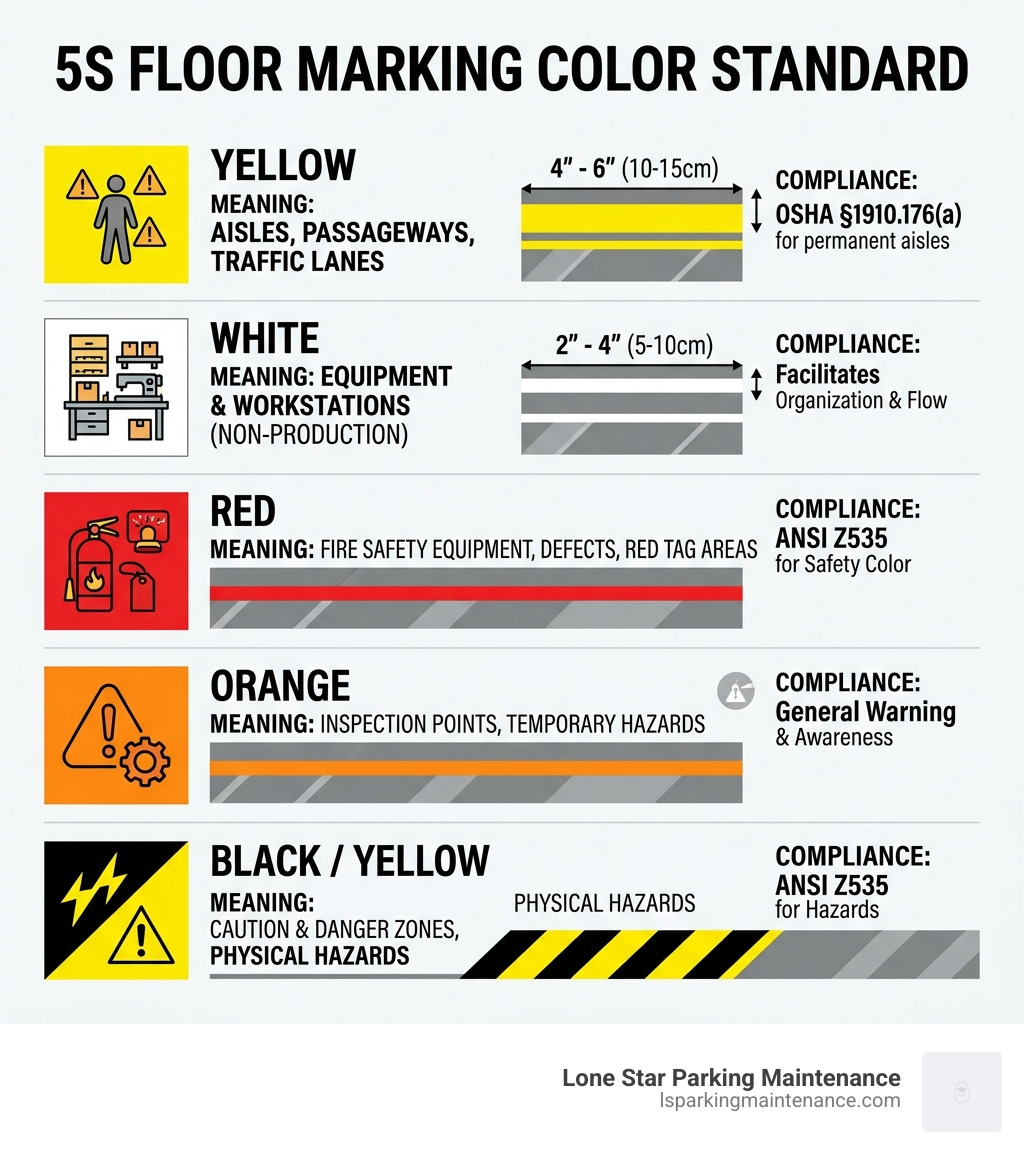
In safety, color is a language. If everyone uses their own “dialect,” accidents happen. To maintain compliant safety line striping, we follow the 5S and OSHA-recommended color standards:
- Safety Yellow: The universal color for aisles, traffic lanes, and work cells. If it moves or people walk there, it’s usually yellow.
- Red: Reserved for “Danger” or “Stop.” This includes fire lanes and defect/scrap areas.
- Red and White Stripes: Used for fire protection equipment. OSHA requires a 36-inch clearance around fire extinguishers and electrical panels. More info about Fire Lane requirements can help you ensure your DFW property meets local fire marshal codes.
- Black and Yellow Stripes: These indicate physical hazards, such as low-hanging beams, trip hazards, or the edges of loading docks.
- White: Typically used for equipment zones, storage racks, and general production lines.
- Green: Often used for safety-related items like first aid kits or eyewash stations.
Width and Clearance Requirements
Consistency is key for visibility. OSHA recommends that safety lines be at least 2 inches wide, though a 4-to-6 inch width is the industry standard for maximum visibility in large facilities. For forklift traffic, aisles should typically be 10 to 14 feet wide for two-way travel, or 6 to 8 feet for single-direction traffic.
Professional Application and Surface Preparation
You could buy the most expensive epoxy in the world, but if you apply it over a layer of Texas dust and oil, it’s going to peel up faster than a cheap sticker. Proper preparation is 90% of the job.
The Preparation Process
We start by evaluating the surface. For new concrete, we often need to deal with “laitance” (a weak top layer) or curing compounds that prevent paint from sticking. For older lots, we look at oil saturation and existing flaking paint.
- Pressure Washing: This is the first step for most outdoor lots. Is pressure washing necessary? Absolutely. It removes the grime and loose debris that prevent a mechanical bond.
- Shot Blasting and Grinding: For industrial epoxy applications, we use shot blasting (firing small steel beads at the floor) or diamond grinding to “open up” the concrete pores.
- Acid Etching: A chemical alternative to grinding that creates a sandpaper-like texture for better adhesion.
- Moisture Testing: We never apply high-performance coatings to “wet” concrete. We test for moisture vapor to ensure the paint won’t bubble or delaminate.
To get your property ready, check out our guide on how to prepare your lot for striping.
Precision Application
Once the surface is prepped, we use airless spraying equipment to ensure a crisp, uniform edge. For specialized markings like ADA symbols or “NO PARKING” text, we use precision stencils. The goal is a clean, professional look that communicates authority and care.
Maintenance and Liability Protection
Safety lines are not a “set it and forget it” feature. Over time, UV rays, heavy tires, and weather will wear them down.
The 25 Percent Rule
A good rule of thumb for property managers is the “25 Percent Rule.” If your lines have lost 25% of their original visibility or coverage, it’s time to restripe. Beyond this point, the risk of confusion and accidents increases dramatically. Faded lines are often cited in “slip and fall” or vehicle collision lawsuits as evidence of negligent maintenance.
Enhancing Property Value and Safety
Regular maintenance does more than just stop OSHA from knocking on your door. It also:
- Protects Against Liability: Documented maintenance schedules show you are proactive about safety.
- Improves Efficiency: In warehouses, clear lines reduce “search time” for materials and prevent traffic jams.
- Boosts Curb Appeal: A freshly striped lot is the “red carpet” to your business. It tells customers you care about the details.
To keep your lines looking sharp between striping cycles, consider Parking Lot Power Washing to remove the dirt and tire marks that dull your markings.
Frequently Asked Questions about Safety Striping
What are the most common OSHA violations in line striping?
The most frequent citations involve unmarked aisles in areas where forklifts operate and blocked fire exits. If a fire inspector or OSHA officer sees that your storage crates have “crept” over the lines and are blocking an emergency path or a fire extinguisher, you’re looking at a violation. Another common mistake is having inadequate clearance for mechanical equipment because the lines were drawn too narrow for the machines actually in use.
What is the minimum width for compliant safety lines?
While OSHA standards are somewhat flexible, they state lines must be “clearly visible.” The accepted minimum is 2 inches, but for high-traffic zones, we almost always recommend 4 to 6 inches. This ensures that even in low-light conditions or as the paint starts to wear, the boundary remains undeniable.
When did the new federal retroreflectivity rules take effect?
The FHWA’s final rule regarding pavement marking retroreflectivity took effect on September 6, 2022. This mandate requires that all pavement markings on roads open to public travel (including many large commercial parking lots) meet minimum maintenance levels for nighttime visibility. If you haven’t refreshed your outdoor markings since before late 2022, you may need an inspection to ensure you meet these new MUTCD standards.
Conclusion
At Lone Star Parking Maintenance, we know that compliant safety line striping is about more than just paint on the ground—it’s about protecting your employees, your customers, and your bottom line. From the initial surface prep to the final coat of high-traffic epoxy or thermoplastic, we bring professional craftsmanship and deep knowledge of DFW-specific regulations to every project.
Don’t wait for an accident or an OSHA citation to tell you your lines are too faded. Whether you need a new warehouse layout, a refreshed parking lot, or ADA-compliant signage, we are here to help. Explore our full range of Parking Lot Striping services and let’s make your facility the safest it can be.