
Why Every Crack in Your Driveway Is Costing You More Than You Think
Driveway crack filling is the process of sealing cracks in asphalt or concrete surfaces to stop water, debris, and vegetation from making damage worse. Here’s a quick overview of how it works:
How to fill driveway cracks (quick steps):
- Clean the crack – Remove dirt, debris, and vegetation with a wire brush or compressed air
- Dry the surface – Make sure the crack is completely dry before applying any filler
- Choose your filler – Use a product matched to your surface (asphalt or concrete)
- Apply the filler – Pour or squeeze filler into the crack from the bottom up
- Smooth it out – Level the surface flush with a putty knife or squeegee
- Let it cure – Allow drying time before walking or driving on the repaired area
A cracked driveway is more than an eyesore. It’s an early warning sign of structural trouble ahead.
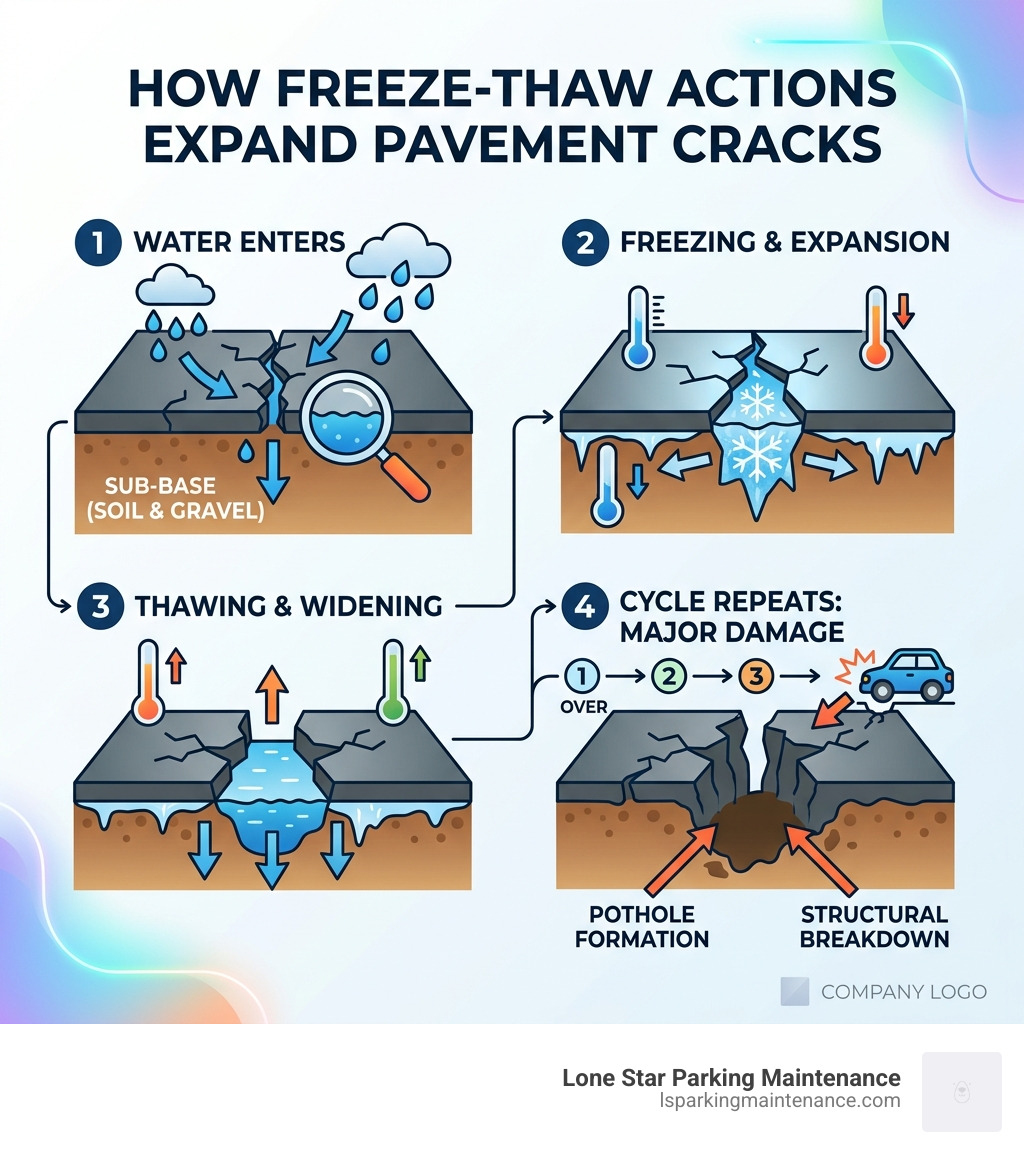
Water is the real enemy here. Once it gets into a crack, it works its way down to the foundation below. In colder climates, that water freezes, expands, and forces the crack wider. This cycle repeats season after season until what started as a hairline crack becomes a pothole — or worse, widespread structural failure.
The numbers back this up. 75% of unsealed cracks develop into potholes within three years. Seal them, and that number drops to just 1%.
For property managers and business owners in the DFW Metroplex, ignoring pavement cracks isn’t just a cosmetic problem. It’s a liability risk, a safety hazard, and an expensive mistake. The good news? Catching cracks early and filling them correctly is one of the most cost-effective maintenance decisions you can make.
This guide walks you through everything — from choosing the right filler to applying it like a pro.
Why driveway crack filling is Essential for Maintenance
When we talk about pavement longevity, we aren’t just talking about keeping things looking pretty for the neighbors. We’re talking about protecting the massive financial investment sitting right under your tires. In the DFW Metroplex, our pavement faces a unique set of challenges—from blistering summer heat that causes expansion to sudden cold snaps that trigger contraction.
Understanding what are the benefits of crack filling? starts with recognizing the “foundation protection” aspect. Think of your driveway like a house; if the roof leaks, the framing rots. If your pavement “leaks” through cracks, the sub-base (the dirt and rock underneath) washes away or softens. Once that foundation is compromised, the heavy weight of vehicles will cause the surface to collapse, leading to those dreaded potholes.
By staying on top of repairs, you are ensuring that water stays on the surface and flows toward the drains where it belongs. Beyond water, crack filling provides essential vegetation control. We’ve all seen those stubborn weeds that can push through solid asphalt. Those roots act like tiny jackhammers, physically prying the pavement apart from the inside out.
Driveway crack filling is the most cost-effective preservation tool in our arsenal. It is significantly cheaper to spend a few hundred dollars on high-quality filler today than it is to spend tens of thousands on a full “tear out and repave” project in five years because the foundation failed.
Choosing the Right Filler for Your Surface
Not all fillers are created equal, and using the wrong one is often worse than doing nothing at all. The first rule of thumb: match your material. Asphalt requires bitumen-based products, while concrete needs specialized cementitious or epoxy-based sealants.
| Feature | Hot Rubberized Filler | Cold Pour Liquid Filler |
|---|---|---|
| Best For | High-traffic, large cracks | Small DIY repairs, hairline cracks |
| Elasticity | Extremely high (moves with pavement) | Moderate to low |
| Durability | 3–10+ years | 1–2 years |
| Drying Time | 10–40 minutes | 24–48 hours |
| Equipment | Requires melter/kettle | Pour directly from bottle/tube |
When you are learning how to repair cracks in your asphalt or concrete driveway, you have to consider the “movement” of the crack. “Working cracks” are those that expand and contract significantly with the temperature. For these, elasticity is king. You want a filler that acts like a rubber band, stretching in the winter and compressing in the summer without pulling away from the edges of the pavement.
Key Features of High-Quality driveway crack filling Materials
If you’re browsing the aisles of a home improvement store or selecting a professional service, look for these “must-have” features:
- UV Resistance: Texas sun is brutal. Without UV inhibitors, fillers become brittle and crack within a single season.
- Waterproofing: The primary job is to create an impermeable seal.
- Self-leveling properties: This ensures the liquid flows into every nook and cranny, creating a flat, flush finish without much manual tooling.
- Oil-proof barriers: Especially important for driveways where cars might drip fluids, as oil can dissolve standard asphalt.
- Anti-aging formulas: These prevent the filler from oxidizing and turning gray and brittle over time.
Identifying Crack Types and Sizes
Before you start, you need to know what you’re up against. If you’re asking, “how do I know if my parking lot needs crack filling?“, start by measuring the width.
- Hairline Cracks: These are less than 1/8 inch wide. Most liquid fillers won’t even fit inside these. Usually, a good sealcoating is enough to protect these.
- Longitudinal and Transverse Cracks: These run along or across the driveway. These are the “bread and butter” of crack filling and should be addressed immediately if they are between 1/8 inch and 1.5 inches wide.
- Alligator Cracking: This looks like the skin of a reptile—a web of interconnected cracks. Warning: Crack filler will not fix this. This is a sign of foundation failure and usually requires a patch or replacement.
- Potholes: These require “cold patch” or “hot mix” asphalt rather than liquid crack filler.
Step-by-Step Guide to Professional Results
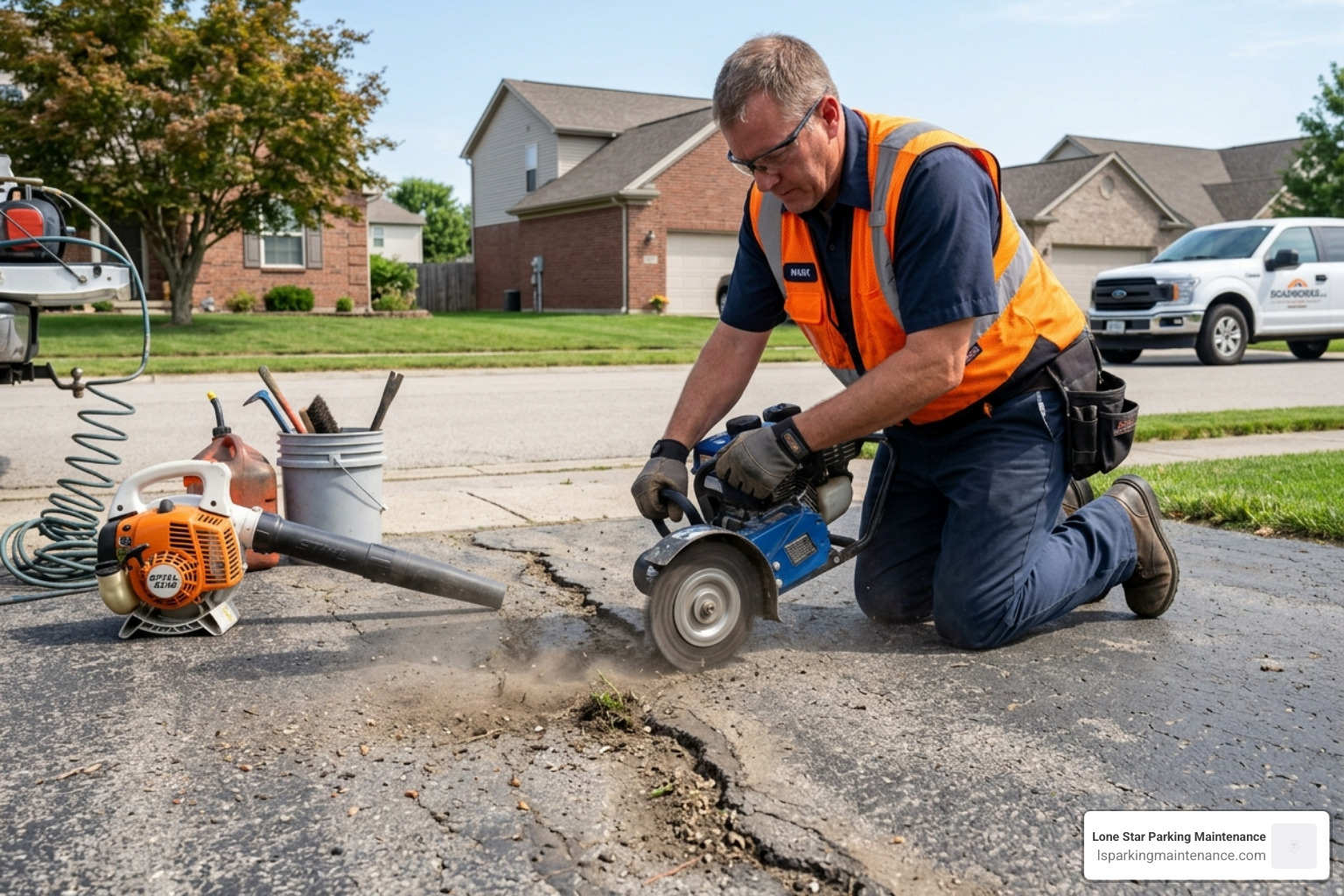
To get a repair that lasts for years rather than weeks, you have to focus on the “prep.” Professional results are 90% preparation and 10% application.
Preparing the Surface for driveway crack filling
If you pour filler over dirt, it will peel off like a cheap sticker. Here is how we ensure a “forever” bond:
- Debris Removal: Use a stiff wire brush to dislodge rocks, dirt, and old, failed filler.
- Vegetation Control: If grass is growing in the crack, it must be removed entirely. We often use a “crack-weeding” tool or a screwdriver to get the roots out.
- Routing (Optional but Recommended): For the best results, professionals “route” the crack. This involves using a machine to cut a clean U-shaped reservoir. This can actually double the life of the sealant because it provides more surface area for the material to grip.
- Compressed Air: Use a leaf blower or air compressor (at least 90 psi) to blow out every last speck of dust.
- Moisture Control: This is critical. The crack must be bone-dry. If it rained recently, you might need a heat lance or a simple propane torch to dry the sidewalls of the crack.
Required Preparation Tools List:
- Stiff wire brush
- Push broom
- Screwdriver or weeding tool
- Air compressor or high-powered leaf blower
- Propane torch (for drying)
- Safety gear: Gloves, eye protection, and kneepads
Application Techniques for a Flush Finish
Once the area is prepped, it’s time to fill.
- Bottom-Up Filling: Always start at the deepest part of the crack. If you just pour over the top, you’ll trap air bubbles that will eventually cause the surface to sink.
- Backer Rods: For cracks deeper than 1/2 inch, don’t waste expensive filler. Insert a foam backer rod into the crack first, leaving about 1/4 inch of space at the top for the filler.
- Overbanding: This technique involves applying the filler so it slightly overlaps the edges of the crack (about 1–2 inches on each side).
- Squeegee Leveling: Use a U-shaped squeegee to “strike off” the excess material, leaving it flush with the pavement.
- Silica Sand Usage: If you need to open the driveway to traffic quickly, you can sprinkle fine silica sand over the wet filler. This prevents “tracking” (tires picking up the wet material) and adds a bit of traction.
Frequently Asked Questions about Driveway Repairs
We get a lot of questions about the “when” and “how” of driveway maintenance. Here are the most common ones we hear in the DFW area.
How long does it take for crack filler to dry?
Drying time depends entirely on the product and the weather.
- Hot Rubberized Fillers: These are “traffic ready” as soon as they cool down, which usually takes 10 to 40 minutes.
- Cold Pour Liquid Fillers: These take much longer. While some “quick-dry” versions claim to be ready in 2 hours, most standard cold pour products require 24 to 48 hours to fully cure before you should drive a vehicle over them.
- Factors: High humidity and cooler temperatures will significantly extend these times. In the humid Texas spring, give it extra time!
Can I fill cracks in the winter?
Yes, but with caveats. Most manufacturers recommend a minimum pavement temperature of 40 degrees Fahrenheit. If the ground is frozen, the filler won’t bond. However, in the DFW Metroplex, we can often perform repairs in the winter by using a heat torch to warm the pavement and evaporate any hidden moisture. The biggest risk in winter isn’t the cold—it’s the moisture from morning frost or ice. If the crack isn’t dry, the repair will fail.
When should I call a professional instead of doing it myself?
DIY is great for a few small cracks on a Saturday morning. However, you should look into parking lot sealing and crack filling professionals if you notice:
- Large-Scale Damage: If you have hundreds of linear feet of cracks, doing it by hand with a squeeze bottle will be inconsistent and exhausting.
- Alligator Cracking: This requires specialized “mastic” or infrared patching that DIYers can’t access.
- Commercial Needs: For businesses, safety standards and “curb appeal” are tied to your brand. Professional equipment (like 380°F oil-jacketed melters) provides a level of durability that store-bought jugs simply can’t match.
Conclusion
At Lone Star Parking Maintenance, we’ve seen how a little proactive care can save property owners thousands of dollars. Whether you’re managing a residential driveway in Plano or a massive commercial garage in downtown Dallas, the principles remain the same: keep the water out, and you keep the pavement strong.
We pride ourselves on using top-quality materials that exceed industry standards, ensuring that every job we do is rooted in safety and customer satisfaction. From the initial cleaning to the final seal, our commitment to the DFW Metroplex is to provide pavement solutions that last.
Don’t wait for those small cracks to become expensive liabilities. Protect your investment with professional parking lot sealing and crack filling today. Whether you need a consultation or a full maintenance plan, we are here to help you keep your surfaces smooth and your foundation solid.