
Core Types of Parking Lot Paint Striper Machines
Understanding the mechanics behind pavement marking equipment prevents costly mistakes on the job. The line striping industry utilizes several core delivery systems, each engineered for specific scales of work, material viscosities, and site environments.
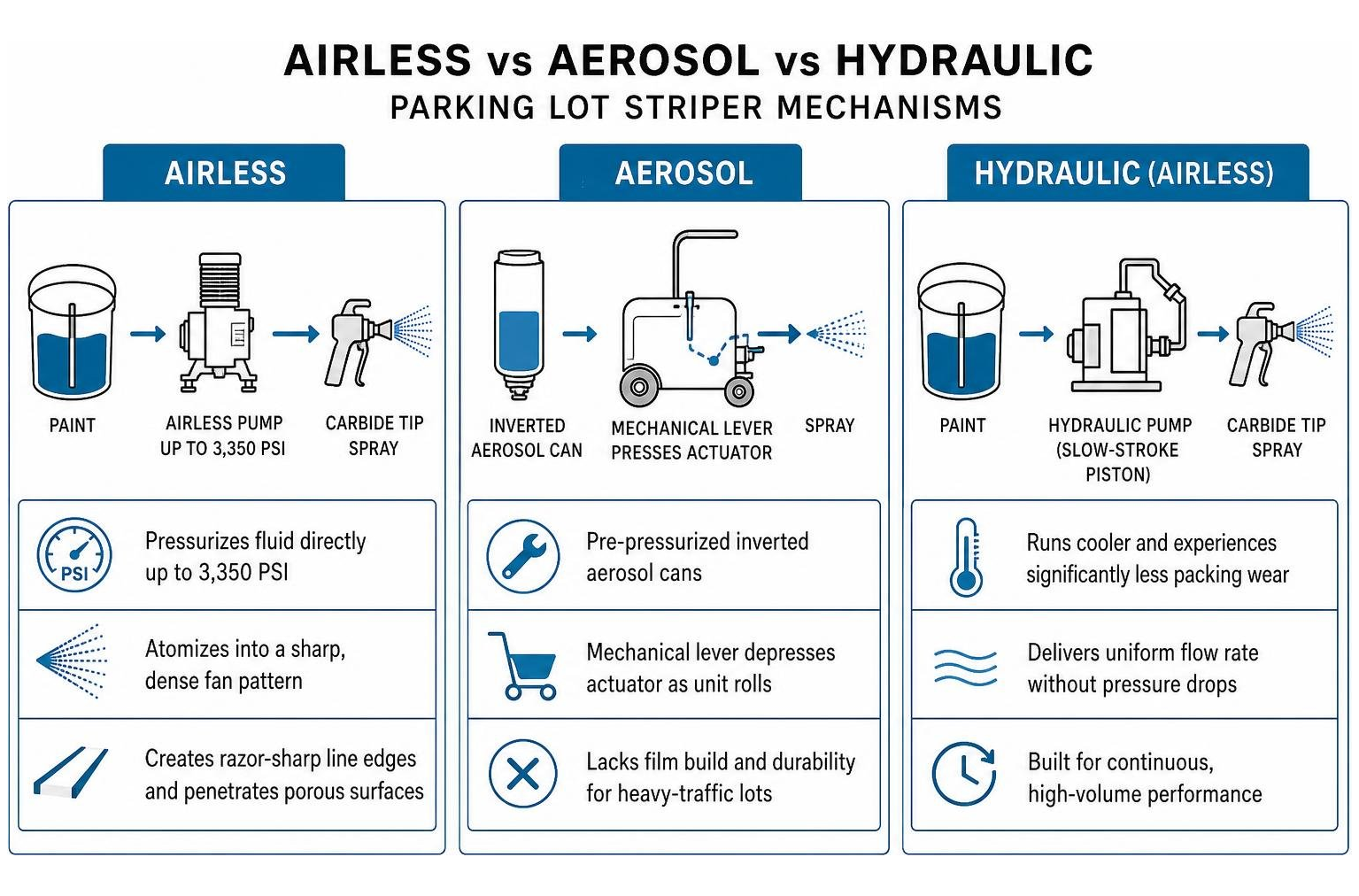
Airless spray technology is the gold standard for high-volume, professional commercial lots. Unlike conventional compressed-air sprayers that mix air directly into the paint stream—often creating overspray and misting—airless pumps pressurize the fluid directly up to 3,350 PSI. The paint is forced through a precision-machined carbide tip, atomizing into a sharp, dense fan pattern. This creates razor-sharp line edges and penetrates the porous micro-texture of asphalt and concrete without thinning the coating.
Hydraulic drive systems elevate airless performance by powering slow-stroke fluid pistons. These hydraulic pumps run cooler, experience significantly less packing wear, and deliver a uniform flow rate without pressure drops during continuous spraying.
On the opposite end of the mechanical spectrum are aerosol sprayers. These carts rely on pre-pressurized inverted aerosol cans. The can sits inverted in a wheeled carriage, and a mechanical lever depresses the actuator tip as the operator rolls the unit forward. While convenient and virtually maintenance-free, they lack the film build and durability necessary for commercial facilities subject to heavy daily traffic.
Manual vs. Powered Parking Lot Paint Striper Systems
Selecting between manual applicators and powered systems comes down to the volume of paint applied, labor costs, and edge definition requirements.
Manual hand-push aerosol carts and mechanical roller applicators are lightweight and inexpensive. However, because they rely entirely on the operator’s walking pace to govern the paint thickness, line uniformity varies widely. A momentary pause can leave a heavy puddle, while walking too fast deposits a thin, brittle coat that wears away within weeks.
In contrast, powered airless stripers use constant mechanical fluid pressure. When evaluating the top striping machines, commercial contractors prioritize mechanical stability. Powered walk-behind and self-propelled units feature rigid steel chassis, vibration-dampening handlebars, and lockable front caster wheels. This mechanical alignment ensures straight stalls, consistent mil thickness, and clean cut-off lines across hundreds of stalls without causing severe operator fatigue.
Gas-Powered vs. Battery-Powered Stripers
The choice of power source dictates where and how long a machine can operate continuously on a single job.
- Gas-Powered Stripers: Typically driven by reliable industrial engines like the Honda GX120 (4.0 HP), Honda GX200 (6.5 HP), or Honda GX270 (9.0 HP). Gas engines provide unmatched hydraulic pressure and uninterrupted runtime on sprawling outdoor commercial lots. They can run all day with quick fuel top-offs, making them the workhorse of exterior pavement maintenance across the DFW Metroplex.
- Battery-Powered Stripers: Driven by high-capacity lithium-ion battery packs and brushless DC motors. These units produce zero emissions and operate with minimal noise. They are indispensable for enclosed parking garages, hospital parking decks, underground facilities, and municipal zones with strict local noise ordinances.
While lithium airless units deliver the same working pressure (up to 3,300 PSI) as their gas counterparts, contractors must manage battery runtime and maintain spare battery packs for multi-acre exterior projects.
Top Striping Equipment Roundup: Category Leaders
Commercial pavement marking equipment spans from lightweight aerosol touch-up tools to heavy-duty self-propelled platforms. The table below highlights the performance metrics across these major machine classes:
| Machine Category | Typical Pressure (PSI) | Flow Rate (GPM) | Max Tip Size | Primary Best Use Case |
|---|---|---|---|---|
| Aerosol Carts | Pre-set aerosol | N/A (Canister) | Fixed Can Nozzle | Small warehouse aisles, light touch-ups |
| Walk-Behind Airless | 3,000 – 3,350 PSI | 0.75 – 2.2 GPM | .027″ – .036″ | Commercial retail lots, churches, schools |
| Self-Propelled / Rider | 3,300 – 3,350 PSI | 2.2 – 2.5 GPM | .039″ – .045″+ | Large shopping centers, airports, roadways |
Best Heavy-Duty Walk-Behind Parking Lot Paint Striper Units
Walk-behind airless units strike the ultimate balance between agile maneuverability and commercial-grade output.
The industry benchmark Graco LineLazer V 3900 series delivers up to 1.25 GPM at 3,300 PSI, supporting dual-gun operations for simultaneous double-yellow line application.
For high-volume commercial garages and extensive surface lots, the PROSTRIPE 300 HD walk-behind line striper sets a high standard with its 3,350 PSI working pressure and an impressive material delivery rate of 2.2 GPM. Powered by a heavy-duty HYDREX hydraulic pump, this unit effortlessly pulls thick, heavy-bodied waterborne traffic paints directly from standard 5-gallon pails or an attached hopper.
For rental applications or entry-level commercial use, standard gas-powered rental striper specs often feature flow rates between 0.75 and 0.85 GPM with a maximum .030″ spray tip, providing dependable performance for mid-sized restriping jobs.
High-Capacity Self-Propelled and Rider Attachments
When managing massive logistics facilities, regional shopping centers, or long roadways, pushing a 250-pound machine by hand dramatically reduces production speeds over an eight-hour shift. Self-propelled units integrate hydrostatic drives that propel the equipment forward and backward at consistent speeds.
The PROSTRIPE 300 SP self-propelled line striper operates at speeds up to 10 mph (16 km/h) and integrates an 18-gallon (68-liter) paint hopper, eliminating the downtime of constantly swapping 5-gallon buckets.
For large-scale intersection layouts and dual-color requirements, the PROSTRIPE 400 SP dual-color line striper provides a massive 40-gallon (150-liter) paint tank, dual suction lines, and multi-gun synchronization.
Alternatively, walk-behind units can be paired with ride-on sulkies like the Graco LineDriver or modular standing platforms. These rider attachments transform standard walk-behind stripers into high-speed riding systems, doubling daily output while maintaining straight lines across thousands of linear feet.
Budget Aerosol and Entry-Level Line Markers
Property managers handling minor spot repairs, short-term layout adjustments, or light industrial markings can benefit from economical entry-level tools.
The CAROD line marking machine weighs only 12 lbs, features heavy-duty 6-inch wheels, adjusts line widths from 2 to 4 inches by raising or lowering the can housing, and costs around $79.99. Similarly, the AERVOE Striping Machine 800 (priced around $183.79) provides sturdy steel construction for crisp aerosol application.
While these units cannot replicate the high mil thickness or multi-year lifespan of professional airless coatings, they serve as affordable tools for simple touch-ups between scheduled maintenance cycles.
Key Specifications and Operational Features to Evaluate
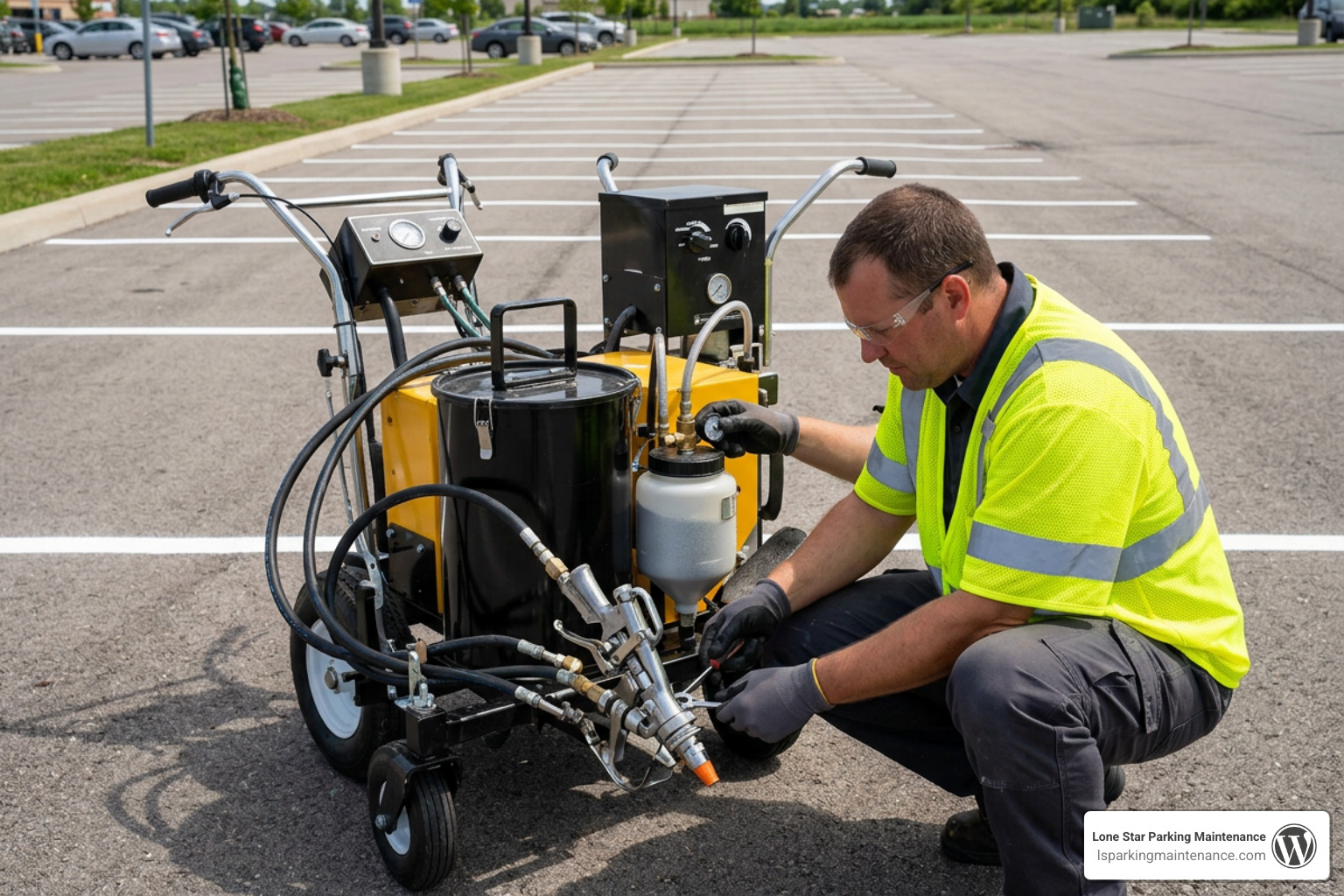
When selecting professional line marking machinery, pay close attention to technical specifications:
- Maximum Working Pressure (PSI): Professional airless units operate between 3,000 and 3,350 PSI. High pressure ensures proper atomization of viscous, fast-drying traffic coatings without thinning.
- Flow Rate (Gallons Per Minute – GPM): A higher GPM rating (ranging from 0.75 GPM on compact units up to 2.5 GPM on high-output rigs) allows the pump to support larger tip sizes and multiple spray guns simultaneously without pressure drops.
- Maximum Spray Tip Size: Tip ratings (such as .019″, .027″, or .035″) dictate the orifice size. Heavy latex traffic paints and high-build coatings require larger tip orifices to prevent clogging.
- Paint Capacity: Rigs utilize direct-immersion siphon tubes for 5-gallon pails, or mount onboard low-profile hoppers ranging from 18 to 40 gallons. Larger tanks minimize refills on large commercial lots.
- Gun Configuration and Spacing: Dual-gun capabilities allow operators to spray parallel double lines, standard parking stalls, and 24-inch crosswalk stop bars in a single pass.
Selecting machinery with precise line-edge controls is also essential when marking accessible stalls, loading zones, and fire lanes in full compliance with ADA compliant parking lot striping standards.
Paint Types, Stencils, and Glass Bead Systems
A machine is only as effective as the materials it applies. Modern striping machinery handles a diverse array of specialized coatings:
- Waterborne Acrylic Traffic Paint: The most widely used commercial pavement marking paint. It is fast-drying, environmentally friendly, low in VOCs, and easy to clean with water.
- Solvent-Based Alkyd Paint: Highly durable and cold-weather tolerant. Alkyd paints adhere exceptionally well to oil-stained asphalt or concrete, requiring solvent flush cycles during machine cleanup.
- Methyl Methacrylate (MMA): A two-component, heavy-duty resin system designed for extreme-wear zones such as busy intersections and loading docks. MMA requires specialized 1:1 or 98:2 mechanical mixing equipment.
For nighttime visibility, glass bead dispensing systems are crucial. Glass beads are dropped directly onto the wet paint film under gravity or pneumatic pressure. The spherical beads act as optical lenses, refracting vehicle headlight beams straight back toward the driver.
High-output walk-behind and self-propelled rigs feature integrated bead hoppers holding 70 to 165 lbs of reflective media. When combined with precision parking lot stencils—such as arrows, handicap symbols, and speed limit markings—the resulting layout matches the guidelines outlined in our complete guide to lot line painting.
Surface Prep and Equipment Maintenance Protocols
Proper machine care guarantees clean lines and prevents costly mid-job breakdowns. Follow these essential field maintenance protocols:
- Hydraulic Pump Flushing: At the end of every work session, thoroughly flush the fluid pump, suction tube, and spray lines. Use clean water for waterborne acrylics or mineral spirits/solvent for alkyd enamels until the fluid discharge runs crystal clear.
- Spray Tip and Mesh Filter Care: Disassemble spray tips and manifold filters. Store them in a dedicated tip cleaning solution to dissolve paint skins before they harden inside the carbide orifice.
- Engine and Hydraulic Oil Checks: Inspect engine oil and hydraulic fluid reservoirs before each shift. Clean hydraulic oil prevents high-pressure piston failure during hot Texas summer operations.
- Surface Cleaning Before Spraying: Always ensure the pavement is thoroughly prepped. Dust, gravel, and grease prevent proper paint adhesion. Evaluate whether pressure wash preparation is required to clear heavy dirt layers and surface contaminants before laying down fresh lines.
- Seasonal Winterization: When storing equipment during cold periods, pump light motor oil or pump armor storage fluid through the displacement pump to protect internal packings, valves, and metal cylinders against corrosion.
Frequently Asked Questions About Parking Lot Stripers
How much does a professional line striping machine cost?
Entry-level inverted aerosol striping carts range from $80 to $250, making them suitable for small properties with light touch-up needs.
Professional-grade walk-behind airless machines powered by gas or lithium-ion batteries generally range from $3,000 to $6,500 depending on pump flow rate (GPM) and gun configurations.
Heavy-duty, self-propelled hydraulic striping machines equipped with pressurized glass bead dispensers and riding platforms range from $9,000 to over $15,000. For commercial property owners, hiring a specialized contractor is often far more cost-effective than purchasing and maintaining high-end airless machinery.
What safety gear and PPE are required when operating a striper?
Operating commercial high-pressure paint machinery requires standard personal protective equipment (PPE):
- Eye Protection: ANSI-approved wrap-around safety glasses or face shields protect against high-pressure fluid injection and airborne paint mist.
- Chemical-Resistant Gloves: Nitrile or neoprene gloves prevent skin contact with chemical solvents and traffic coatings.
- Respirator Masks: NIOSH-approved organic vapor respirators are essential when spraying solvent-based alkyd paints or operating in enclosed garages.
- High-Visibility Apparel: Class 2 or Class 3 reflective safety vests keep operators visible to moving traffic.
- Traffic Control Equipment: High-visibility traffic cones, barricades, and caution tape must be deployed to close off active drive aisles during striping.
Can a parking lot striper handle both stall lines and curb stenciling?
Yes. Professional airless striping machines feature quick-release, detachable spray guns connected to 25-foot or 50-foot flexible high-pressure fluid hoses.
The operator can quickly remove the spray gun from the wheeled cart mounting bracket, attach a reversible stencil tip, and manually paint curb faces, directional arrows, ADA wheelchair logos, and fire lane lettering without moving the main machine chassis.
Conclusion
A well-maintained parking lot creates an immediate impression of safety, order, and professionalism. Whether managing a compact commercial pad or a sprawling distribution center across the DFW Metroplex, choosing the right striping equipment ensures sharp lines, durable paint adhesion, and full regulatory compliance.
At Lone Star Parking Maintenance, we pair industrial-grade striping technology with premium traffic coatings to deliver long-lasting pavement markings. For an in-depth breakdown of field equipment and layout strategies, explore our comprehensive parking lot striping tools guide.