
What Are Asphalt Milling Services in Texas?
Asphalt milling services Texas property managers and business owners rely on are a proven, cost-effective way to restore damaged pavement — without tearing everything out and starting from scratch.
Here’s a quick summary of what you need to know:
- What it is: Asphalt milling (also called cold planing) removes the top layer of damaged pavement using a specialized grinding machine
- Why it matters: It fixes cracks, uneven surfaces, and drainage problems at a fraction of the cost of full replacement
- Who needs it: Parking lots, roads, driveways, and commercial properties showing wear, rutting, or surface cracking
- How long it takes: Most projects are completed in one to two days
- What happens to the old asphalt: It’s recycled into Reclaimed Asphalt Pavement (RAP) — a 100% recyclable material
- Typical depth: Anywhere from 1 inch for surface smoothing up to 3–5 inches for full-depth removal
If you manage a commercial property in the DFW Metroplex, chances are you’ve seen what Texas summers, heavy truck traffic, and years of deferred maintenance can do to a parking lot. Surfaces crack. Water pools. Edges crumble. What looks like a surface problem can quietly become a safety and liability issue.
The good news? In most cases, you don’t need to replace the entire pavement. Milling removes only what’s damaged, preserves the stable base underneath, and prepares the surface for a fresh overlay — saving time, money, and materials.
Understanding Asphalt Milling and How It Works
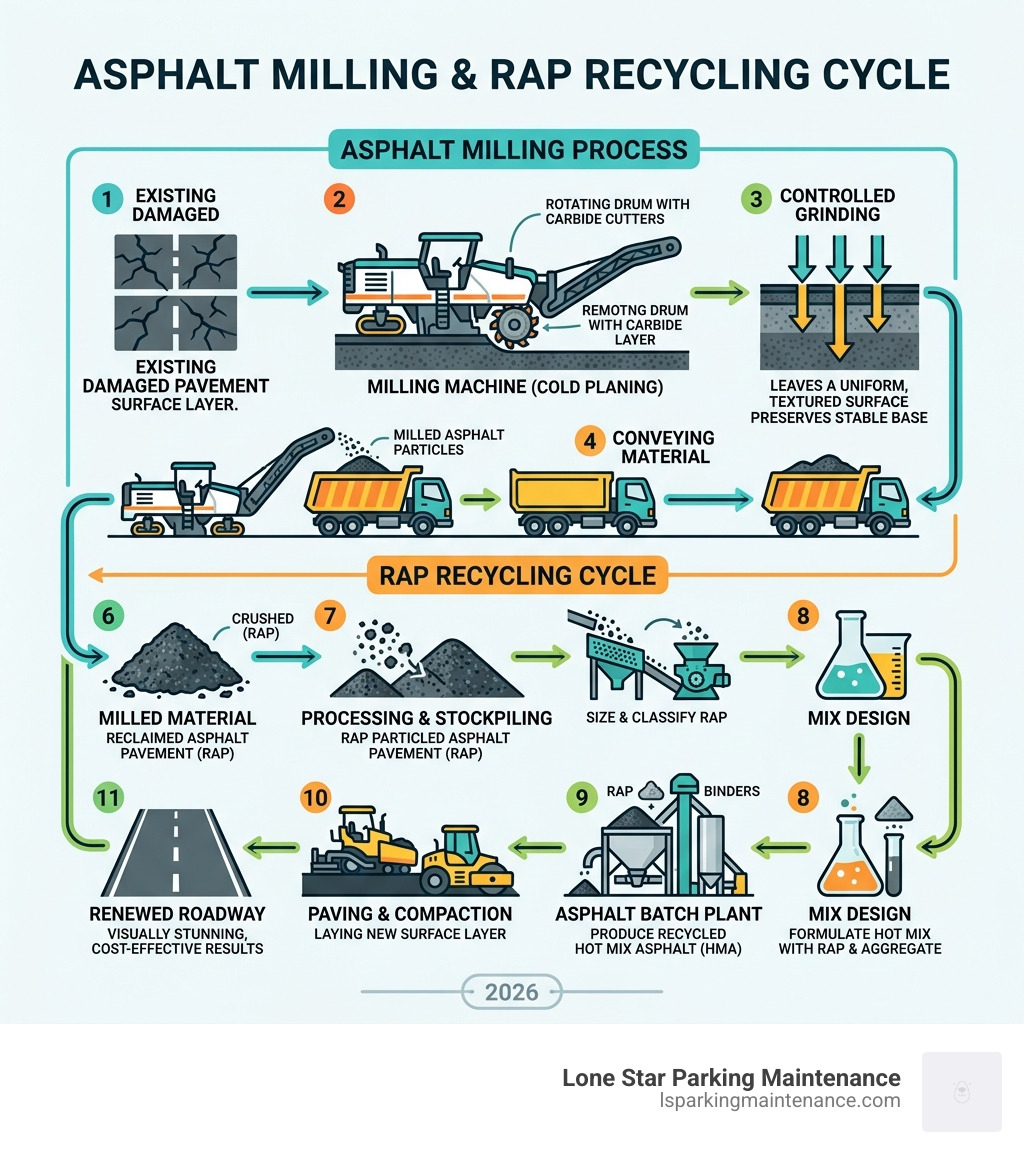
To understand why we recommend asphalt milling services Texas for so many of our DFW clients, it helps to look under the hood of the process itself. Asphalt milling, frequently referred to in the industry as “cold planing,” is a controlled removal process. Instead of using a bulldozer to rip up chunks of pavement (which can damage the stable soil and stone base underneath), we use a high-tech milling machine.
The heart of this machine is a massive rotating drum equipped with hundreds of hardened carbide cutters. As the machine moves forward, this drum spins, grinding the existing asphalt surface into small, uniform gravel-sized particles.
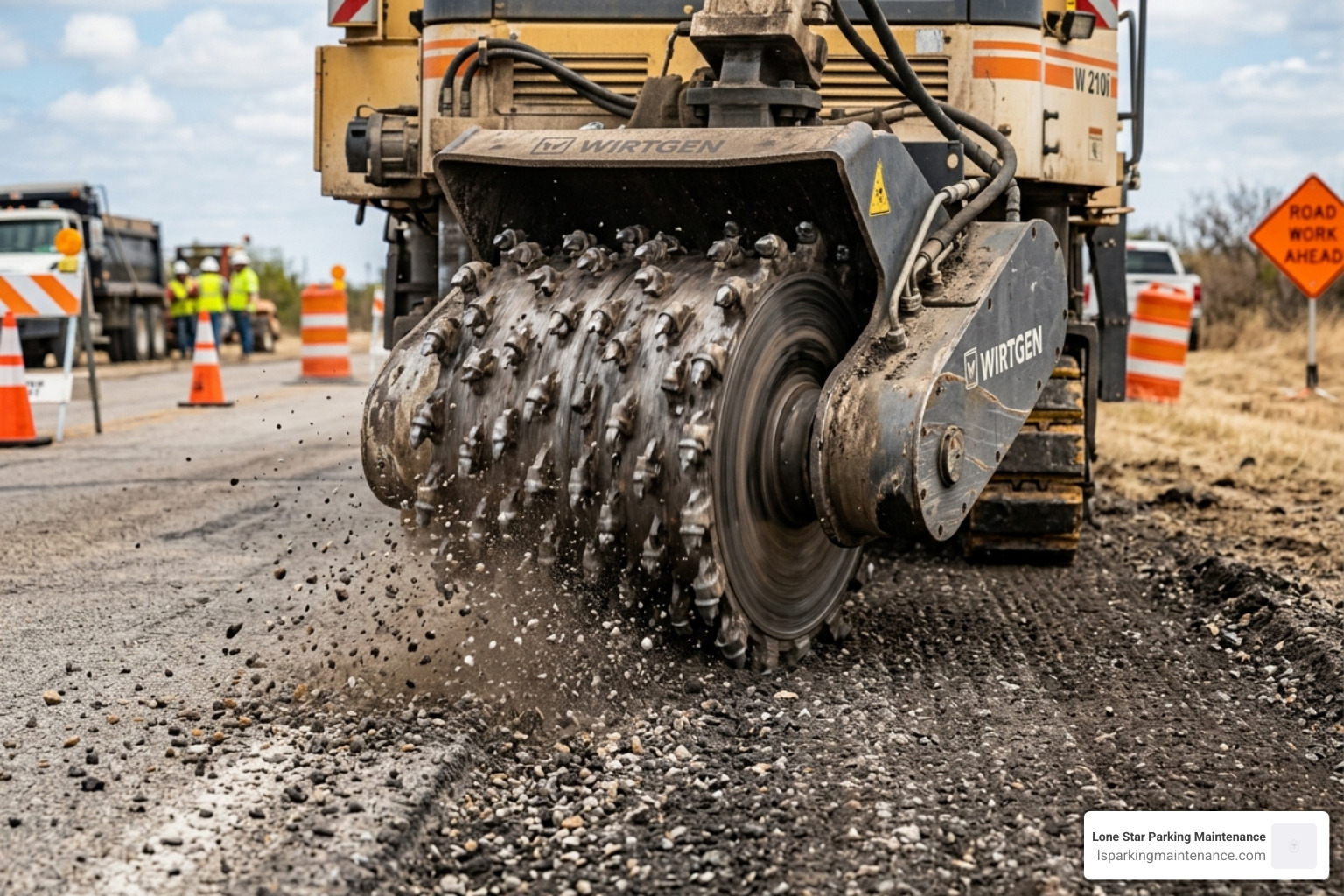
This isn’t just “scratching the surface.” The process is incredibly precise. We can adjust the machine to shave off as little as half an inch to remove surface oil stains or “bleeding” (where the asphalt binder rises to the top), or we can go several inches deep to remove severe rutting caused by heavy truck traffic. By removing the damaged outer layer, we expose the structural integrity of the pavement.
This process also addresses “aggregate separation,” which is a fancy way of saying the rocks and the glue holding your parking lot together have started to fall apart. By profiling the surface with a milling machine, we create a textured, “toothed” finish. This texture is the secret sauce for a long-lasting repair; it provides a much larger surface area for the new asphalt overlay to bond to, ensuring the new layer doesn’t slide or peel away over time.
Learn more about how asphalt milling services can be tailored to your specific property needs.
The Benefits of Asphalt Milling Services Texas
When we talk to property managers in Dallas or Fort Worth, the first question is usually: “Why shouldn’t I just pave over the old stuff?” The answer lies in height and drainage. If you keep adding layers of asphalt, eventually your parking lot will be higher than your curbs and sidewalks. This creates a massive tripping hazard and ruins your drainage.
Asphalt milling services Texas solve this by removing the old height before adding the new.
| Feature | Asphalt Milling & Overlay | Full Reconstruction |
|---|---|---|
| Cost | Significantly lower | High (includes excavation) |
| Timeline | 1–2 Days | Weeks |
| Drainage | Corrects slope/grade | Full redesign |
| Environmental Impact | High (90%+ recycled) | Low (more landfill waste) |
| Curb Preservation | Maintains original height | Often requires curb replacement |
One of the biggest advantages we see in the DFW area is transition smoothing. Have you ever driven into a parking lot and felt a massive “thump” where the new pavement meets the concrete gutter or the main road? Milling allows us to “taper” the edges so the new asphalt sits flush with existing structures. This is essential for ADA compliance and for keeping your visitors’ cars (and your snowplows in the winter!) safe from damage.
Discover the advantages of pavement milling for your commercial facility.
Choosing the Right Depth for Asphalt Milling Services Texas
Not every parking lot needs the same level of “shave.” We generally categorize milling into two types:
- Partial-Depth Milling: This usually involves removing the top 1 to 2 inches of the “wearing course.” This is perfect for lots that have surface-level cracks or look “faded” but are still structurally sound. It keeps the “binder layer” (the stronger middle layer of asphalt) intact.
- Full-Depth Milling: If the damage goes deeper—usually 3 to 5 inches—we perform full-depth removal. This is necessary when the asphalt has completely failed, but the stone base underneath is still solid.
Precision is key here. In light-duty areas like apartment parking spots, the asphalt might only be 3 inches thick to begin with. In heavy-duty areas like DFW warehouse truck docks, it could be 6 inches or more. We measure the depth carefully to ensure we don’t disturb the subgrade, which would lead to a much more expensive repair.
Addressing Climate Challenges with Asphalt Milling Services Texas
Texas weather is notoriously hard on pavement. In the DFW Metroplex, we deal with extreme heat that causes “rutting” (the indentations made by tires) and “bleeding.” Then, we get those occasional deep freezes that lead to thermal cracking.
Asphalt is flexible, but over time, the sun oxidizes the oils in the pavement, making it brittle. Once it’s brittle, it cracks. Once it cracks, water gets in. In Texas, that water can erode the soil underneath, leading to those giant dips you see in older roads.
Asphalt milling services Texas are the best defense against this cycle. By milling away the oxidized, brittle top layer, we remove the “thermal cracks” before they can reflect upward into a new layer of pavement. It’s like exfoliating your skin; you have to get rid of the dead stuff to let the new layer thrive.
Asphalt milling solutions for Texas roads are specifically designed to handle these heavy traffic loads and climate shifts.
When to Choose Milling Over Full Pavement Replacement
It can be tempting to think that if a parking lot looks bad, it needs to be completely ripped out. However, full replacement is often overkill. We look at two main factors: base integrity and subgrade stability.
If your parking lot has “alligator cracking” (cracks that look like scales) in just a few small spots, those are usually signs of localized base failure. We can mill those specific areas, repair the base, and then overlay the whole lot.
However, if 80% of the lot is shifting and sinking, you might need a full reconstruction. But for the vast majority of DFW commercial properties, the stone base is perfectly fine—it’s just the top “skin” that has worn out. Milling is the “Expert asphalt milling services in Texas” solution because it addresses the surface wear without the massive bill that comes with a total rebuild.
Another reason to choose milling is “reflective cracking.” If you just pave over a crack without milling it out, that crack will “reflect” through the new layer in as little as a year. Milling removes the “memory” of those old cracks.
Expert asphalt milling services in Texas can help you determine if your base is stable enough for a simple milling project.
The Step-by-Step Asphalt Milling Process
We take pride in a clean, efficient workflow. Here is how a typical project goes:
- Assessment: We walk the site to identify drainage issues and determine the exact depth needed.
- Precision Grinding: The milling machine (cold planer) moves across the lot. We use water during this stage for dust suppression and to keep the cutters cool.
- Material Collection: As the machine grinds, a conveyor belt moves the particles directly into a dump truck. This keeps the site clean as we go.
- Surface Cleaning: Once the machine is done, we use power brooms and vacuums to remove every last bit of dust. A clean surface is vital for the next step.
- Tack Coat Application: We apply a “glue” (tack coat) to the milled surface.
- Overlay: New hot-mix asphalt is laid over the textured, milled surface, resulting in a smooth, level finish.
This “Understanding the milling and reclamation process” ensures that we aren’t just putting a Band-Aid on the problem—we are rebuilding the surface from the inside out.
Understanding the milling and reclamation process is key to knowing what to expect on your job site.
Sustainability and Reclaimed Asphalt Pavement (RAP)
One of the coolest things about our industry is that asphalt is the most recycled material in America. When we mill your parking lot, that old asphalt doesn’t head to a landfill in North Texas.
Instead, it becomes Reclaimed Asphalt Pavement (RAP). These millings are 100-percent recyclable. They are taken to a plant, cleaned, and mixed with new binders to create fresh asphalt. Some research shows that contractors can recycle over 90% of the material from a single milling project.
By choosing asphalt milling services Texas, you are participating in a sustainable circular economy. It requires less mining for new rock and less oil for new binder. Plus, using recycled millings can often lower the overall material cost of your project.
Sustainable roadway repair with milling is not just good for your wallet; it’s good for the Texas environment.
Frequently Asked Questions about Asphalt Milling
How long does a typical milling project take?
Most commercial milling projects in the DFW area are incredibly fast. Because the equipment is so efficient, we can often mill and clean a medium-sized parking lot in a single day. The “downtime” for your business is minimal. In many cases, cars can even drive on the milled surface (at slow speeds) before the new asphalt is laid, which isn’t possible with a full reconstruction. Typically, the entire process from milling to the final new layer is wrapped up in 1 to 2 days.
How deep can the milling machine go?
The depth is entirely dependent on the condition of your pavement and your structural needs. For simple surface smoothing or correcting a “bumpy” ride, we might only go 1 inch deep. For heavy-duty restoration where the binder layer is damaged, we may go up to 5 inches deep. We always aim to protect the subbase; if we go too deep and hit the dirt or loose stone, it requires a different process called “reclamation.”
What factors affect the cost of milling in Texas?
Several things influence the price:
- Square Footage: Larger areas often have a lower “per-square-foot” cost because the heavy equipment is already on-site.
- Haul-off Distance: How far do the trucks have to drive to drop off the RAP at a recycling center?
- Project Scope: Does the lot have a lot of “tight corners” or concrete islands? Small, intricate areas require smaller, more specialized machines which can take more time.
- Fuel Surcharges: Since the machines and trucks run on diesel, fluctuating fuel prices in Texas can play a role.
Conclusion
At Lone Star Parking Maintenance, we know that your parking lot is the first thing your customers see. It’s the “welcome mat” to your business. Whether you are managing a retail center in Plano, a warehouse in Fort Worth, or an office complex in Dallas, asphalt milling services Texas offer the perfect balance of durability and value.
We are committed to top-quality materials, sticking to industry standards, and ensuring every client in the DFW Metroplex is satisfied with a safe, smooth, and professional result. Don’t let a few cracks turn into a total reconstruction bill.
If you are ready to transform your pavement, we are here to help. More info about parking lot sealing and crack filling can also help you maintain your lot once the milling and overlay are complete. Reach out to us today to get your surface back on the right track!