
The Paving Option Most Business Owners Have Never Considered
A chip seal parking lot is one of the most cost-effective ways to protect and resurface a commercial parking area — yet most property managers have never heard of it.
Here’s a quick summary of what you need to know:
- What it is: A surface treatment that bonds crushed stone aggregate into a liquid asphalt binder, creating a textured, waterproof wearing surface
- Cost: Typically 15-20% of the cost of a full asphalt overlay — often 20-30% less per square foot than traditional blacktop
- Lifespan: 5-10 years with proper maintenance, depending on traffic and climate
- Best for: Commercial parking lots, retail centers, churches, municipal lots, and other moderate-traffic surfaces
- Key benefits: Waterproofing, skid resistance, UV protection, and fast installation — often completed in a single day
If you manage a parking lot in the DFW Metroplex, you’re probably familiar with the problem: faded striping, surface cracks, pooling water, and the eye-watering quotes for full asphalt resurfacing. It can feel like your only options are “pay a lot” or “let it get worse.”
But there’s a third option that’s been used on roads and parking surfaces for decades — and it’s far more budget-friendly than most property owners expect.
Chip seal (also called tar and chip, or Bituminous Surface Treatment) gives you a durable, safe, and attractive surface at a fraction of the cost of conventional paving methods. The catch? Most people simply don’t know it exists for commercial parking lots.
That’s exactly what this guide is here to fix.
Understanding the Chip Seal Parking Lot: Process and Materials
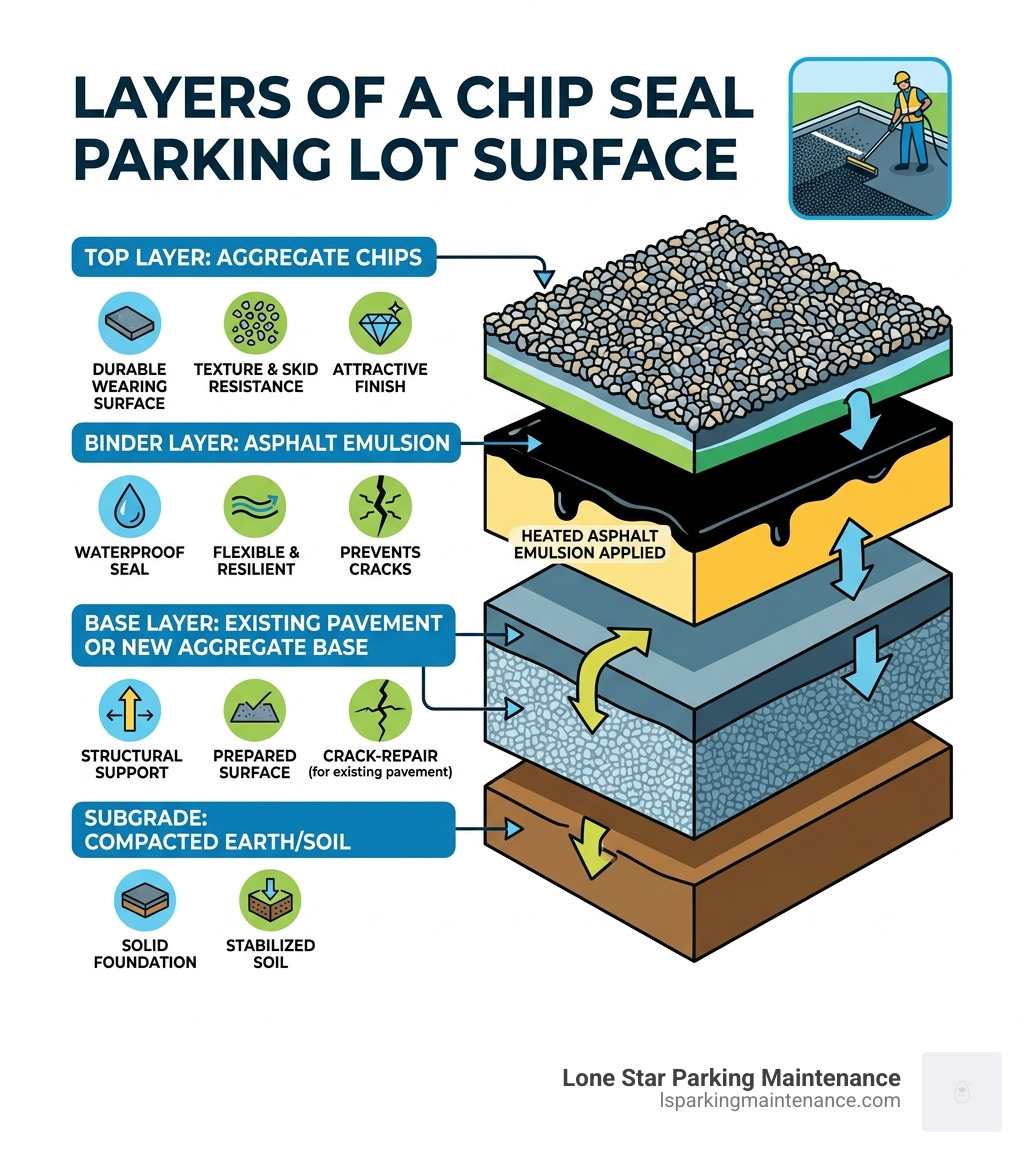
To understand why a chip seal parking lot is such a powerhouse for property maintenance, we first have to look at what it’s made of. Unlike traditional hot-mix asphalt, which is mixed at a plant and hauled to your site, chip seal is constructed right on top of your existing surface.
The Ingredients
The process relies on two primary components:
- Liquid Asphalt Binder: We use an emulsified asphalt, which is essentially asphalt cement mixed with about 30% water and an emulsifying agent. This allows the liquid to be sprayed at lower temperatures while still providing a rock-solid bond once the water evaporates.
- Crushed Stone (Chips): These aren’t just random rocks. We use high-quality, angular crushed stone—usually 3/8 inch or 1/4 inch in size. The angular shape is crucial because it allows the stones to “lock” together rather than rolling around like marbles.
The Step-by-Step Application
Applying a chip seal is a precision operation that we execute in several distinct phases:
- Surface Preparation: This is the most critical step. We thoroughly clean the existing pavement to remove dirt, weeds, and debris. If there are major structural failures or large potholes, those are repaired first. We also ensure proper drainage is in place, as water is the enemy of any pavement.
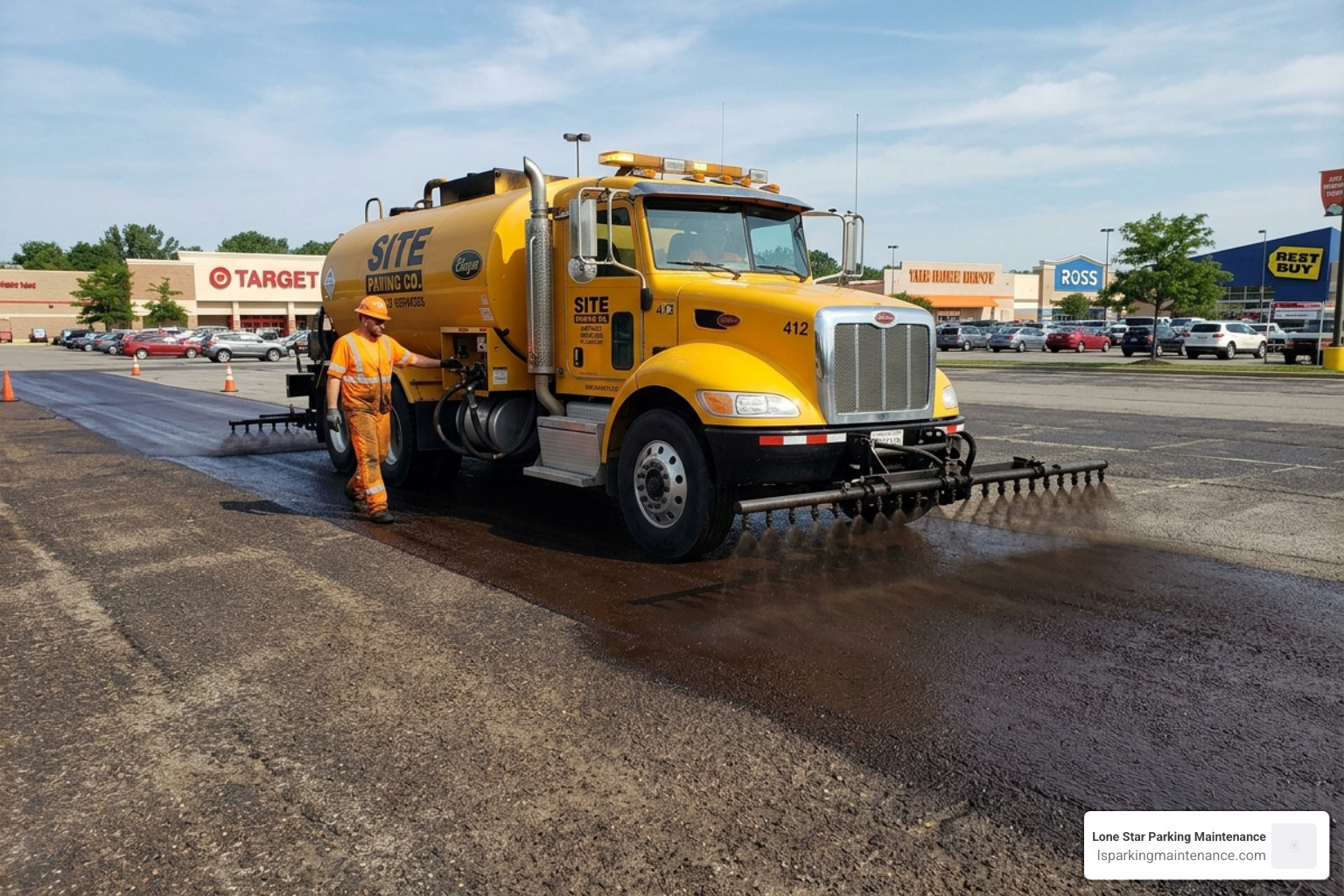
- Applying the Binder: A specialized distributor truck sprays a uniform layer of the hot liquid asphalt emulsion across the lot. This creates a sticky, waterproof membrane.
- Chip Spreading: Immediately following the spray truck (often within minutes), a chip spreader distributes a consistent layer of crushed stone over the wet binder.
- Pneumatic Rolling: We use rubber-tired (pneumatic) rollers to press the stones firmly into the liquid asphalt. This ensures the “chips” are seated flat and securely embedded in the binder.
- Curing: The surface needs time to set. While it can often be driven on at low speeds almost immediately, the “set” typically takes 24 to 48 hours.
- Sweeping: After the chips have had time to fully bond, we return with power sweepers to remove any loose gravel. This usually happens after the surface has cured, ensuring a clean, finished look.
Key Benefits: Why Businesses Choose Chip Seal Over Asphalt
In the DFW Metroplex, our weather can be brutal on pavement. From the scorching Texas sun to sudden heavy downpours, your parking lot takes a beating. Here is why a chip seal parking lot is often the superior choice for local businesses.
Massive Cost Savings
The most obvious benefit is the bottom line. Chip seal typically costs only 15% to 20% of what you would pay for a traditional asphalt overlay. Because it requires less heavy machinery and fewer raw materials than a 2-inch thick layer of hot-mix asphalt, we can pass those savings directly to you. It’s the ultimate way to maintain a professional appearance without draining the capital improvement budget.
Superior Waterproofing and Protection
Water is the leading cause of pavement failure. When water seeps into cracks, it softens the base underneath, leading to potholes. A chip seal acts as a giant waterproof “envelope” for your parking lot. It fills small cracks and seals the surface against moisture.
Furthermore, it offers excellent UV ray protection. The liquid binder prevents the underlying asphalt from oxidizing and becoming brittle. If you’ve ever wondered why is parking lot sealing important?, the answer lies in extending the life of your investment by blocking out the elements.
Safety and Visibility
A chip seal parking lot provides a highly textured surface. This translates to:
- Skid Resistance: The rougher texture offers better traction for tires, especially during wet weather.
- Anti-Glare: Unlike smooth blacktop, which can reflect blinding sunlight or headlights during a rainstorm, the stone chips diffuse light, making it easier for drivers to see lane markings.
- Night Reflectivity: The natural stone reflects light better than dark asphalt, improving visibility in poorly lit areas.
Aesthetic Customization
You aren’t stuck with just “black.” Depending on the stone available at local quarries, you can often choose aggregate colors that complement your building’s architecture, providing a rustic, high-end look that stands out from the sea of standard blacktop.
Comparing Paving Options: Chip Seal vs. Asphalt, Concrete, and Gravel
When evaluating alternative paving methods, it helps to see how they stack up side-by-side.
| Feature | Chip Seal | Hot-Mix Asphalt | Concrete | Gravel |
|---|---|---|---|---|
| Initial Cost | Low (15-20% of overlay) | High | Very High | Lowest |
| Lifespan | 5–10 Years | 15–20 Years | 25–30 Years | 1–3 Years |
| Maintenance | Low (Sweeping/Fog Seal) | High (Sealcoating) | Low | High (Regrading) |
| Traction | Excellent | Good | Fair | Poor |
| Construction Speed | Very Fast (1 day) | Moderate | Slow (Cure time) | Fast |
The “Goldilocks” Solution
Gravel is cheap but dusty and messy. Concrete is durable but incredibly expensive and prone to cracking in the shifting Texas soil. Asphalt is the standard, but it requires constant maintenance.
Chip seal sits in the “sweet spot.” It is roughly double the cost of gravel but provides a clean, permanent, and dust-free surface. Compared to blacktop, it is 20-30% cheaper per square foot and offers “self-healing” properties. In the heat of a DFW summer, the asphalt binder can become slightly pliable, allowing small cracks to essentially “flow” back together and seal themselves.
For many properties, combining Parking Lot Sealing and Crack Filling with a chip seal application provides a level of structural integrity that rivals much more expensive options.
Longevity and Maintenance of Your Chip Seal Surface
A well-installed chip seal parking lot in the DFW area can easily last 5 to 7 years, and in many cases, up to 10 years if traffic is moderate. However, the lifespan depends heavily on how the surface is treated in its early days.
The Critical Curing Period
While you can drive on a chip seal almost immediately, the surface is “tender” for the first few weeks. We recommend that drivers observe a 35 mph speed limit (or lower in parking lots) to prevent tires from “plucking” stones out of the binder before it has fully hardened.
Ongoing Care
Maintenance for chip seal is refreshingly simple:
- Regular Sweeping: Keeping the surface free of debris prevents abrasive materials from grinding down the stones.
- Crack Filling: If large structural cracks appear in the base, they should be addressed quickly. You might ask, how long does parking lot sealing last? Usually, a chip seal refresh is recommended every 5-7 years to keep the protective layer thick.
- Fog Sealing: This is a light application of a diluted asphalt emulsion over the top of the chip seal. It further “locks” the chips in place, turns the lot a dark black color, and makes striping pop.
- Snow Plow Protection: In the rare event of a North Texas freeze, snow plow operators should be instructed to keep their blades slightly elevated to avoid catching the aggregate.
Frequently Asked Questions about Chip Seal Parking Lots
Is a chip seal parking lot suitable for high-traffic areas?
Chip seal is excellent for moderate-traffic areas like retail centers, churches, and office parks. For high-traffic commercial lots or areas with heavy truck traffic (like loading docks), we often recommend a double chip seal. This involves two layers of binder and two layers of stone, which provides a thicker, more durable wearing course that can handle the stress of turning tires and heavy loads.
How long does it take for a chip seal parking lot to cure?
One of the biggest advantages of chip seal is speed. Most projects can be completed in a single day. While the stones take about 6 to 8 weeks to fully “nest” and bed into the asphalt, the lot is usually ready for light traffic within 24 to 48 hours. In many cases, we can phase the work so your business never has to fully close.
What is the best weather for applying chip seal?
Timing is everything. We look for warm, dry weather. The ideal “sealcoat season” in Texas is typically from late spring through early fall. We need the heat to help the emulsion cure and the stones to bond. High humidity or rain within 24 hours of application can interfere with the curing process. When we discuss what types of sealants do you use for parking lot sealing?, we always factor in the current DFW climate to ensure the best possible result.
Conclusion
At Lone Star Parking Maintenance, we believe that every business deserves a safe, attractive, and durable parking area without having to overspend on unnecessary full-depth repaving. The chip seal parking lot is a proven, time-tested solution that offers the best return on investment for property managers in the DFW Metroplex.
Whether you are looking to upgrade a dusty gravel lot or protect an aging asphalt surface, our team brings top-quality materials and a commitment to industry standards to every project. We don’t just “spray and pray”—we assess your base, fix your drainage, and ensure your lot is ready to handle years of Texas traffic.
Don’t let your parking lot become a liability. Schedule your parking lot sealing and crack filling today and let us show you why chip sealing is the best-kept secret in the industry.