
Your Parking Lot Is Telling You Something — Are You Listening?
An asphalt crack repair service is a professional maintenance solution that seals cracks in pavement before water, traffic, and weather turn small damage into expensive structural failure. If you manage a commercial property in the DFW Metroplex, here’s what you need to know upfront:
Quick answers for property managers:
- What it is: Professional cleaning, filling, and sealing of asphalt cracks using industrial-grade materials
- When you need it: As soon as cracks appear — or at minimum, annually
- Cost range: Roughly $0.50 to $1.50 per linear foot for standard surface cracks
- Best material: Hot-pour rubberized filler (more durable and flexible than DIY cold-pour products)
- How long it lasts: 3 to 5 years with proper application and follow-up maintenance
- Can you drive on it after? Yes — usually within hours of hot-pour application
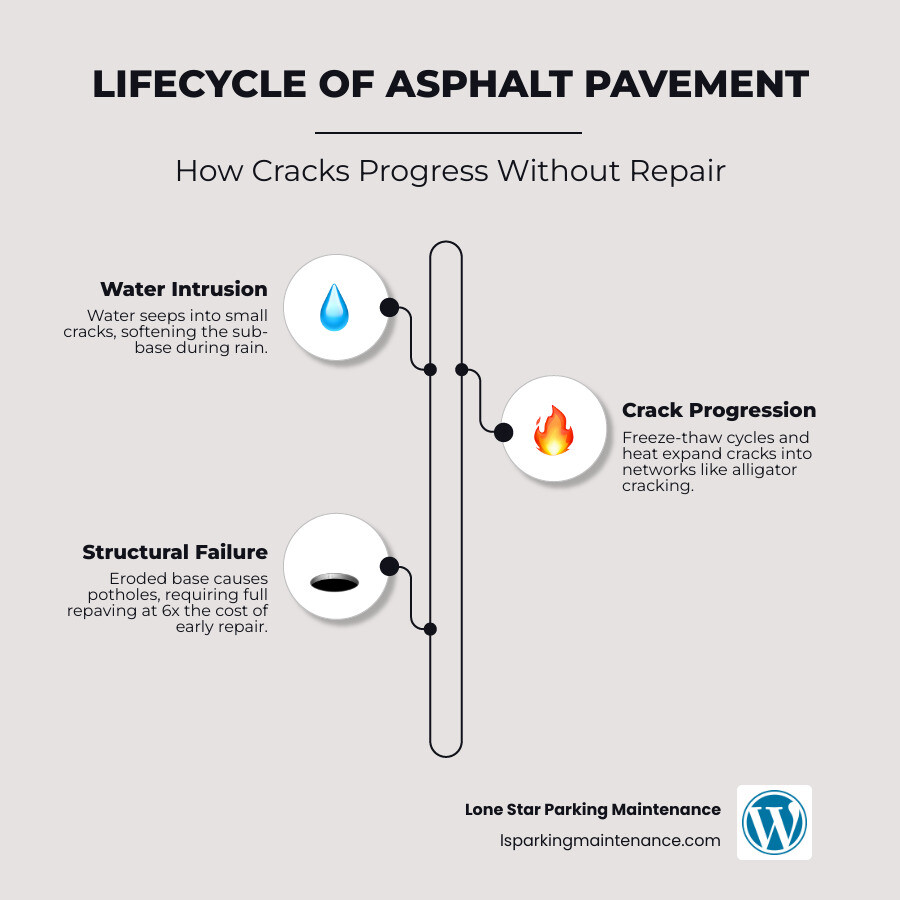
Even a small crack in your parking lot is not just a cosmetic issue. Water gets in. It softens the base layer beneath the asphalt. In DFW, summer heat and occasional freeze cycles do the rest — and what started as a hairline crack becomes a pothole or widespread structural damage.
The good news? Catching it early is dramatically cheaper. Research shows every $1 spent on crack repair today can save up to $6 in future repaving costs.
This guide walks you through everything you need to find the right asphalt crack repair service for your property — from understanding crack types and repair methods to hiring a qualified contractor.
Understanding the Importance of an Asphalt Crack Repair Service
When you look at your parking lot or driveway in April 2026, you might see a few thin lines stretching across the surface. It is easy to ignore them, but those lines are the first signs of a battle for your pavement’s survival.
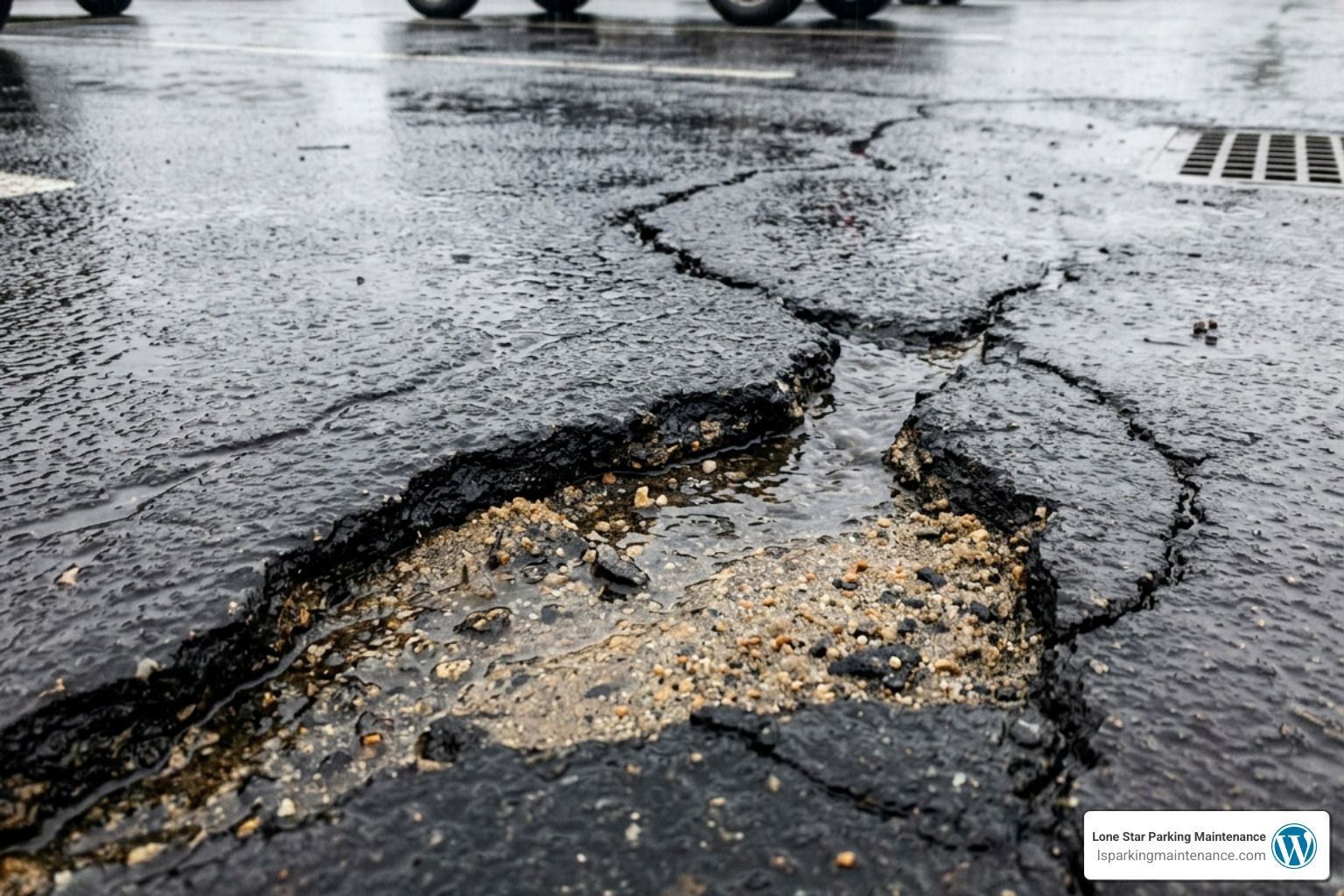
The primary enemy of asphalt is water. When rain falls on an unsealed surface, it finds its way into those cracks. Once inside, it doesn’t just sit there; it begins to erode the sub-base—the foundation that holds up the heavy weight of vehicles. Without a solid foundation, the asphalt loses its support and begins to crumble.
In our region, moisture damage is exacerbated by the freeze-thaw cycle. Even though we enjoy plenty of Texas sunshine, those winter nights where temperatures dip below freezing cause trapped water to expand, pushing the asphalt apart from the inside out. By utilizing a professional asphalt crack repair service, you are effectively “waterproofing” your investment.
Beyond the structural integrity of the road, there is a massive liability factor. Cracks can grow into trip hazards for pedestrians or cause damage to vehicles. Addressing these issues early reduces your liability and ensures your property meets safety standards. More info about the benefits of crack filling highlights how this simple step prevents the catastrophic failure of your parking facility.
Common Types of Asphalt Cracks and Their Causes
Not all cracks are created equal. Identifying the type of crack is the first step in determining the right repair strategy.
- Alligator Cracking: Also known as fatigue cracking, these look like the scales of an alligator. This is a sign of structural failure, often caused by heavy traffic on a base that has already been weakened by water.
- Longitudinal Cracks: These run parallel to the direction of the pavement. They are often caused by poor joint construction or temperature fluctuations.
- Transverse Cracks: These run perpendicular to the pavement’s centerline. They are usually “thermal cracks” caused by the asphalt shrinking in cold weather.
- Reflective Cracking: These occur when an old crack in a lower layer of asphalt “reflects” up through a new overlay.
- Edge Cracks: These form along the outer edges of the pavement, often due to poor drainage or lack of support from the surrounding soil.
While heavy traffic and UV rays are the usual suspects, other factors like ground movement and thirsty tree roots can also wreak havoc on your asphalt.
How an Asphalt Crack Repair Service Extends Pavement Lifespan
A well-installed asphalt driveway or parking lot should last between 25 and 30 years. However, that lifespan is entirely dependent on how well the foundation was prepared and, more importantly, how well it is maintained.
Without annual maintenance, that 30-year lifespan can easily be cut in half. Professional DFW asphalt services focus on preventing “oxidation”—the process where the sun’s UV rays bake the oils out of the asphalt, making it brittle and grey. When the binder deteriorates, the rocks and sand that make up the asphalt begin to “ravel” or break loose.
The ROI (Return on Investment) of crack filling is undeniable. As mentioned earlier, spending $1 on maintenance now prevents a $6 repaving bill later. In a large commercial lot, that ratio can represent tens of thousands of dollars in savings over the life of the property.
The Professional Process: How Cracks are Filled and Sealed
The secret to a repair that lasts years versus one that fails after the first rainstorm lies in the preparation. You can’t just pour filler into a dirty crack and expect it to stick.
Materials Used in a Professional Asphalt Crack Repair Service
When you hire a professional, you are getting access to industrial-grade materials that simply aren’t available at the local hardware store.
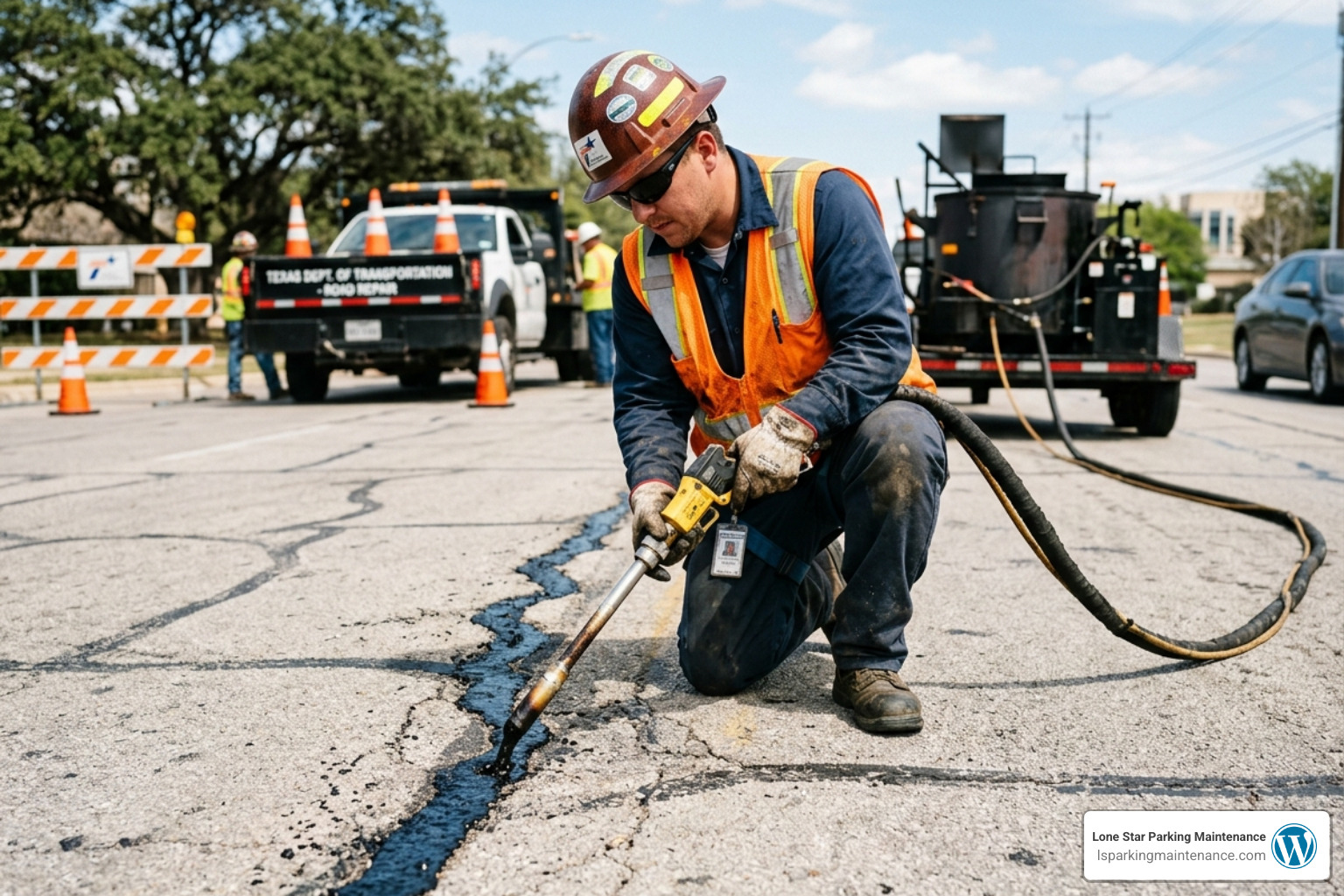
- Hot-Pour Rubberized Filler: This is the gold standard. It is a rubberized asphalt material heated to between 360°F and 380°F. Because it is applied as a hot liquid, it flows into every nook and cranny of the crack, creating a deep bond. As it cools, it remains flexible, allowing it to expand and contract with the Texas heat.
- Cold-Pour Liquid: While sometimes used for very minor hairline cracks, cold-pour products generally lack the adhesion and longevity of hot-pour solutions.
- DOT Specifications: Professionals use sealants that meet Department of Transportation standards. These are the same high-performance materials used on major highways to ensure public safety and durability.
Step-by-Step Application and Curing
Our process is meticulous because we know that shortcuts lead to call-backs.
- Inspection: We walk the lot to identify every crack and determine if it needs filling or a more intensive patch.
- Cleaning and Debris Removal: We use high-pressure compressed air and wire brushing to remove dirt, rocks, and vegetation. If grass is growing in the cracks, it must be completely removed, or the filler won’t bond.
- Application: Using a heated wand, we apply the hot-pour filler directly into the crack.
- Tooling Smooth: We use a squeegee to finish the surface, ensuring the filler is level with the surrounding asphalt. This prevents snowplows or tires from catching the edge of the repair.
- Curing: While the material cools quickly, we recommend a 4-8 hour dry time before light use and a 24-48 hour full cure before heavy traffic resumes.
For more details on the intricacies of the job, check out The ultimate guide to filling every crack in your driveway, which breaks down the process for residential and commercial owners alike.
Comparing Maintenance Methods: Filling, Sealing, and Patching
It’s easy to get confused by the industry jargon. Is “sealing” the same as “filling”? Not exactly.
| Method | Purpose | Typical Frequency | Best For |
|---|---|---|---|
| Crack Filling | Structural / Preventative | Annually (as needed) | Individual cracks up to 1-inch wide |
| Sealcoating | Cosmetic / Protective | Every 3-5 years | Preventing UV damage and fading |
| Patching | Reactive / Structural | As needed | Potholes and “alligator” areas |
Sealcoating is like putting sunscreen on your skin; it protects the surface from the sun and minor moisture. Crack filling is like getting a stitch; it’s a structural fix for a specific wound. For the best results, we recommend a 3-5 year cycle where crack filling is performed first, followed immediately by a fresh layer of sealcoat to protect the entire surface.
When to Choose Patching Over Crack Filling
Sometimes, a crack is too far gone for simple filling. If you see “alligator” cracking or a deep pothole, it usually means the base layer has failed. In these cases, we look at asphalt patching solutions. This might involve “milling” (grinding away the top layer) or even full-depth reclamation, where we recycle the old pavement to create a new, durable foundation. If water is constantly pooling in one area, a drainage redesign may be necessary before any new asphalt is laid.
Hiring the Right Contractor for Your Property
Choosing an asphalt crack repair service in the DFW Metroplex requires due diligence. You aren’t just looking for the lowest price; you are looking for a partner to protect your asset.
When interviewing contractors, ask the following:
- Are you licensed, bonded, and insured?
- Do you carry worker’s compensation for your crew?
- Do you use your own crews or subcontractors?
- What is your cleanup process?
- Do you provide a written warranty on your work?
Knowing how do i know if my parking lot needs crack filling can help you speak the contractor’s language and ensure you aren’t being upsold on unnecessary services.
Frequently Asked Questions about Asphalt Maintenance
How much does asphalt crack repair cost and how do I know if I need it?
The national average for a new asphalt installation is around $4,740, but maintenance is much more affordable. Professional crack filling typically costs between $0.50 and $1.50 per linear foot.
You know you need it if you see:
- Visible gaps or “spiderweb” patterns.
- Pooling water that doesn’t drain after a Texas rainstorm.
- A faded, grey surface (this indicates the asphalt is becoming brittle).
- Vegetation growing through the pavement.
How soon can I drive on the pavement and how long will it last?
One of the best parts of using a professional asphalt crack repair service is the minimal downtime. Because we use hot-pour rubberized materials, they begin to firm up as soon as they hit the cooler pavement. In most cases, the lot is ready for traffic within a few hours.
A professional repair should last 3 to 5 years, depending on the volume of heavy truck traffic and the severity of the weather. Regular annual inspections can catch new cracks early, keeping your maintenance costs low and predictable.
Why hire a professional instead of attempting a DIY repair?
It’s tempting to grab a jug of liquid filler from a big-box store, but DIY repairs often fail within a single season.
- Temperature Matters: DIY products are “cold-applied.” They don’t bond to the sidewalls of the crack like 380°F hot rubber does.
- Equipment: Professionals use specialized high-pressure air lances to ensure the crack is bone-dry and clean. A standard garden hose or broom won’t suffice.
- Safety: Working with molten rubber and high-temperature machinery requires specialized training.
- Assessment: A pro can tell the difference between a surface crack and a structural failure that requires a more intensive fix.
Conclusion
Maintaining your property’s asphalt isn’t just about making it look “pretty”—it’s a smart financial strategy. By investing in a regular asphalt crack repair service, you are protecting your sub-base, reducing your liability, and significantly extending the life of your pavement.
At Lone Star Parking Maintenance, we bring DFW Metroplex expertise to every project. Whether you manage a small retail lot or a massive industrial facility, our commitment to top-quality materials and safety standards ensures your property remains a valuable asset for years to come.
Don’t wait for a small crack to become a $50,000 repaving project. If you’re ready to protect your investment, explore our parking lot sealing and crack filling services today. We’ll help you keep your pavement smooth, safe, and looking its best well into the future.