
Understanding Parking Structure Sealcoating: Sealants vs. Membranes
When protecting multi-level concrete garages, understanding the key structural differences between localized joint sealants and full-coverage traffic-bearing membranes is essential for facility managers. While traditional asphalt sealcoating relies on emulsified surface barriers to block moisture and UV degradation on ground-level asphalt lots, reinforced concrete parking decks face multi-directional dynamic stresses. Elevated concrete slabs experience continuous movement, dynamic vehicular loading, and structural deflections that demand high-performance elastomeric materials.
Concrete is inherently porous and susceptible to micro-cracking. Without proper protection, surface water carrying de-icing salts, automotive fluids, and industrial pollutants penetrates deep into the concrete matrix. Chloride ions break down the protective passivating layer around embedded steel reinforcing rebar, leading to subsurface corrosion, expansion, and eventual structural spalling. A comprehensive parking structure sealcoating strategy pairs specialized localized expansion joint sealants with full-coverage fluid-applied traffic membranes to deliver complete moisture defense.
High-performance commercial coating systems like MasterSeal Vehicular Traffic 2530 Specifications create a continuous, seamless chemical barrier. These specialized formulations absorb physical dynamic stresses caused by rolling tire loads while permanently locking out liquid moisture and corrosive chemicals from reaching internal structural components.
Key Differences in Horizontal vs. Vertical Parking Structure Sealcoating
Not all concrete expansion joints or structural cracks accept the same formulation. Application angle, joint geometry, depth-to-width ratios, and gravitational pull dictate whether a self-leveling (SL) or non-sag (NS) sealant is required for long-term stability.
- Self-Leveling Sealants: These low-viscosity fluid formulations level out automatically under gravity to fill horizontal expansion joints rapidly and uniformly. However, they are strictly restricted to horizontal surfaces with no more than a 6 percent grade limit to prevent uncontained material runoff.
- Non-Sag Sealants: Gun-grade, high-viscosity formulations hold their shape without slumping in vertical expansion joints, wall-to-floor transitions (cant beads), column perimeter joints, and steep ramp slopes.
Selecting the correct viscosity for each application area ensures that moisture cannot bypass sealant lines or infiltrate behind structural retention walls and underneath supported deck slabs.
Membrane System Benefits for Vehicular Decks
Full-deck fluid-applied elastomeric membranes do far more than provide basic surface moisture resistance; they actively preserve overall structural integrity under continuous traffic loading. Multi-layer polyurethane and polyaspartic systems provide durable flexibility, allowing them to bridge moving hairline cracks that dynamically open and close as environmental temperatures shift.
A heavy-duty elastomeric basecoat offers tensile strengths reaching 3,400 psi combined with up to 900 percent elongation. Passing rigorous industry testing standards like ASTM C957, these high-performance elastomeric membranes stretch seamlessly over expanding substrate cracks without tearing or delaminating, providing reliable, continuous protection that maximizes how long your capital investment lasts.
Comparing High-Performance Joint Sealants for Garages
Selecting high-performance joint sealants for parking decks requires balancing tensile strength, elongation capacity, movement capability, cure velocity, and Volatile Organic Content (VOC) compliance. Cold-applied, low-modulus silicone sealants are industry leaders because they provide exceptional long-term elasticity without exerting excessive strain on concrete joint edges during severe freeze-thaw cycles.
| Sealant Type | Modulus / Form | Elongation | Movement Capability | Ideal Application Zone |
|---|---|---|---|---|
| Self-Leveling Silicone (e.g., DOWSIL™ SL) | Ultra-Low Modulus / 1-Part | 1500% | -50% to +100% | Horizontal expansion joints (up to 6% slope) |
| Non-Sag Silicone (e.g., DOWSIL™ NS) | Low Modulus / 1-Part Gun-Grade | 1600% | -50% to +100% | Vertical joints, wall risers, steep ramps |
| Fast-Cure Silicone (e.g., DOWSIL™ FC) | Ultra-Low Modulus / 2-Part | 1600% | -50% to +100% | High-traffic joints requiring rapid return to service |
Proper joint geometry is crucial when installing these elastomeric formulations. Technicians install closed-cell polyethylene backer rods to control sealant depth, establish a proper 2:1 width-to-depth ratio, and prevent three-sided adhesion, which allows the joint to flex freely under intense concrete thermal expansion.
Selecting Fast-Cure Solutions for Tight Timelines in Parking Structure Sealcoating
Commercial facility owners and parking operators rarely have the flexibility to close a revenue-generating garage for extended periods. Traditional one-part moisture-cure silicones rely on atmospheric humidity and can require several days to achieve full structural cure. In contrast, two-part fast-cure silicones cure rapidly through an internal chemical reaction.
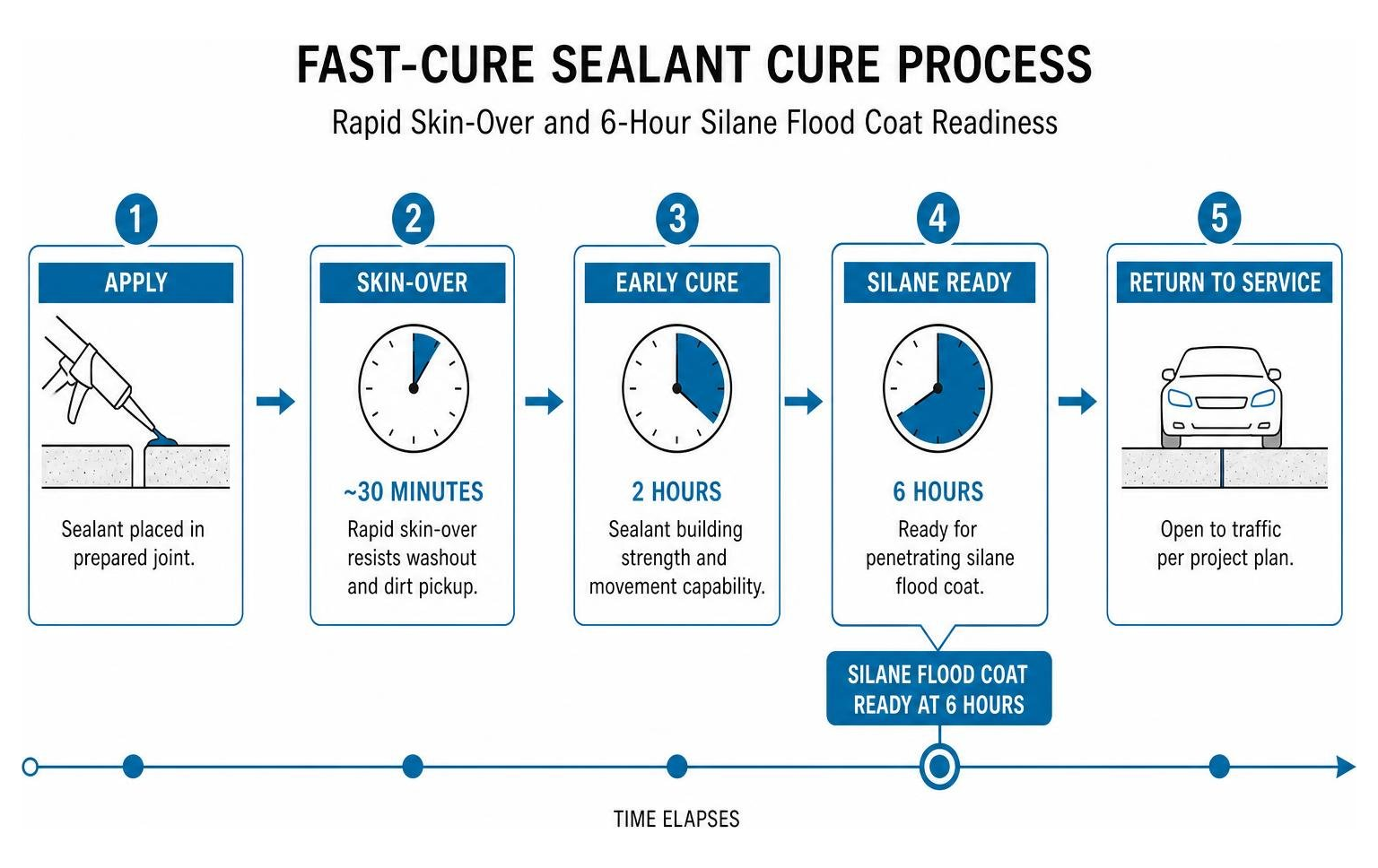
These advanced fast-cure sealants withstand early thermal concrete movement and dynamic traffic vibrations without suffering cohesive split failures or adhesive bond release. High-tech products such as DOWSIL™ FC Parking Structure Sealant skin over quickly and can accept penetrating silane water repellent flood coats in as little as six hours post-application. Understanding what sealants to use helps project managers maintain tight, multi-phase maintenance schedules without compromising coating durability or facility uptime.
Step-by-Step Surface Preparation and Application Protocol
Even premium waterproofing systems fail prematurely if applied over improperly prepared substrates. The single most common cause of membrane peeling, bubbling, and debonding is applying coatings over oily, contaminated, smooth, or structurally compromised concrete surfaces.

- Substrate Assessment & Moisture Testing: Inspect concrete for curing compounds, laitance, grease, or existing coating failures. Concrete must cure for a minimum of 28 days, achieve 3,000 psi compressive strength, and pass relative humidity testing (ASTM F2170) to verify low moisture vapor emissions.
- Mechanical Profiling (Shotblasting): Profile the slab mechanically using self-contained shotblasting equipment to reach ICRI Concrete Surface Profile #3 (CSP #3). Acid etching is strictly unacceptable for deck membranes as it introduces uncontained water and acid salts into the slab.
- Crack Routing and Detailing: Route dynamic substrate cracks to a minimum 1/4-inch width, vacuum thoroughly, and fill with elastomeric polyurethane detail coats or non-sag sealants. Install 45-degree elastomeric cant beads at all vertical-to-horizontal intersections.
- Primer and Basecoat Application: Apply high-adhesion epoxy or polyurethane primers followed by a continuous elastomeric basecoat mixed with slow-speed mixers (400–600 rpm) to prevent air entrainment and pinholing.
- Aggregate Broadcast & Topcoat System: Apply dynamic wear coats, broadcasting angular, kiln-dried quartz aggregate into the wet coating until saturated. After curing, sweep excess aggregate and seal with a heavy-duty UV-stable topcoat to provide skid-resistant vehicular traction.
Executing proper mechanical shotblasting guarantees powerful mechanical interlock, often enabling primerless bonding on clean porous concrete, as demonstrated in the Ocean County Parking Garage Case Study. Combining proper profiling with proactive crack filling and sealing ensures a long-lasting, watertight deck defense.
Tailoring Zoned Applications for Top Decks and Lower Levels
Every level of a parking structure experiences distinct environmental and operational stresses that demand tailored coating thickness and formulation adjustments:
- Top Decks (Weather-Exposed Decks): Open top levels endure intense direct ultraviolet (UV) radiation, radical temperature fluctuations, rainfall, wind, and freeze-thaw thermal expansion. They require highly flexible elastomeric membranes paired with aliphatic polyaspartic or polyurethane topcoats that resist yellowing and UV degradation.
- Supported Intermediate Levels: Enclosed middle decks are sheltered from direct weather but endure persistent tire shear, oil drops, dynamic slab deflections, and exhaust deposits. Penetrating silane water repellents or light-duty elastomeric systems protect intermediate slabs without adding unnecessary structural dead load.
- High-Wear Drive Lanes & Turning Ramps: Helical ramps, ticket queues, pay stations, and sharp turn radii suffer extreme tire scrubbing, heavy braking, and constant mechanical impact. These zones require reinforced multi-coat systems featuring double-broadcast aggregate layers for maximum wear resistance.
By customizing coating specifications according to wear zones, building owners optimize maintenance capital while maximizing protection where wear is most aggressive.
Overcoming Environmental, Chemical, and Traffic Load Challenges
Parking structures operate under demanding environmental conditions daily. Across North Texas and the DFW Metroplex, summer surface temperatures on exposed decks can top 140°F, forcing concrete slabs to expand significantly. Rapid winter temperature drops create dramatic contraction forces that break brittle, unqualified coating materials.
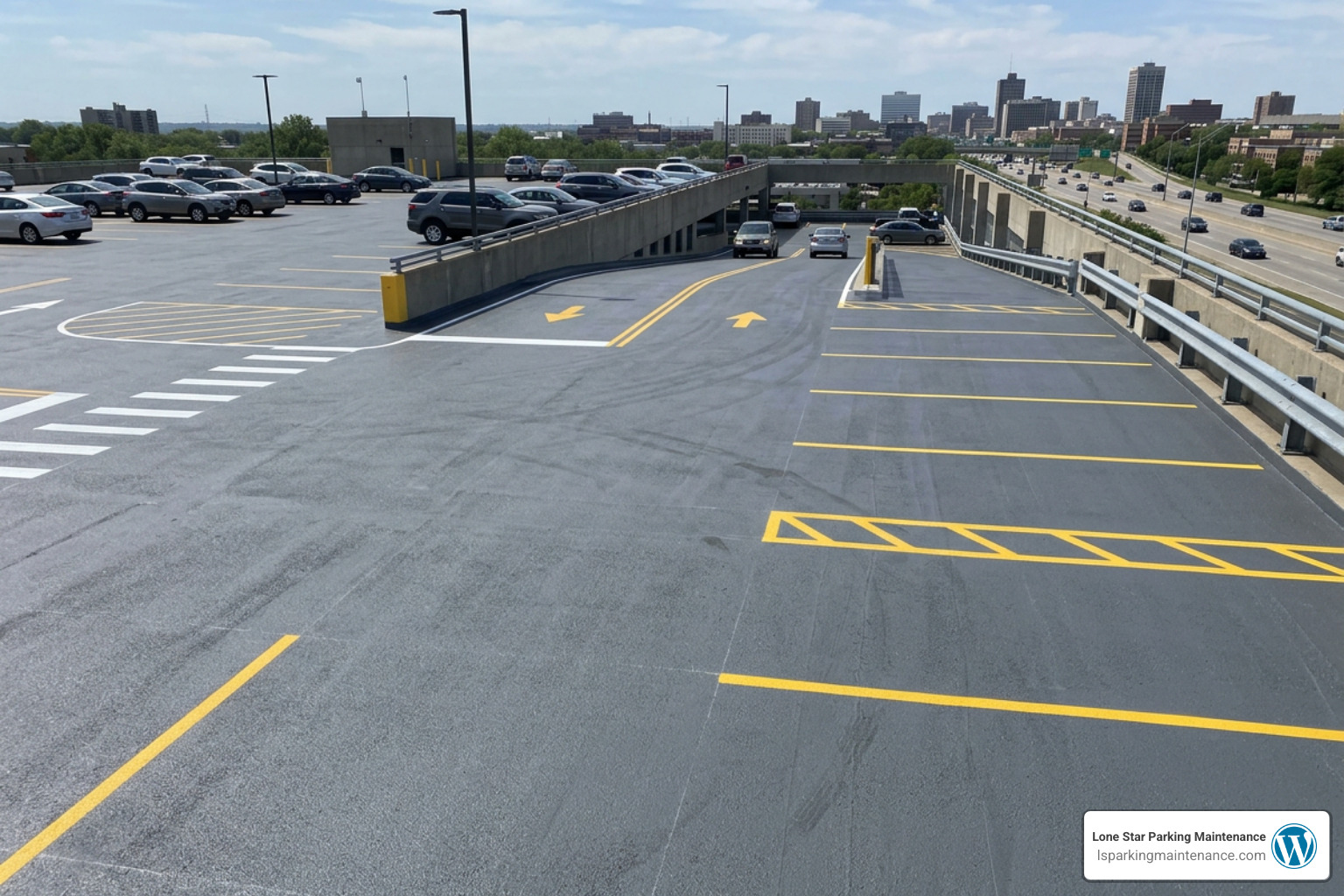
A professional parking structure sealcoating installation is specifically engineered to overcome these complex destructive forces:
- Chemical Resistance: Motor oils, transmission fluids, battery acids, and de-icing chemicals rapidly degrade unprotected concrete binders. High-solids polyaspartic and polyurethane wear coats form an impenetrable barrier that prevents chemical absorption and concrete softening.
- Dynamic Mechanical Loading: Heavy SUVs, electric vehicles with high battery weight, delivery trucks, and constant turning movements subject deck surfaces to severe shear stresses. Encapsulating high-hardness angular aggregates within tough resin matrices resists gouging and premature wear.
- Freeze-Thaw Spalling Defense: Water expands by approximately 9 percent when freezing inside concrete capillary pores. Sealing the surface prevents water entry, eliminating freeze-expansion forces that cause surface pop-outs, delamination, and concrete spalling.
Addressing these environmental threats early preserves property valuations and keeps structures safe for visitors, shielding your garage investment much like regular asphalt maintenance shields surface lots.
Frequently Asked Questions About Parking Deck Sealing
What is the difference between self-leveling and non-sag silicone sealants?
Self-leveling (SL) silicone sealants are low-viscosity, fluid-applied materials formulated specifically for horizontal joints with slopes under 6%. They flow smoothly under gravity to fill joint cavities uniformly without requiring hand tooling. Non-sag (NS) sealants are thick, gun-grade formulations designed with high thixotropic properties. This allows them to bridge joints on vertical concrete surfaces, wall-to-floor cant intersections, column wraps, and steep ramp inclines without slumping, sagging, or running out of the joint during application.
How long must concrete cure before applying a traffic bearing membrane?
New structural concrete must cure for a minimum of 28 days under normal weather conditions and achieve a minimum compressive strength of 3,000 psi prior to applying fluid-applied waterproofing membranes. Additionally, moisture content within the concrete slab must be evaluated via relative humidity (RH) testing (ASTM F2170) or calcium chloride testing (ASTM F1869) to verify that moisture vapor emission rates meet the coating manufacturer’s strict specifications before primer application.
Why is shotblasting to CSP #3 necessary before sealcoating a concrete garage?
Mechanical shotblasting is the industry standard surface preparation method for parking structures because it effectively strips away surface laitance, contaminants, oil residue, and old coatings while fracturing the smooth top matrix of the concrete. This produces a uniform profile meeting ICRI Concrete Surface Profile #3 (CSP #3). The roughened anchor pattern provides crucial mechanical keying, allowing fluid-applied polyurethane and epoxy coatings to lock tightly into the substrate, preventing bond failure and blistering under heavy rolling vehicle traffic.
Conclusion
Protecting a multi-level concrete garage demands specialized structural knowledge, rigorous surface profiling, and precision application expertise. Unprotected or poorly maintained parking structures inevitably suffer from internal rebar corrosion, concrete spalling, moisture intrusion, and costly long-term structural repairs. Implementing a proactive, engineered maintenance program that combines low-modulus silicone expansion joint sealants with durable elastomeric traffic membranes preserves structural integrity while maintaining a clean, professional aesthetic.
At Lone Star Parking Maintenance, we specialize in comprehensive parking garage maintenance tailored to commercial properties across the DFW Metroplex. From mechanical shotblast surface preparation and joint repair to high-performance traffic deck waterproofing and precision line striping, our experienced technicians deliver long-lasting, turn-key solutions.
Ready to extend the life of your concrete parking garage? Schedule Professional Parking Garage Maintenance and Striping with our team today!