
Why Water and Parking Lots Are a Dangerous Combination
When you need to install parking lot drains, the core steps are:
- Assess your site — identify low points, sheet flow paths, and existing drainage issues
- Choose your system — catch basins, trench drains, French drains, or permeable pavers based on rainfall and traffic load
- Design for your conditions — calculate runoff using Q = CiA, set minimum 1% slope toward drains, and select the right load class grates
- Excavate and install — set channels at proper grade, encase in concrete, and connect to your stormwater outlet
- Maintain regularly — clean catch basins semi-annually and inspect grates monthly to prevent failure
Picture this: it’s a Tuesday morning after a heavy overnight storm. Your parking lot looks more like a shallow lake. Customers are stepping over ankle-deep puddles to reach your front door — or worse, they’re turning around and driving somewhere else.
Poor drainage isn’t just an eyesore. It’s a liability. Standing water softens the subgrade beneath your asphalt, accelerates cracking, and creates slip-and-fall risks that can land a property owner in court.
And in the DFW Metroplex, where heavy rain events are common, the damage compounds fast. Water that has no clear path out of your lot will find its own path — usually under your pavement.
The good news: a properly designed drainage system can prevent almost all of this. This guide walks you through everything you need to know — from choosing the right system for your property to installation, engineering basics, and long-term maintenance.
Install parking lot drains word roundup:
The Cost of Poor Drainage: How Water Destroys Your Pavement
Water is the absolute worst enemy of any paved surface. While asphalt looks solid and impenetrable, it is actually a flexible pavement that relies entirely on the strength of the soil and stone base beneath it. When water is allowed to pool on the surface, it eventually finds its way through microscopic pores and hairline cracks in the asphalt.
Once water penetrates the surface, it saturates the subgrade. This subgrade saturation weakens the foundation of your parking lot. When heavy vehicles drive over these saturated areas, the flexible asphalt bends under the weight, but the weakened base cannot support it. The result? The pavement cracks, sinks, and breaks apart, leading to rapid structural failure.
In the DFW Metroplex, we also have to contend with freeze-thaw cycles. Even though our winters are generally mild, we experience rapid temperature swings. When water gets trapped in pavement cracks and freezes, it expands by about 9%. This expansion forces the asphalt apart. When the ice melts, it leaves behind a larger void. Over a single winter, this cycle can turn minor cracks into massive, tire-popping potholes.
Beyond structural damage, poor drainage creates immediate business liabilities:
- Slip-and-Fall Hazards: Algae and slick films quickly grow in areas with standing water. In winter, these puddles turn into invisible sheets of black ice.
- Property Damage Claims: Potholes can damage customer vehicles, leading to costly claims against your business.
- Erosion: Uncontrolled runoff washes away surrounding landscaping, erodes concrete curbs, and undermines sidewalks.
To protect your pavement and your bottom line, you must take proactive steps to manage water flow. For practical strategies on identifying these trouble spots early, check out our guide on how to Stop the Soak with These Parking Lot Drainage Tips.
Why You Should Install Parking Lot Drains Before Pavement Failure
Waiting until your parking lot is covered in potholes and deep cracks to address drainage issues is a costly mistake. Retrofitting a drainage system after structural failure has occurred means you will not only pay to install parking lot drains, but you will also face massive bills for asphalt patching, soil stabilization, and structural resurfacing.
When drainage is ignored, minor asphalt cracking quickly escalates into foundational damage. Once the subgrade is compromised, simple sealcoating or crack filling will no longer solve the problem; entire sections of your lot must be excavated and rebuilt.
By installing proper drainage systems early, you protect the structural integrity of your pavement and extend its lifespan by decades. If you want to understand the core mechanics of how water moves across your property and why early intervention is key, read our essential breakdown in Parking Lot Drainage 101.
Choosing the Right Drainage System for Your Property
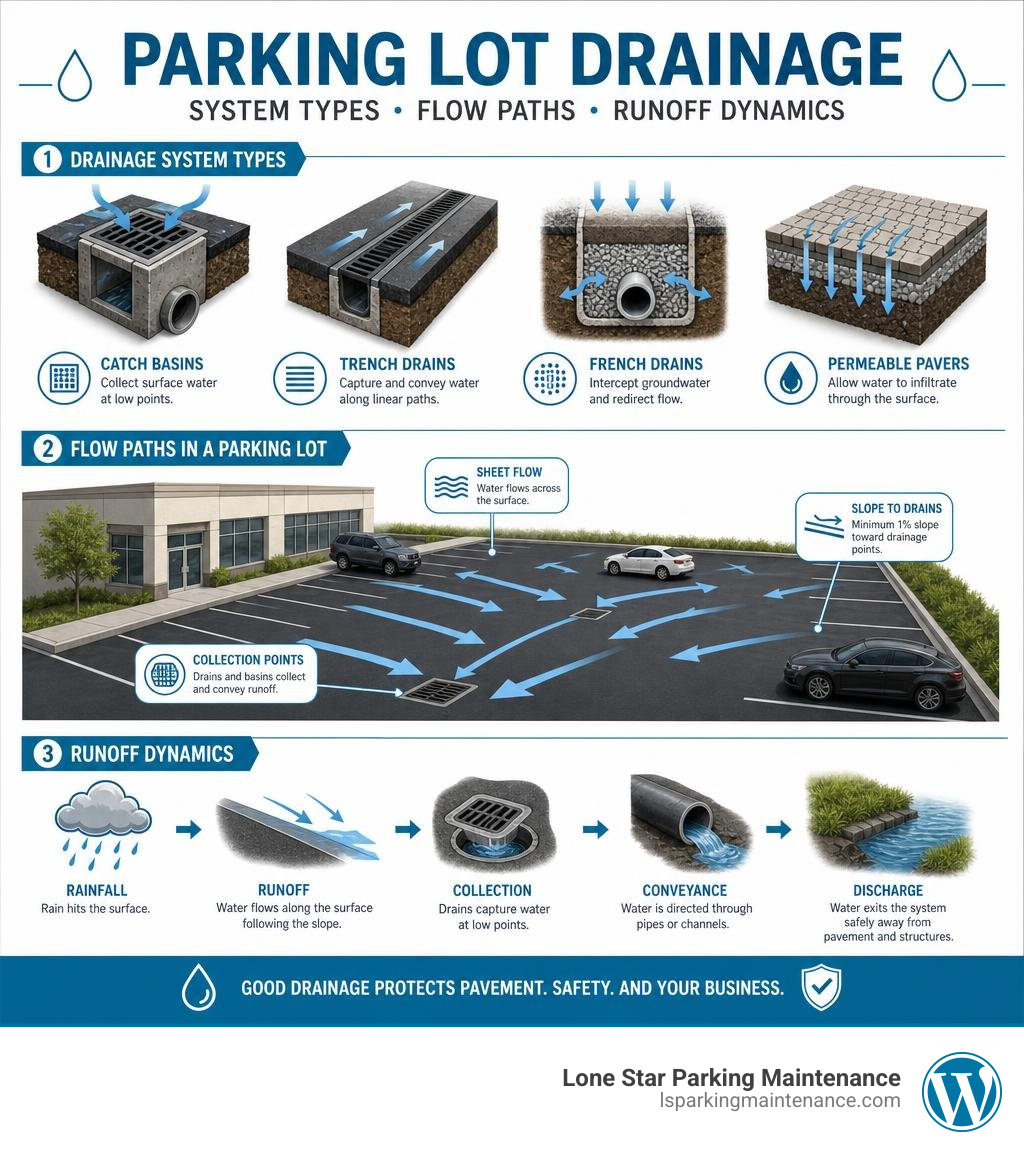
Every commercial property has unique layout challenges, traffic patterns, and soil conditions. Selecting the right system depends on whether you are dealing with surface sheet flow or subsurface water accumulation.
| Drainage System Type | Primary Function | Best Suited For | Maintenance Level | Expected Lifespan |
|---|---|---|---|---|
| Standard Catch Basins | Point source surface water collection | Low to moderate rainfall, localized low points | Medium (Semi-annual cleanout) | 20-30 Years |
| Trench Drains | Linear surface water interception | Moderate to heavy rainfall, sheet flow across large areas | Medium (Quarterly debris removal) | 20-30 Years |
| French Drains | Subsurface water management | Saturated subgrades, landscaping runoff | Low (If installed with filter fabric) | Up to 30 Years |
| Permeable Pavers | Eco-friendly infiltration & runoff reduction | Light to moderate traffic, green buildings | High (Requires vacuum sweeping) | 20-25 Years |
| Bioswales | Natural filtration & detention | Large properties, eco-compliance | Medium (Landscaping care) | Indefinite (With plant care) |
Catch Basins and Trench Drains for Surface Water
For managing surface water, catch basins and trench drains are the workhorses of commercial parking lots.
Standard Catch Basins are designed to collect water at specific localized low points. They feature a grate at pavement level and a concrete or plastic basin underground. Debris and sediment settle to the bottom of the basin, while clean water exits through an outlet pipe set higher up. For heavy-duty commercial applications, we highly recommend concrete-encased drainage basins. These are built to withstand the constant weight of heavy delivery trucks without shifting or cracking.
Trench Drains (or linear drains) are designed to intercept sheet flow—water that flows across a wide, flat pavement surface. Instead of collecting water at a single point, a trench drain acts as a continuous barrier. It is ideal for placing along building perimeters, at the bottom of slopes, or across parking lot entrances to prevent water from flooding adjacent structures.
When choosing a trench drain, matching the channel width and grate to your specific traffic load and rainfall intensity is crucial. For detailed engineering specifications on linear drainage channels, refer to the Trench Drain Design and Load Considerations guide.
French Drains and Subsurface Solutions
While catch basins and trench drains handle water on top of your pavement, French drains manage the water hidden beneath it.
If your parking lot is built near a high water table, or if adjacent sloped landscaping constantly sheds water toward your asphalt, the soil beneath your pavement will remain saturated. This leads to soft spots, sinking asphalt, and early pavement failure.
A French drain consists of a trench filled with gravel and a perforated pipe wrapped in a filter fabric sleeve. The fabric prevents fine dirt and silt from entering and clogging the pipe, while the gravel allows subsurface water to easily seep into the pipe and drain safely away from your pavement’s foundation.
When properly designed and installed, a commercial French drain can last up to 30 years, preserving your lot’s structural integrity. Learn more about how to protect your subgrade from subterranean saturation in French Drains 101: Stop Sinking and Start Draining Your Lot.
Designing Your Drainage System: Sizing, Slope, and Load Classes

Designing a commercial drainage system requires precise engineering calculations. If your drains are undersized, they will overflow during heavy Texas downpours, leaving you with the exact same flooding problems you started with.
To design an effective system, engineers rely on the Rational Method to calculate peak stormwater runoff. This method is highly accurate for drainage areas under 200 acres, making it perfect for commercial parking lots.
Key Engineering Calculations to Install Parking Lot Drains Correctly
The peak runoff flow rate is calculated using the Rational Formula:
$$Q = \frac{C \cdot i \cdot A}{96.23}$$
Where:
- Q = Peak runoff rate in cubic feet per second (CFS).
- C = Runoff coefficient (a dimensionless value representing the percentage of rainfall that runs off the surface). For conventional, impermeable asphalt and concrete parking lots, this value is extremely high, typically ranging from 0.70 to 0.95.
- i = Rainfall intensity in inches per hour. This value is determined using regional Intensity-Duration-Frequency (IDF) curves for your specific design storm.
- A = Drainage area in acres.
To ensure your system can handle severe weather, local municipal codes in the DFW Metroplex generally require commercial parking lot drainage systems to be designed for at least a 2-year design storm frequency, with many major commercial zones requiring capacity for 10-year or even 25-year events. We utilize precipitation frequency data from NOAA Atlas 14 to get precise, updated rainfall statistics for our region.
Once you know the peak runoff rate ($Q$), you must size your drainage channels and set the correct pavement pitch:
- Pavement Slope: Paved parking lot surfaces should have a minimum finished slope of 0.4% (ideally between 1% and 5%) to guide water toward the drains and prevent localized ponding.
- Gutter and Channel Grades: Curbed pavement gutters must maintain a minimum grade of 0.5% to ensure water continues to flow efficiently.
- Pre-Sloped Channels: When installing trench drains on flat ground, we use pre-sloped channel systems (typically featuring a built-in 0.5% to 1% slope). This built-in slope ensures water maintains a consistent velocity, which helps flush out sediment and prevents clogging.
For a step-by-step breakdown of channel sizing and layout planning, you can consult the Dura Slope Trench Drain Quick Start Guide.
Understanding Load Classes and Grate Selection
Selecting the correct load class for your drainage grates is critical for safety and system longevity. Grates installed in commercial parking lots must withstand heavy vehicular traffic without bending, cracking, or popping out of their frames.
We use standard load class ratings to match grates to their intended applications:
- Class B (Up to 27,500 lbs): Suitable for light passenger car parking and pedestrian areas.
- Class C (Up to 55,000 lbs): Designed for commercial areas with moderate traffic, including light delivery trucks and buses.
- Class D (Up to 88,000 lbs): Required for heavy-duty traffic areas, gas stations, loading docks, and heavy delivery truck routes.
- Class E (Up to 132,000 lbs): Reserved for industrial facilities, commercial docks, and high-impact heavy machinery zones.
Additionally, if your drains are located along pedestrian walkways or near accessible parking stalls, they must feature slip-resistant, ADA-compliant grates with narrow slot widths to prevent heels, wheelchairs, and strollers from getting caught.
Step-by-Step Guide: How to Install Parking Lot Drains Safely
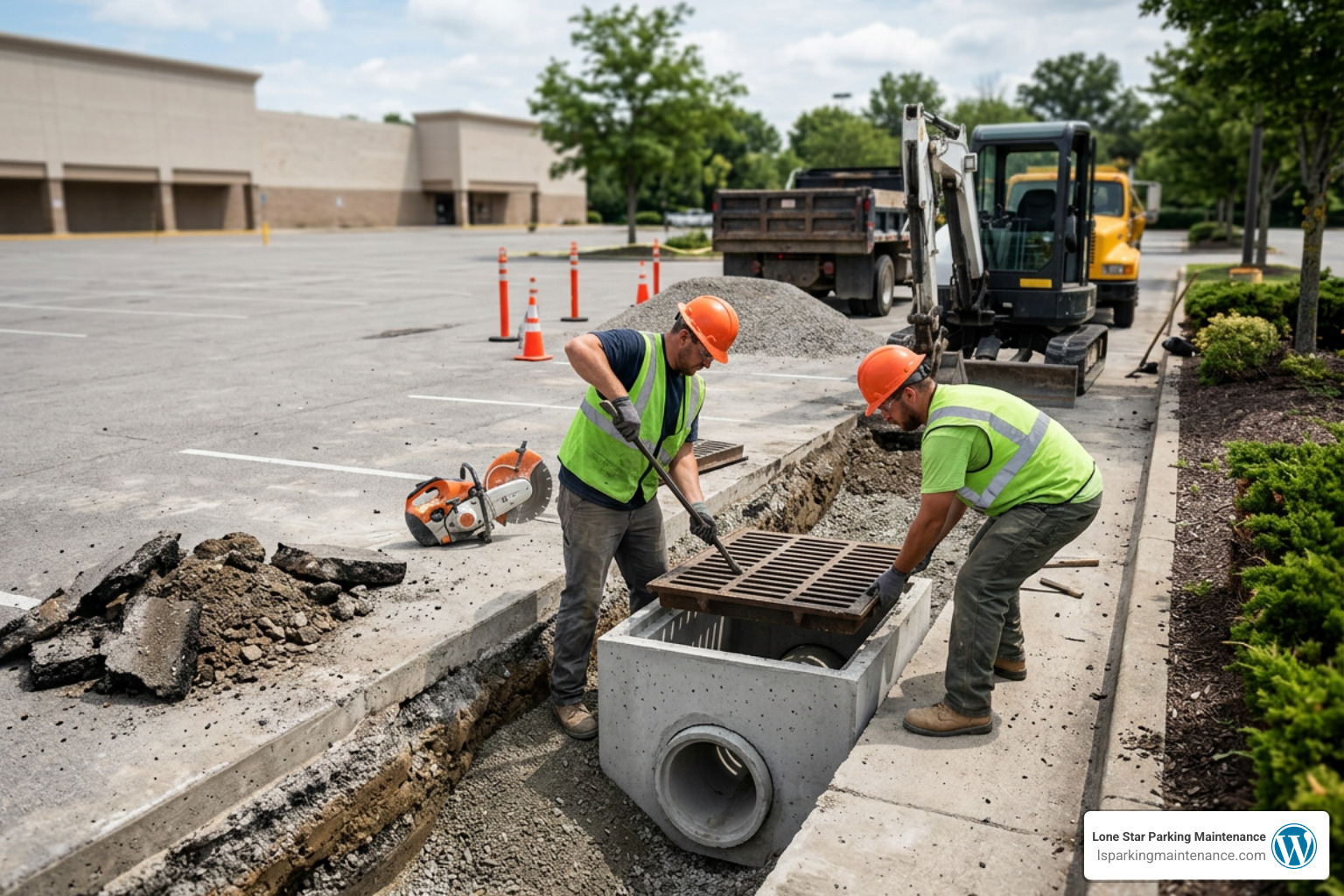
When we install parking lot drains, following precise construction steps is essential to ensure the system remains stable under heavy traffic loads for decades. Here is how a professional trench drain installation is executed:
- Utility Marking & Excavation: Before breaking ground, we always contact local utility companies to locate and mark any underground lines. We then excavate a trench that is 4 to 8 inches wider and deeper than the drainage channel itself. This extra space is required to accommodate a structural concrete encasement collar.
- Pouring the Bedding Concrete: We pour a concrete base at the bottom of the trench to support the channels at the correct grade.
- Assembling and Aligning Channels: We lay out the channel sections starting from the deepest outlet end and work our way upstream. It is vital to ensure all joints are sealed with waterproof silicone or butyl caulk. We use installation chairs and rebar stakes driven into the subgrade to lock the channels in place and prevent them from shifting during the pour.
- Preventing Floating: Because plastic and polymer concrete channels are lightweight, they will float when wet concrete is poured around them. To prevent this, we install the grates (wrapped in protective plastic for easy cleanup) or use wooden bracing to lock the channel securely to the rebar framework.
- The Concrete Pour: We place a minimum of 3,000 to 4,000 PSI concrete equally on both sides of the channel, using a concrete vibrator to eliminate air pockets and ensure complete consolidation under the channel. The finished concrete collar must be recessed 1/8 inch to 1/4 inch above the edge of the drain channel to ensure water flows smoothly into the grate.
- Curing and Final Connections: We allow the concrete to cure for at least 24 hours before removing any protective wrapping or alignment inserts. Finally, we connect the drain run to the main stormwater sewer or outlet.
For residential-scale driveways or light-duty parking zones, you can review the basic steps in the Water on Driveway – Instructions guide to see how low-capacity systems are configured.
Sustainable Stormwater Management: Gray Infrastructure vs. LID
Traditionally, commercial properties relied entirely on “gray infrastructure”—concrete pipes, catch basins, and massive detention ponds—to collect and carry stormwater away as quickly as possible. However, modern commercial developments are shifting toward Low Impact Development (LID) and green infrastructure solutions.
LID focus on managing stormwater at its source by mimicking natural hydrology. This includes systems like bioswales, rain gardens, and permeable pavements.
How do these two approaches compare?
- Runoff Reduction: While conventional asphalt sheds 100% of rainwater, permeable pavement systems can reduce runoff depths by 47% and lower peak flow rates by 56%.
- Cost Efficiency: Over a 20- to 30-year service life, LID systems can be 10% to 15% cheaper than traditional gray infrastructure. In fact, the US EPA reports that green infrastructure can reduce total project costs by 15% to 50% by eliminating the need for expensive underground piping and massive land-consuming detention ponds.
- Environmental Impact: Permeable pavers act as natural filters, reducing suspended solids in stormwater by 80% to 90%, nutrients by 60% to 80%, and heavy metals by 50% to 70%.
- Financial Incentives: Many municipalities charge commercial properties stormwater utility fees based on their total square footage of impermeable surfaces. By installing permeable pavers, you can significantly reduce these monthly utility fees.
To learn more about how sustainable design integrates with federal regulations, check out the EPA Green Infrastructure Solutions guidelines.
Maintenance and Inspection: Protecting Your Drainage Investment
Installing a high-quality drainage system is only half the battle. If you don’t maintain it, sediment, leaves, and trash will quickly clog the system, leading to localized flooding and pavement damage.
A small investment in routine maintenance can save you tens of thousands of dollars in premature pavement replacement. In fact, our commercial property analysis shows that sites scheduling semi-annual catch basin cleaning prevent over 90% of non-structural drainage failures. Conversely, neglecting your system can lead to a 96% decrease in surface infiltration rates in permeable pavements due to dirt and debris clogging the void spaces.
We recommend implementing the following maintenance schedule for your parking lot:
- Monthly Inspections: Walk your lot after major rainstorms to check for standing water and clear surface debris from all grates.
- Quarterly Sediment Removal: Empty trash and sediment baskets inside catch basins.
- Semi-Annual Professional Cleaning: Schedule deep cleaning in the spring (to clear winter sand and debris) and fall (to remove fallen leaves). A standard catch basin cleaning costs between $100 and $300 per basin, which is a tiny fraction of the cost of repairing a collapsed asphalt subgrade.
- Annual Pressure Washing: Flush trench drain channels with high-pressure water to clear out fine silt and prevent algae growth.
To understand why keeping your drains clear is the single best thing you can do for your asphalt’s lifespan, read Your Parking Lot Storm Drain is the Unsung Hero of Pavement. For a complete, step-by-step checklist on managing your property’s water runoff, refer to A Practical Guide to Parking Lot Drainage.
Frequently Asked Questions about Parking Lot Drainage
What is the minimum slope required for parking lot drainage?
To prevent standing water and ensure proper flow, finished asphalt parking lot surfaces must have a minimum slope of 0.4% (approximately 1/2 inch of drop per 10 feet of run), though a 1% to 2% slope is highly recommended. Concrete valleys and gutters should maintain a minimum slope of 0.5%.
How often should parking lot drains be cleaned and inspected?
We recommend inspecting your drainage grates monthly and after every major storm event. Catch basins and sediment baskets should be professionally cleaned at least twice a year—once in the spring and once in the late autumn.
Can permeable pavers replace traditional catch basins?
Yes, in many cases! Because permeable pavers allow water to filter directly through the pavement surface, they can reduce runoff volumes by 80% to 100%. This can completely eliminate the need for traditional catch basins, storm pipes, and retention ponds on smaller commercial properties.
Conclusion
Your parking lot is the very first thing customers, tenants, and business partners see when they arrive at your property. Don’t let standing water, unsightly puddles, and crumbling asphalt ruin your business’s curb appeal or expose you to costly slip-and-fall liabilities.
When you invest in a professionally designed and installed drainage system, you are protecting your pavement subgrade, preventing costly potholes, and extending the lifespan of your asphalt by decades.
At Lone Star Parking Maintenance, we specialize in helping businesses across the DFW Metroplex design, install, and maintain high-performance parking lot drainage systems. From heavy-duty trench drains to concrete-encased catch basins and routine cleaning, we use top-quality materials and industry-leading standards to keep your property safe, clean, and completely dry.
Ready to secure your pavement’s future? Contact Lone Star Parking Maintenance today to schedule a comprehensive drainage assessment for your commercial property!