
Why Asphalt Crack Repair Can’t Wait
Asphalt crack repair is one of the most cost-effective things you can do to protect your parking lot or driveway from serious — and expensive — damage.
Quick answer: How to repair asphalt cracks in 5 steps:
- Inspect – Identify crack type, width, and severity
- Clean – Remove debris, weeds, and moisture from the crack
- Choose your product – Cold pour for narrow cracks, hot rubberized for wider or high-traffic areas
- Fill – Apply filler or sealant, slightly overfilling, then level flush
- Cure – Allow 20–40 minutes for hot pour, or 24–48 hours for cold pour before traffic
Here’s the problem most property managers in the DFW Metroplex know too well: a small crack appears in your parking lot, you put off fixing it, and a few months later you’re looking at a pothole — or worse, full pavement failure.
Water is the real enemy. It seeps into even the tiniest crack, weakens the base layer, and in freeze-thaw conditions, expands and forces the crack wider. Neglect it long enough, and you’re not talking about a $20 tube of filler anymore. You’re talking about resurfacing or full replacement.
The good news? Caught early, most cracks are simple and affordable to fix — whether you’re a DIYer or working with a professional maintenance crew.
This guide walks you through every step, every product type, and every decision point so you can protect your pavement and your budget.
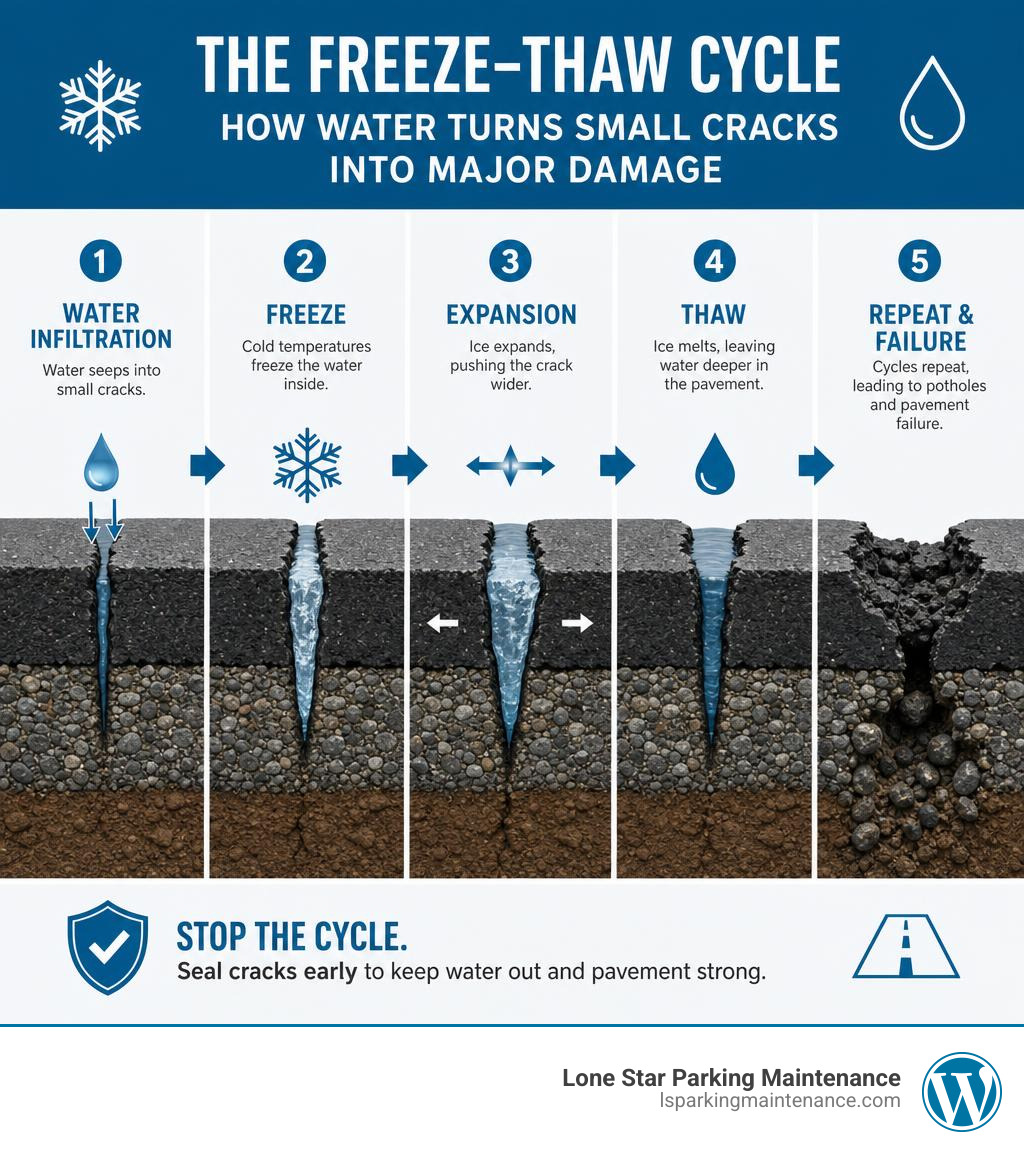
Understanding Asphalt Damage: Types of Cracks and Severity
Before grabbing a bucket of sealant, we need to know what we are dealing with. Not all cracks are created equal. Some are minor surface blemishes, while others are distress signals from a failing subbase.
To help you assess your pavement, let’s break down the most common types of cracks we see across the DFW Metroplex:
- Longitudinal Cracks: These run parallel to the direction of traffic or the laydown of the pavement. They are often caused by poor joint construction or temperature fluctuations.
- Transverse Cracks: These run perpendicular to the pavement’s centerline. They are typically thermal cracks caused by the asphalt contracting during cold Texas winter snaps.
- Block Cracks: These look like large, interconnected rectangles or squares. They usually occur when the asphalt binder ages and dries out, indicating that the pavement is losing its flexibility.
- Edge Cracks: Running along the outer edges of a driveway or parking lot, these occur when the surrounding soil yields or when there is insufficient support at the pavement’s edge.
- Slippage Cracks: These crescent-shaped cracks happen when a vehicle brakes or turns sharply on low-strength asphalt or when there is a poor bond between pavement layers.
- Fatigue (Alligator) Cracks: Looking like the scaly skin of an alligator, these are interconnected webs of deep cracks. They are a sign of structural failure, meaning the subbase underneath has weakened.
If you are wondering if your property is showing these symptoms, you can read more about identifying these issues in our guide on how to know if your parking lot needs crack filling.
For an in-depth scientific look at how state transportation departments classify these distresses, check out the scientific research on crack treatment.
Crack Sealing vs. Crack Filling: Which Method Do You Need?
Many people use “crack sealing” and “crack filling” interchangeably, but in the pavement preservation industry, they are two entirely different strategies. Choosing the wrong one can lead to premature failure of your repairs.
The choice depends on whether you are dealing with a working crack or a non-working crack.
- Working Cracks: These are cracks that experience significant seasonal movement (usually 0.1 inches or more of annual horizontal movement). They expand when it is cold and contract when it is hot. Working cracks require crack sealing using flexible, elastomeric sealants that stretch and compress with the pavement. This process often involves “reservoir routing”—using a specialized machine to cut a clean channel (often 1/2 inch by 1/2 inch) to give the sealant room to flex.
- Non-Working Cracks: These are cracks that experience very little movement (less than 0.1 inches annually). They are typically diagonal, block, or longitudinal cracks in stable pavement. These can be treated with crack filling, which simply fills the void to keep water out without requiring high-performance elastomeric properties.
Understanding these differences is key to maximizing your maintenance budget. For a breakdown of the long-term economic advantages, see our article on the benefits of crack filling.
For a highly technical deep dive into how state agencies manage these materials, you can read the Caltrans joint and crack sealing guidelines.
Crack Sealing vs. Crack Filling Comparison
| Feature | Crack Sealing | Crack Filling |
|---|---|---|
| Primary Target | Working cracks (horizontal movement $\ge$ 0.1″) | Non-working cracks (horizontal movement < 0.1") |
| Material Used | High-performance elastomeric polymer-modified rubber | Rigid or semi-flexible cold-pour / asphalt emulsions |
| Preparation | Reservoir routing (cutting) and heat-lance drying | Wire-brushing, blowing, and cleaning |
| Expected Lifespan | 3 to 10 years | 1 to 2 years |
| Best Application Season | Moderate temperatures (Spring / Fall) | Year-round (above freezing) |
The Ultimate 5-Step Guide to Asphalt Crack Repair
Ready to roll up your sleeves? Whether you are a homeowner tackling a weekend project or a property manager overseeing a maintenance crew, following a precise step-by-step process is the only way to guarantee a repair that lasts.

Step 1: Inspect and Assess the Damage
First, walk the area. Measure the width of the cracks.
- Under 1/8 inch: Usually too narrow for filler; these are best protected by a high-quality sealcoat.
- 1/8 inch to 1/2 inch: The sweet spot for standard liquid filler or hot rubberized sealant.
- 1/2 inch to 1 inch: Can still be filled, but may require a foam backer rod first to prevent the material from sinking to the bottom of the earth.
- Over 1 inch or alligator cracked: These require a cold or hot asphalt patch rather than a liquid filler.
If you are working on a home driveway, you can read our ultimate guide to filling driveway cracks for specific residential tips.
Step 2: Clean and Prep the Cracks
We cannot stress this enough: your repair is only as good as your preparation. If you apply filler over dirt, dust, or weeds, the material will stick to the debris instead of the asphalt, and it will pop out within months.
- Kill and remove weeds: Pull any vegetation out by the roots.
- Scrape the crack: Use a wire brush, a screwdriver, or a specialized crack-chisel to scrape away dirt and loose rocks.
- Blow it out: Use a leaf blower or compressed air to blow out all remaining dust.
- Dry completely: Never apply sealant to wet asphalt. If you pressure washed the area, wait at least 24 hours. Professionals often use a hot-air lance to blow out moisture and preheat the crack walls.
Step 3: Choose the Right Asphalt Crack Repair Product
For a quick residential fix, cold-pour liquid fillers in a bottle or caulk tube are easy to apply. For a permanent repair, hot rubberized crack filler is the industry standard.
If you want a middle ground without a massive melting kettle, you can use rope-form fillers (like Crack-Stix), which you pack into the crack and melt in place using a simple propane torch.
Step 4: Apply the Filler or Sealant Correctly
- For Cold Pour: Cut the applicator tip to match the crack width. Squeeze the material into the crack, filling it from the bottom up.
- For Hot Rubberized: Apply the molten material (heated to 350°F–400°F) directly into the crack.
- The “Wipe Zone” Technique: Use a U-shaped squeegee to scrape the excess material flush with the pavement, leaving a thin, 1-inch-wide band on either side of the crack to seal the edges.
- Pro Tip: Dust the wet filler with a light coating of fine black sand. This prevents the hot material from tracking onto car tires and improves the bond with subsequent sealcoating.
Step 5: Allow Proper Curing Before Traffic or Sealcoating
Do not let cars drive over your hard work too early!
- Hot rubberized sealant cools and cures extremely fast—it is usually traffic-ready in 10 to 40 minutes.
- Cold pour fillers dry via evaporation, meaning they require 24 to 48 hours before they can handle heavy traffic or be covered with a sealcoat.
For more details on coordinating this step with a full-surface refresh, read about our parking lot sealing and crack filling services.
Choosing Your Materials: Hot Rubberized vs. Cold Pour Fillers
If you are weighing the cost of materials versus their longevity, the data speaks for itself.

- Cold Pour Fillers: These are asphalt emulsions or acrylic-based liquids sold in jugs at local home improvement stores. They are highly convenient for DIYers because they require no heating. However, they shrink as they dry and lack elasticity. They typically last only 1 to 2 years before cracking again.
- Hot Rubberized Crack Filler: This is the professional choice. Made of asphalt, rubber polymers, and synthetic additives, it must be melted in a specialized kettle. When hot, it bonds deeply to the asphalt walls. As it cools, it remains highly flexible, allowing it to expand and contract through extreme Texas temperature swings. Hot rubberized fillers routinely last up to 10 years.
While hot rubberized filler has a higher upfront cost due to the equipment required, it is far more cost-effective over time. If you want to know why investing in professional materials is worth every penny, read these 10 reasons to love asphalt repair.
When to Hire a Professional for Asphalt Crack Repair
While a homeowner can easily patch a few feet of driveway cracks with a bottle of cold pour, commercial properties and large driveways are a different story.
A standard residential driveway typically requires about 6 blocks (120 lbs) of hot rubberized crack filler, with each pound covering roughly 7 to 8 linear feet of medium-width cracks. Melting and applying that much material safely requires commercial walk-behind melter-applicators.
If your property has extensive cracking, high traffic volumes, or structural issues like alligator cracking, hiring a professional ensures the job is done safely and up to municipal standards. You can read our advice on finding the best asphalt crack repair service for your property to help you choose the right partner.
Frequently Asked Questions about Asphalt Maintenance
Can asphalt crack repair be done in cold winter weather?
Yes, but with strict precautions. The biggest challenge in winter is moisture. If there is frost or ice trapped inside the crack, the heat from hot-applied filler will turn that moisture into steam, creating air bubbles that destroy the bond.
To repair cracks in cold weather, the pavement must be completely dry, and professionals must preheat the crack walls using a hot air lance to ensure proper adhesion.
How long does asphalt crack filler typically last?
Durability depends heavily on the product used and traffic exposure:
- Cold pour filler: 1 to 2 years.
- Hot-applied rubberized sealant: 3 to 10 years.
- Factors affecting lifespan: Heavy truck traffic, poor drainage, and extreme sun exposure (UV rays dry out the asphalt binder) will shorten the lifespan of any repair.
When is it time to resurface instead of filling cracks?
Crack filling is a preventive maintenance tool, not a cure-all. If your pavement has structural failures—such as deep potholes, a sinking subbase, or widespread alligator cracking—filling the cracks is like putting a band-aid on a broken bone.
When more than 25% to 35% of your pavement surface is severely damaged, it is time to look at an overlay or full resurfacing. You can explore your options in our detailed guide on all about parking lot resurfacing or read the ultimate guide to resurfacing parking lots.
Conclusion
Taking care of your asphalt early is the single best way to avoid massive repaving bills down the road. By understanding the types of cracks on your property, choosing the right materials, and following a thorough cleaning and application process, you can easily add years of life to your pavement.
At Lone Star Parking Maintenance, we help property owners across the DFW Metroplex keep their parking lots safe, beautiful, and durable. We use only top-quality, industry-standard hot rubberized sealants designed to withstand the tough Texas heat.
Don’t let minor cracks turn into major liabilities. Contact us today to schedule professional parking lot sealing and crack filling and keep your pavement strong for years to come!