
Why Parking Lot Number Signs Matter for Your Facility
Parking lot number signs are labeled markers — typically made from reflective aluminum — that assign a unique identifier to each parking space or zone in a facility. Here’s a quick overview of what you need to know:
- What they do: Identify individual spaces, rows, or levels so drivers can find and remember where they parked
- Common materials: Rustproof aluminum (40 mil to 80 mil thick), vinyl labels, or HDPE plastic
- Standard sizes: 10″x10″, 12″x12″, 18″x18″, and 24″x24″
- Reflectivity options: Engineer Grade (~500 ft viewing distance), High Intensity Prismatic (~1,000 ft), Diamond Grade (~1,300–1,600 ft)
- Typical lifespan: 10–12 years for professional-grade aluminum with 3M reflective sheeting
- Who needs them: Apartment complexes, retail lots, garages, office buildings, and distribution centers
Most property managers don’t think about numbered signs until their lot becomes a problem — confused tenants, blocked spaces, and frustrated visitors. A well-numbered lot eliminates that friction before it starts.
I’m Cason, and in this guide I’ll walk you through everything you need to know to choose, plan, and install the right numbering system for your parking facility.
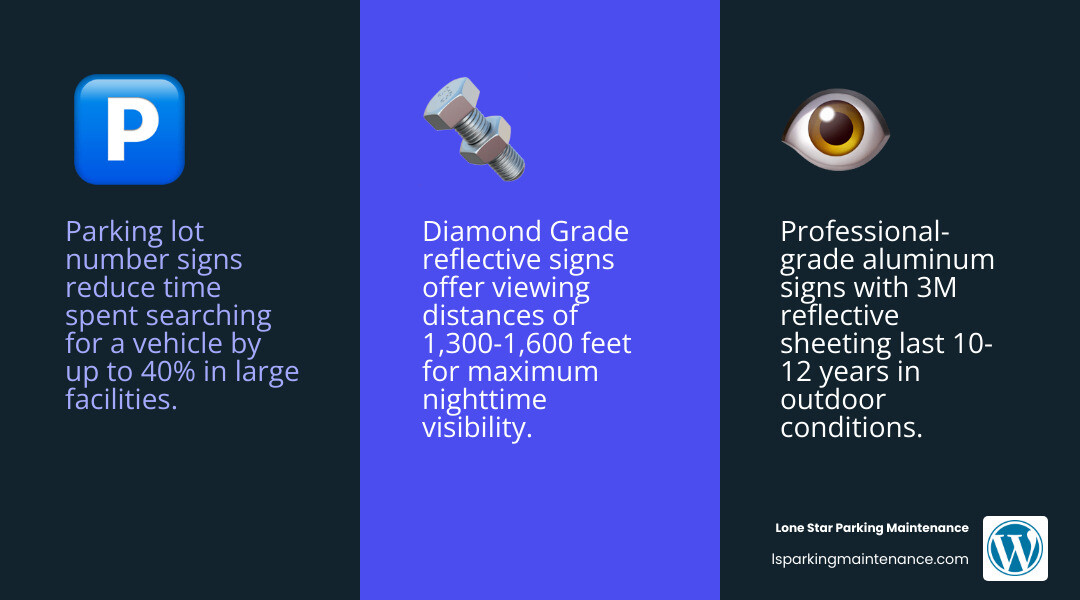
Parking lot number signs terms simplified:
Why Parking Lot Number Signs are Essential for Facility Organization
Managing a commercial property or multi-family residential complex in the DFW Metroplex is no small feat. Between maintaining the asphalt, dealing with erratic Texas weather, and ensuring your tenants are happy, parking organization can easily fall through the cracks. However, installing high-visibility parking lot number signs is one of the simplest, most cost-effective ways to streamline your operations.
Wayfinding and Customer Experience
Have you ever spent fifteen minutes wandering around a massive, blazing-hot parking lot in July trying to remember if you parked near the blue light pole or the green dumpster? We have all been there.
A logical numbering system turns a frustrating, disorganized maze into a user-friendly space. For multi-level parking garages, using clear markers like a Large Number 2 Sign – Metal Sign helps visitors immediately identify their exact level and zone. For example, a driver parking in “Zone 2B” will have a much easier time finding their vehicle than one who simply “parked somewhere on the second floor.”
Efficient Space Management
For residential communities, corporate offices, and retail centers, space allocation is critical. Numbered signs allow you to assign dedicated stalls to specific tenants, employees, or customers. This reduces parking disputes, prevents unauthorized vehicles from occupying premium spots, and simplifies enforcement. If someone parks in Stall 42 without a permit, your towing service or enforcement team can identify and resolve the issue instantly. To understand how these signs fit into your broader property layout, check out our comprehensive guide on parking lot signage.
Enhancing Security and Emergency Response
In the event of an emergency, every second counts. If a security incident, medical emergency, or fire occurs in your lot, callers can give first responders an exact location (e.g., “near parking stall 115”) rather than a vague description. Furthermore, highly reflective numbered signs are a massive asset for security camera monitoring. Property managers can easily check camera feeds at night and verify exactly which stalls are occupied, or confirm if a security gate is open or closed, simply by reading the high-contrast numbers visible on screen.
Key Features to Look For in Parking Lot Number Signs
When shopping for parking lot number signs, it is tempting to buy the cheapest options available online. However, cheap retail signs are often half the thickness of professional-grade products, meaning they will warp, bend, or fade under the intense Texas sun within a couple of seasons. To ensure your investment lasts, you need to understand the structural features that define a high-quality sign. For a deeper dive into choosing the right materials, take a look at our buying guide for compliant parking lot signs.
Material Thickness and Rustproof Aluminum
The gold standard for outdoor sign durability is rustproof, sign-grade aluminum alloy, specifically ASTM 5052-H38. Aluminum naturally forms a protective oxide layer that shields it from corrosion, making it perfect for humid, rainy, or coastal environments.
More importantly, pay close attention to the thickness (measured in mils or inches):
- Standard retail plates (40 mil / 0.040″): Thin and lightweight. Best for indoor garages or temporary, low-impact areas.
- Medium-duty aluminum (63 mil / 0.063″): This is 50% thicker than standard retail signs. It offers excellent resistance to warping and vandalism.
- Heavy-duty aluminum (80 mil / 0.080″): The industry standard for municipal and high-traffic commercial spaces. These signs can withstand heavy winds and physical impacts without bending.
Protective Laminates and Graffiti Resistance
High-quality signs feature a protective top layer, such as 3M SmartShield POF (Polyolefin) laminate. This film serves a dual purpose:
- UV Protection: It shields the printed graphics from fading under intense ultraviolet light, extending the sign’s life to 10 years or more.
- Graffiti Resistance: Vandalism is an unfortunate reality for many commercial properties. A premium laminate allows you to easily wipe away spray paint, permanent markers, and dirt using mild solvents without damaging the underlying sign graphics.
Selecting the Right Size and Material for Parking Lot Number Signs
Choosing the right size for your parking lot number signs is directly tied to viewing distance and traffic speed. If a driver is moving at 15 mph through your lot, they need to be able to read the sign from far enough away to safely react and turn into the stall.
For standard parking spaces, a 12″x12″ or 12″x18″ sign is usually ideal. For larger logistics bays, loading docks, or major drive aisles, you should opt for 18″x18″ or 24″x24″ signs to ensure maximum legibility. If you are looking to order custom sizes or sequences, you can explore professional options like Custom Parking Lot Numbers Signs.
The table below compares the most common sign materials, their typical lifespans, and their best-use cases:
| Material | Thickness | Reflective Option? | Lifespan | Best For |
|---|---|---|---|---|
| Standard Aluminum | 40 mil (0.040″) | Yes | 5–7 Years | Indoor parking garages, well-lit spaces, budget-conscious projects |
| Heavy-Duty Aluminum | 63 mil (0.063″) | Yes | 10 Years | Outdoor surface lots, reserved tenant spaces, apartment complexes |
| Ultra-Duty Aluminum | 80 mil (0.080″) | Yes | 10–12 Years | High-wind areas, public roadways, municipal lots, logistics bays |
| HDPE Plastic | Varying | No | 3–5 Years | Temporary parking, event parking, indoor low-impact zones |
| Adhesive Vinyl | 4+ mil | Optional | 3–5 Years | Applying directly to concrete walls, columns, or smooth barrier gates |
Understanding Reflectivity Grades for Parking Lot Number Signs
If your parking lot is active after dark, reflectivity is not just a nice feature—it is a safety and legal requirement. The Federal Highway Administration (FHWA) mandates that all traffic control and parking signs in areas open to public travel must be reflective.
To achieve this, signs are layered with specialized retroreflective sheeting. The three most common grades of reflectivity include:
- 3M Engineer Grade Prismatic (EGP): This is the standard choice for non-critical commercial parking lots. It meets ASTM D4956 Type 1 standards and provides a viewing distance of approximately 500 feet. It is highly cost-effective and perfect for standard stall numbering. A great example of this style is the Parking Spot Sign With Digit 10.
- 3M High Intensity Prismatic (HIP): Offering significantly higher retroreflectivity, HIP signs can be viewed from about 1,000 feet away. They have an average outdoor lifespan of 10 years and are highly recommended for busy main driveways, entrance signs, and darker areas of your lot.
- 3M Diamond Grade (DG3): This is the highest level of reflectivity available, visible from 1,300 to 1,600 feet. With an outdoor lifespan of up to 12 years, Diamond Grade is typically reserved for public roads, school crossings, and critical safety signs where maximum visibility is paramount.
How to Plan and Install Your Numbering System
Before you grab a drill and start mounting signs, you need a clear, systematic plan. Installing signs haphazardly will only lead to driver confusion and a cluttered aesthetic.
Step 1: Map Out Your Numbering Scheme
Decide on a logical, sequential flow. For single-level surface lots, a simple numerical sequence (1, 2, 3…) works perfectly. For multi-level garages or sprawling corporate campuses, we recommend a combination of numbers and letters. For instance, use the number to represent the level or section, and the letter to represent the specific aisle (e.g., 1A, 1B, 2A, 2B). This simple structure makes it incredibly easy for visitors to remember their location.
Step 2: Choose Your Mounting Method
How you mount your signs depends on your parking lot’s physical layout:
- U-Channel Posts: These are the most common choice for outdoor surface lots. Standard U-channel posts are 8 feet tall, made of heavy-duty steel, and can be driven directly into the dirt or anchored in a concrete footer.
- Wall or Column Mounting: In parking garages, mounting signs directly to concrete walls or structural columns saves space and keeps the drive aisles clear.
- Portable Sign Stands: If you manage a valet area, temporary event parking, or a lot with changing layouts, weighted rubber bases (ranging from 30 lbs to 90 lbs) with portable posts allow you to move your signs as needed.
- Fence Mounting: For lots enclosed by chain-link fences, you can mount signs back-to-back by drilling through the top rail or using specialized fence brackets.
Step 3: Use the Right Hardware
Always use rust-resistant hardware, such as galvanized or stainless steel bolts, nylon washers (to prevent scratching the sign’s reflective face), and tamper-resistant nuts. Most professional signs come with pre-drilled 5/16″ or 3/8″ holes centered at the top and bottom to line up perfectly with standard U-channel posts. To ensure your custom signs match your exact mounting needs, read the ultimate guide to custom made parking lot signs.
Best Practices for Numbering Parking Spaces
To ensure your numbering system is highly effective, compliant, and durable, keep these industry-standard best practices in mind:
- Follow ANSI Text Standards: According to the ANSI Z535-2011 standard, you should design your signs with 1 inch of text height for every 25 feet of expected viewing distance. If drivers need to read a sign from 100 feet away, the numbers should be at least 4 inches tall.
- Ensure ADA Compliance: Never let your numbering system interfere with handicap parking spaces. The Americans with Disabilities Act (ADA) has strict rules for accessible parking. For example, parking lots with 1 to 25 spots must have at least one accessible space, and lots with 1,001+ spaces require 20 accessible spots plus 1 for every 100 spaces over 1,000. These spaces must feature dedicated, non-numbered ADA signs mounted at the correct height. To learn more about meeting these legal standards, review our guide on handicap parking compliance.
- Maintain High Contrast: Use simple, bold fonts with high-contrast color schemes. Black numbers on a white or reflective yellow background provide the highest readability in all lighting conditions, as seen on standard markers like the Parking Lot Number 24 Sign and the Parking Lot Number 25 Sign.
Customizing Signs with Arrows and Logos
Your parking lot is the very first thing visitors see when they arrive at your property. It is an extension of your brand. Standard, generic signs get the job done, but custom-designed signs can elevate the entire aesthetic of your facility.
Directional Arrows
If your parking facility has a complex layout, one-way aisles, or designated parking zones located behind a building, combining numbers with directional arrows is incredibly helpful. Using a template like the Parking Lot Number With Arrows Custom Signature Sign allows you to guide drivers to specific reserved sections (e.g., “Stalls 50-100 ➔”) before they even turn down the aisle.
Corporate Branding and Logos
For upscale retail centers, luxury apartment complexes, and corporate headquarters, custom-branded signs are a fantastic touch. You can customize your signs to match your company’s color palette, use specific municipal fonts, or even print your corporate logo directly onto the reflective sheeting. This not only looks highly professional but also reinforces your property rights and deters unauthorized parkers. For step-by-step branding tips, check out our guide on branding your asphalt custom parking signs with logo.
Frequently Asked Questions about Parking Lot Numbering
Do private parking lots have to follow federal reflectivity standards?
Yes. Under Title 23 of the Code of Federal Regulations (Part 655.603), privately owned properties that are open to public travel—such as shopping malls, strip centers, sports arenas, and large apartment complexes—must comply with the Manual on Uniform Traffic Control Devices (MUTCD). This means any traffic control, directional, or parking signs in these areas must meet federal retroreflectivity standards to ensure safe navigation at night.
What is the recommended text height for parking lot signs?
To comply with the ANSI Z535-2011 standard, you should design your signs with 1 inch of text height for every 25 feet of viewing distance under normal conditions. For standard parking stalls where drivers are viewing signs from their vehicles at close range, a text height of 3 to 4 inches is highly effective and easily legible.
How do you mount number signs to a chain-link fence?
The easiest and most secure method is to use specialized fence brackets or u-bolts designed to clamp around the chain-link mesh or the top rail. Alternatively, for a clean, professional look, you can drill a hole directly through the upper metal bar of the fence, align the prepunched holes of two signs back-to-back on opposite sides of the fence, and secure them together using a single rustproof bolt and nut.
Conclusion
An organized, professional parking lot is a key asset for any commercial property or residential community. By installing high-visibility parking lot number signs, you can instantly improve wayfinding, simplify parking enforcement, and enhance the overall safety and security of your facility.
At Lone Star Parking Maintenance, we specialize in helping property managers throughout the DFW Metroplex keep their facilities in pristine condition. From precision parking lot striping and sealcoating to professional signage installation, concrete repairs, and power washing, we provide the top-quality materials and expert service your property deserves.
Ready to transform your parking facility? Schedule professional parking lot striping and signage services with Lone Star Parking Maintenance today, and let our team handle your layout from start to finish!