
Your Parking Lot’s First Impression Starts at the Pavement
Restriping a parking lot is one of the most cost-effective ways to improve safety, boost curb appeal, and stay legally compliant — all at once.
Here’s a quick overview of what you need to know:
- How often: Every 18-24 months for most lots; annually for high-traffic retail
- Key triggers: Fading lines, recent sealcoating, ADA updates, or layout changes
- Typical cost: $350-$800 for a 50-space lot; $700-$1,600 for 100 spaces
- Drying time: 30 minutes to touch; 2 hours before vehicles can return
- Best season: Late spring through early fall (warm, dry weather)
- DIY vs. pro: Professionals are strongly recommended for compliance and precision
Think about the last time you pulled into a parking lot where you could barely see the lines. It’s frustrating — and for your customers, it creates a bad first impression before they even walk through your door.
For property managers and business owners in the DFW Metroplex, faded stripes aren’t just an eyesore. They create real safety risks, potential legal liability, and ADA compliance issues that can be costly to ignore.
The good news? Fresh striping is one of the quickest and most affordable upgrades you can make to your property.
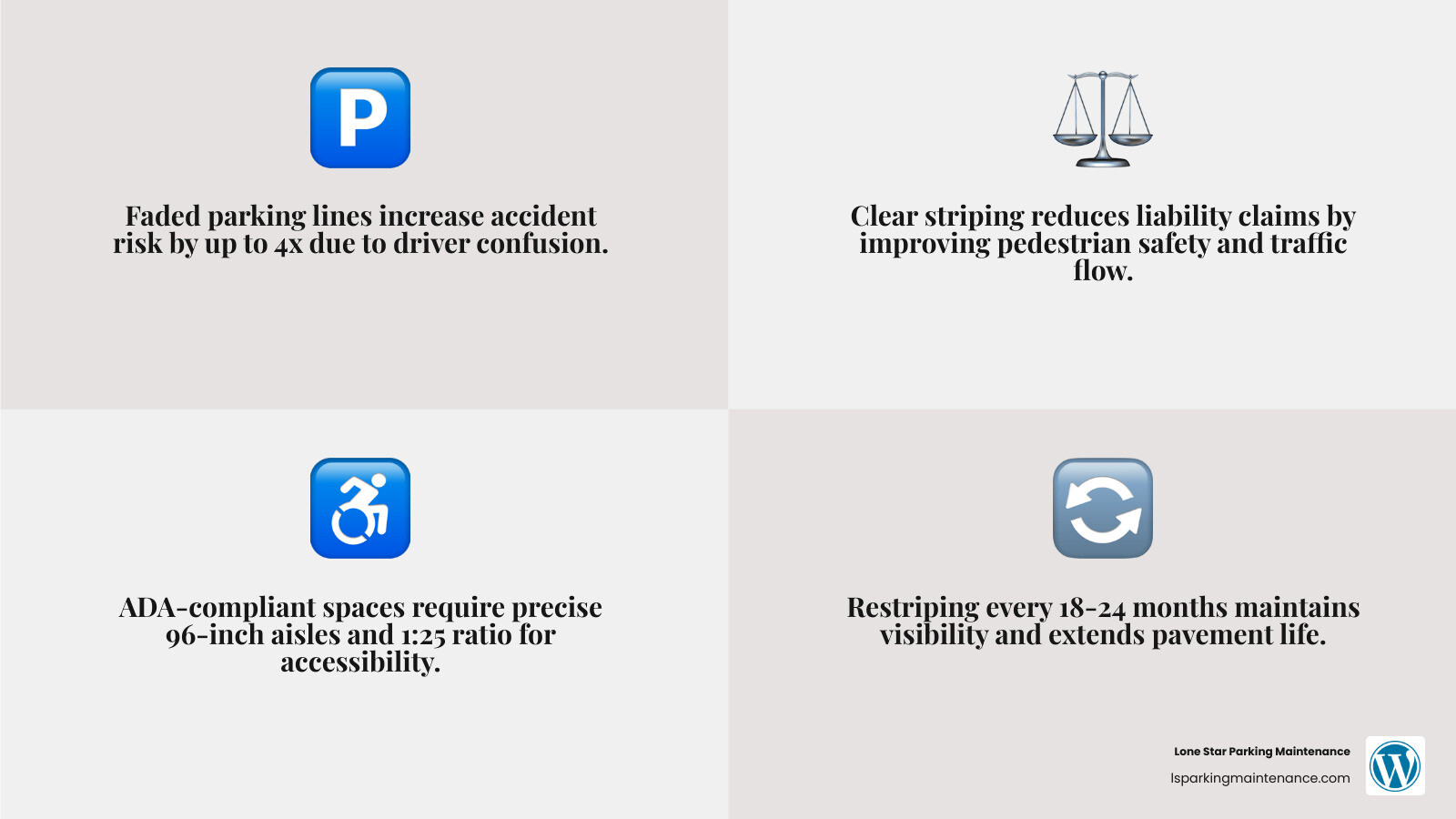
Why Restriping a Parking Lot is Essential for Safety and Compliance
When we talk about restriping a parking lot, we’re talking about much more than just a “face-lift” for your asphalt. Clear, bright lines are the primary language of your parking facility. Without them, your lot becomes a free-for-all where drivers guess where to park, often leading to “creative” parking jobs that block exits or take up two spaces.
Liability Reduction and Pedestrian Safety
As a property owner in Texas, you have a responsibility to maintain a safe environment. Faded or nonexistent markings are a significant liability risk. If an accident occurs because a stop bar was invisible or a crosswalk wasn’t clearly delineated, you could face expensive lawsuits and insurance claims. Fresh paint ensures that everyone—both drivers and pedestrians—knows exactly where they should be.
Fire Code and Traffic Flow
In the DFW Metroplex, local fire codes are strict. Fire lanes must be properly designated with specific red curb paint and stenciling to ensure emergency vehicles have unimpeded access. Furthermore, well-planned traffic flow, marked by clear one-way arrows and “No Parking” zones, prevents the dreaded “parking lot gridlock” during peak hours.
For more information on high-traffic safety, check out our guide on The Best Compliant Safety Line Striping For High Traffic Zones.
Professional vs. DIY: Restriping a Parking Lot
It might be tempting to grab a few cans of spray paint and a piece of cardboard to “touch up” those lines yourself. However, restriping a parking lot effectively requires precision and specialized equipment.
- Equipment Quality: We use industrial-grade airless striping machines that apply paint at a consistent 15-mil wet film thickness. This ensures the paint bonds to the asphalt rather than just sitting on top of the dust.
- Regulatory Knowledge: Do you know the exact height requirement for a “Van Accessible” sign or the specific slope allowed for an ADA ramp? We do. Professional striping ensures you don’t get hit with fines for non-compliance.
- Insurance and Durability: DIY jobs often use lower-quality paint that flakes off after one Texas thunderstorm. Professional materials like acetone-based or thermoplastic paints are designed to withstand the brutal DFW sun and heavy vehicle turning.
When and How Often to Restripe Your Pavement
A common question we hear is: “How long is this going to last?” In the DFW area, the answer depends on your specific environment. Generally, we recommend restriping a parking lot every 18 to 24 months.
The 18-24 Month Rule
For a standard office park or an industrial warehouse with moderate traffic, 18 to 24 months is the sweet spot. However, if you manage a high-traffic retail lot—like a grocery store, medical office, or a popular Tex-Mex restaurant—you should plan for annual restriping. High vehicle turnover and frequent turning wear down paint significantly faster than straight-line driving.
Environmental Factors in Texas
In the DFW Metroplex, our biggest enemy isn’t snow—it’s the sun. Intense UV radiation acts like a giant bleach bottle, breaking down the chemical binders in traffic paint. Interestingly, lines in shaded areas (like under a parking garage or a large oak tree) can last 30% to 40% longer than those in direct sun.
For a deeper dive into timing, you might find this Parking Lot Restriping: A Comprehensive Guide | Seton helpful.
Signs You Need Restriping a Parking Lot
You don’t always need a calendar to tell you it’s time. Keep an eye out for these red flags:
- Visibility from the Driver’s Seat: If you can’t see the lines while sitting in your car on a rainy night, your customers can’t either.
- Peeling Paint: This usually indicates the previous application was done on a dirty surface or used low-quality paint.
- Faded ADA Symbols: This is a major compliance risk. If the blue and white wheelchair symbol is grey and ghost-like, it’s time to call us.
- Driver Confusion: Are people parking at odd angles or ignoring designated lanes? That’s a sign the “visual cues” are gone.
The Impact of Sealcoating on Maintenance
If you’ve recently had your lot sealcoated to protect the asphalt, you must restripe. Sealcoating is essentially a black liquid armor that covers everything—including your old lines.
One thing to watch out for is the “bleeding” phenomenon. If paint is applied too soon after sealcoating, the bitumen oils in the sealer can migrate into the paint, turning your crisp white lines a muddy brown. We always recommend waiting at least 24 hours for the sealcoat to cure before we begin the restriping process.
Navigating ADA Compliance and Standard Dimensions
ADA (Americans with Disabilities Act) compliance is not optional. In Texas, we also adhere to the Texas Accessibility Standards (TAS). Failure to provide the correct number of accessible spaces can lead to private lawsuits that cost $10,000 to $50,000 in legal fees alone—far more than the cost of a bucket of paint!
The 1:25 Ratio
The general rule of thumb is that for every 25 parking spaces, you must have at least one handicap-accessible space. As the lot gets larger, the requirements change (for example, a lot with 100 spaces requires four accessible spots).
Dimensions and Van Accessibility
ADA parking spaces must be at least 8 feet wide. However, the “access aisle” next to the space is just as important.
- Car Accessible: 60-inch (5-foot) minimum access aisle.
- Van Accessible: 96-inch (8-foot) minimum access aisle.
Additionally, one out of every eight accessible spaces (but always at least one) must be van-accessible, requiring a 98-inch vertical clearance for the vehicle.
To ensure your lot meets these strict standards, read The Essential Guide To Ada Compliant Parking Lot Striping.
Standard Parking Space Dimensions
Not all parking spots are created equal. Depending on your clientele, you might want to mix and match sizes to maximize your lot’s capacity.
| Space Type | Width | Length | Access Aisle |
|---|---|---|---|
| Standard | 8.5 – 9 ft | 18 ft | N/A |
| Compact | 8 ft | 16 ft | N/A |
| Accessible (Car) | 8 ft | 18 ft | 5 ft |
| Accessible (Van) | 8 ft | 18 ft | 8 ft |
| Parallel (Standard) | 8.5 ft | 23 ft | N/A |
Angled parking (45 or 60 degrees) is a great way to make navigation easier in narrow lots, but it requires more “traffic row” width—usually 14 feet for 45-degree and 20 feet for 60-degree rows.
Materials and Methods for Restriping a Parking Lot
Choosing the right paint is like choosing the right tires for your truck—it depends on where you’re driving.
- Waterborne Acrylic (Latex): The most common choice. It’s eco-friendly, dries quickly, and is perfect for freshly sealcoated lots. It typically lasts 12 to 18 months.
- Acetone/Solvent-Based: These are tougher and more resistant to oil and chemicals. They are ideal for older asphalt and usually last 18 to 24 months.
- Thermoplastic: This is the “heavy-duty” option. It’s a plastic-based material that is melted and fused to the pavement. It can last 3 to 5 years, though it costs significantly more.
- Epoxy: Often used in indoor parking garages, epoxy can last up to ten times longer than standard paint and resists the “hot tire pickup” that ruins lesser materials.
Learn more about our specific offerings on our Parking Lot Striping service page.
Advanced Marking Techniques
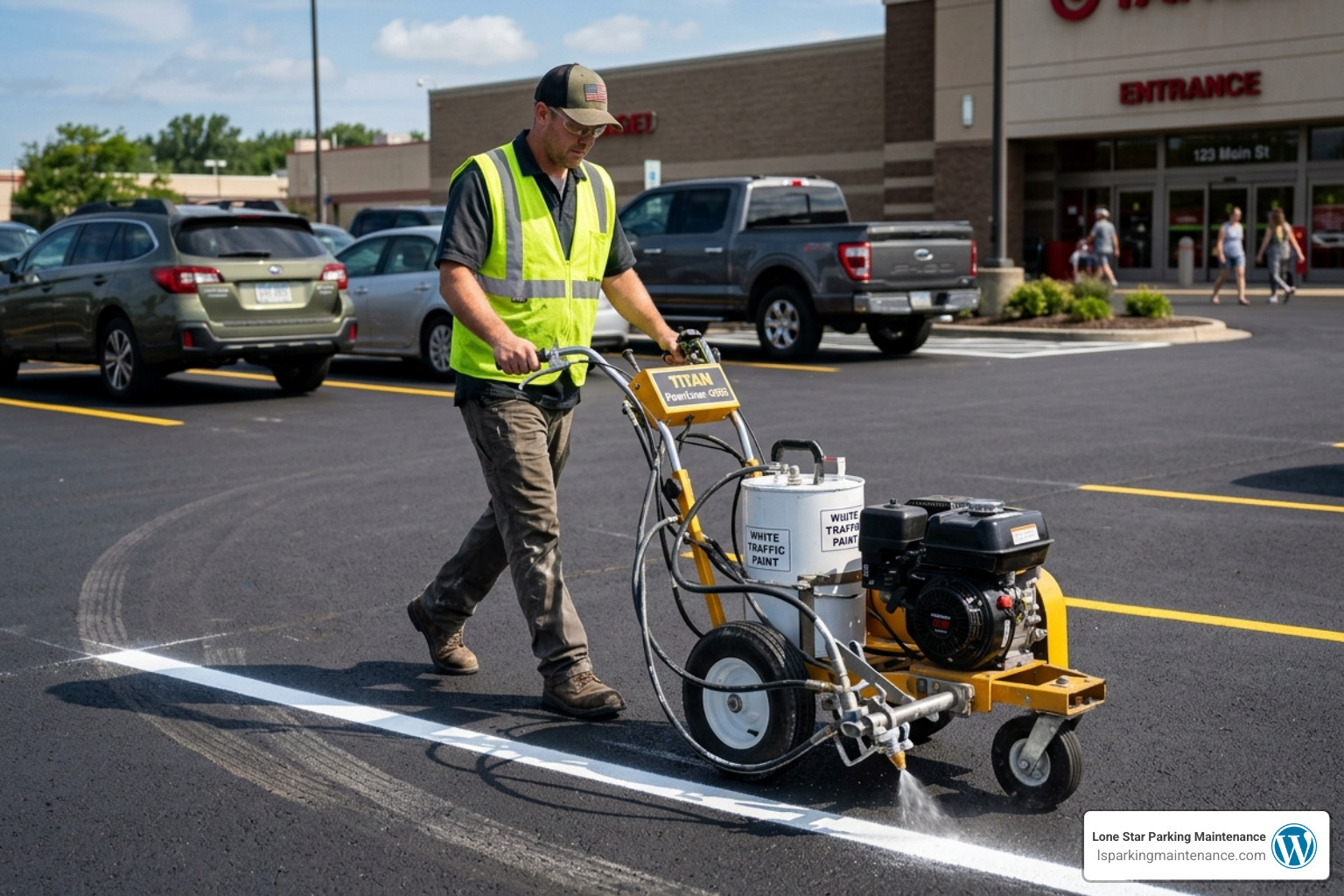
We don’t just “paint lines.” We use several techniques to ensure longevity:
- 15-Mil Wet Thickness: This is the industry standard. We calibrate our equipment to ensure the paint is thick enough to last but not so thick that it “curls” or cracks.
- Reflective Glass Beads: For high-traffic areas or lots that see a lot of night use (like hospitals or 24-hour gyms), we can drop reflective beads into the wet paint to make the lines pop under headlights.
- Stencils: From “No Parking” to “Electric Vehicle Only,” we use precision stencils for a clean, professional look.
- Pavement Tape: Sometimes used for temporary construction or low-traffic areas, though it generally wears faster than paint in the Texas heat.
Preparation, Costs, and Project Timelines
A great striping job is 70% preparation and 30% application. If you paint over dirt, the paint will stick to the dirt, not the asphalt.
Preparation is Key
We start by cleaning the surface. This might involve high-powered blowers to remove loose debris or, in many cases, pressure washing. Pressure washing removes oil stains and heavy dirt buildup that would otherwise cause the paint to peel within months.
If you’re wondering about prep, check out How Do I Prepare My Parking Lot For Striping and Is Pressure Wash Preparation Necessary When Striping Or Re Striping Parking Lots.
Estimating Your Restriping Budget

Budgeting for restriping a parking lot is surprisingly straightforward. Restriping is typically 20% to 50% less expensive than a brand-new layout because the “blueprint” is already there.
- Linear Foot Cost: Usually ranges from $0.25 to $1.00.
- 50-Space Lot: Expect to pay between $350 and $800.
- 100-Space Lot: Usually falls between $700 and $1,600.
- Cleaning/Prep: Adds about $0.10 to $0.20 per square foot.
- Line Removal: If you’re changing the layout entirely, removing old lines can add $0.50 to $1.50 per linear foot.
Project Timelines
For most average-sized lots in the DFW area, we can finish the job in a single day.
- Application: A few hours depending on complexity.
- Drying Time: Paint is usually dry to the touch in 30 minutes.
- Safe for Traffic: We recommend keeping cars off the lines for at least 2 hours.
- The “Sealcoat Wait”: If we are sealcoating as well, the sealant needs 24 hours to dry before we can apply the paint.
Frequently Asked Questions about Restriping
How long does it take for parking lot paint to dry?
In our dry Texas heat, the paint is usually dry to the touch in about 30 minutes. However, we ask that you wait at least 2 hours before allowing vehicles to drive over the new lines. This prevents “tracking,” where tires pick up wet paint and leave white streaks all over your black asphalt.
What is the best time of year to restripe a lot in Texas?
Late spring, summer, and early fall are ideal. We need the ground temperature to be at least 50 degrees Fahrenheit and rising. While we can stripe in the winter, the paint takes much longer to cure, and we have to be very careful about moisture from morning dew or frost.
Does restriping require a complete lot closure?
Not necessarily! We are experts at logistics. We can often restripe in sections, allowing you to keep half the lot open while we work on the other. For very busy businesses, we often perform restriping at night or on weekends to ensure zero disruption to your customers.
Conclusion
At Lone Star Parking Maintenance, we know that your parking lot is the “welcome mat” to your business. Whether you manage a small retail storefront in Plano or a massive industrial complex in Fort Worth, restriping a parking lot is an investment that pays for itself in safety, compliance, and professional appearance.
We are committed to using top-quality materials and adhering to the highest industry standards to ensure your lot stays bright and safe for years to come. Don’t wait until a fender-bender or an ADA fine forces your hand.
Refresh your pavement with expert parking lot striping services today and give your property the fresh new look it deserves. Contact us for a free consultation and let’s get your lot back in line!