
Every Second Counts: What Is a Fire Lane in a Parking Lot?
What is a fire lane in a parking lot? Here’s the short answer:
A fire lane is a clearly marked, no-parking zone in a parking lot that must stay completely clear at all times so fire trucks, ambulances, and other emergency vehicles can reach a building quickly during an emergency.
Key facts at a glance:
- Purpose: Gives emergency vehicles unobstructed access to buildings
- Who uses it: Fire trucks, ambulances, police vehicles, and firefighting crews
- Marked by: Red-painted curbs, white lettering, and “No Parking – Fire Lane” signs
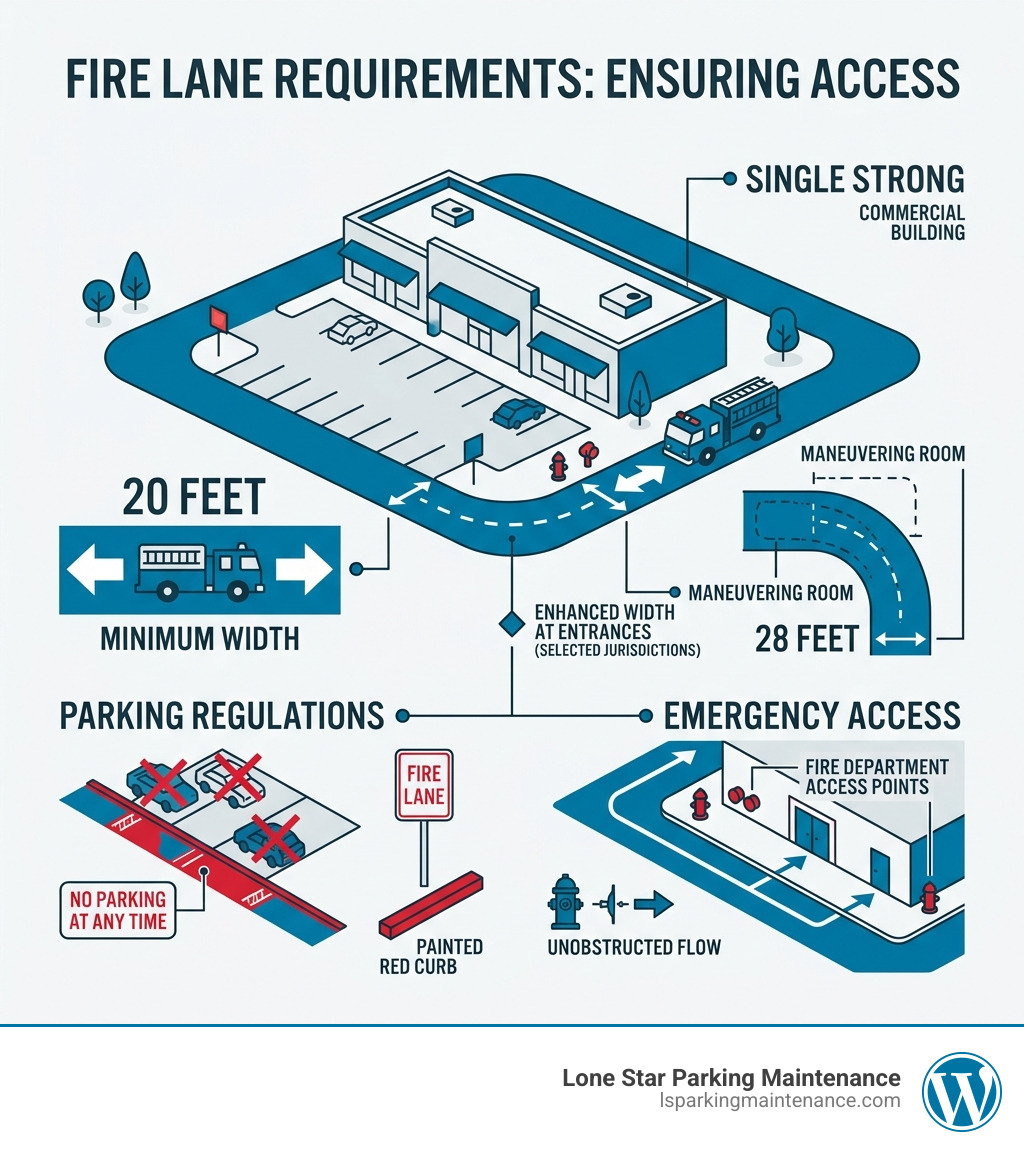
- Minimum width: 20 feet (28 feet near building entrances in some jurisdictions)
- Parking allowed? No — not even for a minute, not even with the engine running
Think about this: a fire breaks out in a strip mall. The fire truck arrives in minutes — but a car is blocking the lane in front of the entrance. That 60-second delay to find another route or move the vehicle can mean the difference between a contained fire and a total loss.
Fire lanes aren’t just painted lines on pavement. They are a critical part of a building’s fire protection system. For property managers and business owners in the DFW Metroplex, keeping those lanes clearly marked and unobstructed isn’t optional — it’s a legal obligation and a safety necessity.
This guide covers everything you need to know: what fire lanes are, how they must be marked, what the rules require, and what happens when they’re ignored or poorly maintained.
Defining the Essentials: What is a Fire Lane in a Parking Lot?
To understand the gravity of these zones, we first have to look at them through the lens of a first responder. In technical terms, a fire lane is a designated pavement or access road reserved for fire and rescue services. While your standard parking aisle is designed for the flow of passenger cars, a fire lane is engineered for the “big guys”—the heavy, wide, and long fire apparatus that need significant room to maneuver.
At its core, what is a fire lane in a parking lot? It is a legal “easement” of sorts that guarantees the local fire department can reach any part of a structure within a specific timeframe. These lanes are not suggestions; they are mandated by the International Fire Code (IFC) and local municipal ordinances across the DFW Metroplex.
The Critical Purpose of What is a Fire Lane in a Parking Lot
Why do we dedicate so much square footage to an area that sits empty 99% of the time? Because when that 1% happens, the fire lane becomes the most important piece of real estate on your property.
- Rapid Response: Every second a fire truck spends navigating around a double-parked delivery van is a second the fire grows. Fire lanes provide a “fast track” directly to the building’s most vulnerable points.
- Equipment Deployment: Firefighting isn’t just about the truck; it’s about the gear. Crews need space to pull high-pressure hoses, set up massive aerial ladders, and connect to the Fire Lanes or Fire Department Connections (FDC).
- Building Egress: During a fire, hundreds of people may be streaming out of building exits. Fire lanes provide a clear “buffer zone” so evacuees aren’t running into traffic or climbing over parked cars.
- Staging and Command: For large-scale incidents, the fire lane serves as a mobile office. Fire chiefs set up command posts here to coordinate rescues and manage personnel.
Visual Standards: Identifying What is a Fire Lane in a Parking Lot
If a driver says, “I didn’t know it was a fire lane,” it usually means the property owner hasn’t met the visual standards required by law. In Texas, and specifically within the DFW area, there is a very specific “uniform” for these lanes.
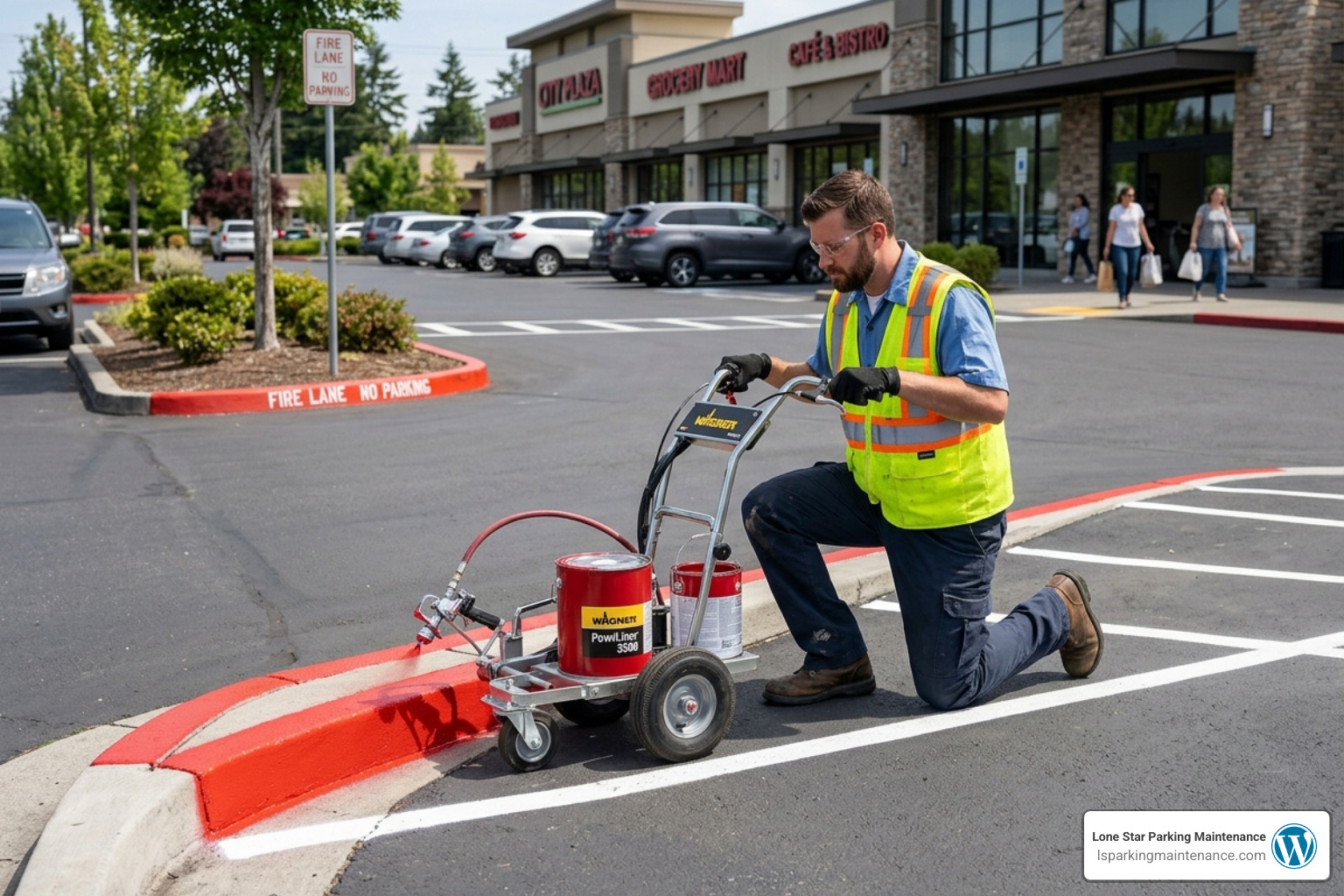
- Red Curbs: The most recognizable feature. The curb must be painted a vibrant, OSHA-standard safety red. This acts as an immediate psychological “stop” sign for drivers.
- White Block Lettering: On top of or on the face of that red curb, you’ll see “FIRE LANE – NO PARKING” in stark white, all-caps lettering.
- Reflective Signage: Because emergencies don’t just happen during business hours, The Best Parking Lot Entrance Signs To Keep Your Property Organized must be reflective so they are visible under headlight beams.
- Pavement Markings: In some large lots or curbless areas, the words are painted directly onto the asphalt in large, 12-inch tall letters.
Technical Specifications and Marking Standards
Designing a fire lane isn’t as simple as slapping some red paint on a curb. There are rigorous engineering standards that must be met to ensure a 35-ton fire truck doesn’t get stuck or sink into the pavement. As of April 2026, these standards remain the benchmark for safety in Texas.
Width and Clearance Requirements
According to general Fire Lane Marking Requirements, the standard minimum width for a fire lane is 20 feet. This provides enough room for a truck to pass while another vehicle might be hooked up to a hydrant.
However, width isn’t the only dimension that matters:
- Overhead Clearance: Trees must be trimmed and banners must be hung at a minimum of 14 feet high. Fire trucks are tall, and an oak limb can easily rip off expensive emergency lighting or ladders.
- Weight Capacity: The pavement must be able to support at least 35 imperial tons (approx. 70,000 lbs). If your asphalt is thin or crumbling, a heavy ladder truck could literally crush the surface, becoming immobilized during a crisis.
Turning Radii and Building Proximity
Fire trucks don’t turn on a dime. They require a “swept path” to make it around corners.
- The 54/30 Rule: Most jurisdictions require an outside turning radius of 54 feet and an inside radius of 30 feet. If your parking lot islands are built too tight, the fire truck simply won’t make the turn.
- Proximity: Fire lanes must typically be within 150 feet of all portions of the exterior walls of the first story of the building.
- Dead-Ends: If a fire lane is a “dead-end” longer than 150 feet, it must have a turnaround area—usually a T-shape, Y-shape, or a cul-de-sac. This is essential for The Best Compliant Safety Line Striping For High Traffic Zones because a fire truck cannot easily back out of a narrow, crowded lot.
Signage and Lettering Requirements
Signage is the “voice” of your fire lane. In the DFW Metroplex, the Fire Marshal is very particular about how these messages are delivered.
- Dimensions: Signs are typically 12×18 inches with red lettering on a reflective white background.
- Text Height: The “No Parking” text should be at least 3 inches tall to ensure it can be read from a distance.
- Spacing: You can’t just have one sign at the beginning of the lot. Signs must be posted every 25 to 50 feet along the entire length of the lane.
- Mounting: Signs should be mounted roughly 7 feet high in pedestrian areas (to prevent head injuries) or 5 feet in other areas. This ensures they are visible even if a tall SUV is parked nearby. For more on how these markings integrate with other lot requirements, check out The Essential Guide To Ada Compliant Parking Lot Striping.
Compliance, Enforcement, and Maintenance
As a property owner, you are the “guardian” of the fire lane. If a Fire Marshal walks your property and finds faded paint or blocked access, the “I didn’t know” excuse won’t save you from a hefty citation.
| Action | Fire Lane Rule | Penalty/Consequence |
|---|---|---|
| Parking | Strictly Prohibited | Immediate Towing & $150+ Fine |
| Idling/Sitting | Prohibited (even with driver) | Traffic Citation/Ticket |
| Loading/Unloading | Prohibited | Ticket & Potential Liability |
| Blocking Hydrant | 15-foot clearance required | Potential window breakage by FD |
Enforcement is usually a joint effort between local police and the Fire Marshal’s office. On private property, the owner often has the right to have vehicles towed immediately without notice if they are in a marked fire lane. This is a vital tool for Parking Lot Striping management to keep the property safe.
Property Owner Responsibilities in April 2026
Maintenance is not a “one-and-done” task. Sun, rain, and heavy Texas heat cause paint to chip and fade.
- Continuous Maintenance: You are legally required to keep the fire lane in a “state of good repair.” If the red paint looks pink, or the white letters are illegible, you are out of compliance.
- Repainting Schedule: We generally recommend repainting fire lanes every 18 to 24 months. In high-traffic DFW retail centers, you might need it annually.
- Preparation is Key: Before you call us for a refresh, make sure you know How Do I Prepare My Parking Lot For Striping to ensure the new paint bonds properly to the surface.
Consequences of Non-Compliance
The risks of neglecting your fire lanes go far beyond a simple ticket:
- Delayed Response: This is the ultimate nightmare. If a response is delayed by 3 minutes due to a blocked lane, a small kitchen fire can become a structural collapse.
- Insurance Denial: If a fire occurs and the Fire Marshal’s report notes that fire lanes were improperly marked or obstructed, your insurance provider may have grounds to deny or reduce your claim.
- Liability: If someone is injured because emergency services couldn’t reach them, the property owner may face massive personal injury lawsuits.
- Aesthetics: Faded, peeling fire lanes make a property look neglected. Clean, bright red curbs signal to your customers that you care about their safety. We often find that Is Pressure Wash Preparation Necessary When Striping Or Re Striping Parking Lots is the best way to ensure those lanes look professional and last as long as possible.
Frequently Asked Questions about Fire Lanes
How wide does a fire lane need to be in Texas?
In most parts of Texas, the minimum width is 20 feet. However, local codes vary. For example, in Stafford, TX, the requirement is 28 feet perpendicular to building entrances and exits. In many DFW suburbs, if the building is over a certain height or requires a specific aerial ladder truck, the Fire Marshal may mandate a wider lane (often 26 feet) to allow for the deployment of “outriggers” (the stabilizer legs on a ladder truck).
Can I park in a fire lane if I stay in the car?
Absolutely not. This is one of the most common myths. “Idling” or “stopping” is treated the same as parking. If an emergency occurs, a driver might panic and stall the car, or they might be away from the vehicle “just for a second” to drop off a package. Firefighters cannot wait for you to move. In an emergency, they are authorized to push vehicles out of the way with their trucks, which will cause significantly more damage to your car than a parking ticket would.
How far from a fire hydrant must the lane remain clear?
Standard fire code requires a 15-foot clearance on either side of a fire hydrant. This ensures that firefighters have enough room to “swing” their massive wrenches and connect large-diameter hoses without being obstructed by a vehicle’s bumper. Blocking a hydrant is considered a high-priority violation and will almost certainly result in an immediate tow.
Conclusion
At Lone Star Parking Maintenance, we live and work in the DFW Metroplex, and we’ve seen how important clear markings are for our local heroes. We don’t just paint lines; we help you create a safety infrastructure that protects your tenants, your customers, and your investment.
Our commitment to safety means we use top-quality, high-durability materials that stand up to the Texas sun. Whether you need a full lot redesign or just a quick refresh of your red curbs, we ensure your property meets every industry standard and local fire code.
Don’t wait for a Fire Marshal’s inspection to find out your lanes are fading. Keep the path clear for the heroes who keep us safe. For professional, code-compliant Fire Lanes striping and maintenance, give us a call today. Let’s make sure your parking lot is ready for anything.