
Why Lot Line Painting Is One of the Smartest Investments for Your Parking Lot
Lot line painting is the process of applying traffic-grade paint to a parking lot surface to mark stalls, lanes, fire zones, ADA spaces, and other critical areas.
Quick answer — what you need to know:
- What it is: Applying durable paint to define parking spaces, traffic lanes, fire lanes, and compliance markings
- How often: Every 12–24 months in harsh climates; every 2–4 years under normal conditions
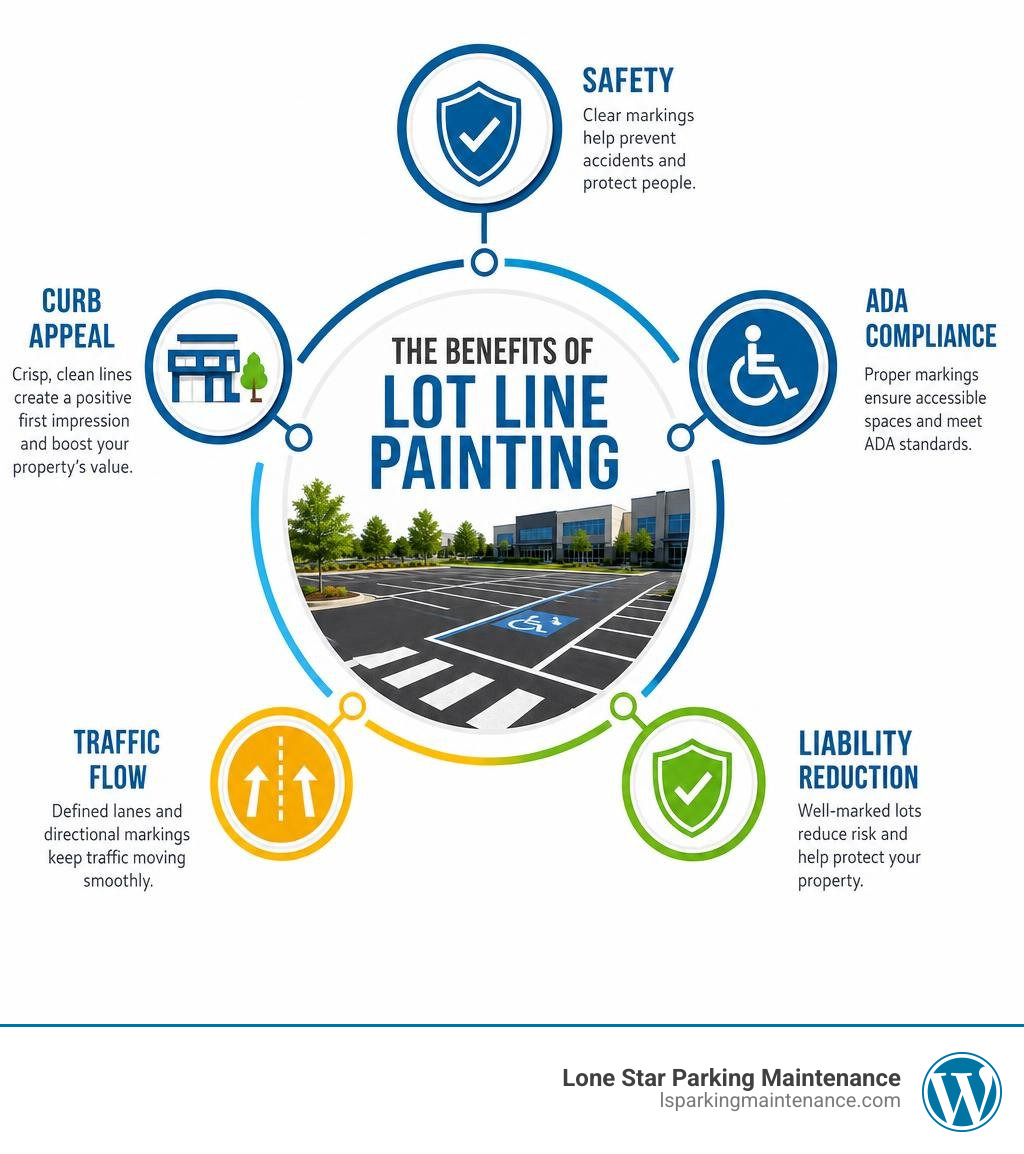
- Why it matters: Safety, ADA compliance, traffic flow, curb appeal, and reduced liability
- Who needs it: Any commercial property with a parking lot — retail, office, medical, warehouse, and more
- Cost: Most standard jobs run under $900
Your parking lot is the first thing customers, tenants, and visitors see when they arrive. Faded lines, missing arrows, and unmarked fire lanes don’t just look bad — they create real safety risks and legal exposure.
The good news? Fresh pavement markings are one of the fastest and most affordable ways to improve a property’s appearance and compliance at the same time.
Whether you manage a strip mall in Frisco or a warehouse complex in Fort Worth, keeping your lines crisp and compliant protects people, maximizes your parking capacity, and keeps you on the right side of ADA and fire code regulations.
This guide covers everything DFW property managers need to know — from paint types and restriping schedules to ADA requirements and the most common mistakes to avoid.
Understanding Lot Line Painting: Painting vs. Striping vs. Pavement Markings
When talking to property managers across the DFW Metroplex, we often hear terms like “painting,” “striping,” and “pavement markings” used interchangeably. While they all contribute to an organized parking lot, they actually refer to different aspects of pavement maintenance. Understanding these differences helps you communicate clearly with contractors and get exactly what your property needs.
To ensure your facility meets local and national standards, all applications must align with the Department of Transportation (DOT) guidelines and the Manual on Uniform Traffic Control Devices (MUTCD). You can review the official Federal Highway Administration MUTCD resource for more information on national traffic control standards. For a deeper look at our professional approach, check out More info about professional striping services.
The Role of Lot Line Painting in Traffic Flow
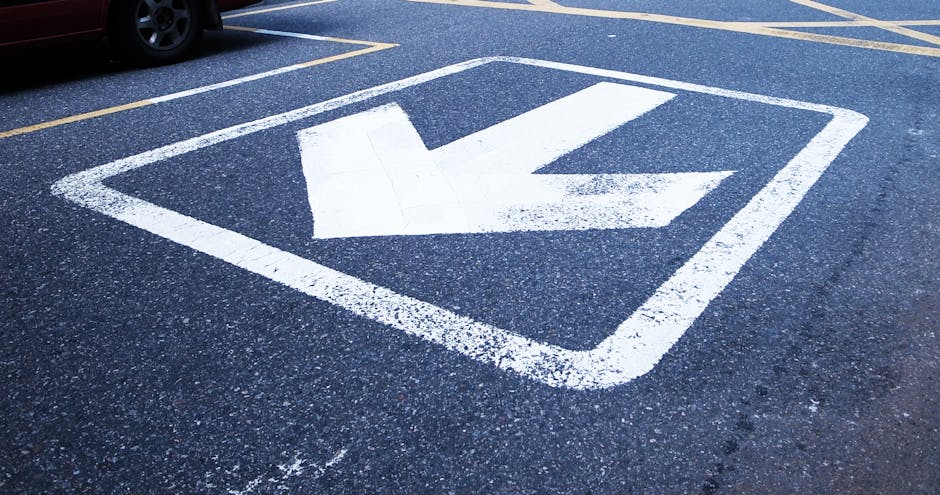
Lot line painting is the broad, umbrella term for applying traffic-grade paint to any asphalt or concrete surface. This includes painting stall lines, ADA symbols, directional arrows, fire lanes, and custom stenciling.
Without highly visible markings, a parking lot quickly descends into chaos. Drivers park at odd angles, block delivery zones, and ignore pedestrian pathways. Properly placed markings establish an intuitive flow that guides drivers safely from the entrance to their parking space.
What is Parking Lot Striping?
Striping refers specifically to the straight, consistent lines that define parking spaces, stall boundaries, and traffic lanes. This process is typically executed using specialized walk-behind or ride-on airless striping machines.
The goal of striping is to create uniform, high-contrast lines (usually white or yellow) that maximize the number of vehicles your lot can safely accommodate. Professional striping requires a steady hand, precise measurements, and high-durability traffic paint.
What are Pavement Markings?
Pavement markings encompass the more complex symbols, words, and safety zones painted onto the pavement. This category includes:
- Crosswalks: Highly visible pedestrian pathways.
- Stop Bars: Thick solid lines indicating where vehicles must stop at intersections.
- Loading Zones: Hatch marks indicating restricted parking areas.
- Thermoplastic Markings: A heavy-duty, heat-fused plastic material used for high-wear areas like public road intersections.
While standard paint works beautifully for most parking lots, busy commercial driveways often benefit from these ultra-durable markings.
When and How Often Should You Refresh Your Lines?
How long can you wait before your parking lot starts looking like a free-for-all? The lifespan of your lines depends heavily on traffic volume, weather exposure, and the quality of the paint used.
If you are wondering whether your lot is overdue, you can learn How to know when to restripe.
Climate and Weather Factors
In rainy, wet climates, line striping often needs to be refreshed every 12 to 24 months to maintain visibility and compliance. Here in Texas, we don’t get constant rain, but we do get intense, relentless summer heat and UV exposure.
The blistering Texas sun bakes the asphalt and breaks down the chemical bonds in standard paint, causing it to fade. As a general rule:
- High-traffic outdoor spaces and curbs typically require fresh striping every 2 to 4 years to remain sharp.
- Low-traffic areas or covered parking garages can sometimes stretch a bit longer, but should still be inspected annually.
Sealcoating and Surface Prep Timelines
If you are planning to sealcoat your parking lot, striping must be coordinated as the final step. Asphalt sealcoating is typically recommended every 2 to 5 years depending on the condition of the pavement, traffic intensity, and weather factors.
Applying sealcoat without crack sealing beforehand is a temporary fix; we always recommend sealing cracks to stop water intrusion before applying the protective topcoat. Once the sealcoat cures, the fresh black surface provides the perfect high-contrast canvas for a brand-new layout of bright white, yellow, and blue lines.

Materials and Equipment for Professional Pavement Marking
To achieve clean, straight lines that stand up to heavy traffic, professionals rely on specialized paints and commercial-grade machinery. If you are exploring the equipment side of the industry, you can read about Choosing the right striping machines.
Selecting Paint for Lot Line Painting
Choosing the right paint is the difference between lines that last for years and lines that wash away after the first major storm. Here is how the most common materials compare:
| Paint Type | Durability | Best For | Key Advantage |
|---|---|---|---|
| Water-Based Acrylic | Moderate | Standard parking lots, eco-friendly projects | Fast drying time, low VOCs, cost-effective |
| Oil-Based Alkyd | High | High-traffic zones, colder temperatures | Excellent adhesion, resists oil and gas spills |
| TBL Durables | Extremely High | Heavy-duty commercial, distribution centers | Lasts 3 to 10 times longer than standard paints |
| Thermoplastic | Maximum | Crosswalks, public roads, stop bars | Thick, heat-fused plastic with incredible longevity |
While water-based paints are highly popular because they dry quickly and are easy on the environment, oil-based paints offer superior resistance to traffic wear. For properties demanding maximum longevity, high-performance options like TBL Durables or thermoplastic provide unbeatable value over time.
Professional Striping Equipment
Professional striping contractors use airless paint striping machines rather than simple aerosol cans or rollers. These machines spray paint at high pressure, ensuring a crisp, sharp edge without fuzzy overspray.
Key features of professional equipment include:
- Precision Line Width Adjustments: Ensuring exact 4-inch or 6-inch lines.
- Laser Line Guides: Helping operators follow faded lines or new chalk layouts with perfect accuracy.
- Dual-Gun Capabilities: Allowing the operator to spray wide lines or parallel lines in a single pass.
If you want to ensure your property aligns with local guidelines, read about Texas parking lot striping standards.
Ensuring ADA Compliance and Fire Lane Safety
Keeping your parking lot looking sharp is great, but keeping it legal is even more important. Non-compliant parking lots face steep fines, towing disputes, and potential lawsuits. To protect your business, consult The essential guide to ADA compliance.
ADA Parking Space Requirements
The Americans with Disabilities Act (ADA) mandates strict design standards for accessible parking spaces. To ensure compliance in 2026, your parking lot must include:
- The Correct Ratio of Spaces: A specific number of accessible stalls based on the total size of your lot.
- Van-Accessible Stalls: At least one of every six accessible spaces must be van-accessible, featuring an adjacent 8-foot-wide access aisle.
- Proper Color and Signage: Accessible stalls must feature the International Symbol of Accessibility (ISA) painted in high-contrast blue and white, accompanied by permanent, post-mounted signs.
For specialized properties like medical clinics and hospitals, layout rules are even stricter. Read our guide on How to master hospital lot line painting to ensure full regulatory alignment.
Fire Lanes and No-Parking Zones
Fire codes are strictly enforced by local DFW municipal inspectors. Emergency vehicles must have unimpeded access to your buildings at all times.
- Red Curbs: Fire lanes must be painted with a solid, vibrant red traffic paint.
- Stenciling: The words “FIRE LANE – NO PARKING” must be stenciled in bold white paint at regular intervals along the curb.
- Clear Markings: Loading docks and dumpster enclosures must be clearly hatched out to prevent parked cars from blocking municipal and emergency access.
To protect your property from costly code violations, read how to Avoid fines for non-compliant lines.
Common Mistakes to Avoid in Parking Lot Striping
Striping a parking lot might look as simple as pushing a lawnmower, but it requires careful preparation and technical skill. A single mistake can lead to crooked lines, peeling paint, or a confusing layout.
To avoid these headaches, review the Best compliant safety line striping practices.
Inadequate Surface Preparation
The absolute number one cause of paint failure is poor surface preparation. If you paint over dirt, dust, loose gravel, or moisture, the paint will bond to the debris instead of the pavement. Within a few weeks, the paint will begin to peel and flake away.
Professional preparation requires:
- Thorough Sweeping and Blowing: Removing all dirt, leaves, and trash.
- Moisture Control: Ensuring the pavement is completely dry (no sprinklers running for at least 24 hours prior).
- Crack and Pothole Repair: Filling cracks so paint doesn’t pool in deep gaps.
Ignoring Local Regulations and Codes
Every municipality in the DFW Metroplex has its own specific zoning laws, fire codes, and parking requirements. Simply copying the layout of a parking lot in another state could leave you open to fines. Working with a local expert who understands North Texas municipal codes ensures your layout is 100% compliant. For professional guidance, look into professional striping in Texas.
Frequently Asked Questions about Lot Line Painting
How much does professional lot line painting cost?
The cost of a striping project depends on several factors, including the number of parking stalls, the count of stencils (such as ADA symbols or directional arrows), whether it is a simple repaint or a brand-new layout, and the overall condition of the surface.
As a helpful benchmark, industry data shows that approximately 70% of standard parking lot line painting jobs cost less than $900. It is a highly cost-effective way to instantly boost your property’s curb appeal and safety.
How long does parking lot paint take to dry?
Modern, high-quality traffic paints are engineered to dry incredibly fast to minimize disruption to your business. Under warm, dry conditions:
- The paint dries to the touch in about 10 minutes.
- It is completely safe for vehicle traffic after 30 minutes.
We often schedule striping projects during off-hours, overnight, or on weekends to ensure your customers and tenants are never inconvenienced.
Can you paint lines over dirty or cracked asphalt?
Technically, yes, but we highly advise against it. Painting over dirt causes the paint to peel off quickly. Painting over deep cracks causes the paint to pool, resulting in uneven, sloppy lines.
For the best results, always sweep the lot thoroughly and complete necessary crack sealing or patching before the paint crew arrives.
Conclusion
Your parking lot is more than just a place for cars to sit — it is the welcome mat for your business. Crisp, bright lot line painting creates an immediate impression of professionalism, safety, and care.
At Lone Star Parking Maintenance, we help property owners across the DFW Metroplex preserve their pavement, protect their visitors, and maintain perfect regulatory compliance. From surface lots to multi-level garages, we bring top-quality materials, industry-leading standards, and a deep commitment to customer satisfaction to every project.
Don’t let faded lines put your property at risk. Schedule your parking lot striping today and let us help you make a great first impression!