
What You’re Actually Paying for Parking Lot Striping Pricing
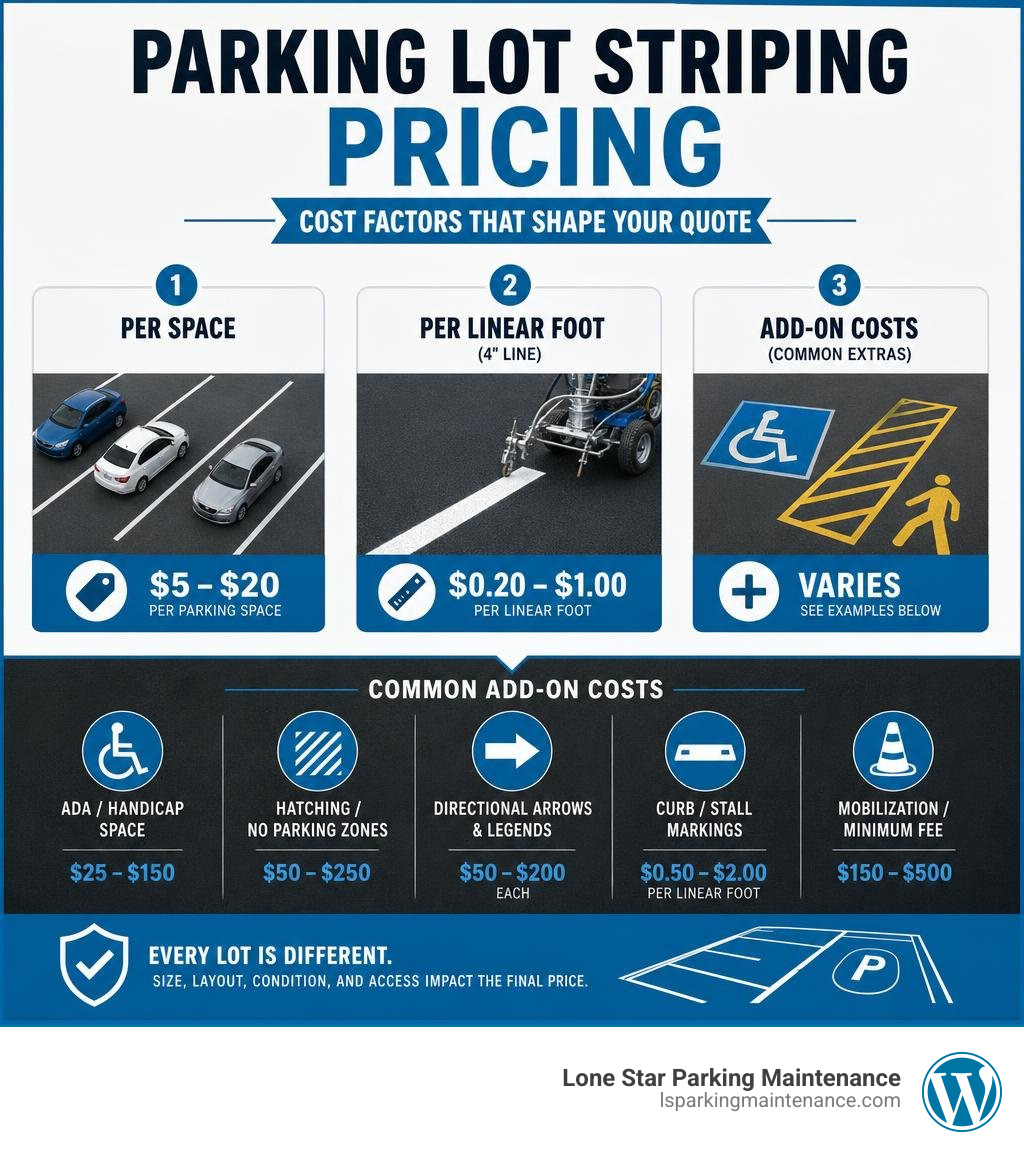
Parking lot striping pricing typically falls between $500 and $1,000 for most commercial projects, with an average around $750. Here’s a quick breakdown so you can budget before reading further:
| Pricing Method | Typical Range |
|---|---|
| Per parking space | $5 – $20 |
| Per linear foot (4″ line) | $0.20 – $1.00 |
| Small lot (under 20 spaces) | $300 – $800 |
| Medium lot (20–50 spaces) | $800 – $2,000 |
| Large lot (100+ spaces) | $1,000 – $4,000+ |
| ADA/handicap space | $25 – $150 |
| Mobilization/minimum fee | $150 – $500 |
Those numbers are a starting point — not a final quote. Your actual cost depends on a handful of factors that can push the number up or down significantly.
Faded lines don’t just look bad. They create confusion, safety risks, and potential ADA liability. For DFW property managers, a lot that looks neglected sends the wrong message to customers before they even walk through the door. The good news is that a professional restripe is one of the most cost-effective maintenance investments you can make — if you know what drives the price and what to watch out for.
This guide breaks down every cost factor so you can budget accurately, compare bids fairly, and avoid surprises.
Parking lot striping pricing word list:
Understanding Parking Lot Striping Pricing: Average Costs and Pricing Models
When you start gathering quotes for your property, you will quickly notice that contractors use a few different ways to calculate their bids. Some will hand you a flat rate for the entire project, while others will break down the cost per parking space or per linear foot.
Understanding how these pricing models work is the key to comparing bids without getting a headache. According to the latest HomeAdvisor 2025/2026 Cost Data, the typical national average to stripe a parking lot sits right around $750, with most small-to-medium business lots ranging between $500 and $1,000.
However, contractors rarely just guess at a number. They rely on three core pricing models to build their estimates:
- Per-Stall Pricing: This is the easiest model to understand. The contractor counts the total number of parking spaces and charges a flat rate per space (usually $5 to $20). This model is incredibly common for straightforward office parks or retail strip centers.
- Per-Linear-Foot Pricing: For larger properties, roadways, or complex layouts, contractors price the job by the foot. Standard 4-inch lines typically cost between $0.20 and $1.00 per linear foot, with most standard restriping work falling on the lower end of that scale ($0.20 to $0.50).
- Flat-Rate / Project Pricing: For very small lots or highly complex jobs with lots of specialty stencils, a contractor might charge a flat project fee. This almost always includes a “minimum charge” or “mobilization fee” to cover the cost of bringing the crew and heavy machinery to your location.
If your lot is simply looking tired and faded, opting for a straightforward restripe is the most budget-friendly path. You can read more about how this process works in our guide to restriping your parking lot for a clean, professional aesthetic.
Standard Per-Stall and Per-Linear-Foot Parking Lot Striping Pricing
Let’s dive a little deeper into the math. If you are looking at a per-stall pricing model, a standard single-line parking stall usually costs about $4 to $8 to stripe. If your property uses double-line (or “U-shaped”) stalls—which are fantastic for giving doors extra clearance and preventing dings—you can expect to pay slightly more, typically $6.50 to $15 per stall.
When contractors bid by the linear foot, they are measuring the total distance of all the lines they need to paint. A standard parking space requires about 36 to 72 linear feet of striping depending on the angle (90-degree, 60-degree, or 45-degree) and whether it is a single or double line.
For standard 4-inch lines, the national average is around $0.24 per linear foot. If your lot requires wider lines, such as 6-inch lines for loading zones or enhanced visibility, the price will scale up to about $0.25 to $0.60 per foot.
New Layout vs. Restriping Parking Lot Striping Pricing
Are you painting over existing, faded lines, or are you starting with a freshly paved or sealcoated black canvas? This is one of the single biggest price determiners.
Restriping is highly efficient. Because the old lines are still visible, our crews can use them as a guide, which means the job goes quickly and requires less layout planning.
A brand-new layout, however, requires precision engineering. We have to carefully measure the entire lot, calculate the optimal angles for traffic flow, map out the ADA-compliant pathways, and snap chalk lines before a single drop of paint touches the pavement. Furthermore, brand-new asphalt or freshly applied sealcoat is incredibly porous. It drinks up paint, which means a new layout almost always requires a second coat of paint to ensure the lines look crisp and bright. Because of this extra labor and material, a new layout will cost 20% to 50% more than a basic restripe.
Key Factors That Drive Parking Lot Painting Costs
No two parking lots are identical, which is why a cookie-cutter quote over the phone is rarely accurate.

When we evaluate a property in the DFW Metroplex, we look at several key variables that directly impact your final invoice:
- Lot Size and Complexity: It sounds obvious, but a massive shopping mall lot costs more than a 10-space convenience store lot. However, smaller lots actually cost more per square foot because of the fixed overhead costs required to get a crew to the site.
- Surface Condition: If your pavement is covered in dirt, gravel, oil spills, or overgrown weeds, the paint will not stick. Proper adhesion requires a pristine surface.
- Paint and Material Selection: The type of paint you choose has a major impact on both your upfront costs and how many years you can go before needing another restripe.
- Scheduling Constraints: If your business is highly active during the day, we may need to work overnight or over the weekend. While this prevents business disruption, after-hours labor can sometimes carry a premium.
To ensure your costs stay low, proper prep work is essential. You can learn more about how to get your property ready in our guide on preparing your parking lot. One of the most common questions we get is whether a deep clean is required before we paint. To get the facts, check out our resource on whether pressure washing preparation is necessary for your specific pavement condition.
Paint and Material Selection: Upfront vs. Lifecycle Costs
When it comes to the paint itself, you aren’t just paying for a color; you are paying for durability. The material you choose will dictate how well your lines survive the blistering Texas summer heat and heavy vehicle traffic.
- Water-Based Acrylic Paint ($20 – $40 per gallon): This is the industry standard for most commercial parking lots. It dries incredibly fast (usually in 30 to 60 minutes), is environmentally friendly, and offers excellent brightness. However, it typically only lasts 6 to 18 months in high-traffic zones before it begins to fade.
- Solvent-Based (Oil-Based) Paint ($30 – $60 per gallon): Highly durable and resistant to freezing temperatures, oil-based paint offers a slightly longer lifespan (18 to 30 months). It’s a great option for colder climates or areas prone to heavy moisture, though it has higher VOC levels.
- Thermoplastic Markings ($200 – $500 per kit / $1.00 – $2.00 per LF): Thermoplastic is a plastic polymer that is melted onto the pavement at temperatures exceeding 400°F. It is incredibly thick, highly reflective, and lasts a massive 3 to 5 years (and up to 7 years in some conditions). While the upfront cost is significantly higher, the cost-per-year is highly competitive because you won’t have to repaint every year.
- Epoxy / MMA ($100 – $200 per kit): Extremely durable chemical-cure coatings typically reserved for heavy-duty industrial warehouses, loading docks, or high-traffic parking garages. They last 2 to 4 years but require highly specialized application equipment.
For a deeper dive into how different paint formulations perform under pressure, you can refer to the SealMaster striping paint guide.
Surface Preparation and Old Line Removal
You cannot paint over dirt and expect it to last. If a contractor offers an unbelievably low bid, they might be planning to skip the prep work.
Standard preparation involves power-blowing the entire lot to remove dust, loose gravel, and debris. If there are heavy oil spots from parked cars, these must be chemically treated so the paint doesn’t bubble and peel off.
If you are changing your parking lot layout—perhaps converting angled spaces to 90-degree spaces to maximize parking capacity—you cannot simply paint over the old lines. Painting black paint over old yellow or white lines is a temporary fix; eventually, the black paint wears away, leaving drivers confused by a double set of lines. True line removal requires pavement grinding or shot-blasting, which typically costs $0.50 to $0.75 per square foot of line removed.
Specialty Markings, ADA Compliance, and Add-On Costs
A functional parking lot requires far more than just white lines. It needs directional cues, safety warnings, and designated spaces to keep traffic moving smoothly and legally.
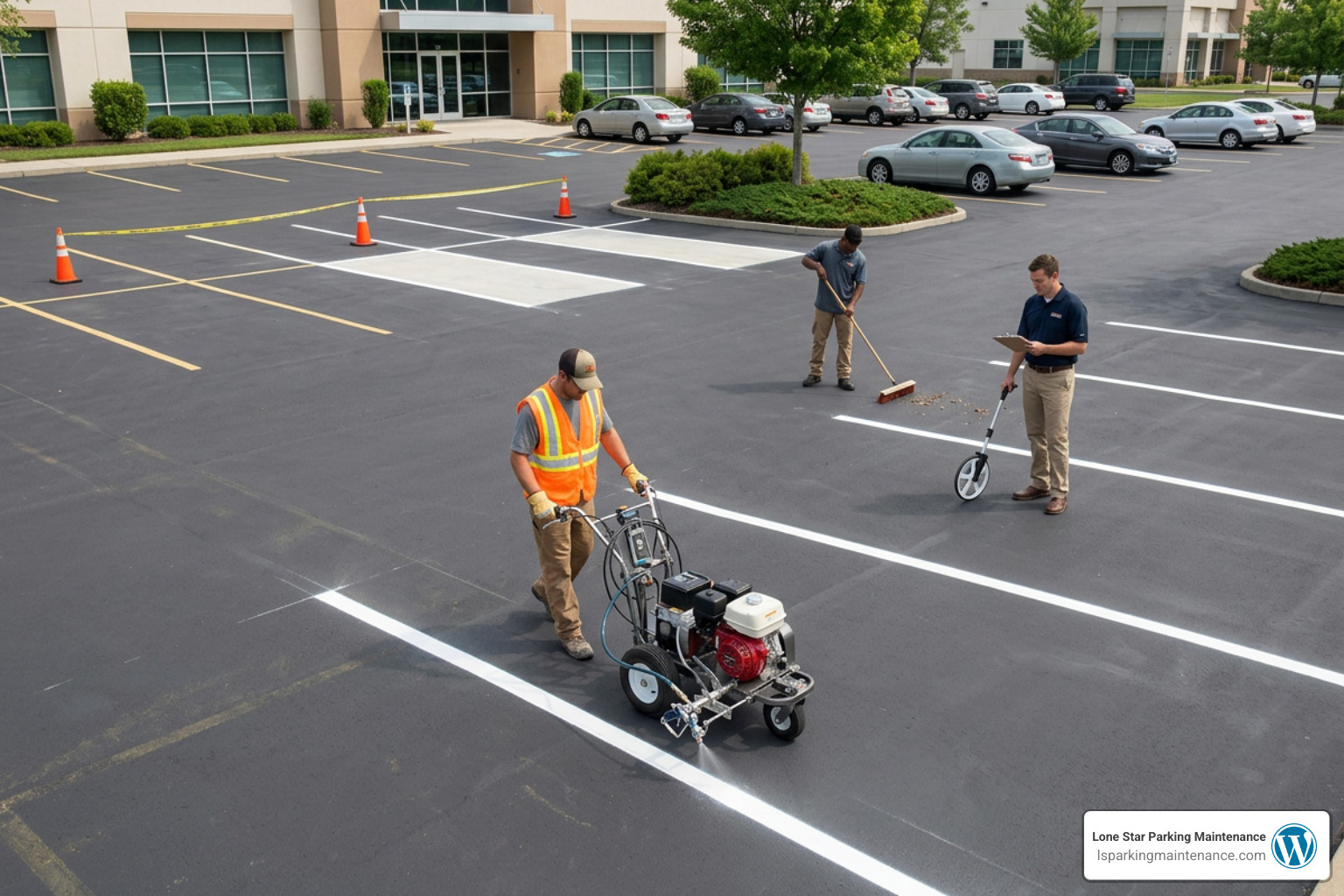
These specialty markings are priced individually as “add-ons” to your base striping quote. If you want to keep your high-traffic areas organized and safe, it is highly recommended to invest in safety line striping for high traffic zones.
Here is a quick look at typical pricing for common add-on stencils and markings:
| Specialty Marking | Average Cost Range |
|---|---|
| Directional Arrow (Straight or Curved) | $10 – $30 each |
| Word Stencil (e.g., “STOP”, “ONLY”, “RESERVED”) | $3 – $7 per character (or $15 – $30 per word) |
| Pedestrian Crosswalk (Standard) | $50 – $100 each |
| Stop Bar (Thick solid line) | $20 – $50 each |
| Curb Painting (Yellow/Red Fire Lane) | $1.00 – $4.00 per linear foot |
| Speed Bump (Painting existing bump) | $20 – $40 each |
ADA Handicap Space Requirements and Costs
As a commercial property owner, ADA compliance is not optional. Title III of the Americans with Disabilities Act mandates a specific number of accessible parking spaces based on the total size of your parking facility. Furthermore, at least one out of every six accessible spaces must be “van-accessible.”
Failing to meet these standards doesn’t just frustrate your visitors—it exposes you to immense legal risk. In Texas, ADA lawsuits can cost tens of thousands of dollars in statutory damages and legal fees.
A standard ADA-compliant parking space requires:
- An accessible parking space line layout.
- A designated adjacent access aisle (cross-hatched lines).
- A painted handicap symbol (stencil).
- Proper upright steel signage.
A basic handicap stencil costs $25 to $50 to paint. However, if you want a highly visible, professional blue background with a white graphic, the cost ranges from $75 to $150 per space. If you are unsure whether your current layout meets federal and state codes, read through ADA compliant parking lot striping to make sure your property is fully protected.
Fire Lanes, Crosswalks, and Curb Painting
Local fire codes require clearly designated, unobstructed fire lanes. Painting these curbs bright red with “NO PARKING – FIRE LANE” stencils typically costs $1.00 to $4.00 per linear foot, depending on the condition of the concrete and how many times we have to repeat the stencil text.
Pedestrian crosswalks are another vital safety feature, especially for retail shopping centers and school zones. A basic continental-style crosswalk (the classic thick “zebra stripes”) generally costs $50 to $100 to paint. Stop bars—the thick, solid white bars that tell drivers exactly where to halt at an intersection or stop sign—typically cost $20 to $50 each.
Frequently Asked Questions about Parking Lot Striping
How often should a parking lot be restriped?
For most commercial properties in the DFW Metroplex, we recommend restriping every 12 to 24 months. High-traffic retail centers, drive-thrus, and busy apartment complexes usually need annual touch-ups to keep their curb appeal sharp. If your lot uses premium thermoplastic markings, you can easily push that timeline out to 3 to 5 years.
What is the typical minimum charge or mobilization fee for striping?
Most professional contractors maintain a minimum mobilization fee of $150 to $350, with a total project minimum charge of $500. This minimum covers the cost of loading the service trucks, driving the crew to your location, and cleaning the equipment afterward. If you have a very small lot with only 10 spaces, you will likely pay the flat minimum charge rather than a per-stall rate.
Can striping be done during normal business hours?
Yes, but it is rarely the best option. While water-based traffic paint dries to the touch in 30 to 60 minutes, driving cars over wet paint will ruin your beautiful new lines and track paint all over your asphalt. To prevent business disruption and ensure a flawless application, we highly recommend scheduling the work during off-peak hours, overnight, or over the weekend.
Conclusion
At the end of the day, your parking lot is the literal welcome mat for your business. Crisp, bright lines tell your customers that you care about their safety, their vehicles, and your property’s overall presentation.
While it might be tempting to hire the cheapest guy with a hand-roller and a can of hardware-store paint, cutting corners on your parking lot layout usually leads to crooked lines, premature fading, and potential ADA compliance fines.
When you work with Lone Star Parking Maintenance, you are partnering with a local, highly experienced team that understands the unique climate, traffic patterns, and regulatory demands of the DFW Metroplex. We use only top-quality, industrial-grade materials to ensure your striping stands up to the Texas elements for as long as possible.
Ready to transform your property and get a highly accurate, transparent quote with zero hidden fees? Explore our professional parking lot striping services today, or reach out to our team to schedule your on-site consultation.