
Hire Parking Lot Restriping Companies That Protect Safety and Value
Choose a parking lot restriping contractor that will inspect the site, provide a clear written scope, and confirm compliance with ADA, fire-lane, and local marking rules. The right company should also explain whether your lot needs simple repainting, sealcoating, crack filling, or asphalt repair before new lines go down.
For property managers, faded stalls, missing arrows, worn crosswalks, and unclear fire lanes are more than an appearance issue. They can confuse drivers, put pedestrians at risk, and make a well-maintained property look neglected. Fresh, properly placed markings improve traffic flow, support accessibility, and help preserve curb appeal.
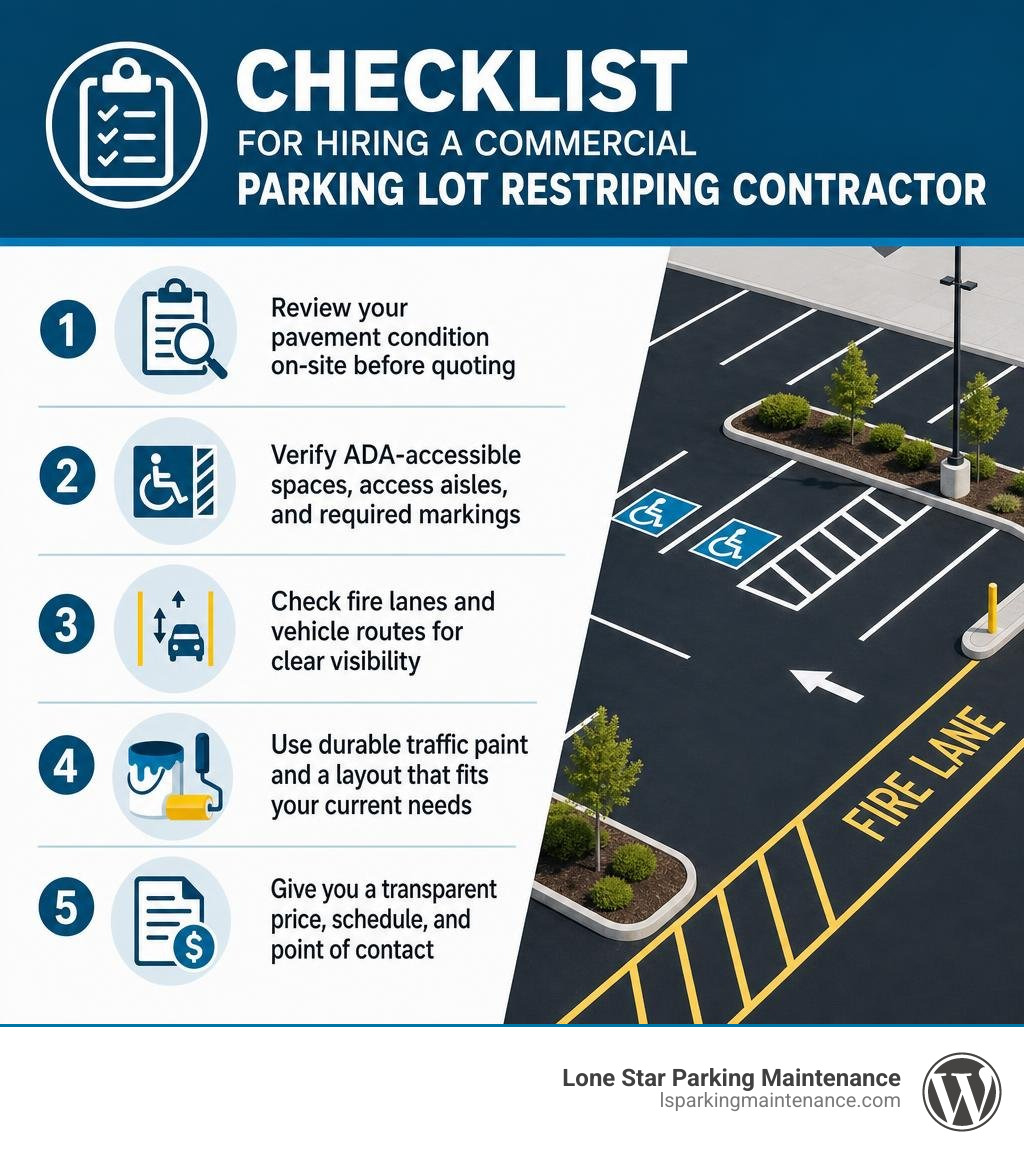
A reliable contractor should be able to:
- Review your pavement condition on-site before quoting
- Verify ADA-accessible spaces, access aisles, and required markings
- Check fire lanes and vehicle routes for clear visibility
- Use durable traffic paint and a layout that fits your current needs
- Give you a transparent price, schedule, and point of contact
Restriping is often most effective as part of a larger maintenance plan. Sealcoating can help protect sound pavement every two to three years, while cracks, potholes, and failing asphalt should be repaired before striping begins.
I’m Cason, and this guide will help you compare parking lot restriping companies and make a confident choice for your DFW property.
Simple parking lot restriping companies glossary:
Why Routine Parking Lot Striping Matters for Safety and Value
Maintaining commercial pavement is an ongoing commitment. When drivers pull into your property, the condition of the parking lot establishes their immediate perception of your management quality and operational safety. Faded lines create uncertainty, leading to erratic driver behavior, poor parking habits, and elevated accident risks.
A structured pavement maintenance program ensures your parking stalls, directional indicators, and safety boundaries remain distinct, functional, and aligned with local ordinances. Routine restriping protects physical assets, mitigates premises liability, and reinforces high tenant satisfaction across the Dallas-Fort Worth Metroplex.
Traffic Flow, Liability, and Curb Appeal
Clear pavement markings dictate how vehicles navigate your facility. Crisp stall lines maximize available parking density, preventing vehicles from straddling spaces or blocking drive aisles. Directional arrows, stop bars, and marked crosswalks guide drivers through blind corners and high-traffic transition areas, drastically reducing fender benders and pedestrian incidents.

From a risk-management perspective, neglected markings leave commercial property managers open to avoidable liability claims. If an accident occurs in an area where stop bars, pedestrian crosswalks, or one-way arrows have completely faded, the property owner may face scrutiny over basic duty of care.
Aesthetics matter just as much. Investing in restriping your parking lot for a fresh new look elevates visual curb appeal, driving higher foot traffic for retail centers and supporting stronger lease valuations for office parks and industrial assets.
Asphalt Longevity: Restriping, Sealcoating, and Surface Repairs
Pavement degradation occurs naturally over time due to intense UV exposure, vehicle fluids, and heavy axle loads. Applying fresh traffic paint over compromised, crumbling pavement is an ineffective quick fix that fails prematurely. Property managers must evaluate the underlying asphalt condition to select the appropriate maintenance solution.
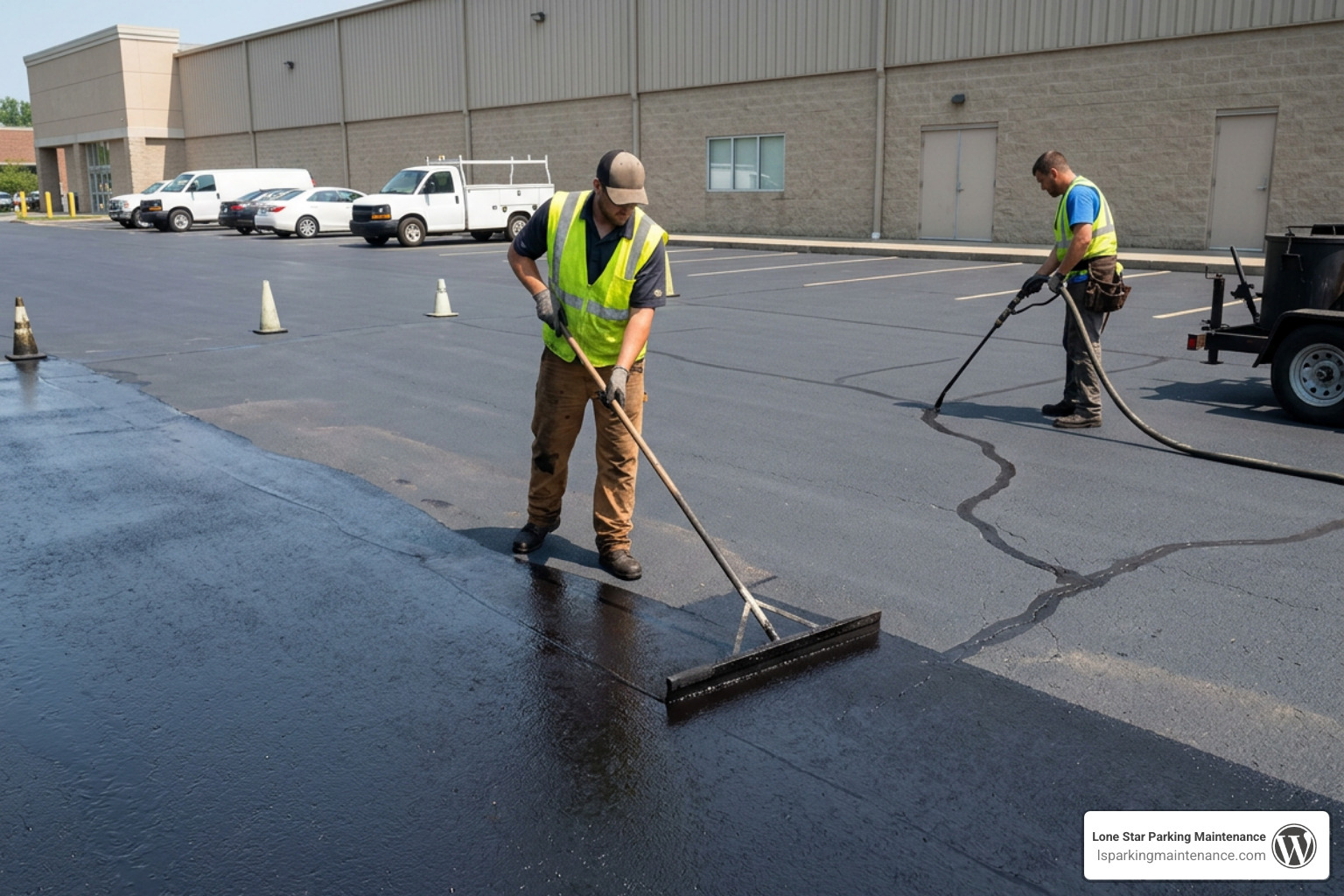
Surface oxidation turns rich black asphalt into a dry, brittle gray base. Left unchecked, minor surface tension leads to hairline fissures, allowing water to penetrate the sub-base and generate expansive potholes. Integrating parking lot sealing and crack filling into your maintenance schedule provides a protective barrier against moisture, oil penetration, and oxidation.
| Maintenance Service | Primary Purpose | Best Application Scenario | Typical Service Life |
|---|---|---|---|
| Line Restriping | Visual guidance, ADA & fire lane compliance, traffic flow | Sound asphalt with faded, hard-to-see markings | 12 to 24 months |
| Crack Sealing | Prevents moisture intrusion into base materials | Isolated cracks between 1/8″ and 1″ wide | 2 to 3 years |
| Pavement Sealcoating | Shields surface against UV oxidation, gas, and oils | Intact asphalt showing surface graying and minor wear | 2 to 3 years |
| Asphalt Patching/Repair | Restores structural integrity and replaces broken base | Deep potholes, alligator cracking, sub-base failure | 5 to 10+ years |
Regulatory Standards: ADA, NFPA, and DOT Compliance
Commercial line striping is strictly governed by federal, state, and municipal codes. Professional striping companies do not merely lay down paint; they ensure your facility remains fully compliant with life safety and accessibility mandates, protecting property owners from costly municipal citations and legal exposure.
ADA Accessibility and Stall Dimensions
The 2010 ADA Standards for Accessible Design set rigid requirements for parking facilities. Commercial lots must allocate an exact proportion of accessible stalls relative to overall parking capacity. Every accessible route requires properly dimensioned parking spaces, adjacent access aisles, non-faded international symbols of accessibility (ISA stencils), and compliant handicap parking compliance vertical signage.
- Standard ADA stalls must measure at least 96 inches (8 feet) wide with a 60-inch (5-foot) adjacent access aisle.
- Van-accessible stalls require a 132-inch (11-foot) width with a 60-inch aisle, or a 96-inch width paired with a 96-inch (8-foot) wide access aisle.
- Two accessible stalls may share a common access aisle.
- Marked access aisles must be hatched with high-contrast paint to prevent unauthorized vehicle obstruction.
Reviewing the essential guide to ADA compliant parking lot striping helps property managers understand baseline compliance requirements before scheduling layout updates.
Fire Lanes, OSHA, and Municipal Safety Markings
Emergency access corridors are non-negotiable life safety elements. The NFPA 1 Fire Code dictates that dedicated fire lanes maintain a clear, unobstructed width of at least 20 feet. In addition to wide lanes, commercial properties must maintain distinct, stenciled red curbs to designate emergency vehicle zones.

Local fire marshals regularly inspect properties and issue substantial fines if safety markings are faded, illegible, or blocked by non-compliant parking stalls. Properly marking fire lanes with DOT-specified traffic paints ensures clear identification for emergency personnel and active enforcement officers.
For facilities with loading docks, service bays, or industrial distribution yards, striping plans must also incorporate OSHA 1910.144 safety color codes. Yellow markings designate caution zones, pedestrian walkways, and physical hazards, ensuring daily operations remain compliant and safe. Take care to ensure your lot details are in order so you don’t get fined for your lines.
Key Criteria for Evaluating Parking Lot Restriping Companies
Selecting an experienced, accountable pavement maintenance partner prevents the headache of uneven lines, poor paint adhesion, and project delays. Vetting contractors thoroughly protects your operational budget and guarantees consistent results across your portfolio.
Vetting Qualifications and Reviews of Parking Lot Restriping Companies
When researching parking lot restriping companies, look beyond basic price quotes. The most reliable contractors distinguish themselves through direct operational accountability, robust insurance coverage, specialized equipment, and verifiable commercial customer feedback.
Key qualifications to review include:
- Dedicated Point of Contact: Avoid outfits that hand your property off to revolving, untrained sub-crews. Direct accountability ensures clear communication from initial walk-through to punch list sign-off.
- Industry Verification and Standing: Look for established local contractors with strong reputations across business organizations and regional property management groups.
- Commercial Equipment: Professional striping contractors utilize commercial airless spray rigs designed specifically for sharp line definition and uniform paint thickness, rather than handheld manual rollers or low-pressure hobby sprayers.
- Comprehensive Insurance: Ensure the contractor holds full commercial general liability, commercial auto, and workers’ compensation policies suited for high-traffic commercial environments.
Review our resource on the ultimate guide to hiring a parking lot line painter near me for an in-depth vetting checklist.
Project Scoping and Quoting from Parking Lot Restriping Companies
A professional contractor should always perform an on-site evaluation before issuing a binding quote. Satellite imagery alone cannot reveal surface oil saturation, localized base failures, or micro-cracking that affects paint bonding.
Detailed estimates should break down your facility’s requirements line by line, including:
- Total linear footage of 4-inch standard stall lines.
- Quantity, color, and size of directional arrows, stop bars, and crosswalks.
- Stenciling details (e.g., “NO PARKING FIRE LANE”, handicap symbols, reserved spaces).
- Specified paint types (waterborne acrylic vs. chlorinated rubber vs. solvent-based formulas).
- Mobilization schedules and traffic control phases.
Reviewing a clear proposal ensures you don’t get crossed out by high parking lot painting costs driven by vague scopes or unexpected change orders.
The Step-by-Step Commercial Restriping Process
A well-planned striping project minimizes disruption to your tenants, customers, and daily operations. Professional contractors execute work during low-traffic windows—such as overnight or over weekends—following a proven execution sequence.
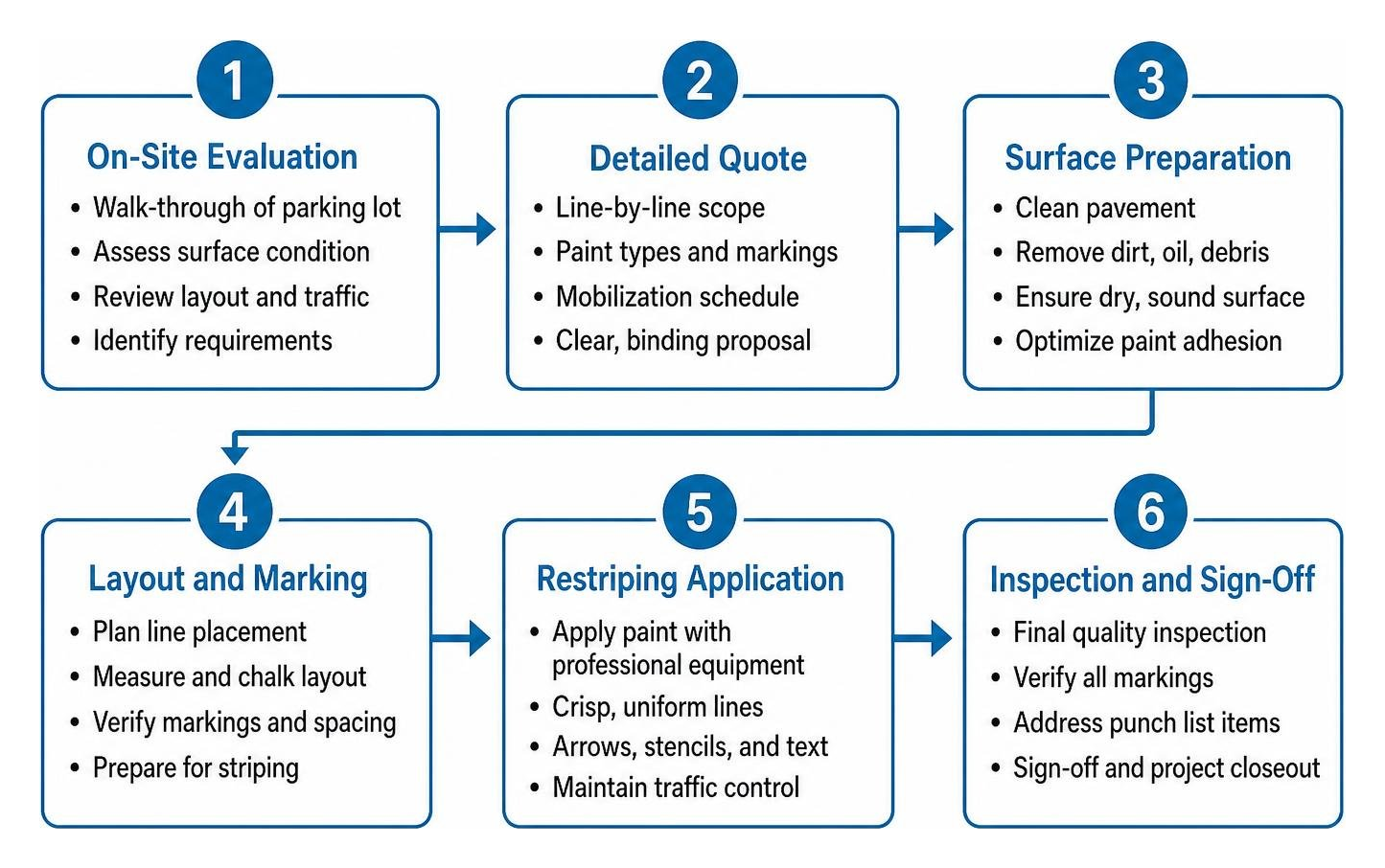
Surface Preparation and Site Readiness
Paint cannot adhere properly to dirty, greasy, or wet pavement. Surface preparation is the single most critical step in determining the longevity of your restriping investment.
The site preparation phase includes:
- Sweeping and Debris Clearing: Industrial walk-behind blowers and mechanical sweepers remove loose gravel, dirt, and organic matter from the pavement.
- Targeted Washing: High-traffic entryways and grease-stained stalls require specialized cleaning. Understand the preparation process by reviewing how do I prepare my parking lot for striping before project kick-off.
- Oil Spot Priming: Automotive oil, transmission fluid, and coolant spots must be treated with an oil-stop primer to prevent chemical bleed-through and paint delamination.
- Complete Moisture Check: Pavement must be dry. Sprinkler systems should be turned off 24 hours prior to work to prevent standing water or surface dampness.
Paint Application and Final Quality Inspection
Once the surface is clean and dry, the application crew snaps chalk lines to ensure straight, uniform layout geometry. Using high-pressure commercial spray equipment, technicians apply DOT-grade traffic paint at the correct mil thickness (typically 12 to 15 mils wet film thickness).
- Line Edge Precision: Airless systems deliver sharp, crisp edges without overspray, fuzzy borders, or paint misting onto parked vehicles.
- Accurate Stenciling: ADA emblems, arrows, and speed designations are laid down using heavy-duty industrial stencils for clean lettering and proper sizing.
- Cure and Barricading: Work zones remain barricaded with high-visibility cones and caution tape until paint has dried to prevent tire tracking.
- Punch List Review: The project manager completes a site walk-through to confirm all layout markings meet scope requirements before releasing the lot for normal vehicle traffic.
Frequently Asked Questions About Parking Lot Restriping
How often should a commercial parking lot be restriped?
Commercial parking lots should generally be restriped every 12 to 24 months, depending on traffic volume, direct sun exposure, and weather conditions. High-turnover retail centers, fast-food drive-thrus, and distribution centers may require restriping every 12 months, whereas lower-traffic professional office parks can often maintain visibility for up to 2 years. If your markings have lost more than 30% of their color contrast or reflective quality, restriping is due.
How much does commercial parking lot restriping typically cost?
Restriping costs depend on total linear footage, stall count, custom stencils, layout changes, and whether prior line obliteration is required. Standard restriping over existing, visible layouts typically ranges between $0.20 and $0.50 per linear foot, with individual stalls averaging $4.00 to $8.00 per space. Specialty stencils (such as ADA logos or fire lane curb lettering) and small-job minimum mobilization fees will factor into the total estimate.
How long does fresh traffic paint take to dry before opening the lot?
Under typical DFW weather conditions (warm, dry, low humidity), standard fast-dry waterborne traffic paint dries to the touch in 15 to 30 minutes. However, full cure requires roughly 60 minutes before opening the surface to vehicle traffic. Restriping conducted at night or in high-humidity conditions will require longer cure times. Professional contractors use cones and barricade tape to prevent premature vehicle access and tire tracking.
Conclusion
A well-maintained parking lot is fundamental to safety, legal compliance, and commercial curb appeal. Worn, faded markings compromise property navigation, expose your business to liability and municipal code fines, and create a negative first impression for visitors.
Working with an experienced, safety-focused contractor ensures your pavement remains visually sharp, accessible, and durable year-round. At Lone Star Parking Maintenance, we deliver professional parking lot striping, sealcoating, surface repairs, and compliant signage tailored to properties across the DFW Metroplex. Contact our team today to schedule an on-site property evaluation and receive a detailed, transparent proposal for your commercial facility.