
Choose a Traffic Rated Catch Basin That Matches Your Pavement Loads
A traffic rated catch basin is a stormwater inlet built to collect runoff while supporting the vehicle loads above it. For a DFW parking lot, driveway, loading area, or roadway, the right basin needs more than a strong-looking grate. Its frame, basin body, concrete surround, bedding, and pipe connections must work together.
| Quick buying guide | What it means |
|---|---|
| Light vehicle areas | Choose a basin and grate rated for the expected car and light-truck traffic. |
| Parking lots and bus routes | Look for heavier Class C or H-20-rated systems where required by the project. |
| Loading docks and industrial yards | Consider Class D, E, or higher systems for forklifts, trucks, and repeated wheel loads. |
| Airport or extreme-duty sites | Class F or FAA-rated drainage may be necessary. |
| Plastic basins | Do not assume the plastic alone is traffic rated; many need engineered concrete encasement. |
A standard landscape catch basin may handle rainwater, but it can crack, shift, or fail when vehicles roll over it. A properly specified traffic-rated unit helps move water off the pavement without creating a broken grate, sinking frame, or safety hazard.
I’m Cason, and this guide will help you compare the heavy-duty catch basin options that make sense for your property and traffic conditions.
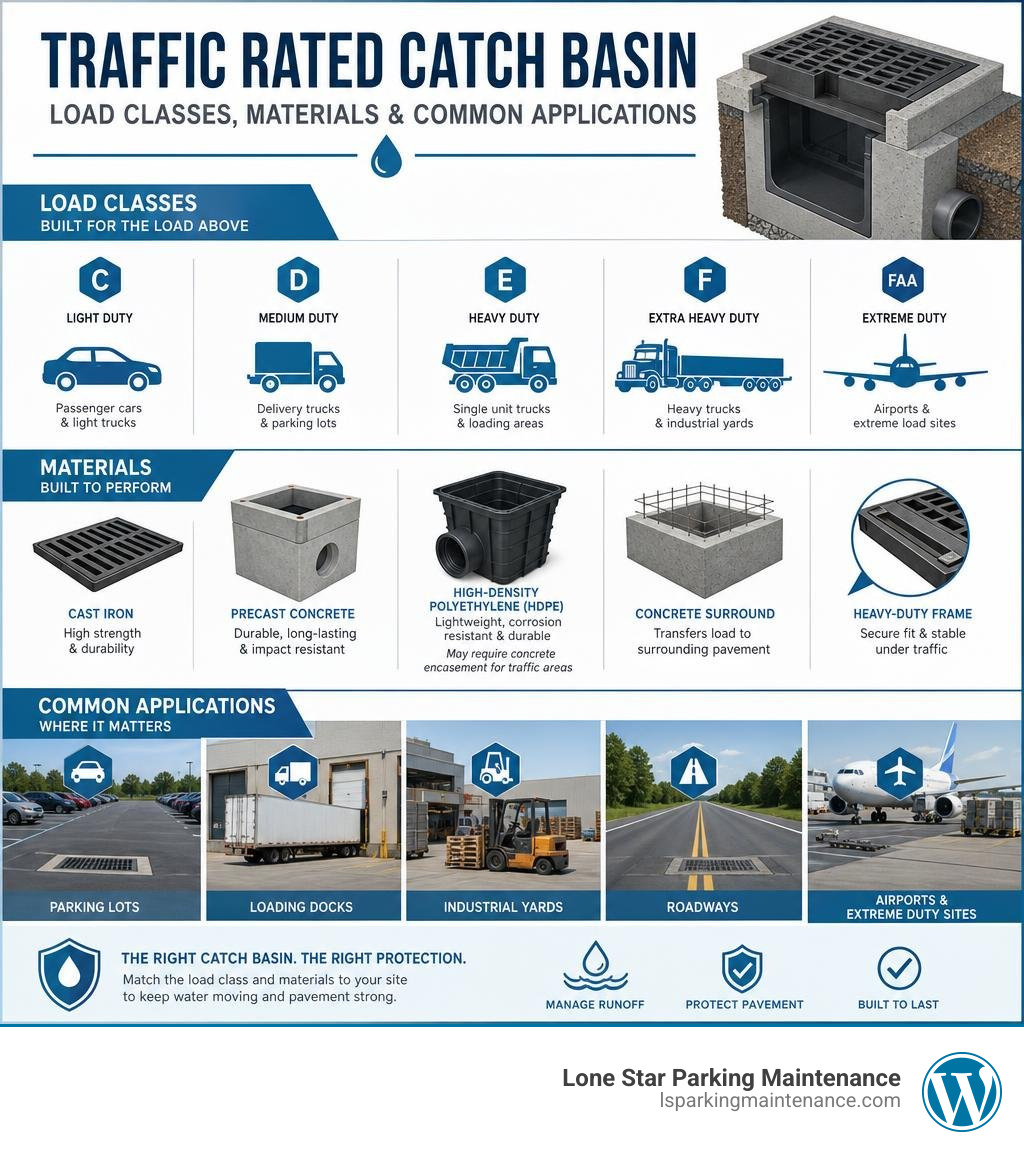
Must-know traffic rated catch basin terms:
What Makes a Traffic Rated Catch Basin Different from Standard Drainage?
When managing surface water on commercial property, it is easy to think any catch basin box with a metal cover will do the job. However, standard landscape or light-duty basins are strictly designed for lawn and pedestrian areas. If a delivery van or garbage truck drives over a standard basin, the top grate can flex, the walls can buckle, and the surrounding asphalt or concrete will quickly crumble.
A traffic rated catch basin differs in three fundamental ways:
- Sump Depth and Hydraulic Capacity: Traffic-rated basins feature extended sump depths designed to trap large volumes of sand, gravel, and debris while maintaining continuous water outlet flow.
- Structural Integrity: The basin structure—whether engineered precast concrete, polymer concrete, or encased high-density plastic—is designed to withstand vertical wheel impacts and lateral soil pressures without crushing.
- Dynamic Load Resistance: Standard drains are rated for static (stationary) loads. Traffic-rated units are built for dynamic loads, absorbing the kinetic force, vibration, and braking friction of moving delivery trucks, buses, and hard-tire forklifts.
Failure to install an appropriately rated drain leads to sunken pavement, cracked aprons, and dangerous trip hazards. If you are already seeing asphalt cracking or standing water around your current drainage structures, reviewing The Complete Guide to Parking Lot Repairs can help you identify structural pavement issues before they cause full subgrade collapse.
Load Class Breakdown: From Medium Duty to Extreme Proof Loads
Selecting the right traffic rated catch basin requires understanding official load classifications. Drainage standards generally follow Class A through Class F ratings (or AASHTO H-20 / HS-20 standards in civil transport applications).
Understanding these weight parameters guarantees your drainage investment will withstand daily vehicle turnover:
- Class A (Up to 3,300 lbs): Strict pedestrian and light landscape use only (patios, residential walkways).
- Class B (Up to 28,100 lbs per foot / ~60-175 PSI): Suitable for light vehicular traffic, personal cars, light trucks, and private driveways driving under 30 mph.
- Class C (Up to 55,000 lbs per foot / ~176-325 PSI / H-20 Rated): Engineered for commercial parking lots, gas stations, buses, light-duty forklifts, and municipal street perimeters.
- Class D (Up to 88,000 lbs per foot / ~326-575 PSI): Heavy-duty rating built for hard-tire forklifts, industrial yards, shipping terminals, and heavy truck lanes.
- Class E (Up to 132,000 lbs per foot): Heavy commercial loading docks, industrial yards, and general airport facility aprons.
- Class F (Up to 200,000 lbs proof load / EN1433 Standard): Extreme proof loads engineered for airport runways, military bases, port facilities, and ultra-heavy equipment yards.
| Load Class | Weight / Proof Load Capacity | PSI Equivalent | Primary Applications |
|---|---|---|---|
| Class A | 3,300 lbs | Pedestrian | Walkways, residential lawns, garden beds |
| Class B | 28,100 lbs/ft | 60 – 175 PSI | Private driveways, car parking stalls |
| Class C | 55,000 lbs/ft | 176 – 325 PSI (H-20) | Commercial parking lots, city streets, bus loops |
| Class D | 88,000 lbs/ft | 326 – 575 PSI | Industrial loading docks, hard-tire forklift zones |
| Class E | 132,000 lbs/ft | Extreme Heavy | Freight terminals, heavy transport facilities |
| Class F | 200,000 lbs | 4,000+ PSI (FAA) | Airport runways, port container terminals, fire aprons |
Material Selection for Basins and Grates
The durability of a traffic rated catch basin relies on matching the right basin body material with a complementary heavy-duty grate.

Basin Body Materials:
- Precast Concrete: The industry workhorse for municipal and highway drainage. Extremely durable, massive deadweight keeps it anchored in high groundwater tables, and built-in knockouts allow flexible pipe connections. Check out precast engineering options like Catch Basin Traffic Rated GA Grate-440 | Oldcastle Infrastructure for large-scale structural installations.
- Polymer Concrete: Made from polyester resin and quartz aggregates (such as the SK1-622D Catch Basin with Polymer Concrete Base Spec Sheet). It features compressive strengths exceeding 13,000 PSI, an ultra-low water absorption rate (0.07%), and superior resistance to road salts, oil, and de-icing chemicals.
- High-Density Polyethylene (HDPE) / Polypropylene: Lightweight and easy to transport, plastic basins dramatically lower labor costs during handling. However, to handle drive-over traffic loads, plastic basins must be fully encased in concrete during placement.
Grate Options:
- Ductile Cast Iron: Offers superior yield strength compared to standard gray iron. Ideal for high dynamic wheel impact zones like parking garage entrances and truck aprons.
- Stainless Steel & Galvanized Steel: Excellent corrosion resistance. Stainless steel packages (like the 22″x22″ Traffic Rated Catch Basin – Type C, Stainless Steel) blend clean architectural aesthetics with Class B/C durability.
- ADA Compliance & Heel-Proof Design: In pedestrian-heavy commercial parking zones, grates must meet Americans with Disabilities Act (ADA) guidelines. Heel-proof grates limit opening sizes (typically under 0.5 inches wide) so high heels, canes, and wheelchairs do not get caught, while maintaining high surface water flow rates (GPM). Learn more in our guide Everything You Need to Know About Parking Lot Drain Covers and Grates.
Structural Variations in Traffic Rated Catch Basins
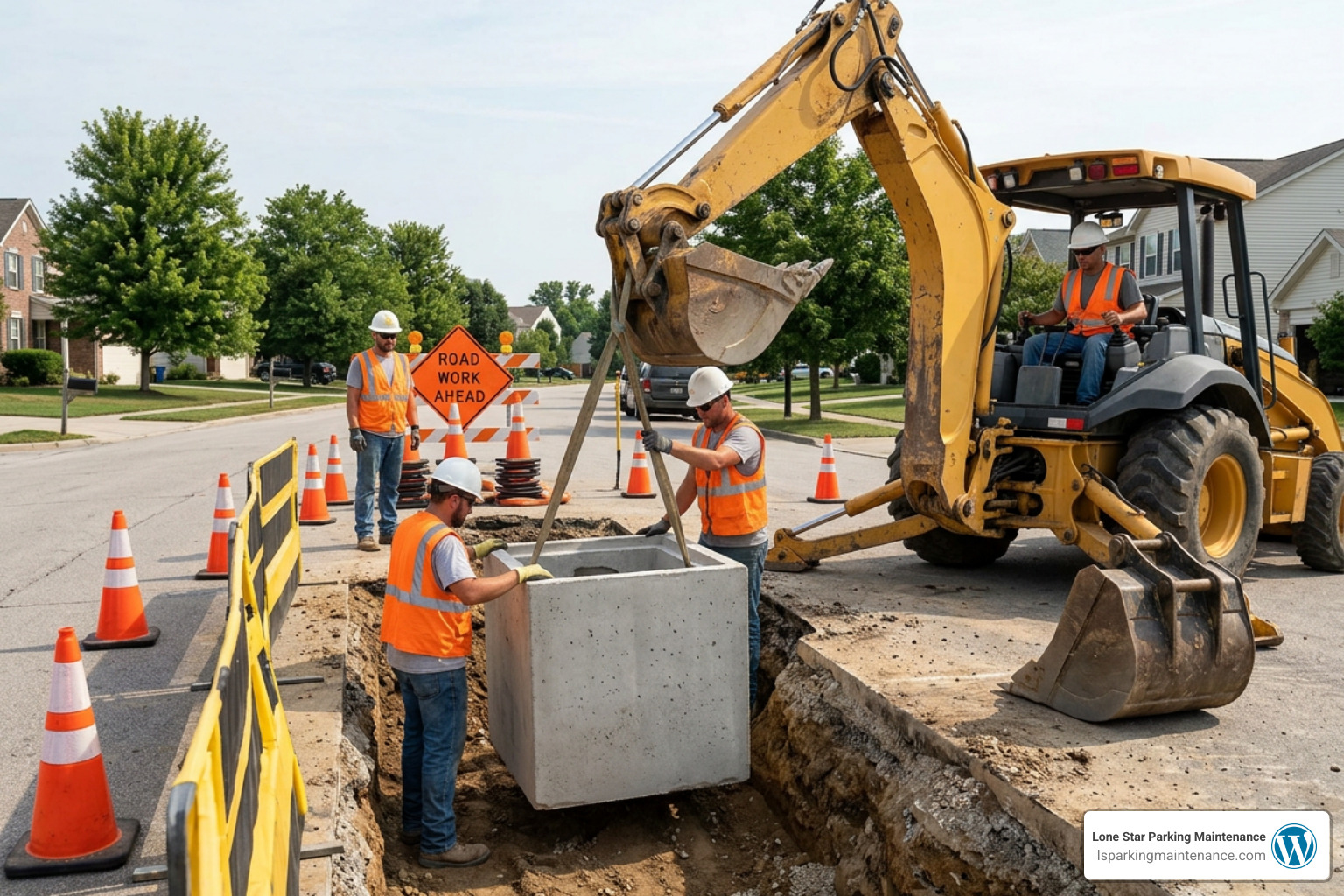
When designing a commercial drainage layout across the DFW Metroplex, choosing the proper physical basin form factor ensures simple installation and long-term performance.
Precast Concrete Traffic Rated Catch Basin Systems
Modular precast concrete basins are ideal for high-volume stormwater collection across large surface parking lots, streets, and industrial driveways. Manufactured off-site under strict quality controls, precast structures eliminate the need to pour custom concrete forms inside deep excavations.
Key features include:
- Modular Sections and Risers: Risers allow contractors to extend the basin opening flush to the finished asphalt or concrete grade regardless of pipe excavation depth.
- Thin-Wall Knock-Out Panels: Pre-stamped wall areas can be easily tapped out on-site using a hammer or chisel to receive multi-directional pipe connections (PVC, HDPE, or corrugated pipe) at custom invert elevations.
- High Flow Rate Sump Areas: Deep vertical sumps settle sand, silt, and heavy trash out of the water column before runoff enters municipal storm mains.
High-Density Polymer Concrete Traffic Rated Catch Basin Units
For demanding commercial facilities, fire station aprons, and distribution centers, high-density polymer concrete catch basins provide maximum durability. Polymer concrete catch basins achieve proof loads of up to 200,000 lbs (EN1433 Load Class F).
Because polymer concrete is non-porous, freeze-thaw cycles will not spall or crack the basin walls during sharp temperature swings. Their ultra-smooth interior surfaces accelerate water velocity, preventing sludge buildup and maximizing gallons-per-minute (GPM) hydraulic discharge.
Heavy-Duty Plastic and Polypropylene Modular Basins
Lightweight modular plastic systems—such as those highlighted in Storm Water Catch Basin Drainage Systems – NDS—offer flexible installation options.
Systems like the Z874-IB – Inline Catch Basin | Zurn incorporate integrated rebar clips and interlocking ends, which can cut installation setup labor significantly.
To ensure plastic catch basins handle drive-over vehicular traffic without crushing:
- They must be completely encased in a poured concrete envelope.
- Stackable risers must be secured with waterproof silicone sealant to guarantee soil-tight or watertight performance.
- Frames must feature 4-corner grate lockdown bolts to keep covers from rattling loose under vehicle vibration.
Critical Installation Requirements for Heavy Load Areas
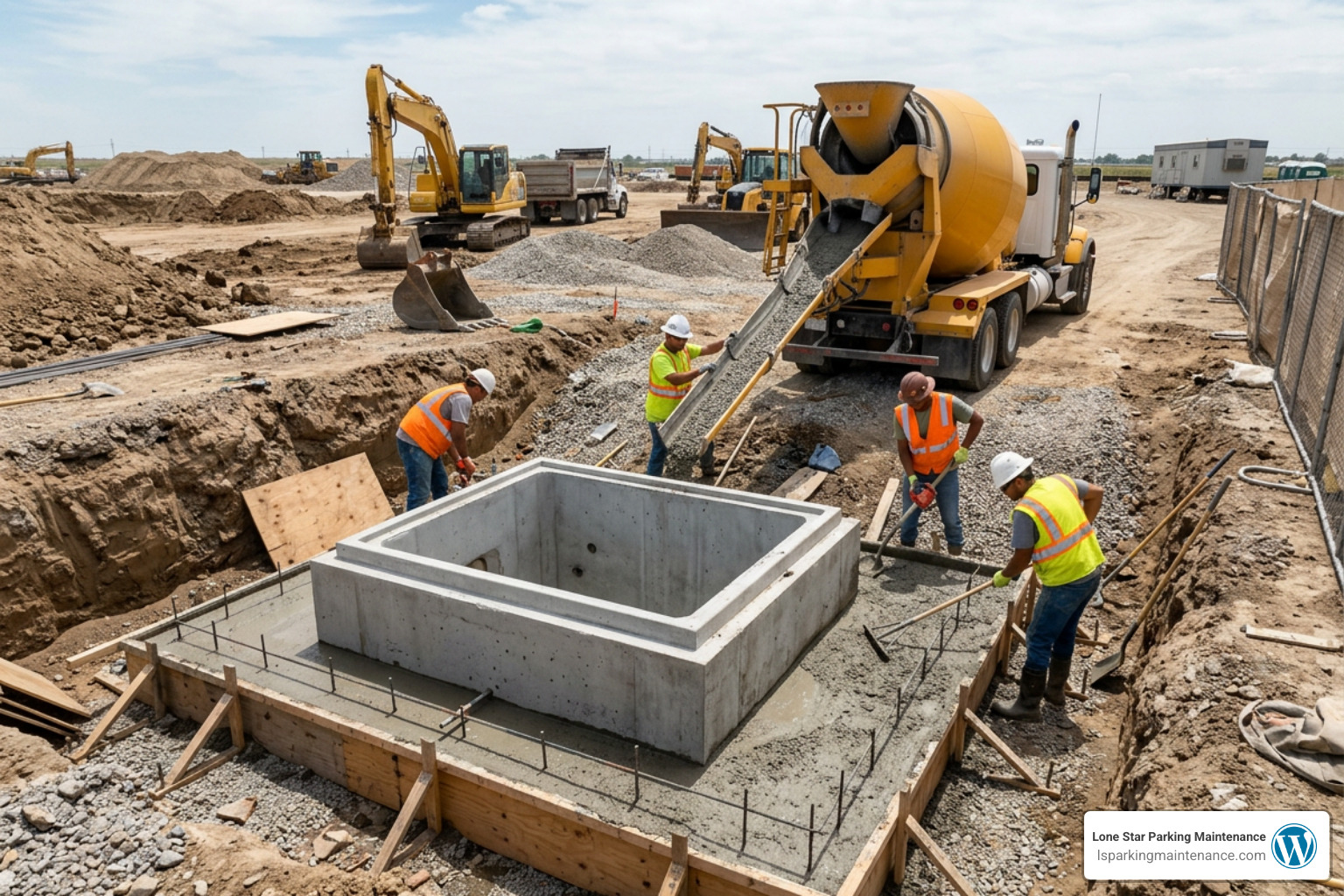
Even a Class F traffic rated catch basin will fail prematurely if installed on unstable subgrade or without proper concrete support collar reinforcement. The installation environment carries the load—the basin and grate merely distribute it.
Here is the step-by-step structural workflow required when installing traffic-rated drainage:
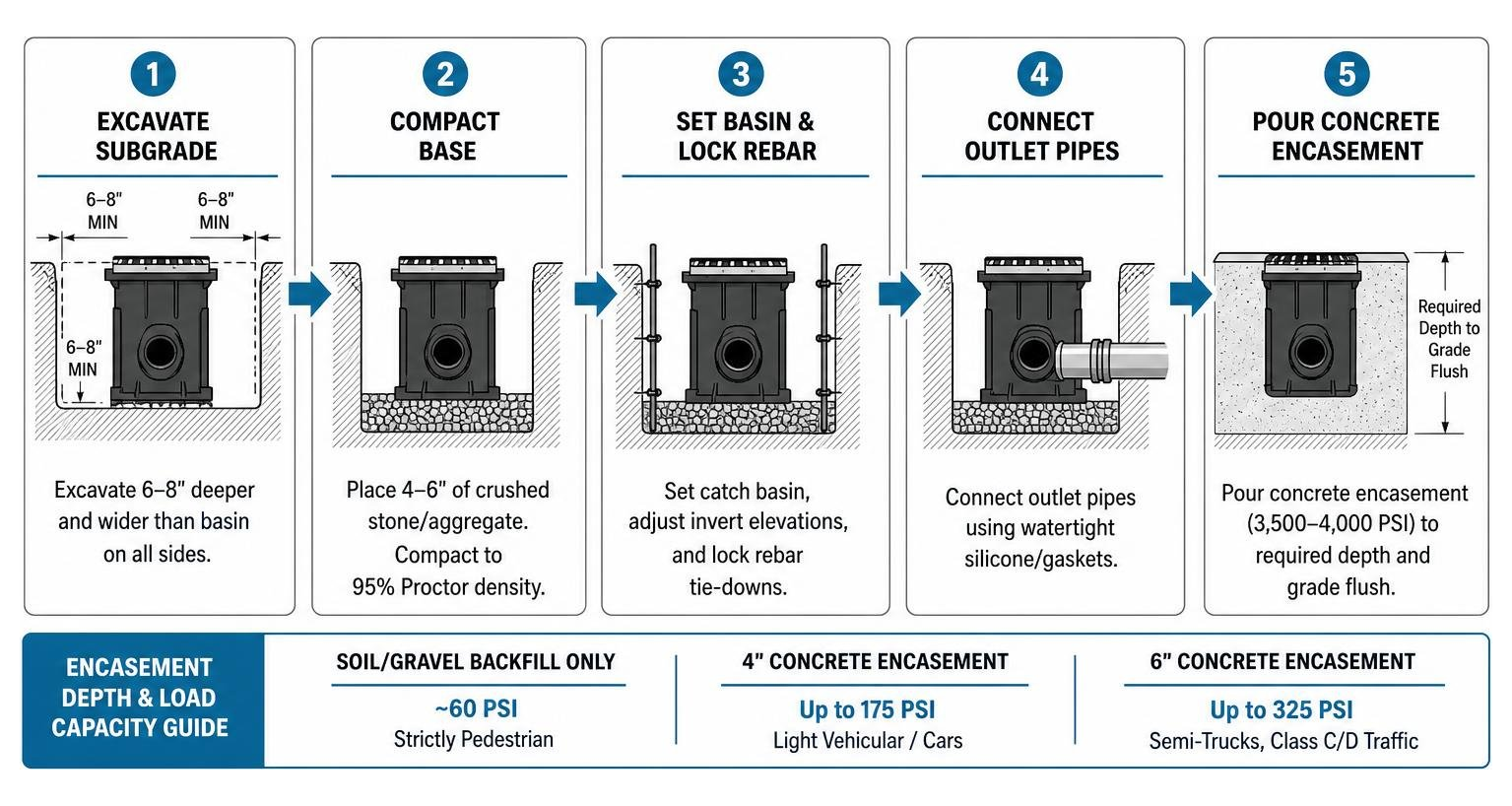
- Subgrade Excavation and Compaction: Excavate the installation pit so there is at least 6 to 8 inches of space around all four sides of the basin body. Compact the underlying soil thoroughly and lay a minimum 4-to-6-inch bedding layer of crushed stone or aggregate.
- Concrete Encasement Depths and PSI: For plastic, HDPE, or thin-wall polymer basins, the surrounding concrete encasement directly determines the final load rating:
- Soil/Gravel backfill only: Rated at ~60 PSI (Strictly Pedestrian).
- 4-inch Concrete Encasement: Up to 175 PSI (Light vehicular / cars).
- 6-inch Concrete Encasement: Up to 325 PSI (Semi-trucks, Class C/D traffic).
- 8-inch Concrete Encasement: Up to 575 PSI (Heavy-duty hard-tire forklifts, Class E). Always use 3,500 to 4,000 PSI minimum concrete mixes for the encasement pour.
- Pipe Outlets and Sealants: Pipe outlets (PVC, Sch 40, or corrugated) should fit snugly into universal adapters or precast knockouts. Apply a generous bead of exterior-grade waterproof silicone sealant or expandable rubber boots around pipe penetrations to prevent groundwater infiltration and soil washing.
For complete step-by-step insights on trenching and grading drainage connections in commercial lots, read Don’t Let Your Business Sink a Guide to Installing Parking Lot Drains and brush up on basic water management with Parking Lot Drainage 101.
Integrating Catch Basins with Trench Drain Systems
Catch basins rarely operate alone in large parking lots. They frequently serve as discharge hubs for continuous linear trench drains.
When pairing trench drains with inline catch basins:
- Velocity Matching: Ensure the invert height of the trench drain matches the inlet knockout on the catch basin to avoid water back-pitching.
- Pipe Sizing: Connect catch basin outlets to smooth-wall PVC pipe rather than corrugated pipe wherever possible. For instance, a 4-inch smooth-wall pipe at a 1% slope delivers 135 GPM, compared to only 54 GPM through a 4-inch corrugated pipe due to internal wall friction.
- For detailed instructions on setting up channel drains ahead of your catch basin, follow our guide Go With the Flow A DIY Guide to Trench Drain Installation.
Maintenance Procedures for Heavy Traffic Catch Basins
Heavy vehicular traffic continuously forces dirt, gravel, oil, trash, and leaves into parking lot drains. Without routine cleanouts, a clogged basin causes localized flooding that ruins nearby asphalt subgrades.
Implement this maintenance checklist to extend the life of your drainage infrastructure:
- Bi-Annual Sediment Cleanouts: Schedule professional vacuum truck services every spring and fall to clear accumulated sediment out of the lower sump box before water outlets become blocked.
- Inspect Removable Trash Buckets: Polymer concrete and inline basins often include removable galvanized or polypropylene trash baskets. Empty these baskets quarterly in high-volume commercial properties. Note: Running a basin with a trash basket slightly reduces peak GPM flow capacity, so clear them frequently during rainy seasons.
- Check Grate Lockdown Hardware: Dynamic vehicle traffic (especially turning trucks) subjects grates to heavy lateral forces. Periodically tighten 4-corner lockdown bolts and inspect anti-shunt lugs to eliminate dangerous grate rattling or pop-outs.
- Seal and Frame Repairs: Check the asphalt-to-concrete transition frame around the grate collar. If you notice cracking, crumbling asphalt, or water seeping beneath the frame, make asphalt joint repairs right away.
For a deeper dive into protecting your pavement infrastructure, see Your Parking Lot Storm Drain Is the Unsung Hero of Pavement and explore actionable maintenance strategies in Stop the Soak With These Parking Lot Drainage Tips.
Frequently Asked Questions About Catch Basins
How much concrete encasement is required for heavy vehicle loads?
To achieve vehicular traffic ratings on high-density plastic or modular catch basins, a concrete surround is required:
- Light Vehicular Traffic (Cars/Pickups): Minimum 4 inches of 3,500 PSI concrete surround (~175 PSI rating).
- Semi-Trucks and Commercial Delivery Lanes: Minimum 6 inches of concrete surround (~325 PSI rating / Class C/D).
- Heavy Industrial & Forklift Traffic: Minimum 8 inches of reinforced concrete surround (~575 PSI rating / Class E).
Precast concrete catch basins do not require full side encasement if backfilled with properly compacted aggregate, but they still require a reinforced concrete collar around the top frame and grate to lock the structure into the surrounding pavement.
What is the difference between H-20 and FAA load ratings?
- H-20 Load Rating: A standard established by AASHTO for highway structures. It specifies a catch basin can support a 32,000 lb axle load (16,000 lbs per dual-wheel set), representing standard highway truck traffic under normal operating conditions.
- FAA Load Rating: Standard established by the Federal Aviation Administration for airport infrastructure. It requires extreme proof load testing (often EN1433 Class F / 200,000 lbs proof load) to resist impact loads from massive commercial aircraft wheel sets landing or taxiing across tarmac pavement.
Can plastic catch basins withstand drive-over traffic?
Yes, polypropylene or HDPE plastic catch basins can withstand heavy drive-over traffic, provided they are encased in concrete according to manufacturer specifications.
The plastic body acts as an internal form while providing excellent chemical resistance and smooth hydraulic flow. However, the surrounding concrete envelope bears the actual structural load imposed by passing vehicle tires. If installed strictly in soil, sand, or gravel, a plastic basin will crack or collapse under heavy vehicle loads.
Conclusion
Choosing the right traffic rated catch basin is one of the most vital decisions you can make when designing or upgrading commercial pavement drainage. From matching proper load classes (Class B through Class F) to selecting ductile iron grates and placing structural concrete encasements, every layer of the installation affects the long-term health of your property.
Skipping load calculations or using landscape-grade drains in vehicular zones leads to sunken frames, cracked asphalt, standing water, and costly liability risks.
At Lone Star Parking Maintenance, we specialize in helping facility managers and property owners throughout the DFW Metroplex repair, maintain, and upgrade their drainage infrastructure. Whether you need full catch basin replacements, asphalt apron repairs, or routine parking lot maintenance, our team brings industry-standard materials, top quality workmanship, and an uncompromised commitment to safety.
Don’t let drainage issues ruin your pavement investment. Contact our experts today to schedule a comprehensive drainage evaluation for your facility via Lone Star Parking Maintenance Commercial Drainage Solutions.