
Why Parking Lot Repairs Matter More Than You Think
Parking lot repairs are one of the most overlooked — and most costly — maintenance needs for commercial properties in the DFW Metroplex.
Here’s a quick breakdown of what you need to know:
| Situation | Best Action |
|---|---|
| Isolated cracks or small potholes, solid base | Crack sealing or patching |
| Widespread surface wear, base still sound | Resurfacing (overlay) |
| Base failure, major structural damage | Full replacement |
| Faded lines, surface oxidation | Sealcoating and restriping |
Your parking lot is the very first thing customers, tenants, and visitors see. A cracked, faded, or pothole-riddled surface sends the wrong message — and creates real safety and liability risks. Potholes alone cost U.S. drivers $3 billion a year in vehicle damage, according to research by the AAA (American Automobile Association). For property owners, ignored damage doesn’t stay small. A $400 pothole repair left through a Texas summer can become a $4,000 problem by the time you get around to it.
The good news? Most parking lot damage is very fixable — if you catch it early and choose the right approach.
This guide covers everything: how to read the warning signs, which repair method fits your situation, what it costs, and how to keep your lot in top shape year after year.
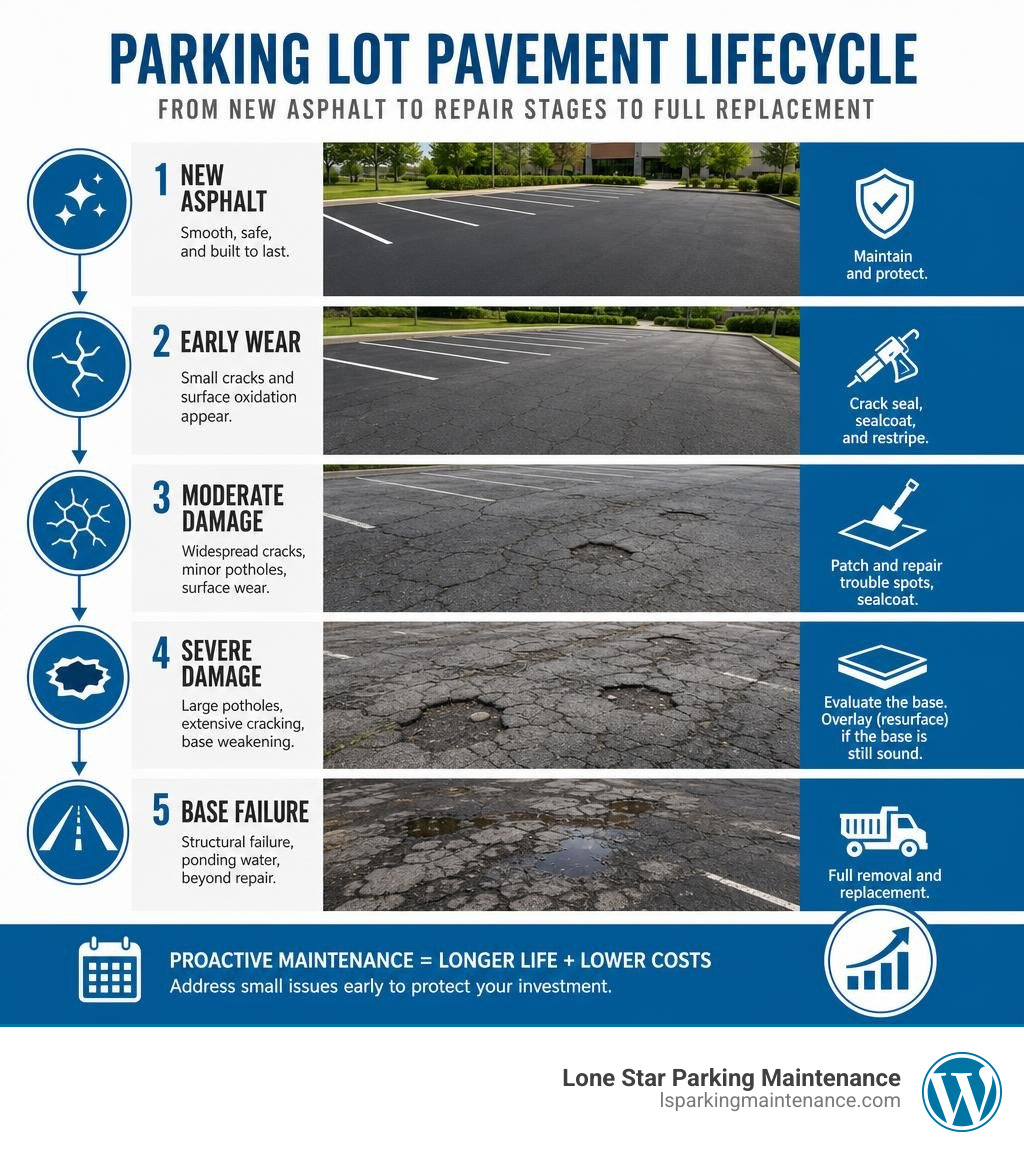
Similar topics to parking lot repairs:
When to Invest in Professional Parking Lot Repairs

Knowing when to call in the professionals for parking lot repairs is the difference between a minor maintenance expense and an budget-busting emergency project. Pavement distress is progressive. What begins as a hairline fracture in the asphalt can quickly expand into a deep pothole after a few heavy rains and delivery truck passes.
When you proactively address issues, you preserve the underlying sub-base. The sub-base is the gravel and soil foundation that supports the weight of every vehicle parking on your property. Once water breaches the surface layer and washes away or softens this foundation, simple surface repairs are no longer an option.
For a deeper look into why proactive maintenance is a game-changer, check out these 10 Reasons Why You Will Love Asphalt Repair Services.
Identifying Early Signs of Pavement Distress
To catch damage before it escalates, keep an eye out for these common signs of pavement distress during your regular property walks:
- Linear Cracks: Longitudinal or transverse cracks are often the first signs of stress. If they are under 1/4 inch wide, they can easily be sealed to prevent water intrusion.
- Alligator Cracking: Named for its resemblance to reptile skin, this network of interconnected cracks is a sign of structural fatigue or sub-base failure. It indicates that the asphalt can no longer support the traffic load.
- Potholes: These form when water gets under the pavement, freezes or shifts the base, and traffic breaks the weakened surface. They are safety hazards and major liabilities.
- Crumbling Edges: The perimeter of your parking lot is highly vulnerable, especially near landscaped areas where irrigation runoff can soften the soil.
- Standing Water (Depressions): If you notice puddles that linger long after a rainstorm, it means your pavement has settled or was improperly graded. Standing water actively accelerates asphalt breakdown.
- Faded, Oxidized Color: When asphalt turns from rich black to dull gray, UV rays have stripped away its binding oils, leaving it brittle and prone to cracking.
- Oil and Chemical Spills: Vehicle fluids soften asphalt binders, turning hard pavement into a soft, crumbly mess.
Long-Term Benefits of Timely Parking Lot Repairs
Delaying parking lot repairs might save a few dollars this month, but it will cost you significantly more down the line. Investing in timely repairs offers several undeniable benefits:
- Protects Against Liability and Injury: Tripping hazards, uneven walking paths, and vehicle damage from potholes can lead to costly insurance claims or lawsuits. Keeping your surface smooth keeps your visitors safe.
- Enhances Curb Appeal and Property Value: First impressions matter. A clean, well-maintained parking lot signals to customers and tenants that you care about your business and pay attention to detail.
- Ensures ADA Compliance: Overlooking faded striping or cracked handicap spaces can lead to heavy municipal fines. Regular repairs and restriping keep your property compliant with the Americans with Disabilities Act (ADA).
- Extends Pavement Lifespan: Regular maintenance can extend the life of an asphalt parking lot from a standard 15 years to well over 25 years, delaying the massive capital expenditure of a full replacement.
To learn more about keeping your visitors safe and your liability low, read our guide on Concrete and Asphalt Maintenance: Keeping Your Lot Safe.
Repair vs. Resurfacing vs. Full Replacement

One of the most common questions commercial property owners ask is: “Do I need a quick patch, a resurfacing overlay, or a complete tear-out?”
Making the wrong choice can lead to wasted money. For example, placing a beautiful new asphalt overlay over a failing, unstable foundation will result in reflective cracking within a year. Conversely, tearing out an entire lot when a few targeted repairs and a sealcoat would suffice is an unnecessary waste of capital.
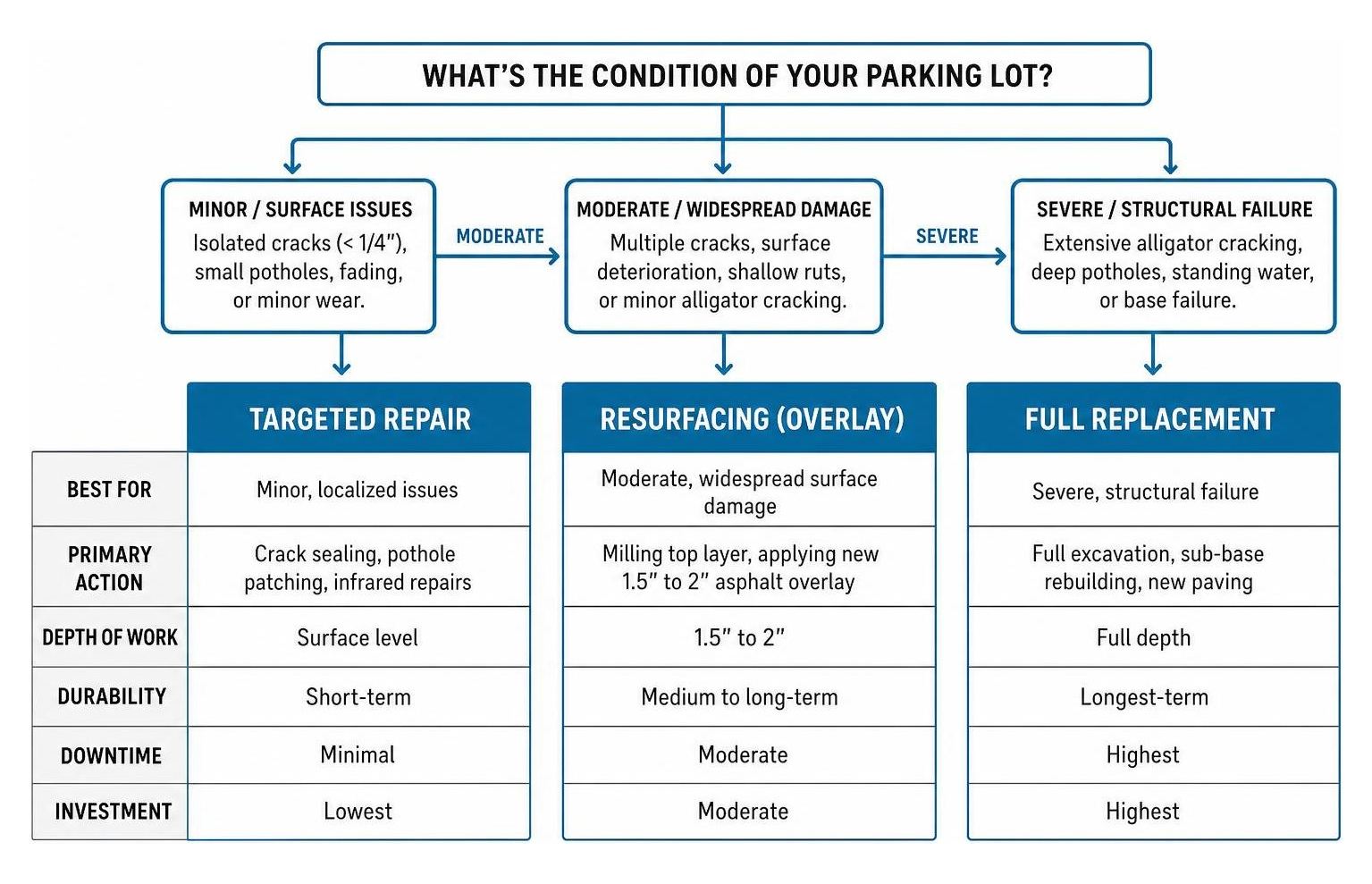
Here is a side-by-side comparison to help you evaluate your options:
| Feature | Targeted Repair | Resurfacing (Overlay) | Full Replacement |
|---|---|---|---|
| Primary Action | Crack sealing, pothole patching, infrared repairs | Milling top layer, applying new 1.5″ to 2″ asphalt overlay | Full excavation, sub-base rebuilding, new paving |
| Best For | Lots with < 20% surface damage and a stable foundation | Lots with widespread surface wear but a strong sub-base | Lots with > 35% damage, deep structural failure, or poor drainage |
| Lifespan | 1 to 5 years (depending on repair type) | 8 to 12 years | 15 to 20+ years (with maintenance) |
| Relative Cost | Low | Moderate (roughly half the cost of replacement) | High |
| Disruption | Minimal (hours to complete, phased sections) | Moderate (1–3 days, requires partial closures) | High (multiple days/weeks, major traffic rerouting) |
To gain a deeper understanding of the resurfacing process, check out our comprehensive resources: All About Parking Lot Resurfacing and The Ultimate Guide to Resurfacing Asphalt Parking Lots.
Cost-Effective Parking Lot Repairs for Minor Damage
When damage is localized, targeted parking lot repairs are the most cost-effective solution.
- Crack Sealing: This is the single most important preventative maintenance step. Technicians clean out cracks with pressurized air, then inject a hot, rubberized sealant that remains flexible in changing temperatures. This blocks water from reaching the sub-base. Learn more with our guide Don’t Let Cracks Win with Texas Asphalt Crack Repair Experts and explore the step-by-step process in The Ultimate Guide to Texas Crack Sealing and Repair Services.
- Pothole Patching: For permanent pothole repairs, we recommend a saw-cut and replace method. Rather than throwing “cold patch” into a wet hole, we cut out the damaged area, remove the debris, compact the sub-grade, apply a tack coat, and lay hot-mix asphalt. Discover professional techniques in How to Patch Pavement Like a Pro.
- Infrared Asphalt Repair: This advanced method uses infrared rays to heat existing asphalt to a workable state. We then add a small amount of fresh hot-mix, rake the area, and compact it. This creates a seamless, joint-free patch that is highly resistant to water penetration.
Asphalt vs. Concrete: Pros and Cons for Replacement
If your parking lot has reached the end of its lifecycle, you have a choice to make: replace it with asphalt or concrete? Both materials have distinct advantages.
Asphalt
- Pros: Lower initial installation cost; faster installation and curing times (drivable within 24–48 hours); easier to repair and resurface locally.
- Cons: Requires regular maintenance (sealcoating every 3–4 years); shorter overall lifespan (15–20 years); can soften during intense Texas summers.
Concrete
- Pros: Extreme durability; handles heavy loads (like garbage trucks and delivery semis) exceptionally well; requires minimal maintenance; lasts 30–40 years.
- Cons: Significantly higher upfront cost; longer curing time (typically 7 days before heavy traffic is allowed); repairs are more complex and visually contrasting.
How Climate and Weather Impact Your Choice
Here in the DFW Metroplex, our climate plays a massive role in pavement wear.
Our blistering summer heat softens asphalt, making it vulnerable to “rutting” and power-steering scuffs from heavy vehicles. At the same time, the highly expansive clay soils in North Texas shift dramatically between wet and dry seasons. This movement places immense structural stress on both asphalt and concrete.
While we don’t experience the prolonged, deep freezes of northern states, our winter “freeze-thaw” cycles are still highly destructive. When rainwater enters unsealed cracks and freezes, it expands by approximately 9%, widening the crack. When it thaws, it leaves a void, which collapses under the weight of traffic to form a pothole.
Cost Factors and Lifespan of Pavement Restorations
Understanding the financial side of parking lot repairs helps you budget effectively. Repair costs are rarely flat-rate; they are influenced by several variables:
- Project Size and Scope: Larger projects often benefit from economies of scale. However, highly fragmented repairs (like patching 20 small, scattered potholes) require more labor and mobilization than repairing one large, continuous section.
- Material Prices: Liquid asphalt is a petroleum product, meaning its cost fluctuates with global oil prices.
- Mobilization and Equipment: Bringing heavy rollers, milling machines, and transport trucks to a site represents a fixed cost. This is why combining repairs into a single project is more economical than calling a contractor out multiple times.
- Sub-Base Condition: If a pothole repair requires excavating and replacing 6 inches of crushed stone base underneath, the labor and material costs will be higher than a simple surface-level skin patch.
For a detailed breakdown of budgeting and life expectancy, refer to the Asphalt Parking Lot Repair Guide 2026.
Minimizing Business Disruption During Construction
We understand that you cannot simply shut down your business for a week to fix your parking lot. Downtime means lost revenue.
To keep your operations running smoothly, we utilize several strategies to minimize disruption:
- Phased Scheduling: We divide your parking lot into zones. We complete repairs, sealing, and striping in one zone while keeping the rest of the lot open for employees and customers, then swap.
- Off-Hours and Weekend Work: For high-traffic retail centers or medical facilities, we can schedule our crews to work overnight or over the weekend when your business is closed.
- Clear Traffic Control and Signage: We place highly visible barricades, cones, and directional signs to guide drivers safely around active work zones.
- Proactive Communication: We work with property managers to draft clear, concise notifications for tenants, residents, or employees, ensuring everyone knows where to park ahead of time.
Preventative Maintenance: Sealcoating, Striping, and Drainage
The secret to avoiding expensive parking lot repairs is a robust preventative maintenance program. Think of pavement maintenance like oil changes for your car — consistent, low-cost care prevents catastrophic engine failure.
A comprehensive maintenance plan consists of three pillars:
- Sealcoating: Sealcoat is a protective liquid coating applied over asphalt. It acts as a barrier against UV rays, water intrusion, and chemical spills (like oil and gasoline). Proper sealcoating can extend the life of your asphalt by 3 to 5 years and should be reapplied every 3 to 4 years.
- Line Striping: Crisp, bright markings are essential for safety, maximizing parking capacity, and ensuring ADA compliance. We use high-durability, traffic-grade paints to restripe parking stalls, fire lanes, directional arrows, and handicap spaces.
- Drainage Inspections: Water is asphalt’s worst enemy. Regularly clearing debris from catch basins, checking drain slopes, and ensuring water flows freely off your pavement prevents standing water from seeping into the sub-grade.
For best practices on combining these services to maximize your return on investment, read Don’t Let Cracks Win with These Asphalt Patching and Sealing Best Practices.
Frequently Asked Questions About Parking Lot Maintenance
How do I choose a reputable parking lot repair contractor?
Look for a contractor who provides a detailed, written proposal with clear maps showing exactly where repairs will occur. They should offer an in-person site assessment rather than a phone quote, as sub-base conditions cannot be evaluated through a screen. Ensure they carry full commercial liability and worker’s compensation insurance, use commercial-grade hot-mix materials, and have a proven track record in the DFW Metroplex.
How long do different types of parking lot repairs last?
- Crack Sealing: Typically lasts 2 to 3 years before requiring touch-ups.
- Hot-Mix Pothole Patches: A professional, full-depth cut-and-patch repair can last 10 to 15 years—essentially matching the remaining lifespan of the surrounding pavement.
- Sealcoating: Provides optimal protection for 3 to 4 years depending on traffic volume.
- Asphalt Overlay (Resurfacing): Extends the life of your lot by 8 to 12 years if applied over a stable sub-base.
What is the difference between overlay and full reconstruction?
An asphalt overlay is a cosmetic and structural refresh where we mill down the top 1–2 inches of damaged surface asphalt and overlay a fresh layer of hot-mix directly onto the stable base. Full reconstruction is a complete excavation. We remove all asphalt layers, completely regrade and compact the underlying soil and gravel sub-base, and lay entirely new asphalt. Full reconstruction is reserved for lots with deep structural failure.
Conclusion
Your parking lot is a valuable asset that directly impacts your property’s safety, curb appeal, and overall value. Ignoring minor cracks and potholes today only paves the way for expensive, disruptive replacements tomorrow. By investing in timely parking lot repairs and staying consistent with preventative maintenance, you can keep your lot looking pristine while saving thousands of dollars over its lifespan.
At Lone Star Parking Maintenance, we are proud to serve commercial properties throughout the DFW Metroplex. We combine top-quality materials, strict adherence to industry standards, and an unwavering commitment to safety to deliver results that last.
Whether you need crack sealing, pothole patching, sealcoating, or a complete parking lot restriping, our team is ready to help.
Contact Lone Star Parking Maintenance today to schedule your professional site assessment and keep your parking lot safe, compliant, and beautiful.