
What You Need to Know About Texas Crack Filling Services
Texas crack filling services are professional pavement maintenance solutions that seal cracks in asphalt before water, debris, and heat turn small problems into expensive structural failures.
If you’re a property manager or business owner in Texas, here’s a quick summary:
- What it is: A process where trained crews clean, prepare, and seal asphalt cracks using hot-pour rubberized or polymer-based materials
- Why it matters: Unsealed cracks let water into the base layer, leading to potholes, sinking, and full pavement failure
- Who needs it: Any commercial parking lot, driveway, or private road showing cracks wider than 1/8 inch
- Best timing: Spring and fall, when temperatures are moderate and humidity is low — though repairs can be done year-round in most parts of Texas
- How long it lasts: Properly applied crack filler lasts 2 to 3 years; crack sealing with rubberized sealant can last 3 to 5 years
- Cost vs. alternative: Crack filling costs a fraction of asphalt overlay or full pavement replacement
Paved surfaces deteriorate over time. Heat, heavy traffic, ground movement, and UV exposure all take a toll — and in Texas, the climate makes that process faster than in most states. A small crack that looks harmless today can spread into a network of damage within a single season if left untreated.
The good news? Catching cracks early is one of the most cost-effective things a property owner can do. Research from Auburn University’s National Center for Asphalt Technology estimates that crack sealing can add approximately three years to a pavement’s service life.
This guide covers everything you need to know — from what causes cracks to how the repair process works, what materials are used, and how to choose the right contractor in Texas.
Explore more about Texas crack filling services:
Why You Need Professional Texas Crack Filling Services

Asphalt pavement is designed to be highly durable, but it is not completely indestructible. When left to the mercy of the elements, even the most expertly laid asphalt will eventually begin to show its age. For commercial property owners and facility managers in the DFW Metroplex, staying on top of pavement maintenance is a necessity.
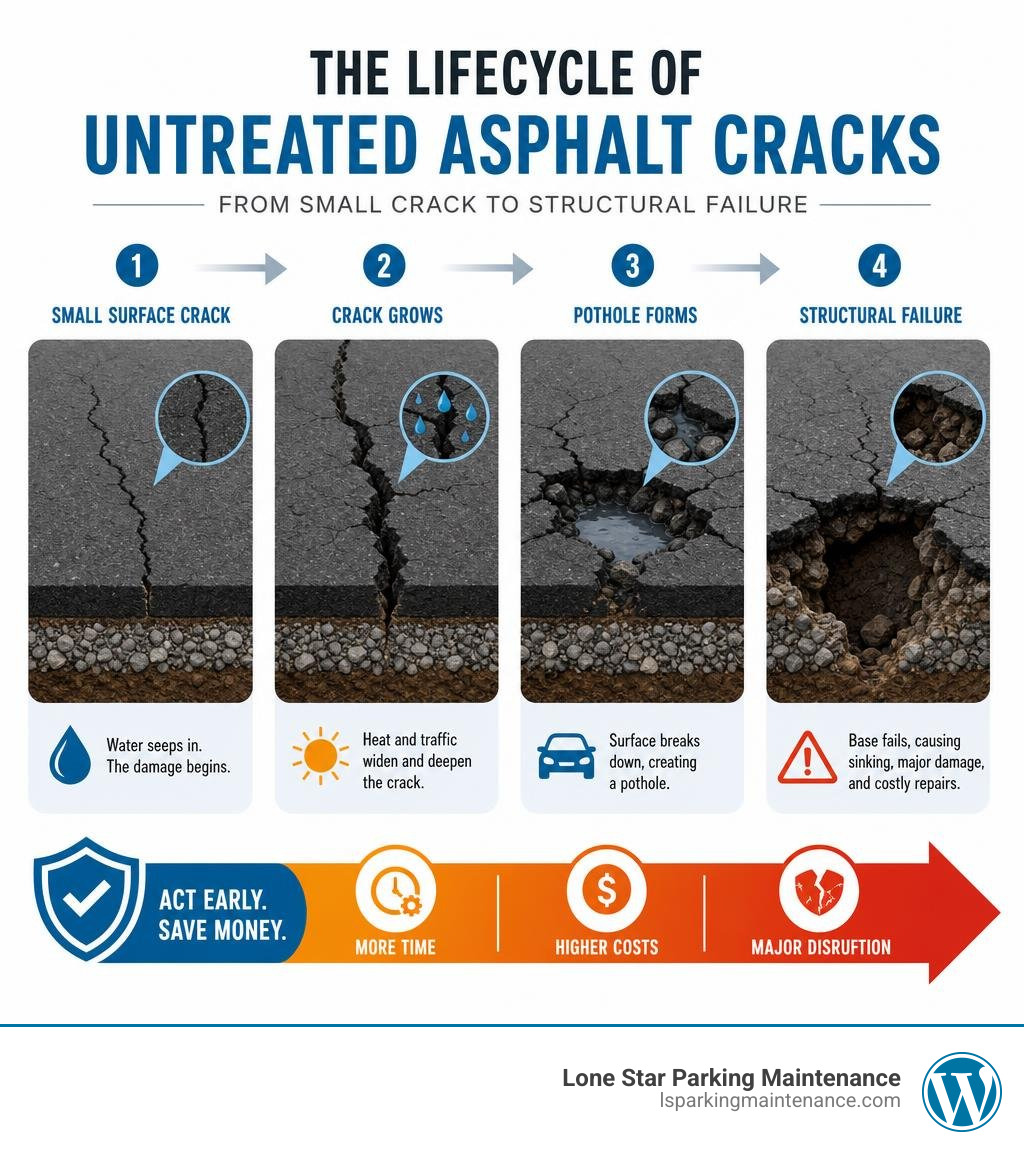
Ignoring a minor crack might seem harmless in the short term, but it is actually the first stage of major pavement failure. When cracks are neglected, they act as open funnels that direct water, dirt, and chemicals straight into the deeper layers of your parking lot. Utilizing professional Texas crack filling services is your first line of defense against rapid asphalt deterioration. If you want to keep your parking facility safe, clean, and structurally sound, understanding the core benefits of crack filling is an essential step in your property management strategy.
How Texas Crack Filling Services Prevent Water Damage
Water is the absolute worst enemy of asphalt. While a smooth, sealed asphalt surface is highly effective at shedding water, cracked asphalt does the exact opposite. When rain falls on a cracked parking lot, the water pools in the crevices and begins to seep downward.
Once water breaches the surface layer, it reaches the aggregate base and subgrade soil below. This subgrade is the foundation that supports the weight of every vehicle driving over your lot. As water saturates this foundation, it softens the soil and washes away the supporting aggregate. This process is known as base erosion.
Without a solid foundation beneath it, the surface asphalt can no longer support heavy traffic loads. When vehicles drive over these hollowed-out areas, the asphalt collapses, forming unsightly and dangerous potholes.
Furthermore, Texas weather can be unpredictable. While we are famous for our sweltering summers, DFW winters frequently bring sudden freeze-thaw cycles. When water gets trapped inside open pavement cracks and freezes, it expands. This expansion forces the walls of the crack outward, fracturing the surrounding asphalt. When the ice melts, it leaves behind a significantly wider gap. Professional Texas asphalt crack repair experts stop this destructive cycle in its tracks by sealing those gaps with commercial-grade, watertight materials that keep moisture out.
Cost Savings and Pavement Preservation
Every smart business owner knows that preventative maintenance is always cheaper than reactive emergency repairs. This is especially true when it comes to asphalt management.
Think of crack filling as the equivalent of getting the oil changed in your car. It is a quick, inexpensive service that prevents your engine—or in this case, your entire parking lot—from completely breaking down. By investing in routine crack filling, you are actively preserving your asphalt asset and extending its total lifespan by years.
According to industry research from the Federal Highway Administration and leading pavement preservation studies, every dollar spent on crack sealing can save up to four to ten dollars in future rehabilitation costs. If you ignore cracks, you will eventually be forced to pay for expensive asphalt overlays, extensive milling, or a complete pavement reconstruction.
To help property owners understand the basics of this process, we recommend checking out a beginner’s guide to black top crack filler, which breaks down how these protective materials work to shield your wallet from major repair bills.
Understanding Asphalt Damage: Causes and Types of Cracks
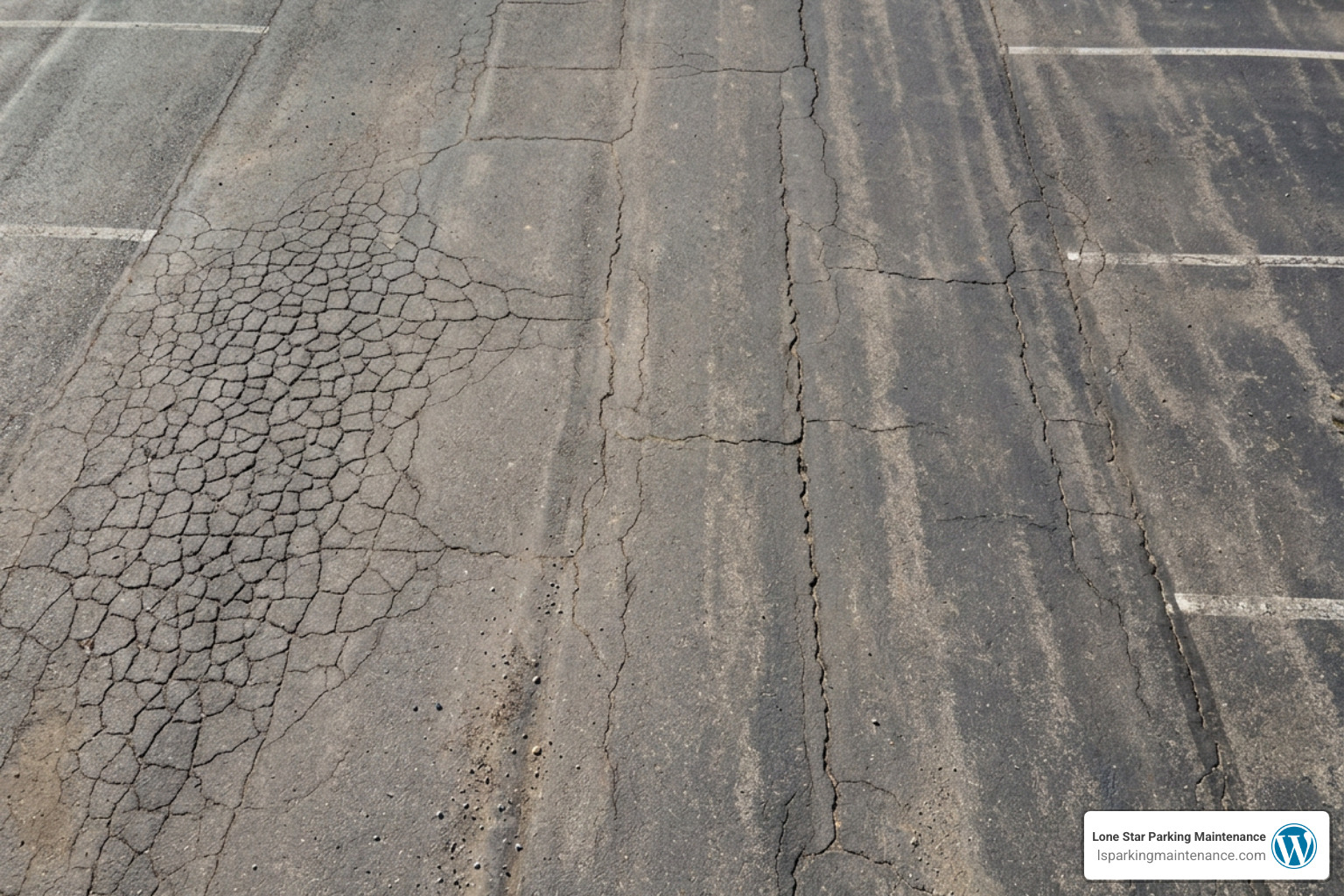
Before you can effectively repair your parking lot, you need to understand what you are up against. Asphalt cracks do not all look the same, nor do they all form for the same reasons. Pavements crack due to a combination of environmental stressors, heavy traffic loads, ground shifts, and UV oxidation.
When asphalt is exposed to the intense Texas sun, the ultraviolet rays break down the liquid asphalt binder that holds the aggregate together. This causes the pavement to lose its flexibility, turn a dull gray color, and become highly brittle. Once the pavement loses its elasticity, any minor stress will cause it to fracture. If you are asking yourself, “How do I know if my parking lot needs crack filling?” the answer lies in identifying the specific types of cracks currently developing on your surface.
Common Types of Asphalt Cracks
Different structural stresses produce different crack patterns. Recognizing these patterns helps us determine the best repair method:
- Longitudinal Cracks: These run parallel to the direction of the pavement laydown or the centerline of the roadway. They are often caused by poor joint construction between lanes, temperature cycles, or slight shifting in the subgrade.
- Block Cracking: These are large, interconnected rectangular or square-shaped cracks that typically cover large areas of the pavement. Block cracking is usually a sign of age-related binder oxidation. It occurs when the asphalt drys out and shrinks over time. For residential property managers, learning how to handle these can be found in the ultimate guide to filling every crack in your driveway.
- Edge Cracks: These run along the outer edges of the pavement, usually within one to two feet of the curb. They form when the dirt shoulder or base support at the edge of the asphalt is weak, or when heavy vehicles drive too close to the unconfined edge of the lot.
The Danger of Alligator Cracking
While longitudinal, block, and edge cracks can usually be repaired with high-quality crack filling services, there is one type of cracking that signals a much deeper issue: alligator cracking (also known as fatigue cracking).
Alligator cracking gets its name because the pattern resembles the scaly skin of an alligator. It consists of many small, closely spaced, interconnected cracks. This pattern is a definitive sign of structural failure. It indicates that the subgrade layer beneath the asphalt has completely lost its load-bearing capacity, usually due to severe water penetration or poor initial installation.
Unfortunately, alligator cracks cannot be fixed with standard crack filling. Because the pavement is constantly shifting and flexing in these areas, crack filler will not hold. Attempting to fill alligator cracks is like putting a band-aid on a deep wound that requires stitches. To fix alligator cracking, the damaged section of asphalt must be cut out, the subgrade must be repaired, and a fresh asphalt patch must be installed.
The Professional Crack Sealing and Filling Process
Many property owners assume that crack filling is a simple DIY job that involves pouring some cold-pour liquid from a home improvement store into a crack. However, professional commercial applications are vastly different. Industrial-grade repairs require specialized equipment, high temperatures, and precise preparation to ensure a long-lasting, watertight bond.
If you want to understand the steps involved in professional-grade repairs, you can read how to fill cracks quickly to get a sense of the preparation required. Let’s look at how the pros handle this process to ensure maximum durability.
Crack Filling vs. Crack Sealing
Though the terms are often used interchangeably, there is a technical difference between crack filling and crack sealing:
- Crack Sealing: This is performed on “working” cracks—cracks that expand and contract significantly as temperatures change. This method uses highly flexible, hot-poured rubberized sealants that can stretch and compress without breaking their bond with the asphalt.
- Crack Filling: This is used on “non-working” cracks—cracks that show minimal movement (usually less than 0.1 inches). This process typically uses less flexible, more rigid materials to fill the void and prevent water intrusion.
For the best results, a comprehensive pavement maintenance plan often combines crack sealing, crack filling, and sealcoating. To understand how these methods compare to full replacement, review the table below:
| Maintenance Method | Primary Purpose | Expected Lifespan | Relative Cost |
|---|---|---|---|
| Crack Sealing / Filling | Prevents water penetration into individual cracks | 2 – 5 Years | Low |
| Asphalt Sealcoating | Protects entire surface from UV rays, oil, and light moisture | 2 – 3 Years | Moderate |
| Full Pavement Replacement | Rebuilds failing subgrade and installs brand-new asphalt | 15 – 20 Years | High |
Step-by-Step Application and Curing
To ensure the repair material adheres properly, our crews follow a rigorous, multi-step application process:
- Inspection and Assessment: We walk the property to identify which cracks are suitable for sealing and which areas might require patching.
- Surface Preparation: This is the most critical step. If a crack is filled with dirt, weeds, or loose gravel, the sealant will stick to the debris instead of the asphalt, causing it to peel away quickly. We use wire brushing, high-powered blowers, and compressed air to clean every speck of debris out of the cracks.
- Material Heating: We heat industrial-grade rubberized polymer sealant in a specialized double-jacketed melter to temperatures between 350°F and 400°F.
- Application: The hot sealant is injected directly into the clean crack using a pressurized wand.
- Squeegee Finishing: A crew member follows closely behind with a V-shaped or U-shaped squeegee to strike off the excess material, leaving a neat, flat band over the crack.
- Curing: The material is allowed to cool and harden. Most professional-grade hot-pour sealants cure and are ready for traffic in as little as 30 to 45 minutes.
To learn more about the best industry standards, check out our guide on asphalt patching and sealing best practices.
Best Seasonal Timing for Texas Asphalt Repairs
Timing is everything when it comes to asphalt maintenance. While we can perform crack repairs during most times of the year in the DFW Metroplex, the absolute best times are spring and fall.
During these transitional seasons, temperatures are moderate (ideally between 50°F and 85°F). This is important because asphalt expands in the summer heat (closing the cracks slightly) and contracts in the winter cold (opening the cracks wide). Applying sealant during moderate temperatures ensures the material is placed when the cracks are at their average width, allowing the rubberized sealant to flex perfectly in both directions. Furthermore, dry weather and low humidity are crucial, as moisture inside the crack during application will ruin the adhesive bond.
What to Look For in Texas Crack Filling Services
When hiring a contractor to service your parking lot in the DFW Metroplex, you should look for the following qualifications:
- Commercial-Grade Materials: Ensure they use hot-pour polymer-modified rubberized sealants, not cheap cold-pour liquids.
- Local Climate Expertise: The DFW Metroplex experiences extreme summer heat and sudden winter freezes. Your contractor must use sealants specifically formulated to withstand these local temperature swings.
- Safety and Compliance: The contractor should follow strict safety protocols and understand ADA parking requirements.
- Proven Track Record: Look for companies with a strong portfolio of local commercial projects and a history of successful pavement maintenance in your area.
Frequently Asked Questions About Texas Asphalt Maintenance
How long does professional crack filling typically last?
A professional hot-pour crack sealing application typically lasts 3 to 5 years, while standard crack filling lasts 2 to 3 years. The exact lifespan depends heavily on the volume of traffic your parking lot receives, local weather conditions, and how well the surface was prepared before application. Regular inspections and touch-ups can help maximize this lifespan.
Can alligator cracks be repaired with standard crack filler?
No, alligator cracks cannot be repaired with standard crack filler. Alligator cracking indicates a deep, structural failure of the asphalt’s subgrade foundation. Because the broken pieces of asphalt shift constantly under the weight of traffic, crack filler will quickly crack and fail. The only permanent solution for alligator cracking is to cut out the damaged area, repair the underlying subgrade, and install a new asphalt patch.
What is the ideal weather for applying asphalt crack sealant in Texas?
The ideal weather for applying hot-pour crack sealant is dry, clear weather with temperatures between 50°F and 85°F. Low humidity is highly preferred, as any moisture trapped inside the cracks will prevent the hot sealant from bonding correctly to the asphalt walls, leading to premature peeling and failure.
Conclusion
Your parking lot is one of the first things customers, tenants, and visitors see when they arrive at your property. It represents a massive financial investment, and keeping it in top condition is essential for both curb appeal and safety.
Don’t let small cracks turn into costly, dangerous potholes. By investing in timely, professional Texas crack filling services, you can protect your pavement’s foundation, double its service life, and save thousands of dollars in premature replacement costs.
At Lone Star Parking Maintenance, we serve the entire DFW Metroplex with top-quality materials, industry-standard techniques, and an unwavering commitment to safety and customer satisfaction. Whether you manage a retail shopping center, an office park, an apartment complex, or an industrial facility, we are here to keep your pavement smooth and secure.
Ready to secure your pavement and extend its lifespan? Contact Lone Star Parking Maintenance today for a free estimate on your parking lot sealing and crack filling needs!