
Texas Asphalt Crack Repair: What Property Owners Need to Know First
Texas asphalt crack repair is one of the most cost-effective maintenance decisions you can make for a parking lot or driveway — but only if you act before small cracks turn into big structural failures.
Here’s a quick answer if you need it now:
How to handle asphalt cracks in Texas:
- Identify the crack type — surface cracks, edge cracks, and block cracking can usually be sealed; alligator cracking signals a deeper structural problem
- Clean the crack — remove all debris, vegetation, and moisture before any repair
- Choose the right material — hot-applied rubberized sealant outperforms cold-fill products in Texas heat cycles
- Seal before winter — even mild Texas freezes can expand unsealed cracks by forcing water into them
- Call a professional for anything wider than 1 inch or showing a pattern of interconnected cracking
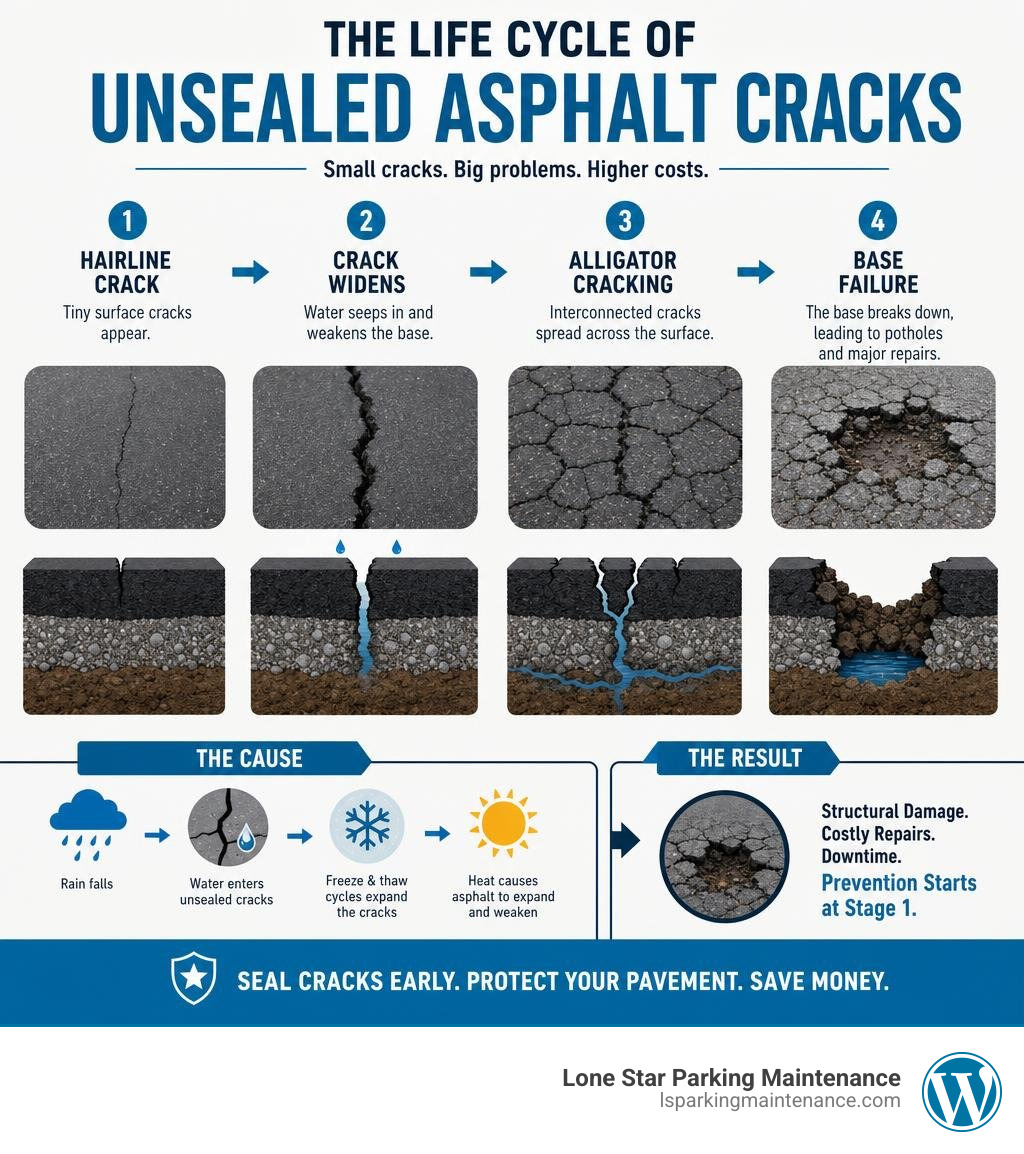
Every crack in an asphalt surface is an open door for water. In Texas, that’s a serious problem. Surface temperatures on asphalt in direct sun regularly exceed 140°F in summer, and even mild winter freezes expand trapped water by roughly 9% — widening cracks with each cycle.
The result? What starts as a hairline crack can quietly eat through your pavement’s base layer, turning a $500 seal job into a $50,000 reconstruction.
The good news: catching cracks early is the lowest-cost maintenance decision you can make.
This guide covers everything — crack types, repair methods, material specs, seasonal timing, and what to look for in a Texas contractor — so you can protect your pavement investment for years to come.
Why Texas Weather and Soils Cause Asphalt Cracking
To understand why asphalt behaves the way it does in the Lone Star State, we have to look at what is happening beneath our feet and directly above our heads. Pavement in the DFW Metroplex faces a unique double-whammy: highly active clay soils below, and relentless, baking UV rays above.
The Shifting Clay Soil of North Texas
If you have lived in the DFW area for more than a minute, you are likely familiar with our infamous expansive clay soil (specifically the Houston Black and similar clay series). This soil acts like a giant sponge. When we get heavy spring rains, the clay absorbs moisture and swells dramatically. When the scorching summer heat arrives, the soil dries out, shrinks, and leaves massive subterranean voids.
This constant rising and falling is like putting your pavement on a slow-motion roller coaster. As the soil shifts, it transfers immense stress to the rigid asphalt layer above. Because asphalt can only flex so much, it eventually snaps, resulting in deep, structural cracks that run along the weak points of your property.
Thermal Expansion and the 140-Degree Summer Bake
Asphalt is a dark, heat-absorbing material. While air temperatures in North Texas regularly hit triple digits in July and August, the actual surface temperature of your parking lot can easily soar past 140°F.
At these extreme temperatures, the liquid asphalt binder (the “glue” that holds the gravel and sand together) softens and expands. When night falls and the temperature drops, the pavement contracts. This rapid thermal expansion and contraction cycle causes the pavement to pull itself apart.
UV Oxidation: The Invisible Killer
Think of UV oxidation as a slow, chemical sunburn for your parking lot. Unprotected asphalt starts out rich, black, and highly flexible. Over time, UV radiation breaks down the chemical bonds in the asphalt binder. As the binder oxidizes, the pavement turns a dull gray color, loses its flexibility, and becomes incredibly brittle. Once the asphalt is brittle, even light traffic loads can cause immediate surface cracking.
To keep your pavement from drying out and cracking under these brutal conditions, it is critical to implement asphalt patching and sealing best practices early in your pavement’s lifecycle.
Identifying Different Types of Asphalt Damage
Not all cracks are created equal. Before we can choose the right weapon to fight back, we have to know exactly what kind of crack we are dealing with. Treating a structural failure with a simple cosmetic fix is like putting a band-aid on a broken bone.
We rely on the official TxDOT Routine Pavement Maintenance guidelines to classify pavement distress. Here are the most common crack types you will find on Texas properties:
1. Longitudinal Cracks
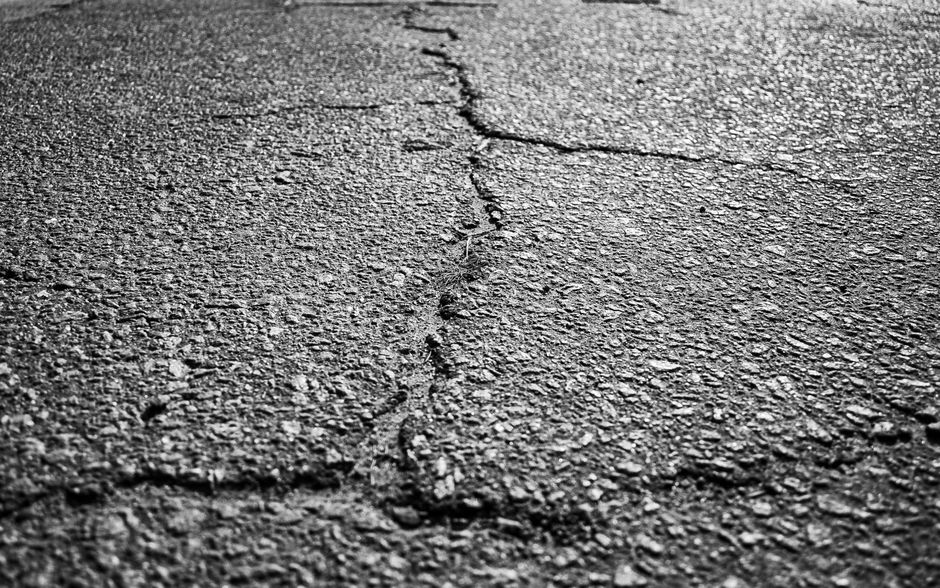
These cracks run parallel to the direction of the pavement laydown or the centerline of the driveway. They are often caused by poorly constructed joints between asphalt passes or by the natural settlement of the underlying base. If caught early, longitudinal cracks are prime candidates for routing and sealing.
2. Block Cracking
Block cracking looks like large, interconnected squares or rectangles, typically ranging from 1 foot to 10 feet across. This pattern is almost always a sign of age and UV oxidation. Because the asphalt has dried out and lost its elasticity, it shrinks and cracks in a grid-like pattern. Sealing these cracks early prevents them from breaking down into smaller, loose chunks of pavement.
3. Edge Cracks
Edge cracks run along the outer margins of your parking lot or driveway. They usually occur because there is insufficient support at the edge of the pavement, often caused by heavy vehicles driving too close to the shoulder or soil erosion from poor drainage.
4. Alligator Cracking
Also known as fatigue cracking, this pattern looks like the scaly back of an alligator. It consists of small, closely spaced, interconnected cracks. Warning: Alligator cracking is a clear indicator of structural subgrade failure. It means the base layer beneath the asphalt has softened (usually due to water intrusion) and can no longer support the weight of vehicles. Alligator cracks cannot be fixed with standard crack sealants; they require deep patching or reconstruction.
For a comprehensive breakdown of how to handle these issues on residential or light-commercial driveways, check out our guide to filling driveway cracks.
Crack Type vs. Repair Method Quick Reference
| Crack Type | Primary Cause | Severity Level | Recommended Repair Method |
|---|---|---|---|
| Longitudinal | Joint failure, base settlement | Low to Medium | Crack routing and hot-applied sealing |
| Block Cracking | UV oxidation, aging binder | Medium | Crack sealing followed by sealcoating |
| Edge Cracks | Lack of shoulder support, poor drainage | Medium | Edge repair, drainage correction, sealing |
| Alligator Cracks | Subgrade failure, heavy traffic loads | High (Critical) | Full-depth repair or asphalt milling and overlay |
The Professional Texas Asphalt Crack Repair Process
When it comes to Texas asphalt crack repair, the secret to success is not just the material we use — it is the preparation. If you simply pour sealant over a dirty, dusty crack, the material will stick to the dirt rather than the asphalt, causing the repair to fail within a single season.
To ensure a repair that lasts, we follow a rigorous, professional process. This is heavily inspired by the official TxDOT Rout-and-Seal method, which is the gold standard for state highway maintenance.
For a simplified overview of how this works on a practical level, you can read about how to repair asphalt cracks.
Step-by-Step Texas Asphalt Crack Repair Standards
Here is the exact step-by-step process we use to ensure your pavement repairs stand up to the brutal DFW climate:
Step 1: Crack Routing (Creating the Reservoir)
To give the sealant enough surface area to bond properly, we use a specialized mechanical router to follow the path of the crack. This process cuts a clean, V-shaped or square reservoir (typically 1/2 inch wide by 1/2 inch deep). Routing removes loose, oxidized asphalt from the edges and ensures a consistent channel for the sealant.
Step 2: Deep Cleaning (Wire Brushing and Compressed Air)
Once routed, the crack must be completely cleaned. We use high-velocity compressed air (often combined with mechanical wire brushing) to blow out all dirt, dust, vegetation, and loose debris. If there is moisture present, we use a hot air lance to dry the crack completely. Moisture is the ultimate enemy of adhesion; applying hot sealant to wet asphalt will cause the material to bubble and fail to bond.
Step 3: Material Melting (The Oil-Jacketed Melter)
We heat our commercial-grade rubberized sealant in a specialized, double-jacketed oil melter with continuous agitation. This equipment ensures the material is heated evenly to its exact target temperature (typically between 370°F and 400°F) without burning or scorching the rubber polymers.
Step 4: Application and Squeegee Finish
The molten sealant is injected directly into the clean reservoir from the bottom up to prevent air pockets. We immediately follow the application with a specialized U-shaped squeegee to strike off the excess material. This creates a neat, 3-to-4-inch wide “band-aid” or wipe zone that sits flush with the pavement surface, sealing the edges tightly.
Step 5: Curing and Cooling
The hot-applied sealant must cool and cure before traffic can be reintroduced. Depending on the ambient temperature, this usually takes anywhere from 30 to 60 minutes.
Selecting Materials for Texas Asphalt Crack Repair
The material chosen for your repair makes all the difference. In the retail market, you will find plenty of cheap, cold-pour liquid crack fillers. While these are easy to squeeze out of a bottle, they dry into a rigid, brittle plastic that quickly cracks when the winter freeze arrives or when the summer heat expands the pavement.
For professional-grade durability, we look to the strict standards set by the state. We utilize materials that meet or exceed CR-90 STATE TxDOT specifications.
Hot-Applied Rubberized Sealant (The Gold Standard)
This material is formulated with asphalt cement, synthetic polymers, and recycled crumb rubber modifiers (often between 22% and 26% rubber content). This unique blend gives the sealant incredible elasticity. In the freezing winter, it can stretch without tearing; in the blistering summer, it can flex without tracking or sticking to car tires.
TxDOT DMS 6100 and Class A Standards
State specifications like DMS 6100 ensure that the sealant has a high flash point, low density, and excellent resistance to weathering. Using these materials guarantees that your crack repairs will remain flexible and watertight for years, rather than months.
Crack Sealing vs. Full-Depth Repair and Resurfacing

A common question we get from property managers in the DFW Metroplex is: “Can we just seal these cracks, or do we need to repave the whole lot?”
The answer depends entirely on the condition of your pavement’s subgrade. Let’s break down the boundaries between preventative maintenance and major structural rehabilitation.
When Crack Sealing is Sufficient
If your cracks are isolated, clean, and less than 1 inch wide, crack sealing is highly effective. It acts as a preventative shield, keeping water out of the subgrade and extending your pavement’s lifespan by 3 to 5 years.
When Full-Depth Repair is Required
If you have alligator cracking, deep depressions, or areas where the asphalt has completely broken apart into potholes, crack sealing will not help. These are signs of subgrade failure.
According to the TxDOT Full-Depth Repair manual, when the damage extends deep into the base layer, the only permanent fix is to:
- Excavate and remove the failed asphalt.
- Repair, compact, or stabilize the soft subgrade base.
- Apply a new, hot-mix asphalt patch flush with the surrounding surface.
This process is detailed further in the TxDOT Repairs and Patching manual.
Resurfacing and Overlays
If your parking lot is covered in extensive block cracking but the base remains structurally sound, you might be a candidate for an overlay. This involves milling down the top layer of damaged asphalt and installing a fresh, smooth wearing course over the entire surface.
To learn more about these larger-scale options, read our detailed guides on DFW asphalt overlays and the process of resurfacing asphalt parking lots.
Seasonal Timing and Maintenance Schedules for Texas Pavements
Timing is everything when it comes to pavement maintenance. Because hot-applied sealants require specific temperature windows to bond correctly, scheduling your repairs during the right season is crucial.
The Spring Rain Warning
Spring in DFW brings heavy downpours. Trying to seal cracks in the spring can be incredibly challenging because the pavement must be 100% dry. Water trapped in a crack when hot sealant is applied will instantly vaporize, creating steam bubbles that destroy the sealant’s bond.
The Summer Heat Challenge
While dry summer days are plentiful, extreme temperatures (above 100°F ambient) make it difficult for hot-applied sealants to cool and cure. If vehicles drive over the sealant before it has fully cooled, they can track the material across your parking lot.
Fall: The Perfect Window
Fall is the absolute best time for Texas asphalt crack repair. The temperatures are moderate, the air is dry, and the pavement has naturally contracted slightly, opening up the cracks so they can receive a deep, thorough fill. Most importantly, sealing in the fall protects your pavement before the winter freeze-thaw cycles begin.
The Winter Freeze Threat
Do not underestimate a North Texas winter. When water gets into an unsealed crack and freezes, it expands by approximately 9%. This expansion acts like a wedge, forcing the crack wider. When the ice melts, it leaves a larger void, which collapses under the weight of traffic, forming a pothole.
To build a comprehensive annual maintenance strategy, check out our resources on DFW metro asphalt sealing and discover how to budget for these services with our guide on the cost to seal asphalt.
Frequently Asked Questions about Texas Asphalt Maintenance
How long does hot-applied rubberized crack sealant last in Texas?
In the demanding DFW climate, a professionally applied, hot-applied rubberized crack sealant typically has a service life of 3 to 5 years. Cheap cold-pour options, on the other hand, often fail within a single winter or summer cycle. Regular sealcoating applied over the crack sealant can help shield it from UV exposure and extend its life even further.
Can alligator cracks be fixed with standard crack filler?
No. Alligator cracking is a structural failure of the underlying base layer. Applying crack filler over alligator cracks is a waste of money because the shifting base will cause the filler to crack again almost immediately. The only way to fix alligator cracking is to remove the damaged area, repair the base, or perform asphalt milling and patching. You can learn more about this restoration process in our article on why asphalt milling is used.
How soon can traffic return after asphalt crack sealing?
Under normal conditions, hot-applied rubberized sealants cool and cure within 30 to 60 minutes. Once the material is cool to the touch, it is safe for foot and vehicular traffic. On exceptionally hot summer days, we can apply a specialized detackifying agent over the fresh sealant to allow immediate traffic access without tracking.
Conclusion
At Lone Star Parking Maintenance, we know that keeping your commercial parking lot or residential property in top shape is about more than just aesthetics — it is about protecting your hard-earned investment. By addressing cracks early with professional-grade materials and TxDOT-compliant methods, you can avoid the massive headaches and heavy expenses of premature pavement failure.
We proudly serve the entire DFW Metroplex with top-quality materials, adherence to strict industry standards, and an unwavering commitment to safety and customer satisfaction. Whether you need a few minor cracks sealed or a complete parking lot overhaul, our team of local experts is here to help.
Don’t let the Texas elements win. Explore our professional parking lot sealing and crack filling services or read our guide on finding the best asphalt crack repair service to get started today!