
Why Curb Painting Municipal Contracts Are Worth Pursuing in 2026
Curb painting municipal contracts represent one of the most consistent revenue streams available to pavement marking companies and parking lot maintenance contractors. Cities, counties, and school districts issue these contracts every year — and many renew them annually with budget increases.
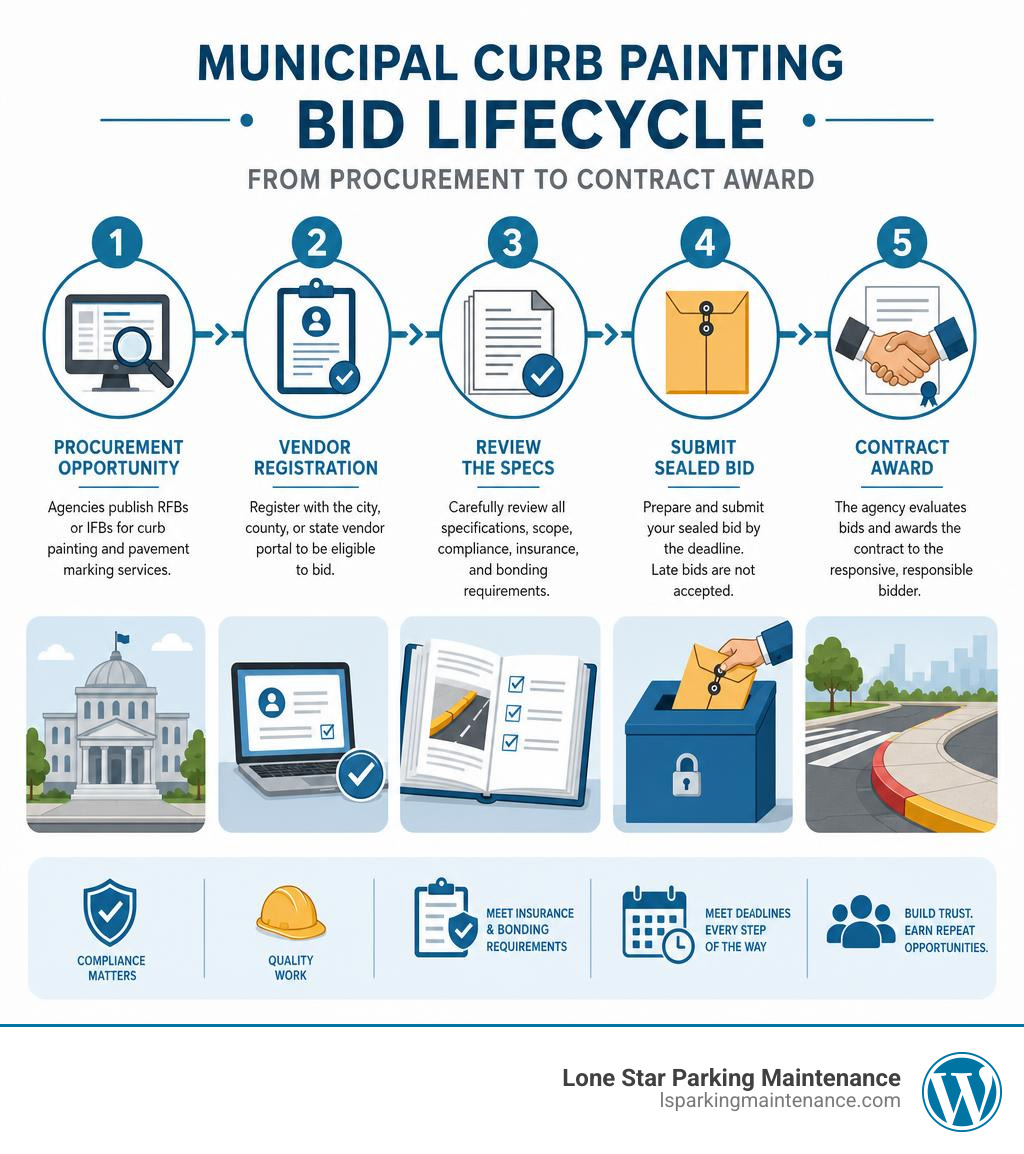
Quick answer: How do you find and bid on municipal curb painting contracts?
- Search public bid portals — Check your city, county, and state procurement websites for open RFBs (Requests for Bids) or IFBs (Invitations for Bid) related to pavement marking, traffic striping, or curb painting.
- Register as a vendor — Most public agencies require vendors to register before bidding. In Texas, this includes the Texas Comptroller’s ESBD portal.
- Review the specs — Municipal bids include detailed paint standards, application methods, insurance minimums, and bonding requirements. Read every line.
- Submit a sealed bid — Most contracts require sealed bids delivered by a hard deadline. Late bids are rejected without exception.
- Meet compliance requirements — Expect prevailing wage rules, general liability insurance ($1M+ per occurrence is common), performance bonds, and sometimes surety bonds.
Municipal curb painting goes far beyond painting house numbers on a curb. These contracts can cover hundreds of thousands of linear feet of traffic striping, crosswalks, stop bars, bike lanes, and colored curb markings across an entire city.
To put that in perspective: the City of Ventura grew a single pavement marking maintenance contract from $330,000 to over $944,000 across four amendments between 2021 and 2025. The City of Kirkland, Washington put out a 2025 annual striping program with an estimated value of $550,000–$580,000 for just one season of work.
That’s serious, recurring public-sector revenue — for contractors who know how to compete for it.
If you manage parking lots or commercial properties in the DFW Metroplex, understanding how these contracts work also helps you hire the right vendor and know exactly what quality and compliance to expect.
Understanding Curb Painting Municipal Contracts and Bidding Processes
Entering public procurement can feel like learning a whole new language. When cities need to refresh their streets, they don’t just call a local painter; they issue a Request for Bids (RFB) or an Invitation for Bid (IFB).
These municipal contracts are highly structured. For instance, a typical annual striping program might require painting hundreds of thousands of linear feet of skip lines, double yellow lines, and thousands of square feet of specialty markings like crosswalks, stop bars, and colored curbs.
To bid on these projects, you must monitor public sector portals. In Texas, state-level and larger municipal opportunities are often aggregated through the Construction and Professional Services – Bids and Vendor … portal. On a municipal level, local governments post individual solicitations, such as the Bids – 25-0026BID – Street Painting Services – City of Longview contract, which outlines exactly what a municipality expects for its street painting services.
When preparing your bid, you must account for every single cost factor, including:
- Mobilization and traffic control: Setting up safety zones and managing traffic flow.
- Material costs: High-durability, municipal-grade paints and glass beads.
- Labor rates: Often bound by state prevailing wage laws.
- Equipment overhead: High-pressure airless sprayers and thermal application units.
Failing to calculate these accurately can turn a winning bid into a costly mistake. Municipalities award contracts to the “lowest responsive and responsible bidder,” meaning you must meet all technical, insurance, and bonding criteria while offering a competitive price.
Standard Curb Paint Colors and Municipal Traffic Regulations
When we paint curbs for municipal or commercial clients, we aren’t just making the property look clean—we are enforcing local laws and traffic regulations. Every color painted onto a curb has a specific legal meaning defined by municipal codes.
While individual cities may have slight variations, most municipalities follow a highly standardized color code system. Let’s look at the standard curb colors and what they mean for drivers:
| Curb Color | Legal Meaning & Parking Restrictions | Standard Application |
|---|---|---|
| Red | No stopping, standing, or parking under any circumstances (except for buses at designated, signed zones). | Fire lanes, intersection approaches, transit stops. |
| Yellow | Loading and unloading zone for passengers (typically up to 3 minutes) or commercial freight (typically up to 20 minutes). | Commercial storefronts, shipping bays, delivery zones. |
| White | Passenger loading and unloading only (usually restricted to a 3-minute limit during active hours). | Airport terminals, school drop-off zones, hotel valets. |
| Green | Short-term restricted parking (typically ranging from 10 to 30 minutes, with 15 minutes being the most common). | Post offices, dry cleaners, convenience stores. |
| Blue | Reserved exclusively for vehicles displaying a valid disabled placard or license plate. | ADA-accessible parking stalls and adjacent access aisles. |
To ensure your facility complies with local and federal accessibility laws, these curb markings must work hand-in-hand with proper signage. For a deep dive into compliance, check out our guide on Everything You Need to Know About ADA Parking Signs and learn the best practices for Mounting Your ADA Signs the Right Way.
Properly coordinated curbs and signs keep traffic moving smoothly and protect property owners from costly municipal code violations. For commercial parking lots, incorporating clear The Best Parking Lot Entrance Signs to Keep Your Property Organized prevents confusion before drivers even reach the curb.
Technical Specifications and Quality Standards in Public Works
Municipalities do not tolerate low-quality paint that fades after a single season of Texas heat. Public works departments enforce rigid technical specifications for all paint, application methods, and drying times.
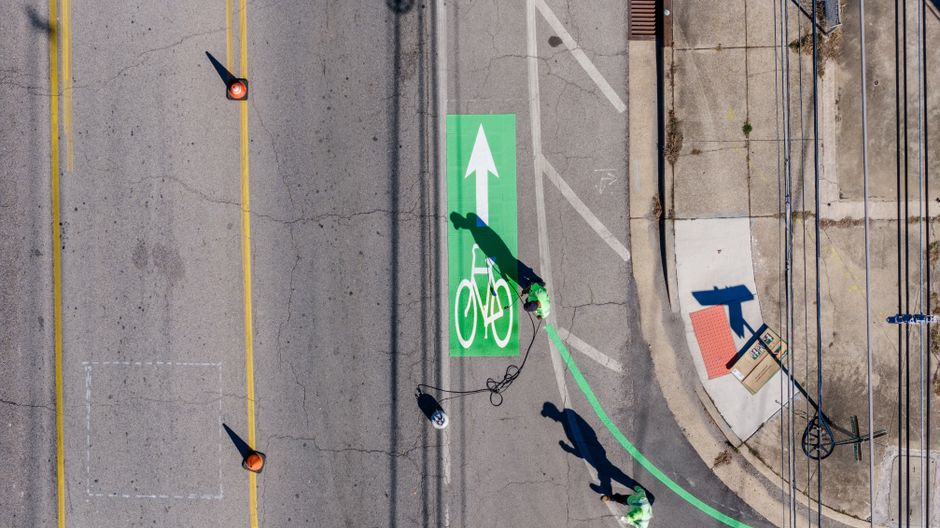
When bidding on curb painting municipal contracts, you can expect to see highly detailed material requirements in the bid documents:
- Paint Composition: Public contracts typically mandate 100% acrylic, waterborne, low-VOC (volatile organic compound) traffic paint. The paint binder must utilize premium resins (such as Rohm & Haas Fastrack or Dow Chemical formulas) to ensure maximum adhesion to concrete and asphalt.
- Reflective Glass Beads: For night visibility, public works specs often require reflective glass beads to be applied directly onto the wet paint. A standard rate is roughly 8 pounds of moisture-proof glass beads per gallon of paint, applied on a 15-mil wet film thickness.
- Drying and “No-Track” Times: To minimize traffic disruptions, municipalities require fast-drying formulas. Many specifications demand a “no-track” time of 75 seconds or less under standard humidity and temperature conditions.
- Viscosity and Application Temperature: Paint must be applied using professional airless or air-assisted spray equipment, often heated to 120°F to 140°F at the spray nozzle, with a paint viscosity of 78 to 95 Krebs units at 77°F.
These high-level specifications are especially critical when painting fire lanes, where faded markings can delay emergency services. To understand the strict requirements surrounding emergency lanes, read our comprehensive guide on Fire Lanes 101: Keeping the Path Clear for Heroes.
Legal Compliance, Insurance, and Bonding for Public Contractors
Working for a city or county means playing by a strict set of legal and financial rules. Public entities must protect taxpayer dollars, which is why municipal contracts feature robust insurance and bonding obligations.
First, contractors must comply with prevailing wage laws. Under Texas law, public works construction projects exceeding $25,000 and public maintenance contracts exceeding $15,000 require contractors to pay their field crews the prevailing wage rate determined for that specific region.
Second, you must carry substantial liability insurance. A standard municipal contract requires:
- General Liability: A minimum of $1,000,000 per occurrence for bodily injury and property damage, with the city named as an additional insured.
- Automobile Liability: At least $1,000,000 per accident.
- Workers’ Compensation: Meeting state statutory limits, including employer’s liability of at least $1,000,000.
Navigating Curb Painting Municipal Contracts Bonding Requirements
To guarantee that the work is completed according to the contract terms, cities require various types of surety bonds:
- Bid Bonds: Often set at 5% of the total bid amount, ensuring that if you are awarded the contract, you will actually sign it and provide the necessary insurance.
- Performance and Payment Bonds: Required by Texas law for public works projects exceeding $25,000. This ensures that subcontractors and material suppliers are paid, and that the city is protected if the contractor defaults.
- Permit and License Bonds: For smaller-scale curb painting (such as residential address numbering), cities often require a dedicated curb painting permit bond. For example, some cities require a $1,000 permit bond with a small annual premium to hold the contractor financially responsible for complying with the local municipal code.
Compliance Standards for Curb Painting Municipal Contracts
Beyond financial protections, municipal contractors must follow strict safety and environmental rules. This includes Cal/OSHA or Texas OSHA safety standards for workers on active roadways, proper temporary traffic control (using cones, signs, and arrow boards), and adhering to strict environmental standards regarding VOC emissions and paint disposal.
Private Curb Address Painting: Permits, Solicitation Rules, and Resident Rights
While major municipal contracts focus on traffic lanes and safety zones, there is a parallel market for painting residential house numbers on curbs. However, this is a highly regulated space designed to protect homeowners from aggressive or fraudulent solicitors.

Many cities require private contractors or non-profit groups to obtain an encroachment permit or a specific curb painting permit before soliciting residents. In some jurisdictions, performing this work without a permit is classified as a misdemeanor.
To protect residents, cities enforce strict rules for private curb painters:
- Explicit Permission Required: A contractor cannot paint a curb address without the express, prior consent of the homeowner.
- Voluntary Payments: Many municipal codes state that curb numbering is not mandatory. If a non-profit or permitted solicitor paints a curb, they must clearly state that any payment or donation is entirely voluntary.
- Specific Stencil Standards: If permitted, curb address numbers must meet strict design codes—typically black numerals between 2.5 and 4 inches in height painted over a clean, white rectangular background using premium-grade exterior paint.
In Texas, cities manage this in various ways. For instance, residents or neighborhood groups can use tools like the Form Center – Curb Painting Rental Waiver – City of San Marcos, TX to coordinate volunteer efforts legally.
Meanwhile, professional commercial address marking services operate within strict local guidelines to provide high-visibility, legal address markings for homeowners and commercial developments alike.
Frequently Asked Questions about Curb Painting Regulations
Do residents have to pay private solicitors for curb address painting?
No. Homeowners are never obligated to pay a solicitor who paints their curb without prior, written, or verbal consent. Legitimate, permitted solicitors must show their city permit upon request. If a contractor paints your curb without permission and demands payment, you are not required to pay, and you can report the incident to local code enforcement or the non-emergency police line.
What are the standard dimensions and paint requirements for curb numbers?
To ensure emergency services can easily read house numbers from the street, standard municipal specifications require black numbers that are 2.5 to 4 inches in height. These must be centered on a crisp, white reflective background. The paint used must be a high-durability, weather-resistant exterior acrylic or alkyd traffic paint.
How do cities handle on-call or as-needed pavement marking contracts?
Many municipal curb and pavement contracts are structured as “as-needed” or “on-call” general service agreements. Instead of a single massive project, the city issues individual work orders or “call-outs” throughout the fiscal year as street maintenance needs arise. Contractors must respond within a specified timeframe (often 5 to 10 business days) to complete the requested striping or curb painting.
Conclusion
Bidding on and executing curb painting municipal contracts requires technical expertise, strict legal compliance, and a deep understanding of municipal codes. Whether a city is refreshing its downtown parking limits or a school district is updating its campus safety lanes, high-quality pavement markings are essential for public safety.
At Lone Star Parking Maintenance, we bring this exact same level of municipal-grade quality, durability, and safety compliance to commercial parking lots across the DFW Metroplex. From crisp fire lanes and clear ADA stencils to professional Protective Pole Covers and Curb Stop Installation, we keep your property safe, organized, and fully compliant with local regulations.
Are you ready to upgrade your commercial facility’s curb appeal and safety markings?