
Why Parking Lot Signage Makes or Breaks Your Property
Parking lot signage is one of the most important — and most overlooked — parts of managing a commercial property.
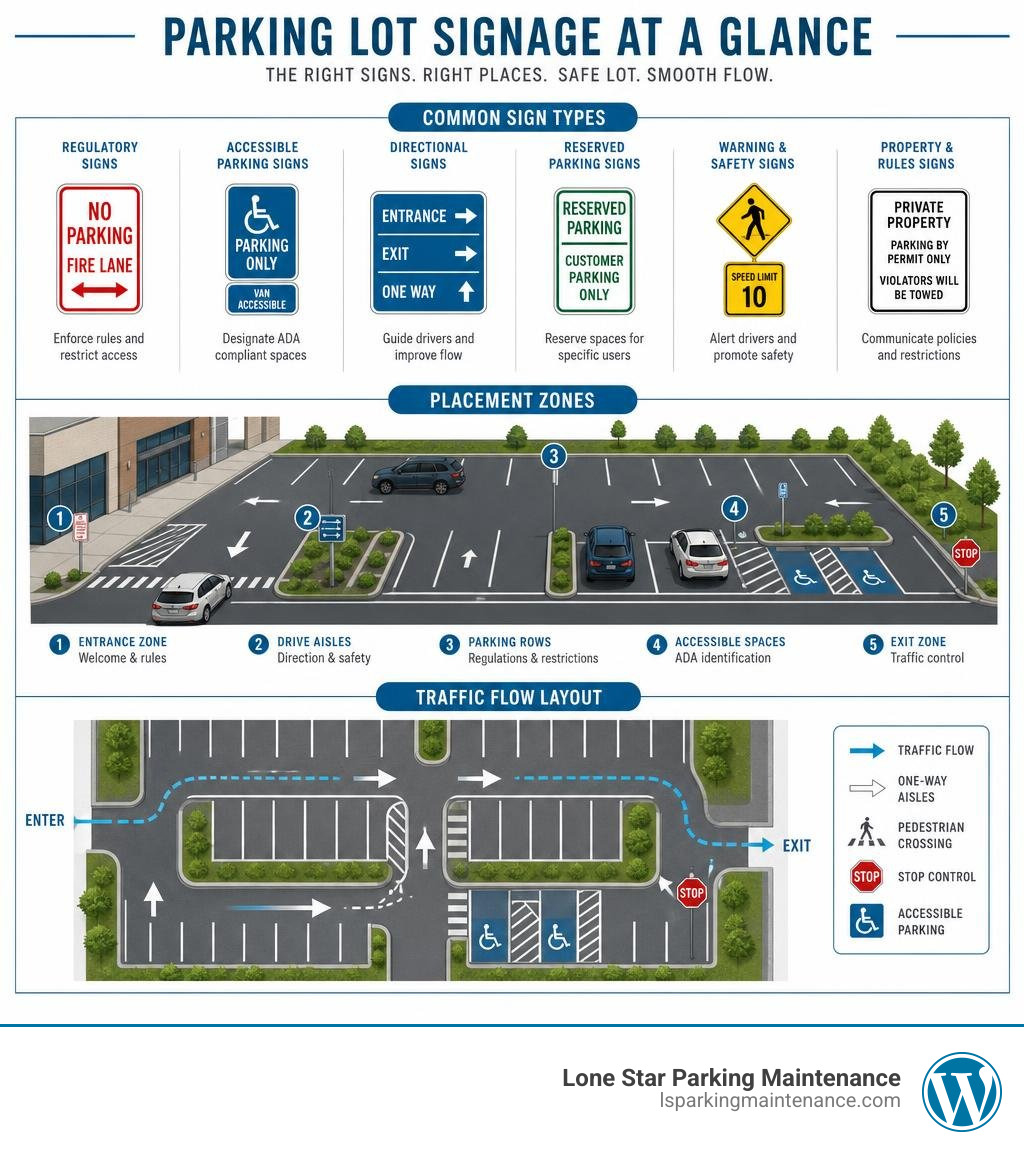
Here’s a quick overview of what every parking lot needs:
- Regulatory signs — No Parking, Fire Lane, Tow Away zones
- Accessible parking signs — ADA-compliant handicap and van-accessible spaces
- Directional signs — Entrances, exits, one-way aisles, arrows
- Reserved parking signs — Designated spots for customers, staff, or tenants
- Warning and safety signs — Speed limits, pedestrian crossings, stop signs
- Property and rules signs — Hours, restrictions, private property notices
Good signage does three things at once: it keeps people safe, keeps traffic moving, and keeps your property legally compliant.
Poor signage — faded, missing, or incorrectly placed — does the opposite. It creates confusion, increases accident risk, and can expose property owners to liability. In fact, enforcement of parking restrictions on private property depends entirely on having the right signs posted correctly — without them, towing or citations may not hold up legally.
For property managers and business owners in the DFW Metroplex, this matters even more. High-traffic commercial lots demand clear, durable signage that works day and night, through Texas heat, rain, and everything in between.
This guide covers everything you need to know — from sign types and compliance rules to materials, installation, and custom options.
Discover more about parking lot signage:
Essential Types of Parking Lot Signage and Their Purposes
To keep your commercial lot operating smoothly, you need a strategic combination of signs. Property managers often make the mistake of focusing solely on striping, but without proper vertical markers, those painted lines can easily be ignored or obscured by parked cars, leaves, or Dallas downpours.
Using a comprehensive Buying Guide for Compliant Parking Lot Signs is the first step in auditing your property. Additionally, mapping out your property entrance using The Best Parking Lot Entrance Signs to Keep Your Property Organized ensures that drivers transition smoothly from fast-moving public roads into your private facility.
According to federal standards detailed in the Figure 2B-24 Long Description, Sheet 1 of 2 – MUTCD 2009 Edition – FHWA, standardized designs prevent driver confusion. Here are the ten essential signs that every commercial parking lot should have:
- Handicap Parking Signs: Legally mandated markers designating accessible spaces.
- Fire Lane Signs: Crucial for keeping emergency access routes completely clear.
- Parking Prohibited Signs: Used near dumpsters, loading docks, and narrow access points.
- Customer Parking Signs: Protects your parking spaces from being used by commuters or nearby businesses.
- Directional Parking Signs: Keeps traffic flow moving in the intended direction.
- Speed Limit Signs: Reminds drivers to slow down and shift into a “pedestrian-aware” mindset.
- Pedestrian Crossing Signs: Marks crosswalks where foot traffic is heavy.
- Entrance and Exit Signs: Clearly indicates where vehicles can safely enter and leave.
- Stop Signs: Placed at intersections and exits to prevent collisions.
- Parking Lot Property Signs: Declares towing policies, security monitoring, and liability disclaimers.
Standard Regulatory and No Parking Signs
Regulatory signs dictate what drivers can and cannot do on your property. In parking lot signage, these are divided into prohibitive and permissive signs.
- Prohibitive Signs: These signs tell drivers what is forbidden (e.g., “No Parking,” “No Standing,” “No Parking Fire Lane”). Under standard traffic control designs, prohibitive signs must feature a red border and red lettering on a white background.
- Permissive Signs: These signs tell drivers what is allowed under specific conditions (e.g., “15 Minute Parking,” “Permit Parking Only”). Permissive signs feature a green border and green lettering on a white background.
If your lot enforces time limits, those restrictions must be clearly printed on the face of the sign, listing the hours, days, and duration of the restriction.
Directional and Wayfinding Signs
Large parking lots can quickly turn into mazes without proper wayfinding. Directional signs protect your property by organizing traffic patterns. This includes marking one-way aisles to prevent head-on collisions, placing clear entrance and exit signs at property boundaries, and using directional arrows to guide drivers to overflow parking areas or back-of-building spaces. Without these simple visual cues, drivers are left to guess, which often results in fender benders and frustrated customers.
Compliance Standards: ADA and MUTCD Requirements
When installing parking lot signage, you cannot simply place any sign wherever you think it looks good. You must follow strict guidelines set by the Americans with Disabilities Act (ADA) and the Manual on Uniform Traffic Control Devices (MUTCD). Failure to comply can result in heavy municipal fines, failed building inspections, and even civil lawsuits.
To make sure your lot is fully up to code, read our guide on Everything You Need to Know About ADA Parking Signs. For a deep dive into the legal requirements governing sign layouts, you can review the Design of Parking, Standing, and Stopping Signs | UpCodes documentation.
Here is a quick look at how ADA and MUTCD requirements differ and overlap:
| Feature / Requirement | ADA Compliance | MUTCD Compliance |
|---|---|---|
| Primary Focus | Accessibility & Equal Access | Traffic Safety & Standardization |
| Common Sign Types | Handicap Parking, Van Accessible | Stop, Yield, Speed Limit, No Parking |
| Color Schemes | Blue and White (International Symbol) | Red/White (Prohibitive), Green/White (Permissive) |
| Mounting Height | Minimum 60 inches (5 feet) to bottom of sign | 5 feet in rural/parking lots; 7 feet in pedestrian zones |
| Required Elements | International Symbol of Accessibility (ISA) | Specific legend hierarchy, shapes, and sizes |
ADA-Compliant Parking Lot Signage
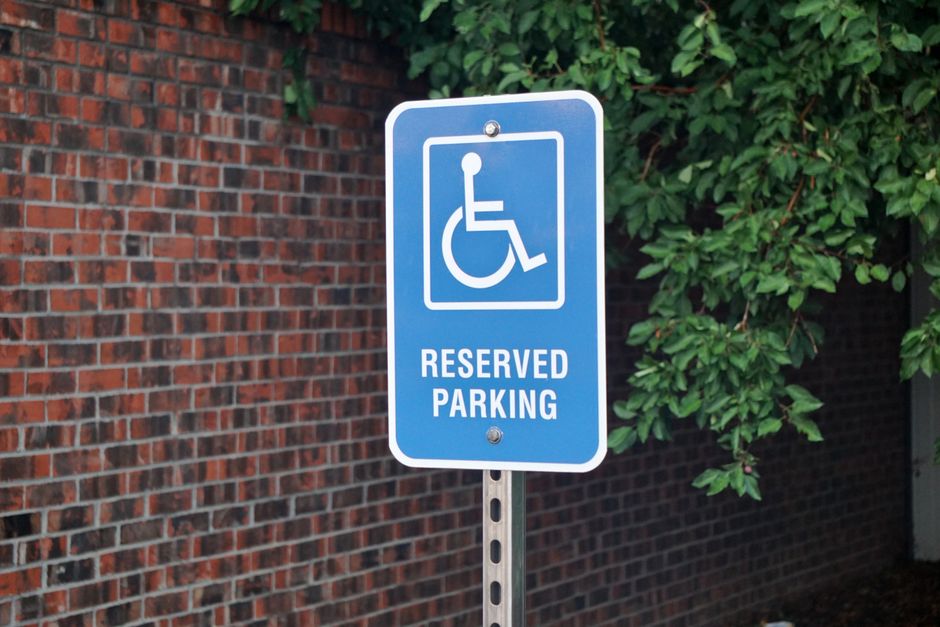
Under federal law, any business that serves the public must provide accessible parking spaces. These spaces must be identified by a vertical sign showing the International Symbol of Accessibility (a white wheelchair figure on a blue background).
Furthermore, a specific ratio of accessible spaces must be “Van-Accessible.” These stalls require an additional “Van Accessible” plaque mounted directly below the standard handicap sign.
In Texas, these signs must meet strict design standards. For example, the Texas Reserved Parking Sign features specific state-compliant language regarding fine amounts for unauthorized parking. To ensure your lot remains compliant with regional laws, you should always source Texas Parking Signs, Fire Lane Signs & Other Regulated Signage that meet both state and federal requirements.
MUTCD Guidelines for Parking Facilities
The MUTCD regulates the design, size, and placement of all traffic control devices. For parking lots, the MUTCD dictates that parking, standing, and stopping signs must be rectangular or square.
The manual also establishes a strict legend hierarchy for information displayed on signs. From top to bottom, the sign must display:
- The restriction or prohibition (e.g., “No Parking”)
- The applicable times of day (e.g., “8 AM to 6 PM”)
- The applicable days of the week (e.g., “Mon – Fri”)
- Any qualifying information or exemptions (e.g., “Permit Required”)
Additionally, MUTCD rules state that letters on standard parking signs must have a minimum height to ensure they are readable by drivers from a safe distance.
Materials, Durability, and Manufacturing Specifications
Texas weather is notoriously tough on outdoor fixtures. Between intense summer UV rays that bake paint, high winds from spring storms, and sudden winter freezes, cheap plastic or thin metal signs simply will not last. Within a year or two, low-quality signs fade, peel, warp, or snap, leaving your property looking neglected and out of compliance.
To protect your investment, your signs should be built to commercial-grade engineering specifications. For reference, the UH PARKING STANDARDS V1 FRONT SECTION – REVISED 112025 document shows how large-scale Texas institutions specify signage to withstand severe weathering and physical impacts.
Reflective Sheeting and Night Visibility
A sign is only useful if drivers can see it. Because commercial parking lots are active 24/7, your parking lot signage must be visible during the hours of darkness. To achieve this, high-quality signs are manufactured using premium 3M reflective sheeting applied over the metal face.
- Engineer Grade (EG): The standard option for parking lots, providing good retroreflective visibility under typical headlight illumination.
- High Intensity Prismatic (HIP): A highly reflective, durable finish that offers superior night visibility, making it excellent for critical safety signs like “Stop,” “Do Not Enter,” and handicap markers.
These retroreflective coatings bounce headlight beams directly back to the driver’s eyes, ensuring safety without requiring expensive electrical sign illumination.
Metal Thickness and Wind Resistance
Commercial-grade parking signs are manufactured using heavy-duty, rust-proof aluminum. The industry standard for professional installations is 80 mil (0.080 inches) thickness.
This thickness is crucial because thinner metals (like 40 mil or 60 mil) easily bend, warp, or snap when subjected to high winds or minor physical bumps from car bumpers. In Texas, engineering standards often require outdoor signs to withstand wind loads of up to 110 mph, which is only possible when using 80 mil aluminum mounted on sturdy, professionally anchored posts.
Customization and Branding for Commercial Properties
While regulatory and compliance signs must follow strict government standards, property owners have plenty of opportunities to customize their parking lot signage. Custom signs allow you to maintain a professional, cohesive look across your commercial development while clearly communicating unique rules.
Learn more about your options by reading The Ultimate Guide to Custom Made Parking Lot Signs and explore how you can elevate your property’s aesthetic in Branding Your Asphalt Custom Parking Signs with Logo.
Designing Custom Parking Lot Signage
Using modern manufacturing methods, custom parking signs can be designed and produced quickly. Common customization options include:
- Corporate Branding: Adding your business logo and custom brand colors to visitor parking, curbside pickup, or employee-of-the-month signs.
- Bilingual Messaging: Printing signs in both English and Spanish to better serve the diverse population of the DFW Metroplex.
- Specific Restrictions: Creating signs for “Curbside Delivery Only – Spot 3,” “Electric Vehicle Charging Only,” or “Reserved for Suite 100.”
- Custom Arrows: Tailoring directional arrows to perfectly match your lot’s unique traffic flow and lane configurations.
Installation and Mounting Best Practices
The best sign in the world is useless if it is installed incorrectly. Improper mounting can lead to signs that lean, shake in the wind, or sit too low—creating a serious safety hazard for pedestrians who might bump their heads.
To ensure your signs are mounted safely and legally, refer to our guide on Mounting Your ADA Signs the Right Way. Additionally, municipal guidelines like those found in the Parking Prohibition / Permissive Parking Sign Design Guidelines outline the physical mathematics of sign visibility and spacing.
Sign Posts and Hardware Options
Depending on your lot’s layout, you have several mounting options:
- U-Channel Posts: The most common and durable choice. These heavy-duty steel posts are driven deep into the ground or set in concrete.
- Square and Round Posts: Often used in modern commercial developments for a cleaner, more decorative look.
- Portable Sign Stands: Excellent for temporary event parking, seasonal curbside pickup, or construction zones.
- Wall Mounting: Perfect for parking garages or spaces directly adjacent to building walls.
To make installation fast and secure, professional signs come equipped with pre-drilled and pre-cleared mounting holes centered directly at the top and bottom. This allows for immediate bolting using tamper-proof hardware to prevent theft.
Placement, Spacing, and Orientation
When installing signs, keep these professional best practices in mind:
- Mounting Height: In parking lots, signs must be mounted at least 5 feet (60 inches) from the ground to the bottom of the sign to ensure they are visible over the hoods of parked cars. If the sign is in a pedestrian pathway, it must be mounted at least 7 feet (84 inches) high to prevent head injuries.
- Angle of Orientation: For parallel parking spaces or curb restrictions, signs should be installed at a 45-degree angle facing oncoming traffic. This makes the sign much easier for drivers to read as they approach.
- Spacing: For long restricted zones (like fire lanes or “No Parking” curbs), signs should be spaced no more than 270 feet apart. This distance is based on standard legibility scales—ensuring a driver is never too far from a visible warning.
- Safety Clearances: Keep signs at least 15 feet away from fire hydrants, 20 feet away from crosswalks, and 30 feet away from flashing beacons or traffic signals.
Frequently Asked Questions about Parking Lot Signage
What are the legal requirements for towing signs on private property?
In Texas, you cannot legally tow a vehicle from a private parking lot unless you have posted very specific warning signs. Under the rules enforced by the Texas Department of Licensing and Regulation (TDLR), tow-away signs must meet strict guidelines.
According to the official Tow-Away Signage in Parking Facilities – Texas.gov standards, these signs must:
- Be mounted at least 5 feet, but no more than 8 feet, from the ground.
- Be placed at every vehicle entrance to the property.
- Contain a clear warning statement (e.g., “Tow-Away Zone” or “Unauthorized Vehicles Will Be Towed at Owner’s Expense”).
- Feature a bright red international towing symbol (a silhouette of a tow truck towing a car) on a white, reflective background.
- Include the telephone number of the towing company or the storage facility where vehicles are taken.
Without these exact elements, towing is considered illegal, and property owners can face severe legal penalties and financial liability.
How many handicap parking spaces does my lot require?
The number of accessible parking spaces required by the ADA is based directly on the total number of parking spaces in your lot.
Here is the basic ratio:
- 1 to 25 total spaces: 1 required accessible space (which must be van-accessible).
- 26 to 50 total spaces: 2 required accessible spaces.
- 51 to 75 total spaces: 3 required accessible spaces.
- 76 to 100 total spaces: 4 required accessible spaces.
- 1001 or more spaces: 20 spaces, plus 1 for every 100 spaces over 1000.
At least one out of every six accessible spaces must be van-accessible. If your lot has only one accessible space, that single space must be van-accessible.
How often should parking lot signs be replaced?
High-quality, commercial-grade aluminum signs with 3M reflective sheeting typically come with a 10-year warranty. However, they can last even longer if properly maintained.
You should inspect and replace your signs immediately if they show:
- Significant fading of colors or text (which makes them hard to read).
- Loss of retroreflectivity at night (test this by shining a flashlight or headlights on them in the dark).
- Physical damage, such as warping, severe bending, or graffiti that cannot be cleaned.
- Loosened hardware or leaning posts that create safety hazards.
Conclusion
Upgrading your parking lot signage is one of the fastest, most cost-effective ways to improve the safety, appearance, and legal compliance of your commercial property. Whether you need to bring your handicap spaces up to ADA code, install clear fire lane markers, or design custom branded signs for your storefront, doing it right requires professional expertise.
At Lone Star Parking Maintenance, we help property managers across the DFW Metroplex design, source, and install durable, fully compliant parking lot signs. From deep-driven steel posts to custom aluminum signs that withstand the Texas heat, we do it all with a commitment to quality and safety.
Ready to secure and organize your parking lot? Contact us today for a professional consultation and discover how we can transform your property with our Professional Parking Lot Striping and Maintenance Services.