
Choose the Right Asphalt Crack Filler Before Water Makes the Damage Worse
The best asphalt crack filler for most busy parking lots is a hot-pour rubberized sealant. It stays flexible as pavement expands and contracts, can return to traffic in roughly 10 to 40 minutes, and may last up to 10 years when it is properly installed. Cold-pour products are simpler for small, low-traffic repairs, but they commonly need more frequent replacement.
For a quick buying decision:
- Choose hot rubberized filler for working cracks, high-traffic areas, and long-term value.
- Choose a self-leveling cartridge sealant for clean, narrow joints and asphalt-to-concrete transitions.
- Choose a cold-pour latex or emulsion filler only for small, DIY-friendly repairs where a shorter service life is acceptable.
- Do not fill cracks until they are clean and dry. Trapped debris and moisture weaken the bond.
Cracks are not only cosmetic. Water can enter the pavement base, worsen freeze-thaw damage, and turn a manageable crack-filling job into a costly pothole or asphalt replacement project. The right material depends on crack width, pavement movement, weather, and vehicle traffic.
I am Cason, and in this guide I will compare the top options and explain which filler fits each pavement problem.
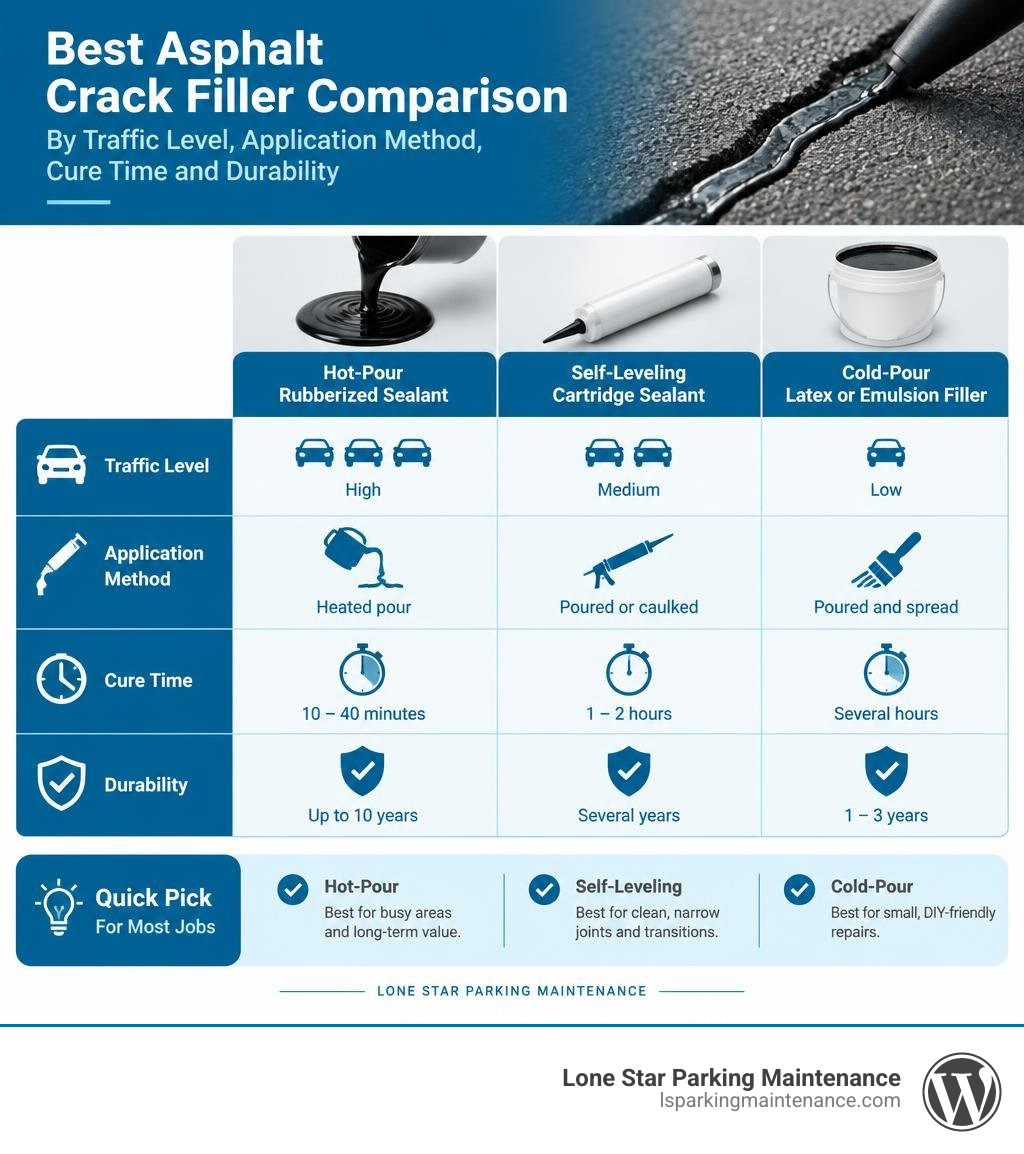
Quick look at best asphalt crack filler:
Types of Crack Repair Solutions: Hot-Pour vs. Cold-Pour
Choosing between hot-pour and cold-pour sealants determines how long your asphalt repair will hold up against heat, moisture, and traffic loads.

Asphalt expands and contracts with daily temperature swings. In the DFW Metroplex, high summer surface temperatures followed by winter cold snaps put constant stress on pavement joints. Understanding the fundamental chemistry between hot-applied rubber and cold asphalt emulsions ensures you choose the right repair strategy.
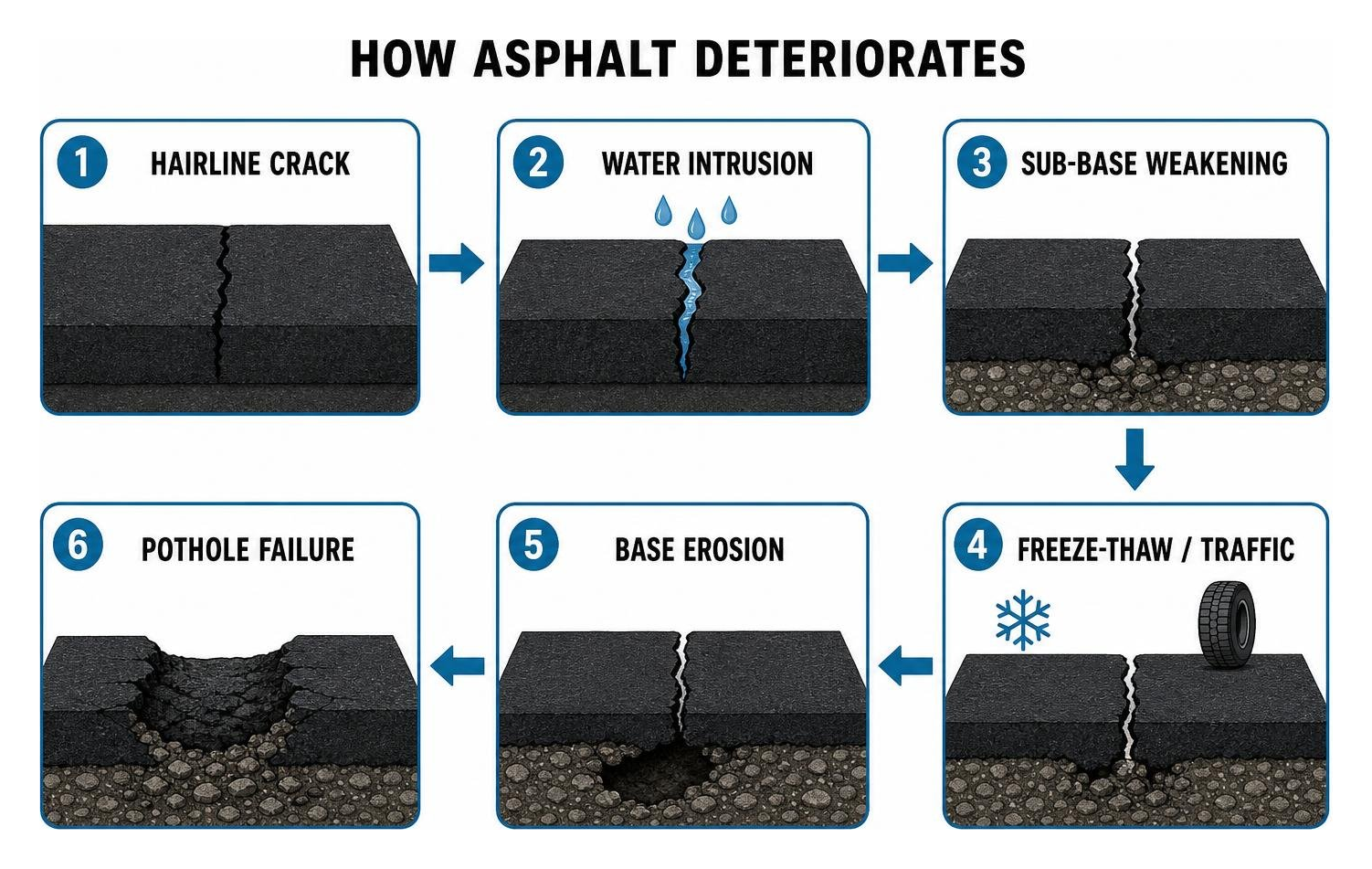
Why Hot Rubberized Options Rank as the Best Asphalt Crack Filler
Hot rubberized sealants, such as Flex-A-Fill 30 lb. Box Black Pavement Crack Repair Sealant priced at $48.54, are the commercial standard across parking lots and highways.
- Longevity: Hot rubberized crack filler can last up to 10 years, whereas cold asphalt emulsion filled cracks often re-crack by the next season.
- Rapid Traffic Turnaround: Hot pour crack filler is traffic ready in 10 to 40 minutes once cooled, compared to 24 to 48 hours for standard cold pour products.
- Coverage Metrics: Each pound of hot crack filler covers about 7 to 8 linear feet of medium-width cracks. A standard block covers about 150 linear feet of medium cracks or 200 linear feet of small cracks.
- Material Shelf Life: Unused hot rubberized crack filler has a stable shelf life of 10 years or more when kept in a dry storage environment.
- Thermal Elasticity: Applied at 380°F to 400°F, molten rubber penetrates deep into fissures, forming a vulcanized bond with existing aggregate that expands and contracts without tearing.
Cold-Applied Sealants for Quick DIY Fixes
Cold-applied products are designed for immediate use straight from a bottle, jug, or cartridge without heating equipment. Options like Latex-ite 29 oz. Asphalt Driveway Crack and Joint Filler (12-Case) ($176.16 per case, or around $14.68 per tube) and Premium Crack Filler | Super Seal cater to smaller residential driveways.
- Ease of Application: Cold pour acrylic latex and liquid asphalt emulsions require only a standard caulking gun or pour spout.
- Drying Times: Formulations like Premium Crack Filler | Super Seal dry to the touch within 30 minutes and fully cure in 4 to 8 hours under warm, dry conditions. Other cold fillers require a full 24 to 48 hours before vehicle traffic is permitted.
- Shrinkage Considerations: Because cold emulsions contain water and carrier solvents, they experience material shrinkage during evaporation. Deep cracks often require two or three coats to achieve a flush finish.
Top Criteria to Choose the Best Asphalt Crack Filler for Your Pavement
Selecting the right product requires evaluating crack dimensions, expected joint movement, structural loads, and cure times.
| Product / Method | Type | Best Crack Width | Cure / Traffic Ready Time | Expected Lifespan | Estimated Cost |
|---|---|---|---|---|---|
| Hot-Pour Rubber (e.g., Crafco Flex-A-Fill) | Hot-Applied Block | 1/8″ to 1″ | 10–40 Minutes | Up to 10 Years | ~$48.54 (30 lb box) |
| Pli-Stix / Crack-Stix | Direct Torch-Melt Rope | 1/4″ to 1″ | 20 Minutes | Lifetime Guarantee | ~$89.49 (Rope roll) |
| Sikaflex-410 | Polyurethane / Hybrid | 1/4″ to 1/2″ | Skin: <60 Min; Full: 24 Hr | 3–5 Years | ~$17.00 (9 oz cartridge) |
| Red Devil 0637 | Acrylic Emulsion | Up to 1/2″ | 24–48 Hours | 1–2 Years | ~$15.00 (10.1 oz tube) |
| Liquid Rubber Sealant | High-Solids Polymer | Up to 3/8″ | 24–48 Hours (0% Shrinkage) | 3–5 Years | ~$19.95 (10 oz cartridge) |
| QPR Permanent Repair | Cold Patch / Mastic | > 1″ / Potholes | Immediate (Tamped) | 3–5+ Years (DOT Approved) | ~$20.00 (50 lb bag) |
Selecting the Best Asphalt Crack Filler for High-Traffic Surfaces
Commercial parking lots and drive aisles experience heavy vehicle turning friction and structural deflection. For narrow joints and perimeter concrete curb transitions, high-performance elastomeric hybrids like Sikaflex-410 Asphalt Sealant | Blacktop Repair offer distinct advantages:
- Movement Capability: Accommodates ±25% joint movement, resisting tearing when adjoining concrete and asphalt slabs shift.
- Self-Leveling Chemistry: Features a skin time of less than 60 minutes at 73°F (50% RH), creating a smooth, watertight seal without manual tooling.
- Zero Shrinkage Alternatives: High-solids products like Liquid Rubber ($19.95 per 10-oz cartridge) contain 100% solids, eliminating post-cure sagging in medium-width fissures.
For extensive pavement networks with deep longitudinal cracks, commercial hot-pour rubber remains the most cost-effective solution for lasting structural protection.
Torch-Applied Rope Fillers for Permanent Residential Repairs
For property owners seeking hot-pour durability without commercial melting kettles, direct-fire melt-in ropes bridge the gap. Products like 30ft. Pli-Stix®Permanent Blacktop Crack & Joint Filler | Super Seal and 30ft. Pli-Stix®Permanent Concrete Joint & Crack Filler | Super Seal offer unique advantages:
- Melt-Away Casing: The rope is pushed directly into cracks ranging from 1/2 inch to 1 inch wide without unwrapping the protective plastic sleeve.
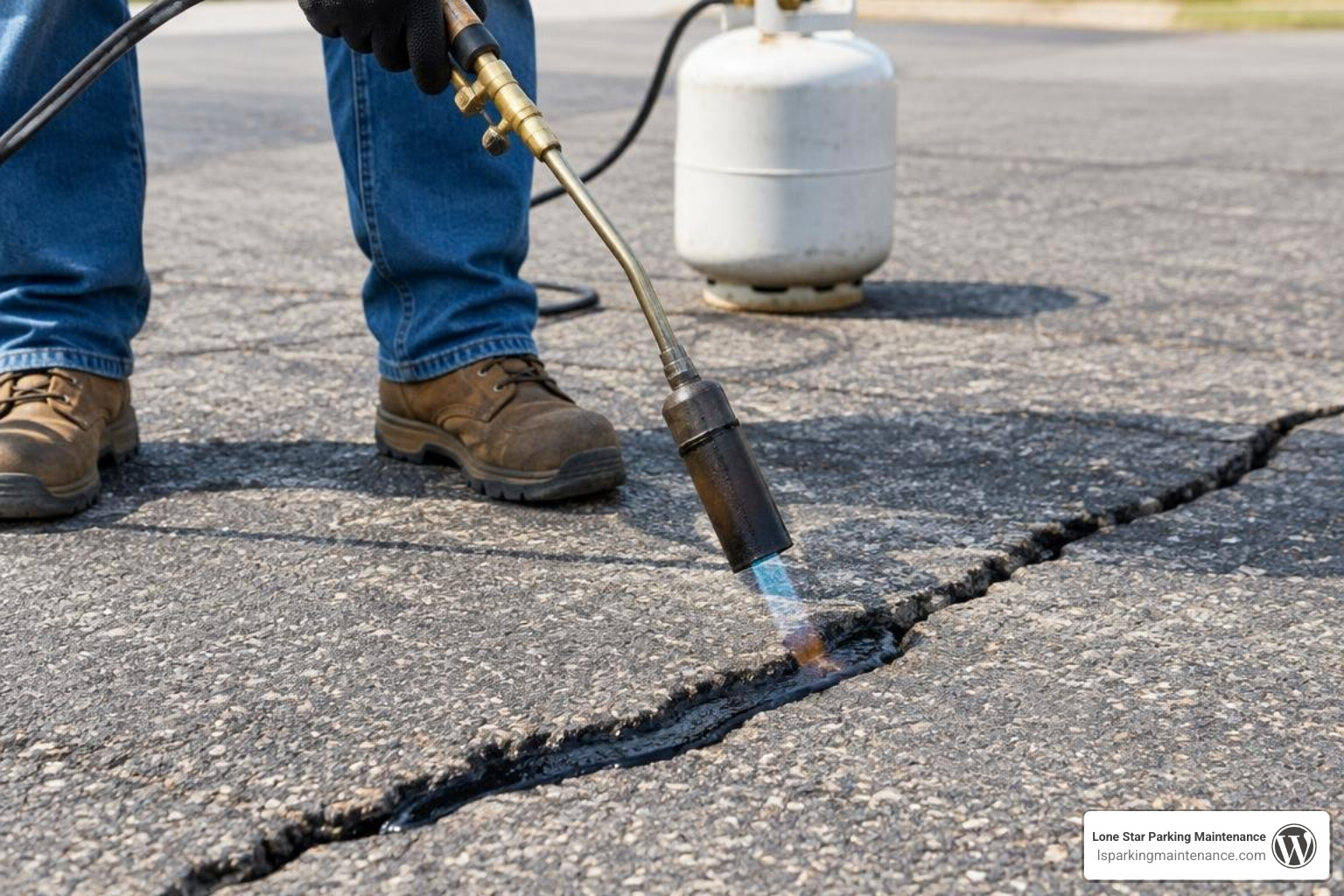
- Torch Application: Using a handheld propane torch or high-output heat gun, the material liquefies directly inside the crack, bonding securely to both sidewalls.
- Rapid Return to Service: Pli-Stix is traffic ready in roughly 20 minutes after cooling.
- Permanent Bond: Backed by lifetime guarantees, these elastomeric ropes do not track under vehicle tires or wash out during heavy rain.
Step-by-Step Guide to Applying Asphalt Crack Repair Sealant
Proper preparation accounts for 90% of crack repair longevity. Applying sealant over loose dirt, vegetation, or trapped moisture leads to premature delamination.
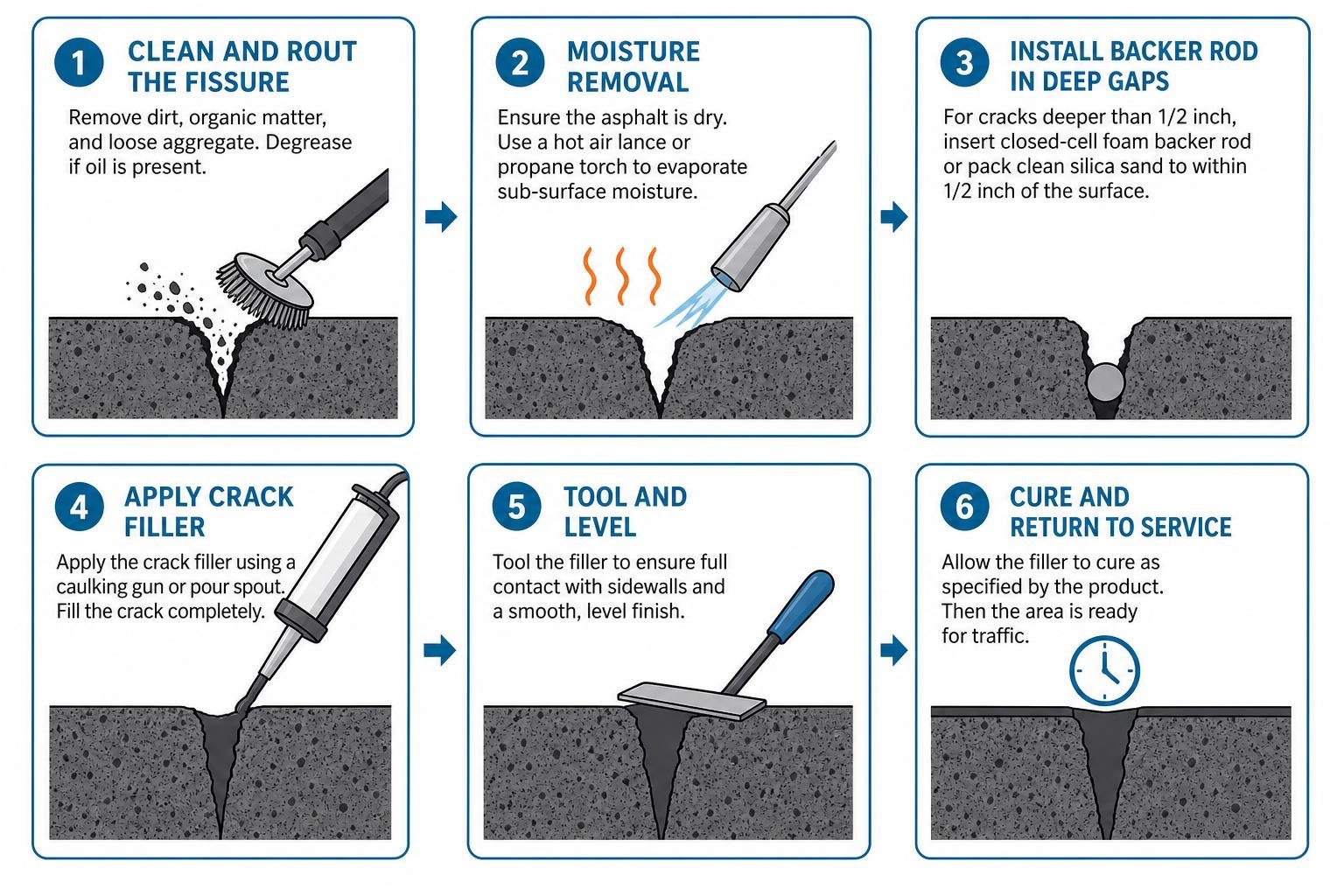
- Clean and Rout the Fissure: Use a stiff wire wheel, mechanical crack router, or high-pressure air lance to remove dirt, organic matter, and fractured aggregate. If oil is present, degrease the area thoroughly.
- Moisture Removal: Ensure the asphalt is dry. When working in humid conditions, use a hot air lance or propane torch to evaporate sub-surface moisture before filler application.
- Install Backer Rod in Deep Gaps: For cracks deeper than 1/2 inch, insert a closed-cell foam backer rod or pack clean silica sand to within 1/2 inch of the surface. This prevents excessive material consumption and maintains a proper 2:1 width-to-depth joint design.
- Apply the Sealant:
- For Hot Pour: Heat the rubberized block to 380°F–400°F and apply using a walk-behind melter-applicator or pour pot. Overfill slightly and strike flush with a U-shaped squeegee to create a banded edge.
- For Torch-Applied Rope: Pack the rope 1/16 to 1/8 inch below the pavement surface. Sweep a torch flame across the joint at a 45-degree angle until completely liquefied.
- For Cartridge/Pourable Cold Fillers: Cut the nozzle tip to match the crack width, dispense continuously into the gap, and level with a hand squeegee.
- Cure and Inspect: Allow the material to cool or cure according to product specifications before opening the area to traffic.
Frequently Asked Questions About Asphalt Crack Repair
How long does asphalt crack filler take to cure before driving?
Cure times vary by material type:
- Hot-pour rubberized sealants are traffic-ready in 10 to 40 minutes as soon as the compound cools below its tack point.
- Direct torch-melt ropes (such as Pli-Stix) cure in about 20 minutes.
- Cold-pour emulsion sealants require 24 to 48 hours of dry weather above 50°F before supporting vehicular traffic. Certain fast-setting formulas dry to the touch in 30 to 120 minutes, but still require several hours to handle tire turning torque.
What is the difference between asphalt crack filler and crack sealer?
- Crack Fillers are formulated for stationary, non-working cracks (such as longitudinal and fatigue cracking). They fill voids to restore pavement profile and reduce water pooling.
- Crack Sealers are engineered with elastomeric polymers for active, working cracks that expand and contract with temperature changes (transverse joints). Sealers maintain adhesive and cohesive flexibility across extreme temperature swings.
Can you sealcoat immediately after filling asphalt cracks?
No. Hot-pour rubberized sealants should cure for at least 24 to 48 hours before sealcoating to allow light surface oils to dissipate. Cold-pour crack fillers generally require 3 to 7 days of warm, dry weather before sealcoating. Applying sealcoat over uncured crack filler traps volatile carriers, causing blistering, tracking, and localized adhesion failure.
Conclusion and Professional Maintenance Solutions
Cracks will expand over time if left unsealed. Addressing pavement fissures with high-grade hot rubberized sealant prevents water penetration, preserves structural sub-bases, and extends the lifespan of your asphalt surfaces.
For small, localized driveway fixes, cold cartridges and torch-applied ropes provide practical DIY solutions. However, commercial parking facilities, drive aisles, and retail developments require industrial-grade materials and equipment to handle daily traffic volume.
Our team at Lone Star Parking Maintenance provides dedicated surface repairs, parking lot striping, power washing, and parking lot sealing and crack filling across the DFW Metroplex. We utilize commercial-grade hot rubberized sealants meeting strict DOT standards to ensure your pavement stays durable, compliant, and well-protected. Contact us today for a detailed property evaluation and tailored pavement maintenance plan.