
Why Every DFW Property Manager Needs to Fix Parking Lot Flooding Now
Fix parking lot flooding by addressing these core issues in order:
- Check and clear all catch basins and storm drain grates of debris
- Inspect the surface grade — you need at least a 1% slope toward drainage inlets
- Install or upgrade drainage with catch basins, trench drains, or French drains at low points
- Add or repair curbing to direct water flow away from buildings and toward drains
- Seal cracks and patch depressions where water is pooling on the surface
- Schedule a professional inspection if standing water persists more than 24 hours after rain
If you manage a commercial property in the Dallas-Fort Worth area, you already know how fast a summer storm can turn a parking lot into a pond. The rain hits hard and fast — and if your lot’s drainage isn’t up to the job, water goes everywhere it shouldn’t.
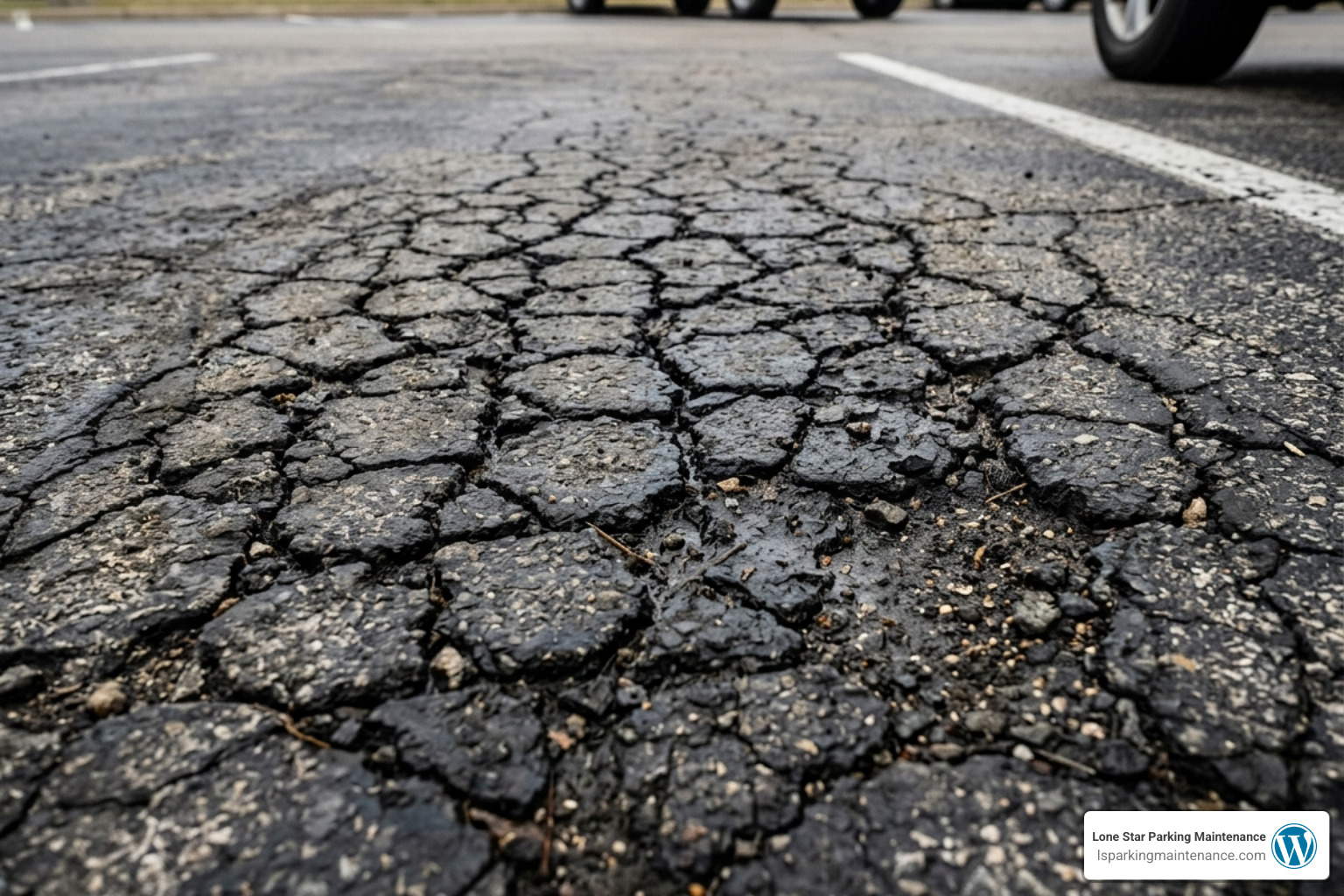
That’s more than an inconvenience. Standing water is quietly destroying your pavement from the inside out. It seeps into cracks, saturates the subbase, and accelerates the kind of structural failure that turns a manageable repair into a full-depth reconstruction job.
The good news? Most parking lot flooding problems are fixable — and many don’t require tearing up your entire lot to solve.
This guide walks you through everything: the causes, the fixes, the costs, and the maintenance habits that keep your lot draining properly year after year.
Why Standing Water is a Liability for Your Asphalt
When we talk about the need to fix parking lot flooding, we aren’t just talking about keeping your customers’ shoes dry. We are talking about the structural survival of your investment. Asphalt is designed to be flexible and durable, but its greatest enemy is standing water.
Water doesn’t just sit on top of the asphalt; it actively searches for a way underneath it. Through a process called oxidation, UV rays and heat make the asphalt brittle, leading to small cracks. Once water enters those cracks, it reaches the subbase—the foundation of your entire parking lot. When that foundation becomes saturated, it loses its ability to support the weight of vehicles. This leads to “alligator cracking” (which looks exactly like it sounds) and eventual potholes.
Beyond structural damage, there is the issue of liability. Standing water can hide deep potholes or obscure pavement markings, leading to trips, falls, or vehicle damage. Furthermore, Parking Lot Drainage and Stormwater Management: Compliance, Maintenance, and Pavement Protection highlights that poor drainage can lead to ADA compliance violations. If a puddle blocks an accessible route or a handicap parking space, your property is no longer compliant, opening you up to legal risks.
Regular maintenance is the first line of defense. Understanding Why is Parking Lot Sealing Important helps you realize that a liquid-tight seal prevents water from ever reaching that vulnerable subbase in the first place.
The Cost of Neglect in 2026
In the DFW Metroplex, the cost of asphalt materials and labor continues to rise. As of April 2026, the financial difference between a well-drained lot and a flooded one is staggering.
A parking lot with adequate drainage and a consistent maintenance cycle (including crack sealing and resurfacing) can easily last 25 years. However, a lot plagued by standing water problems may require full-depth reconstruction in as little as 10 to 12 years. You are essentially cutting the life of your pavement in half by ignoring the puddles.
When you consider How Much to Seal the Deal on Your Asphalt, the investment in preventative care is a fraction of the cost of a total “rip and replace” job. If you wait until the subbase fails, you aren’t just paying for new asphalt; you’re paying for the excavation and replacement of the earth beneath it.
Proven Strategies to Fix Parking Lot Flooding
If you’ve identified that your lot has a “ponding” problem, you need a targeted solution. Not every lot needs a total overhaul; often, adding the right hardware to the low points can solve the issue.
| Drainage System | Best For | Flow Capacity | Relative Cost |
|---|---|---|---|
| Catch Basin | Large open areas / Low points | High | Moderate |
| Trench Drain | Entrances / Loading docks | Medium-High | High |
| French Drain | Subsurface water / Grassy areas | Low-Medium | Moderate |
Catch Basins
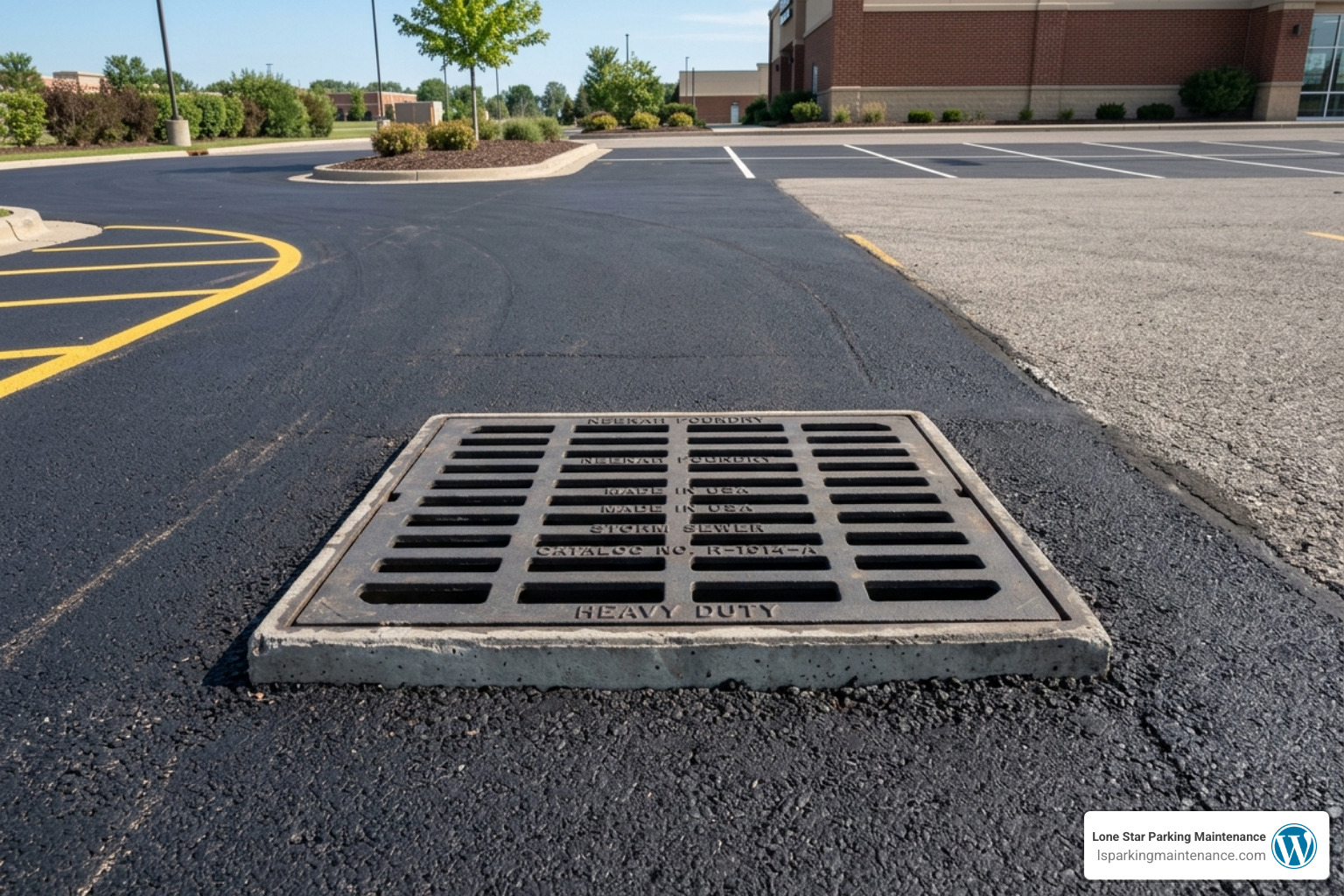
These are the workhorses of parking lot drainage. A catch basin is a buried box with a grate on top. It catches surface water and directs it into the underground storm sewer system. If your lot has a deep “bowl” where water gathers, installing a new catch basin—or repairing a sunken one—is often the most effective way to fix parking lot flooding.
Trench Drains
Also known as channel drains, these are long, narrow grates often seen at the entrance of a parking garage or along a sidewalk. They are designed to intercept “sheet flow”—water running across a large flat surface—before it reaches a building or a pedestrian walkway.
French Drains
These are slightly more “stealthy.” A French drain consists of a perforated pipe buried in a trench filled with gravel. They are excellent for managing subsurface water or runoff that flows from a grassy slope onto your pavement.
For a deeper dive into these options, check out these 7 Parking Lot Drainage Solutions for Better Water Control.
How to Fix Parking Lot Flooding with Proper Grading
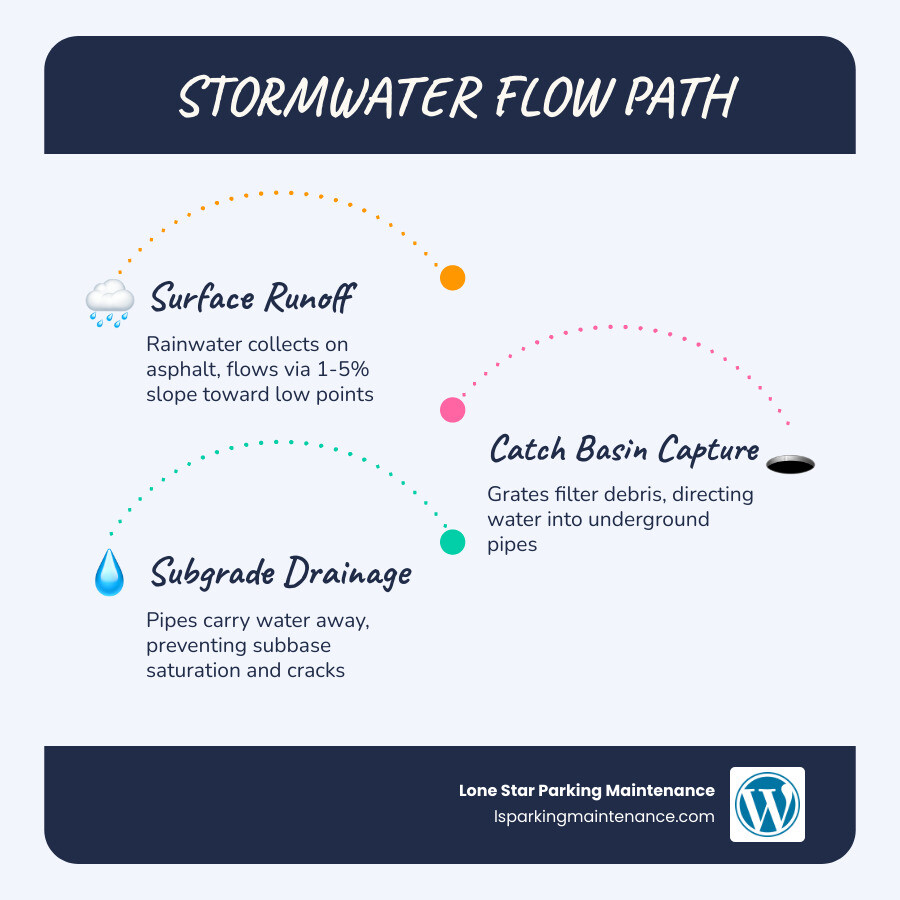
Hardware is great, but water only moves if the ground tells it to. This is where grading comes in. The ideal slope for a commercial parking lot is between 1% and 5%.
- A 1% slope is the bare minimum—it means the surface drops one foot for every 100 feet of distance. This is just enough to keep water moving toward a drain.
- Anything less than 1% and you will inevitably have standing water, especially if the asphalt settles over time.
In the DFW Metroplex, our soil is famous (or infamous) for shifting. This movement can create “birdbaths”—small depressions where water sits. To fix these, we often use DFW Asphalt Overlays. By adding a fresh layer of asphalt, we can “re-pitch” the surface, ensuring the water has a clear, downhill path to the nearest drain.
Using Curbing to Fix Parking Lot Flooding
Curbs do more than just stop cars from driving onto the grass; they act as the “gutters” of your parking lot. Properly designed curbing directs water toward catch basins and prevents it from washing out the landscaping or flooding nearby buildings.
For commercial applications, we recommend concrete curbs that are at least eight inches thick. While asphalt curbing is cheaper, it lacks the structural “heft” to withstand heavy vehicle impacts and the force of rushing water during a North Texas downpour. According to How to Prevent and Manage Parking Lot Flooding – ACPLM, well-placed curbing is one of the most cost-effective ways to manage perimeter runoff.
Sustainable Drainage: Permeable Pavers and LID Systems
As we move through 2026, many DFW property owners are looking toward “Green” or Sustainable drainage solutions. Low-Impact Development (LID) is a strategy that manages stormwater as close to its source as possible.
The star of the LID show is permeable pavement. Unlike standard asphalt, which is a solid, waterproof sheet, permeable pavers allow water to soak directly through the surface and into a stone reservoir underneath.
- Runoff Reduction: These systems can reduce surface runoff by 80% to 100%.
- Pollutant Removal: As water filters through the stone layers, it naturally removes 80-90% of suspended solids and 50-70% of metals.
- Groundwater Recharge: Instead of sending oily water into the city’s storm drains, permeable systems let clean water return to the local water table.
While there is a 20-40% installation premium over standard asphalt, the long-term savings are significant. You may be able to reduce the size of your detention pond or eliminate the need for expensive underground piping altogether.
Environmental Compliance and Stormwater Credits
Managing water isn’t just about maintenance; it’s about the law. The National Pollutant Discharge Elimination System (NPDES) regulates how businesses handle stormwater. Most commercial sites are required to have a Stormwater Pollution Prevention Plan (SWPPP).
By implementing sustainable solutions like bioswales or permeable pavers, you aren’t just helping the environment—you might be helping your bottom line. Many municipalities in the Dallas-Fort Worth area offer stormwater fee credits for properties that reduce their “impervious surface” footprint. Top Parking Lot Drainage Solutions for Effective Water Management notes that LID systems can actually be 10-15% cheaper over their entire lifecycle when you account for these credits and lower long-term maintenance costs.
Proactive Maintenance to Prevent Future Floods
You wouldn’t wait for your car’s engine to seize before changing the oil, right? The same logic applies to your drains. Most “flooding” isn’t caused by a broken pipe—it’s caused by a clogged one.
A catch basin that is 50% full of sediment has significantly reduced capacity. During a heavy rain event, that basin will overflow, causing the very flooding you’re trying to avoid.
Our Maintenance Checklist for 2026:
- Annual Cleaning: Expect to pay $100-$300 per basin. For a large lot with 20 basins, that $4,000 investment can prevent $40,000 in pavement damage.
- Camera Inspections: Every 5-7 years, we recommend a camera inspection of the outlet pipes. This identifies tree root intrusions or pipe collapses before they cause a total system failure.
- Grate Repair: Replace broken or missing grates immediately. Not only are they a trip hazard, but they also allow large debris (like trash and branches) to enter the system and cause major clogs.
Proper Concrete and Asphalt Maintenance ensures that your drainage hardware stays in peak condition.
Seasonal Inspections and Crack Repair
In the DFW area, we suggest a “Spring Cleaning” and “Fall Prep” schedule.
- Spring: Clear out the winter’s accumulation of sand, salt, and debris that can clog inlets.
- Fall: Ensure all leaves and organic matter are cleared so they don’t turn into a “plug” for your drains during autumn rains.
Crucially, you must address cracks as they appear. What are the Benefits of Crack Filling? It stops the cycle of water infiltration before it starts. If you have a driveway or a small lot, our Ultimate Guide to Filling Every Crack provides the DIY basics, though large commercial lots usually require professional-grade hot-pour rubberized sealant.
Frequently Asked Questions about Parking Lot Drainage
How much do parking lot drainage repairs typically cost?
For most commercial properties, targeted drainage fixes—such as installing a new trench drain or a relief catch basin—range from $5,000 to $20,000. While this sounds like a lot, it is significantly cheaper than a full repave. The ROI is found in the extended life of your asphalt; by fixing the drainage, you can add 10-15 years to the lot’s lifespan.
What are the immediate steps to take after a parking lot floods?
- Safety First: Cordon off flooded areas to prevent cars from driving into deep water or pedestrians from slipping.
- Clear the Grates: Often, a flood is caused by a plastic bag or a pile of leaves sitting on top of the grate. Use a rake to clear it (never use your hands).
- Document: Take photos of where the water is pooling. This helps professionals like us identify the “low spots” once the water has dried.
- Call an Expert: If the water stays for more than 24 hours, you likely have a subgrade clog or a structural grading issue.
How often should I clean my parking lot catch basins?
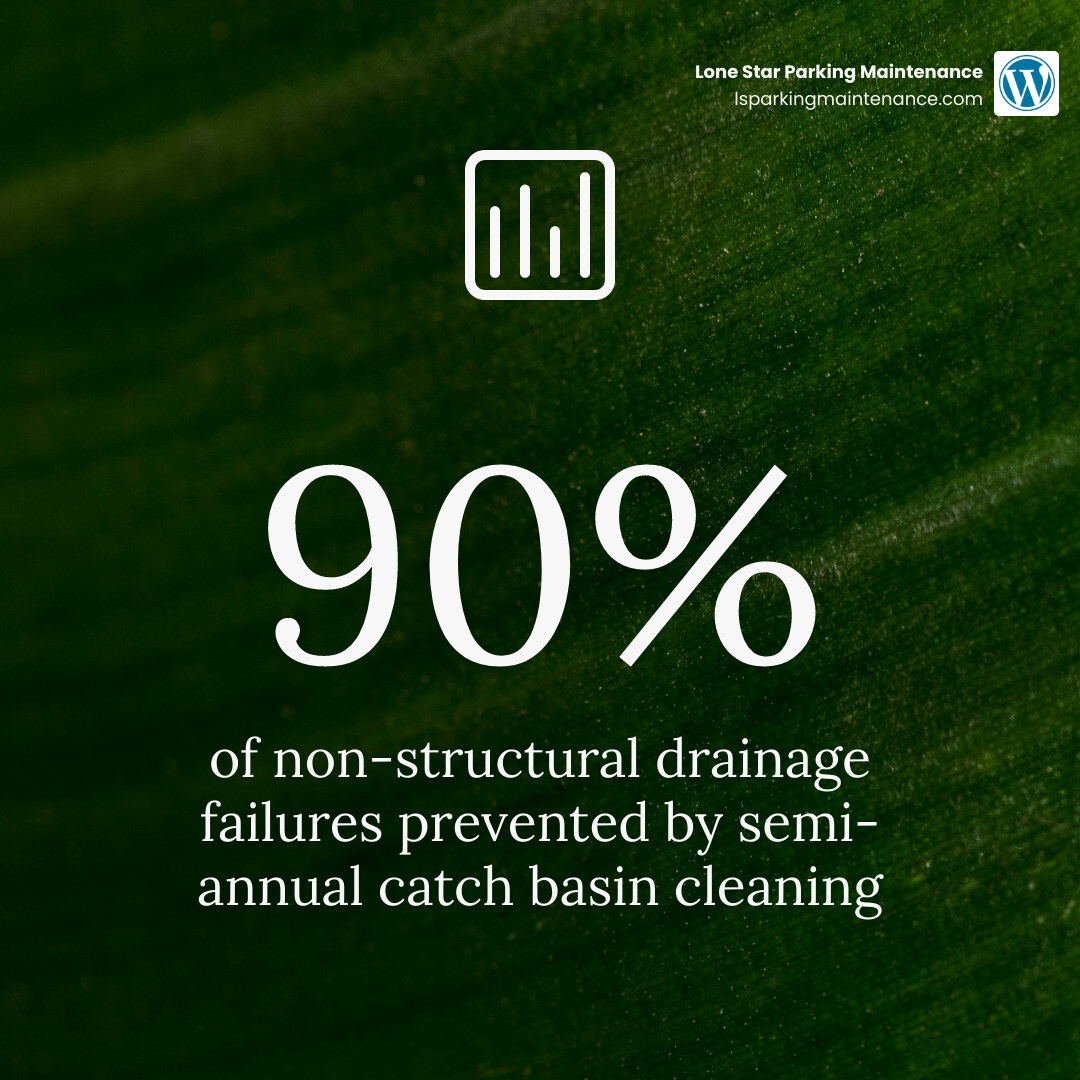
We recommend a semi-annual schedule (twice a year). Our internal data shows that sites that stick to this schedule prevent over 90% of non-structural drainage failures. If your lot is near a construction site or has many trees, you may need quarterly cleanings.
Conclusion: Let Lone Star Parking Maintenance Fix the Flood
Don’t let a “little puddle” turn into a massive capital expense. At Lone Star Parking Maintenance, we’ve seen how the DFW climate can punish a poorly drained parking lot. Whether you need a simple catch basin cleaning, a fresh sealcoat to keep the water out, or a complete surface re-grading, we are here to help.
We are committed to the safety of your tenants and the longevity of your pavement. We use only top-quality materials and adhere to the highest industry standards to ensure your lot stays dry and your business stays accessible.
Ready to stop the soak? Request a consultation for your parking facility today, and let our experts perform a professional inspection to keep your property safe and flood-free.