
Why Handicap Parking Striping Can Cost You More Than You Think
Handicap parking striping is one of the most regulated — and most overlooked — elements of any commercial parking lot.
Here’s a quick summary of what ADA-compliant handicap parking striping requires:
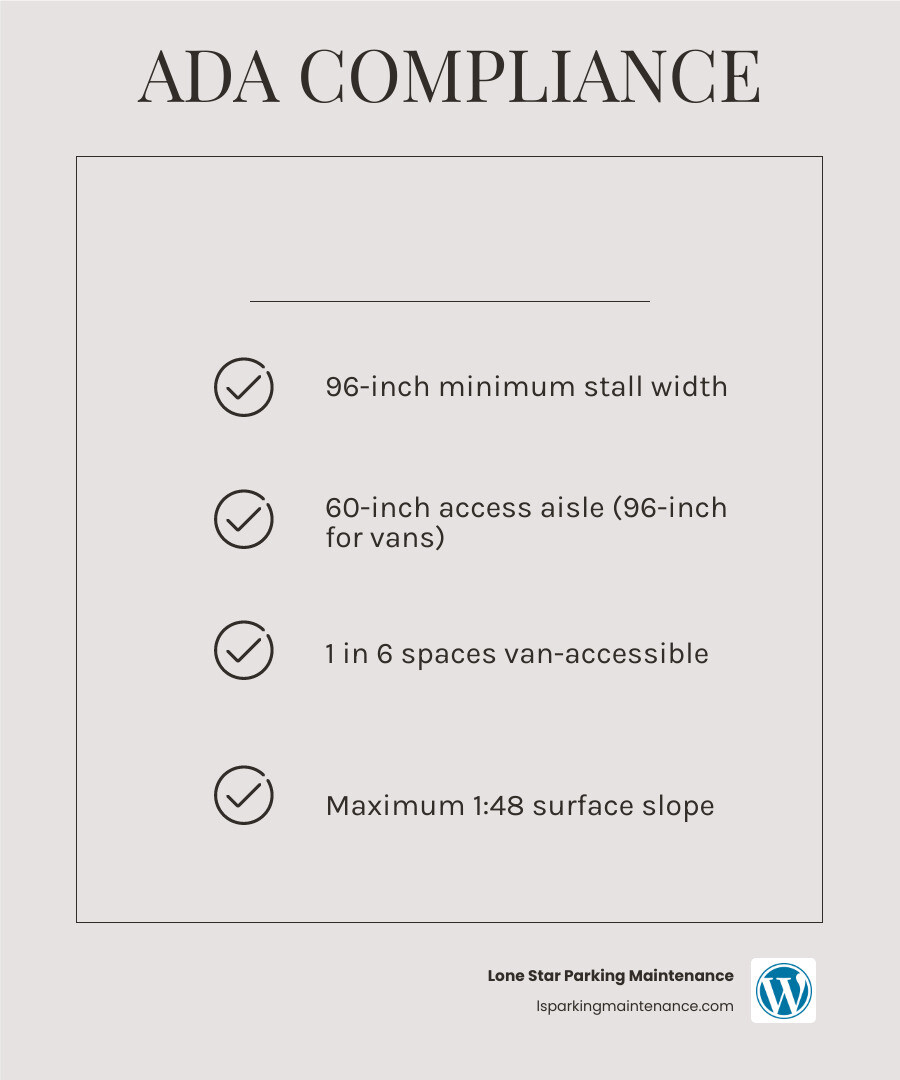
- Minimum stall width: 96 inches (8 feet)
- Access aisle width: 60 inches for standard spaces, 96 inches for van-accessible
- Van-accessible ratio: At least 1 in every 6 accessible spaces
- Sign height: Bottom edge at least 60 inches above the ground
- Pavement markings: International Symbol of Accessibility (ISA), diagonal hatching in access aisles
- Surface slope: No more than 1:48 (about 2%) in any direction
- Location: On the shortest accessible route to a building entrance
For property managers and business owners in the DFW Metroplex, getting these details wrong isn’t just an eyesore — it’s a liability.
Federal fines for ADA non-compliance start at $75,000 for a first offense and climb to $150,000 for repeat violations. And that’s before any private lawsuits enter the picture.
The tricky part? Many parking lots fall out of compliance gradually. Paint fades. Lots get resurfaced without being properly restriped. A sign gets knocked down and never replaced. None of it feels urgent — until it is.
This guide walks you through everything you need to know: the exact dimensions, signage rules, location requirements, and maintenance schedules that keep your lot compliant and your business protected.
Handicap parking striping vocab to learn:
Understanding ADA Requirements for Handicap Parking Striping
When we talk about handicap parking striping, we are talking about more than just blue paint. We are talking about the Americans with Disabilities Act (ADA), a landmark piece of civil rights legislation. Specifically, Title III of the ADA requires businesses and non-profits that serve the public (known as “public accommodations”) to remove architectural barriers in existing facilities when it is “readily achievable” to do so.
The Department of Justice enforces these standards, and they don’t take “I didn’t know” for an answer. As of May 2026, the 2010 ADA Standards for Accessible Design remain the gold standard. These rules ensure that people with disabilities have equal access to goods and services.
For property owners in the DFW Metroplex, this means that even if your building was constructed before the ADA was passed in 1990, you have an ongoing legal obligation to maintain accessible parking. If you’re interested in a deep dive, check out the ADA Compliance Brief: Restriping Parking Spaces | ADA.gov for the federal perspective. Locally, we also have to navigate the Texas Accessibility Standards (TAS), which are enforced by the Texas Department of Licensing and Regulation (TDLR).
Understanding these rules can feel like trying to solve a puzzle where the pieces are made of wet paint. That’s why we’ve put together resources like How to Master ADA Compliance for Parking Lots Without Breaking a Sweat to help simplify the process for our North Texas neighbors.
Dimensions and Layout for Compliant Accessible Spaces
Precision is everything. In handicap parking striping, being off by an inch is the same as being off by a mile in the eyes of an inspector. The layout consists of three main parts: the parking space itself, the access aisle, and the boundary markings that tie them together.
Standard Handicap Parking Striping Dimensions
For a standard car-accessible space, the math is straightforward but strict. The parking stall must be at least 96 inches (8 feet) wide. Adjacent to this stall, you must provide a 60-inch (5-foot) wide access aisle.
The access aisle is the “no-man’s land” where wheelchairs are unloaded. It must be marked with diagonal hatching—usually at a 45-degree angle—to discourage people from parking there. While federal law doesn’t strictly mandate a specific paint color for the lines, the industry standard in Texas is high-contrast blue for the stall lines and the border of the aisle.
One of the most common “invisible” failures we see in Dallas-area lots is the slope. The surface of the space and the aisle must be firm, stable, and slip-resistant, with a slope no steeper than 1:48 (2.08%) in any direction. If your lot is sinking or uneven, your striping might look great, but you’re still technically out of compliance. You can learn more about these technicalities in The Essential Guide to ADA Compliant Parking Lot Striping.
Van-Accessible Parking Requirements
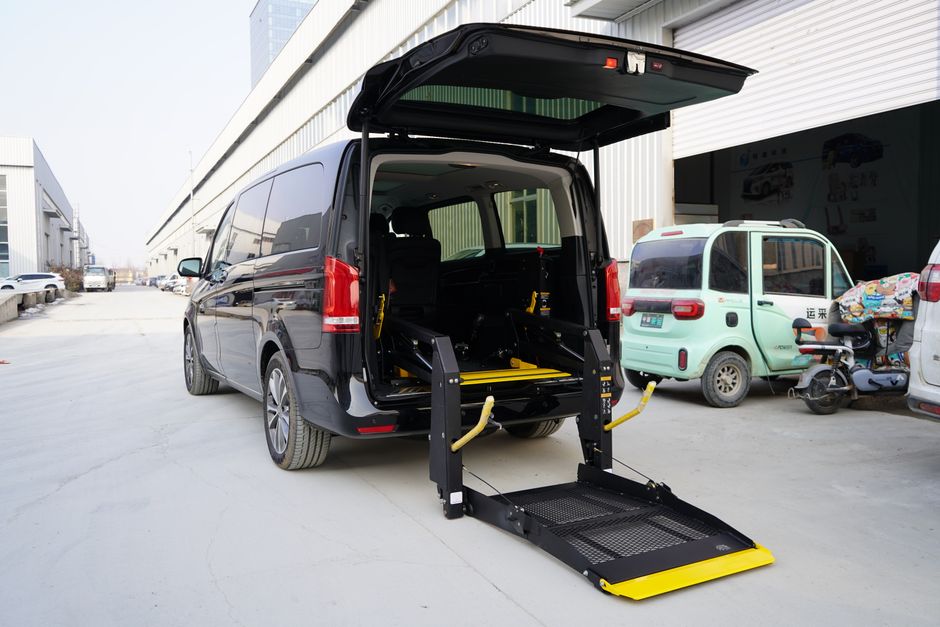
Van-accessible spaces are the “big brothers” of the parking lot. They require more room because they need to accommodate side-loading lifts and ramps.
There are two ways to layout a van-accessible space:
- The Wide Stall Method: A 132-inch (11-foot) wide stall with a 60-inch (5-foot) access aisle.
- The Wide Aisle Method: A 96-inch (8-foot) wide stall with a 96-inch (8-foot) access aisle.
At Lone Star Parking Maintenance, we often recommend the wide aisle method (96/96) because it provides more room for lift deployment. At least one out of every six accessible spaces must be van-accessible. If you only have one handicap space in your entire lot, it must be van-accessible.
Don’t forget the vertical clearance! Van-accessible spaces, their access aisles, and the vehicular routes leading to them must have at least 98 inches of vertical clearance to accommodate raised-roof vans. This is a critical factor for parking garages in downtown Dallas or Fort Worth.
Quick Reference: ADA Dimensions Table
| Feature | Car-Accessible | Van-Accessible (Option A) | Van-Accessible (Option B) |
|---|---|---|---|
| Stall Width | 96″ (8 ft) | 132″ (11 ft) | 96″ (8 ft) |
| Access Aisle Width | 60″ (5 ft) | 60″ (5 ft) | 96″ (8 ft) |
| Vertical Clearance | N/A | 98″ | 98″ |
| Signage Required | ISA | ISA + “Van Accessible” | ISA + “Van Accessible” |
Location, Signage, and Surface Standards
Where you put your handicap parking striping is just as important as how wide it is. The ADA requires that accessible spaces be located on the shortest accessible route from the parking area to the building entrance.
Strategic Placement and Accessible Routes
If your building has multiple entrances, you can’t just bunch all the handicap spots at the far end of the lot. You need to disperse them so they are close to each accessible entrance. The “accessible route” is the path a person takes from their car to your door. This path must be:
- At least 36 inches wide.
- Free of curbs or stairs (unless there’s a ramp).
- Constructed of a firm, stable, slip-resistant surface.
We often install “truncated domes”—those bumpy yellow or red tiles—at the bottom of curb ramps. These provide a tactile warning for visually impaired pedestrians that they are entering a vehicular path. In multi-entrance facilities or large shopping centers across the DFW Metroplex, we carefully plan these routes to ensure they don’t cross behind parked cars, which is a major safety hazard.
Vertical Signage and Handicap Parking Striping Symbols
A common myth is that the blue paint on the ground is enough. It isn’t. Every accessible space must have a permanent sign featuring the International Symbol of Accessibility (ISA)—the familiar white-on-blue wheelchair icon.
Key signage rules include:
- Height: The bottom of the sign must be at least 60 inches (5 feet) above the ground. This ensures the sign is visible even if a tall SUV is parked in the spot.
- Content: Van-accessible spaces must have an additional “Van Accessible” sign mounted below the ISA.
- Pavement Markings: While federal law focuses on the vertical sign, the Texas Accessibility Standards (TAS) and many North Texas municipal codes require the ISA to be painted directly on the pavement as well. We typically use a 36×36 inch stencil for maximum visibility.
For more details on the “fine print” of signs, take a look at Everything You Need to Know About ADA Parking Signs.
Compliance Risks and Maintenance Schedules
Let’s talk numbers. In May 2026, the cost of ignoring your handicap parking striping is higher than ever. Federal civil penalties for ADA violations can reach $75,000 for a first violation and $150,000 for subsequent ones.
Beyond the government, there is the risk of private litigation. In Texas, “drive-by” lawsuits are a real concern for small business owners. If a plaintiff’s attorney spots a lot with faded lines or missing signs, they may file a lawsuit claiming their client was denied access. Settlements for these cases often range from $15,000 to $50,000—far more than the cost of a professional restriping job.
When to Call the Pros
We recommend inspecting your striping every six months. In the harsh Texas sun, paint can fade quickly. Generally, you should plan for a full restripe every 12 to 24 months, depending on your traffic volume.
Faded paint isn’t just an aesthetic issue; if a person with a disability can’t clearly see the boundaries of the access aisle or the ISA symbol, your lot is technically non-compliant. If you’re planning on sealcoating your lot (which we highly recommend for pavement longevity!), that is the perfect time to reconfigure your layout for 100% compliance. You can learn more about this in our guide to Restriping Your Parking Lot for a Fresh New Look.
Frequently Asked Questions about ADA Parking
How many handicap spaces does my lot need?
The number of required spaces is based on the total number of parking spots in each individual lot or garage. It’s not a “one size fits all” calculation.
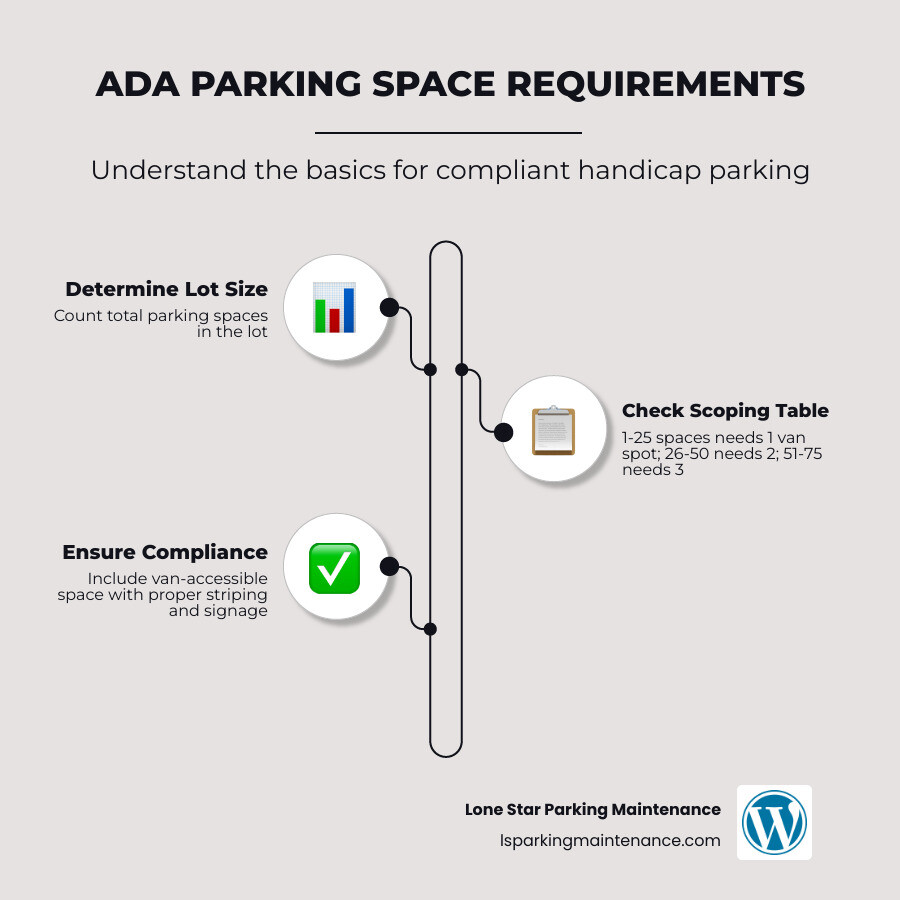
General Scoping Table:
- 1 to 25 spaces: 1 accessible space (must be van-accessible)
- 26 to 50 spaces: 2 accessible spaces
- 51 to 75 spaces: 3 accessible spaces
- 76 to 100 spaces: 4 accessible spaces
- 101 to 150 spaces: 5 accessible spaces
- 151 to 200 spaces: 6 accessible spaces
- 201 to 300 spaces: 7 accessible spaces
- 501 to 1000 spaces: 2% of total
- 1001 and over: 20, plus 1 for each 100 over 1000
Note: Hospital outpatient facilities require 10% accessible parking, and rehabilitation facilities specializing in mobility require 20%.
Does restriping trigger new ADA requirements?
Yes. Under the ADA, restriping is considered an “alteration.” This means when you repaint your lines, you must bring the accessible spaces up to the current 2010 Standards. You can’t simply “grandfather in” an old, non-compliant layout just because that’s how it was originally built. This is the most common mistake we see in older DFW striping projects.
Can two spaces share one access aisle?
Absolutely! This is a great way to save space. Two accessible parking spaces can share a single access aisle located between them. However, if one of those spaces is van-accessible, the shared aisle must meet the wider 96-inch requirement.
Conclusion
At Lone Star Parking Maintenance, we believe that handicap parking striping is about more than just avoiding fines—it’s about making sure every customer can safely and easily access your business. Whether you manage a small retail strip in Plano or a massive corporate campus in Fort Worth, we bring the same level of precision and commitment to every job.
We use top-quality, high-durability materials designed to withstand the Texas heat and heavy traffic. Our team is expert in the nuances of both federal ADA standards and the Texas Accessibility Standards, ensuring your lot is a model of compliance and safety.
Don’t wait for an inspector or a legal notice to find out your lines are out of spec. Contact us for ADA-compliant parking lot striping today, and let’s make sure your first impression is a compliant one.