
Why Crack Filling Is the Smartest Move You Can Make for Your Pavement
Crack filling is one of the most cost-effective ways to protect your asphalt parking lot or driveway from serious damage. Done right, it stops water from getting under the surface, prevents small cracks from turning into expensive potholes, and can add years to the life of your pavement.
Here’s a quick answer to what most people want to know:
What is crack filling, and when do you need it?
- What it is: Applying filler or sealant material into cracks in asphalt or concrete pavement to block water and debris
- When to do it: As soon as cracks appear — ideally before they reach 1 inch wide
- Best time of year: Spring or fall, when temperatures are between 45°F and 65°F
- Who it’s for: Property owners, parking lot managers, municipalities, and homeowners
- Expected results: 2 to 8 years of protection, depending on the material and method used
Cracking is the most common form of distress in asphalt pavement — and it’s usually the first sign of trouble. Left alone, a small crack lets in water. Water weakens the base. The base fails. Now you’re looking at a full repaving job instead of a simple repair.
The good news? Most cracks are very fixable. You don’t need to be a pavement engineer. You just need to know which type of crack you’re dealing with, which material to use, and how to apply it correctly.
This guide walks you through all of it — step by step.
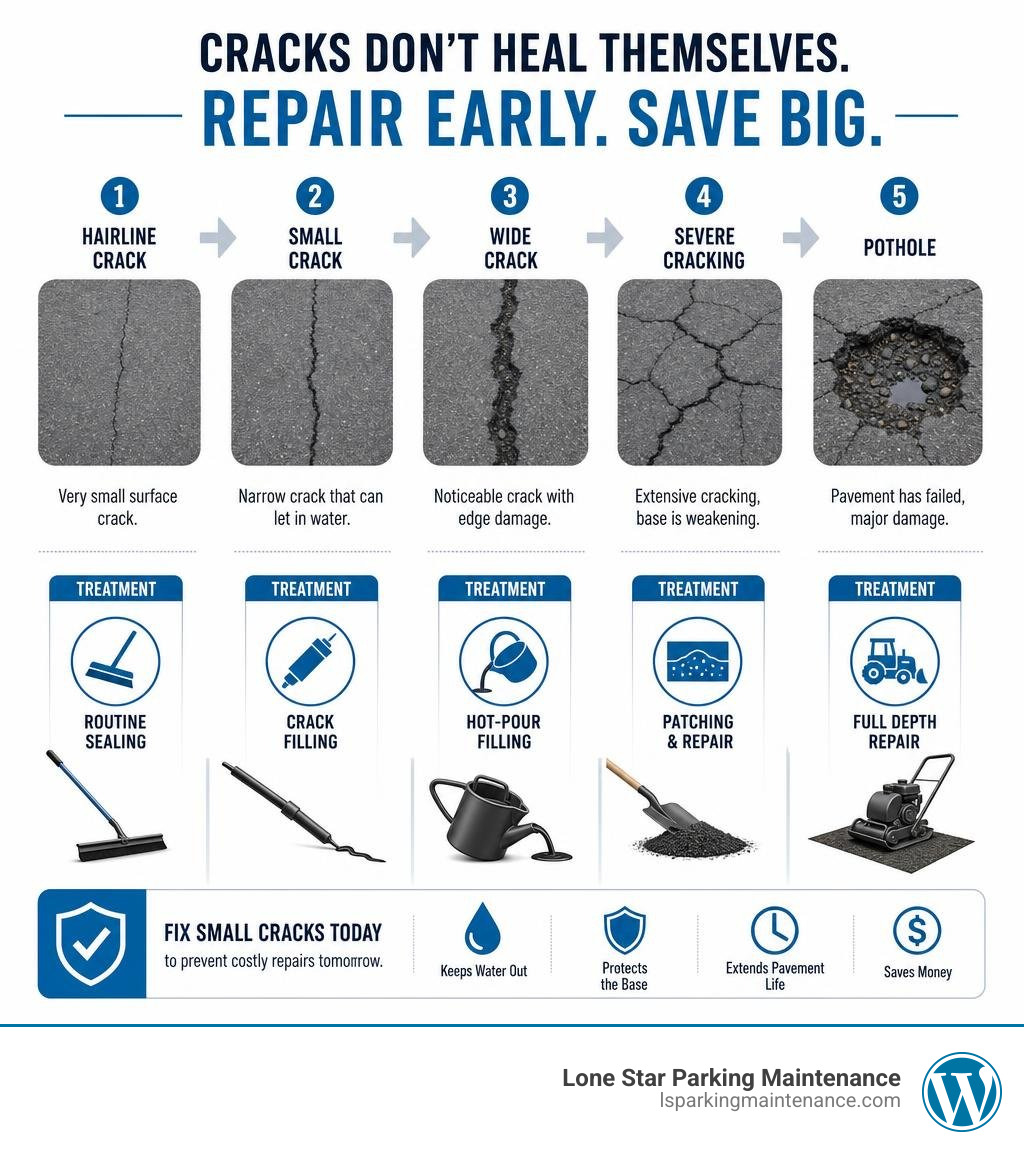
Crack Sealing vs. Crack Filling: Understanding the Key Differences
If you have ever stared down at a fractured parking lot in the DFW Metroplex, you might think a crack is just a crack. But in the pavement maintenance industry, we divide them into two distinct categories: working cracks and non-working cracks. Understanding this distinction is the secret to choosing between crack sealing and crack filling.
- Working Cracks: These are cracks that experience significant horizontal movement (opening and closing) of 0.1 inches (3 mm) or more annually. They are typically transverse cracks that stretch across the width of the pavement. Because they move as temperatures change, they require crack sealing—a process using highly flexible, elastomeric sealants placed in a specially routed reservoir to accommodate the expansion and contraction.
- Non-Working Cracks: These cracks experience very little annual horizontal movement (less than 0.1 inches). They are often longitudinal cracks running in the direction of traffic, diagonal cracks, or block cracking patterns. Because they do not move much, they are perfect candidates for crack filling, which involves placing lower-cost, less flexible materials directly into the crack without extensive routing.
To help you figure out which treatment your property needs, ask yourself: How do I know if my parking lot needs crack filling? Typically, if you see closely spaced block cracks or longitudinal joints that are stable and have minimal edge deterioration, filling is your go-to. If you want to dive deeper into the technical guidelines, the 413.5 Crack Treatment in Bituminous Pavements – Engineering Policy Guide provides excellent engineering specifications on how crack width and movement dictate treatment choices.
By selecting the right method, you unlock the benefits of crack filling, which include stopping water intrusion, preventing subgrade erosion, and keeping dirt and rocks from wedging into the cracks.
Here is a quick breakdown to compare the two methods:
| Feature / Criteria | Crack Sealing | Crack Filling |
|---|---|---|
| Crack Type | Working cracks (annual movement $\ge$ 0.1 inches) | Non-working cracks (annual movement < 0.1 inches) |
| Typical Width | 0.25 to 0.75 inches | 0.1 to 1.0 inches |
| Edge Deterioration | Low to moderate (clean edges) | Moderate to none |
| Preparation | Routing/sawing a reservoir (1:1 ratio) | Thorough cleaning (wire brushing, air blasting) |
| Material Used | High-performance polymer-modified rubberized asphalt | Asphalt emulsion, fiber-modified asphalt, asphalt cement |
| Service Life | 5 to 9 years | 2 to 8 years |
| Primary Goal | Accommodate movement and seal out moisture | Fill the void, reduce water infiltration, reinforce edges |
Selecting Materials and Evaluating Cost-Effectiveness
Choosing the right material is like choosing the right pair of boots for a Texas summer—you want something that won’t melt, crack, or let you down when the heat spikes.
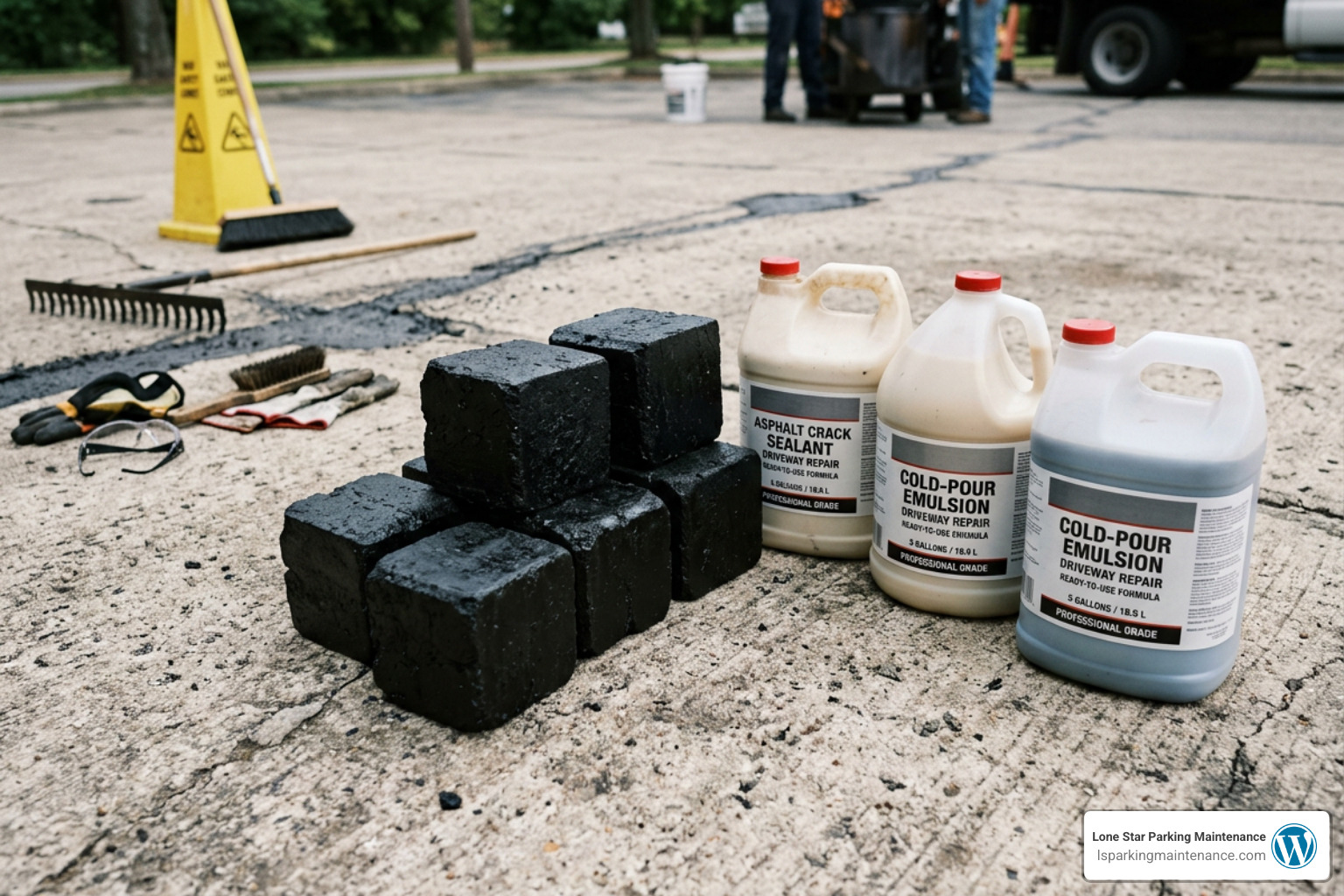
Let’s look at the main types of treatment materials available and how they perform in real-world conditions:
1. Hot-Applied Rubberized & Modified Rubberized Asphalt
These are the heavy hitters of the pavement world. Modified rubberized asphalts contain virgin polymers and granulated tire rubber, giving them incredible flexibility and adhesion.
- Performance: When placed in routed, working cracks, rubberized asphalt sealants can provide between 5 and 9 years of service. If placed overbanded in routed cracks, they provide the most cost-effective long-term (5 to 8 years) crack sealing.
- DFW Advantage: They stand up beautifully to the intense North Texas heat without tracking (sticking to car tires) and remain flexible during our sudden winter cold snaps. A premium example is CR-90 Crack Filler: Fast-Curing, Hot-Applied Sealant for Asphalt & Concrete (ASTM D5078) – W. R. Meadows, which meets rigorous TxDOT standards and can be opened to traffic in under 30 minutes.
2. Fiber-Modified Asphalt
By mixing polypropylene, polyester, or nylon fibers into asphalt cement, manufacturers create a filler with high tensile strength.
- Performance: Placed overbanded, fiber-modified asphalts are incredibly cost-effective, serving effectively for 6 to 8 years in non-working cracks.
3. Asphalt Emulsions and Asphalt Cements
These are cold-pour or low-temperature materials often used for quick, budget-friendly repairs.
- Performance: Emulsion and asphalt cement materials placed flush in unrouted, non-working cracks perform satisfactorily for 2 to 4 years. They are easy to apply but lack the long-term elasticity of rubberized options.
- Concrete Alternative: For concrete surfaces, products like the polymer-modified Data Sheet-UNIQUE Pourable Concrete Crack Filler (203.155) 10-2024 offer excellent cold-weather flexibility and seal out water without requiring specialized heating kettles.
4. Self-Leveling Silicone & Polyurea
Used primarily in concrete pavements and high-traffic joints. Self-leveling silicone placed recessed in routed or sawn working cracks can perform satisfactorily for at least 4 to 6 years. Polyurea cures incredibly fast (often in under 10 minutes) and is ideal for industrial environments.
Evaluating Cost-Effectiveness and Service Life
When planning a project, it is tempting to look only at the upfront material cost. However, a true evaluation relies on analyzing the service life and the 75% effectiveness threshold (the point at which 25% of the treated crack length has failed).
In a massive multi-climate field study monitored over several years, researchers found that of 61 treatments evaluated, 32 had failed after 6.5 years of monitoring. The study revealed some fascinating data:
- The standard recessed Band-Aid method showed the longest estimated service life of 42 months at 75% effectiveness across all test sites.
- The primary failure modes were adhesion loss (the sealant peeling away from the crack wall) and cohesion loss (the sealant tearing down the middle).
To make your repairs last, we always recommend following don’t let cracks win with these asphalt patching and sealing best practices.
From a contractor’s business perspective, crack repairs are highly profitable. A standard box of hot-pour crack filler covers approximately 200 linear feet. With average contractor pricing at around $1 per linear foot, a single box can generate $170 to $180 in profit. Investing in high-quality rubber- or fiber-modified asphalt fillers ensures you get a 6 to 8-year service life, maximizing the return on every dollar spent.
Step-by-Step Guide to Professional Crack Preparation and Application
Ask any pavement professional, and they will tell you the same thing: 90% of crack treatment failures are caused by poor preparation. If you apply the world’s best sealant over dirt, weeds, or moisture, it will peel right off.
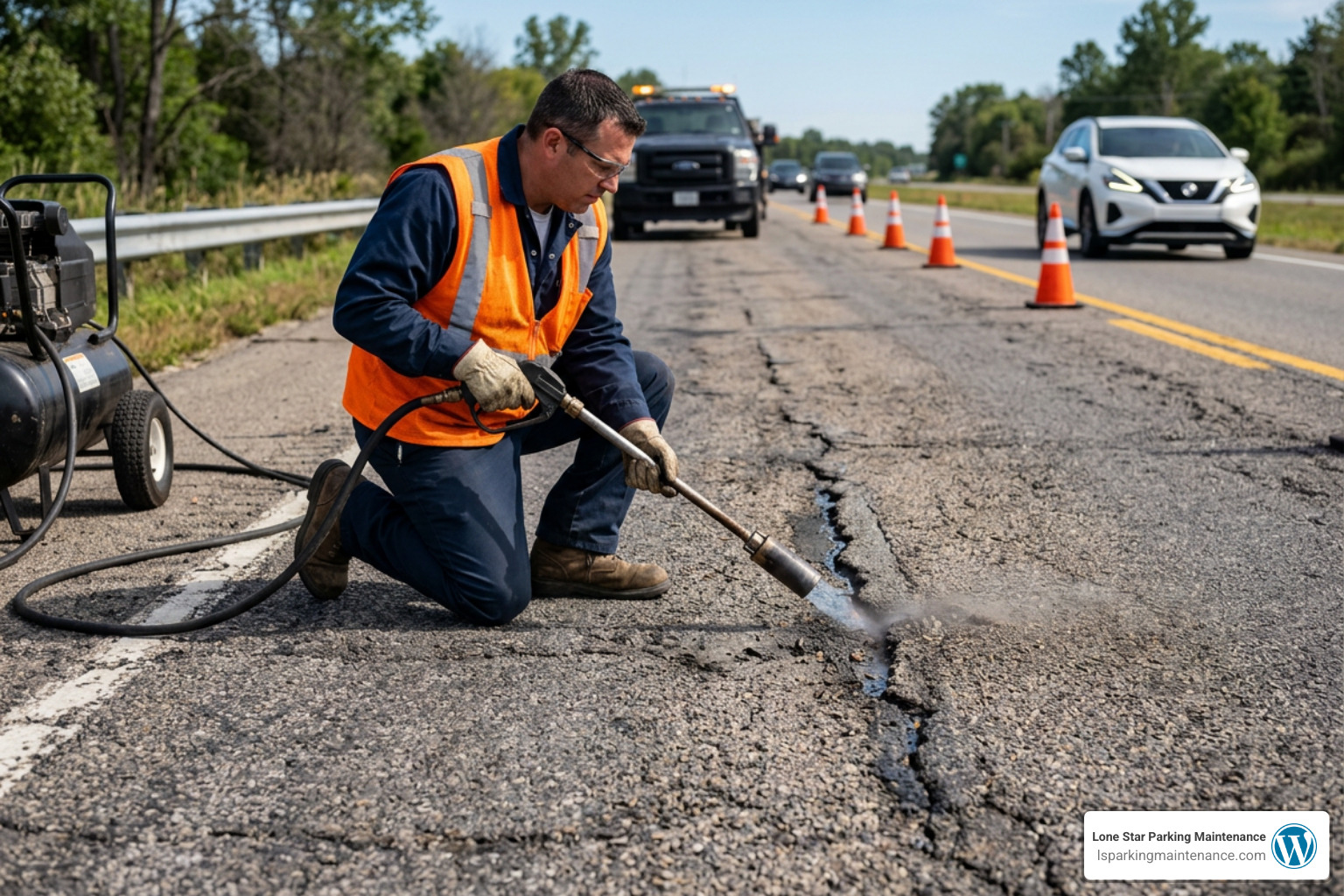
Here is how to execute a professional-grade repair, aligning with the industry-standard Manual of Practice.
Step 1: Routing (Optional but Recommended for Sealing)
For working cracks, use a rotary router to cut a clean reservoir. The reservoir should be at least 1/2 inch wide and 1/2 inch deep, maintaining a 1:1 width-to-depth ratio. This creates clean, vertical edges for the sealant to bond to and provides enough material volume to stretch as the pavement moves.
Step 2: Thorough Cleaning
Remove all dirt, loose asphalt, dust, and vegetation. You can use a wire brush or a high-pressure air compressor. For professional results, we use a hot air lance. This tool uses compressed air and propane heat to blast away debris while simultaneously drying the crack.
Step 3: Drying
The crack must be bone-dry. If there is any moisture present, the hot sealant will boil the water, creating steam bubbles that destroy the adhesive bond.
Step 4: Depth Limitation (Backer Rod or Sand Fill)
If a crack is deeper than 1 inch, do not fill the entire depth with expensive sealant—it will simply sink and migrate downward. Place a heat-resistant backer rod (like CERA-ROD) or clean sand into the crack until it reaches 1/2 inch from the surface.
Step 5: Material Application and Finishing
Apply your material using one of these four configurations:
- Flush Fill: The material is placed directly in the crack and squeegeed flush with the pavement surface.
- Reservoir: The sealant is placed inside a routed reservoir, slightly recessed (1/8 inch) below the surface to protect it from snowplows and heavy traffic.
- Overband (Band-Aid): The material is applied into the crack and squeegeed over the top, creating a thin, flat band (approximately 3 to 4 inches wide) centered over the crack.
- Recessed Band-Aid: A combination where the sealant is placed in a routed reservoir and squeegeed to form a slight overband flush with the surface.
If you are ready to tackle a project, check out how to repair asphalt cracks in 5 easy steps and the ultimate guide to filling every crack in your driveway for detailed, step-by-step DIY instructions.
Essential Equipment for Asphalt Crack Filling
To get professional results, you need the right tools for the job. Depending on the size of your property, your equipment needs will vary:
- Melter-Applicators: These are oil-jacketed kettles designed to melt hot rubberized crack filler safely. They prevent localized overheating (which ruins the polymers) by using a double-wall design filled with heat-transfer oil. They feature built-in agitation sweeps and digital thermometers to keep the material at the exact recommended temperature.
- Push Melters (2-in-1 Machines): Perfect for parking lots, these walk-behind machines melt the block of rubber and apply it through a rear squeegee shoe as you walk.
- Pour Pots: Handheld pots used to carry heated material from a stationary melter to the cracks.
- Safety Gear: Working with hot-applied materials heated up to 380°F requires serious personal protective equipment (PPE), including heavy-duty leather gloves, long-sleeved shirts, safety glasses, face shields, and NIOSH-approved vapor respirators.
Best Practices for Hot and Cold Crack Filling
To ensure your crack repairs survive the test of time, keep these best practices in mind:
- Temperature Control: For hot-applied materials like CR-90, maintain a pouring temperature of around 380°F. Never exceed the maximum safe heating temperature (usually 400°F), or you will degrade the rubber polymers into a useless, sticky soup. Limit kettle retention time to 15 hours maximum.
- Curing and Traffic Readiness: Hot-pour sealants typically cool and cure within 30 minutes in cooler temperatures, though they may take 45+ minutes in hot climates. Cold-pour emulsions can take 2 to 4 hours to cure before they can support traffic without tracking.
- Seasonal Timing: Perform crack treatments when the pavement is at its midpoint temperature—typically in the spring or fall (ambient temperatures between 45°F and 65°F). This ensures the cracks are neither fully open (winter) nor fully closed (summer), allowing the sealant to cure in a neutral state.
Frequently Asked Questions about Crack Repair
What is the difference between hot-pour and cold-pour crack fillers?
Hot-pour rubberized fillers are solid blocks of rubber-modified asphalt that must be melted in a kettle at high temperatures. They offer incredible durability (5 to 9 years of service life) and rapid curing times (under 30 minutes). Cold-pour emulsion fillers are liquid asphalt mixtures applied straight from a jug. They are highly convenient, require no specialized heating equipment, and are great for DIY projects, but they lack the elasticity of hot-pour materials and typically last only 2 to 4 years.
When is the best time of year to perform crack repairs?
The best times of year are spring and fall. During these seasons, temperatures are moderate, and cracks are at their midpoint width. If you fill cracks in the dead of summer when the asphalt is expanded, the cracks will open up in the winter, stretching the sealant beyond its limit and causing adhesion failure. If you fill them in the winter, the sealant may not bond properly due to cold pavement temperatures and hidden moisture.
How do I know if my pavement needs crack sealing or a full overlay?
It all comes down to crack density and pavement condition. If you have isolated transverse or longitudinal cracks with stable edges, crack sealing or crack filling is the perfect preventative maintenance choice. However, if your parking lot is covered in widespread alligator cracking (closely spaced, interlocking cracks resembling reptile skin), this indicates a structural base failure. At this stage, sealants cannot save the pavement, and you will need asphalt patching, a full overlay, or total reconstruction.
Conclusion
At the end of the day, neglecting cracks is the fastest way to destroy your pavement investment. Water is asphalt’s worst enemy, and crack repairs are your absolute first line of defense. By taking action early, you can easily double the lifespan of your parking lot or driveway while avoiding the massive costs of repaving.
If you want to ensure the job is done perfectly to industry standards using top-quality materials, let us handle the hard work. At Lone Star Parking Maintenance, we serve the entire DFW Metroplex with professional pavement preservation services tailored to the unique Texas climate.
Ready to secure your property? Explore our professional parking lot sealing and crack filling services, get expert tips on finding the best asphalt crack repair service for your property, or connect directly with our team of Texas asphalt crack repair experts today to get your free project assessment!