
Why Parking Bumpers for Medical Centers Demand More Than a Standard Approach
Choosing the right parking bumpers for medical centers is one of the most overlooked safety decisions a property manager can make — and one of the most consequential.
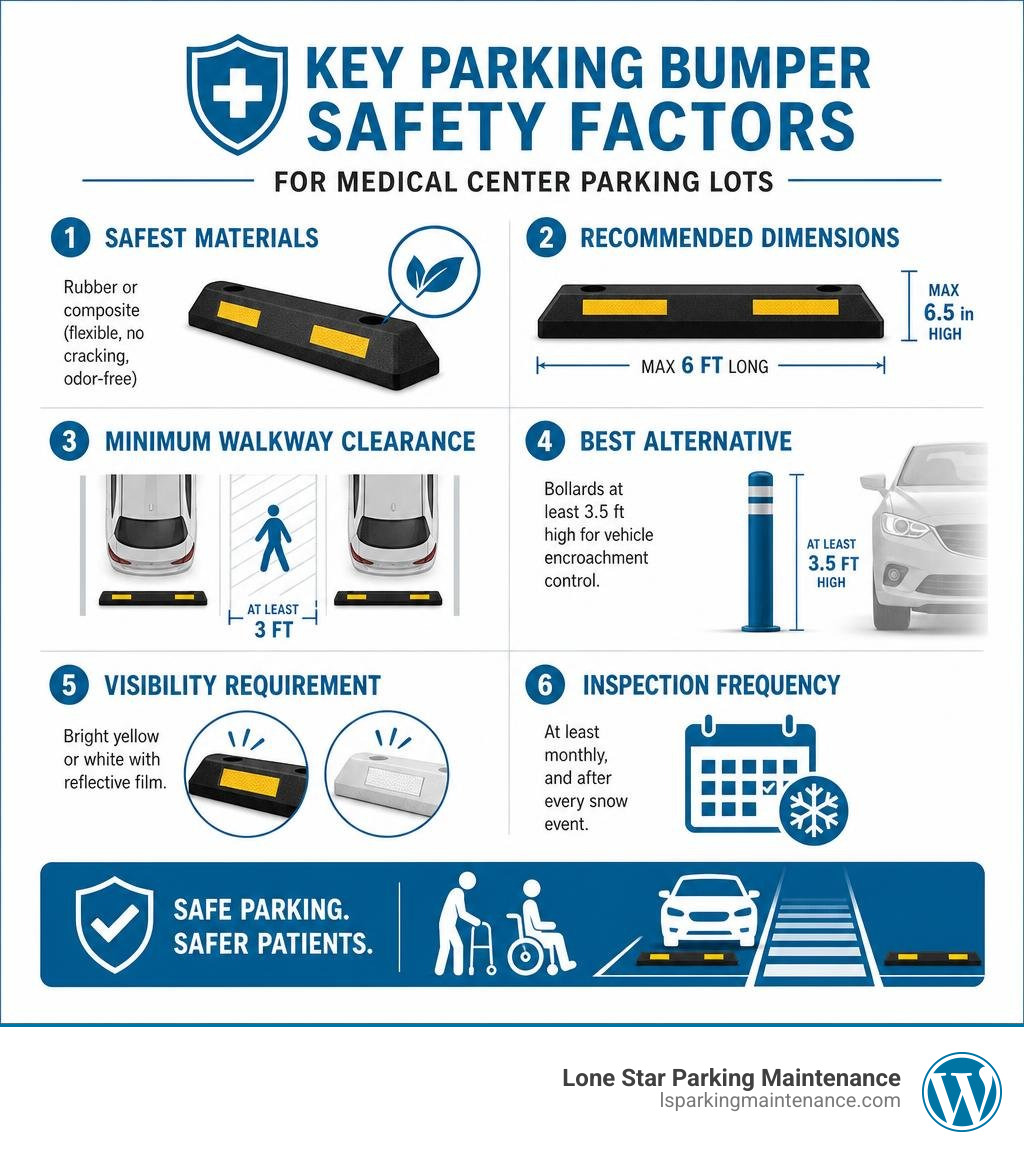
Here’s a quick-reference guide to the most important considerations:
Best parking bumpers for medical centers — at a glance:
| Priority | What to Know |
|---|---|
| Safest materials | Rubber or composite (flexible, no cracking, odor-free) |
| Recommended dimensions | Max 6 ft long, max 6.5 in high |
| Minimum walkway clearance | At least 3 ft between bumpers |
| Best alternative | Bollards at least 3.5 ft high for vehicle encroachment control |
| Visibility requirement | Bright yellow or white with reflective film |
| Inspection frequency | At least monthly, and after every snow event |
Medical center parking lots are not like a typical retail strip mall. Your visitors are often elderly, injured, post-surgery, or using mobility aids. Falls are already the leading cause of injury in older adults, according to the CDC — and a misaligned or poorly marked wheel stop in your lot can turn an ordinary parking visit into a serious premises liability lawsuit.
The stakes are high. And the details matter.
Safety Hazards and Premises Liability of Parking Bumpers for Medical Centers
When we look at a parking lot, we see an organized system of spaces. But to a patient with limited mobility, a poorly placed wheel stop is a physical hurdle. Wheel stops have consistently been identified as major pedestrian tripping hazards for decades. In a medical setting, where visitors are frequently distracted, stressed, or physically impaired, these hazards multiply.
The Tripping Hazard Reality
A standard concrete block sitting in a parking stall might seem harmless, but if it is misaligned, cracked, or blends too seamlessly into the asphalt, it becomes an invisible trap. Pedestrians walking between cars often fail to look down at their feet, especially when navigating a busy medical campus. For an older adult, a trip over a parking bumper can result in severe, life-altering injuries. Because falls are the leading cause of injury in older adults, medical facilities have a heightened duty of care to ensure their pathways are completely free of unexpected obstructions.
Premises Liability and Negligence in Texas
Under Texas premises liability law, medical centers are classified as business operators, and patients are considered “invitees.” This means healthcare facilities owe the highest duty of care to their visitors. To protect your facility from claims of negligence, you must maintain the premises in a reasonably safe condition, routinely inspect for hazards, and either fix or adequately warn visitors of any dangerous conditions.
If a patient trips over an improperly installed, unpainted, or broken parking bumper, the medical center can be held legally liable for the resulting medical bills, pain, suffering, and rehabilitation costs. Texas operates under a modified comparative fault rule (often called the 51% bar). This means that if a court finds the pedestrian was partially at fault for not watching where they were walking, their compensation may be reduced. However, if the medical facility is found to be 51% or more at fault due to poor maintenance, missing paint, or non-compliant spacing, the financial consequences can be devastating.
Undercarriage and Vehicle Damage
It is not just pedestrians who suffer from poorly chosen wheel stops. Low-clearance vehicles frequently scrape their front bumpers or undercarriages on parking blocks that exceed standard heights. When a bumper is too high, drivers misjudge the distance, leading to costly insurance claims for vehicle damage.
To prevent these hazards and maintain a legally compliant, hazard-free environment, it is vital to understand how physical barriers interact with accessible pathways. For more details on keeping your lot accessible, check out our handicap parking compliance guide.
Best Practices for Installing Parking Bumpers in Healthcare Facilities
To minimize safety risks and protect your facility from liability, we must adhere to strict installation standards. Proper installation is a science that balances vehicle control with pedestrian safety.

Essential Installation Standards
When installing parking bumpers for medical centers, we follow several industry-standard rules of thumb to prevent trip-and-fall injuries:
- Limit Wheel Stop Length: Keep wheel stops to a maximum length of 6 feet. This prevents them from extending too far into the walking space between parking stalls.
- Limit Wheel Stop Height: Keep the height to a maximum of 6.5 inches (ideally around 4 inches for modern low-clearance vehicles) to reduce undercarriage scraping and tripping severity.
- Walkway Clearance: Ensure there is an adequate, unobstructed walkway of at least 3 feet between wheel stops. This allows pedestrians, strollers, and wheelchair users to navigate between parked cars without stepping over physical blocks.
- Avoid Pedestrian Paths: Never place a wheel stop directly on a sidewalk, crosswalk, or any foreseeable pedestrian path.
ADA Compliance and Accessible Routes
The Americans with Disabilities Act (ADA) requires that accessible routes remain entirely free of physical obstacles. If a parked vehicle overshoots a parking space and hangs over a sidewalk, it can reduce the sidewalk’s clear width to less than the required 36 inches. While wheel stops can prevent this encroachment, they must be positioned so that they do not block the access aisles or the accessible pathway itself.
Choosing the Right Material
Choosing the right material for your parking blocks affects long-term durability, installation costs, and pedestrian safety.
| Feature | Precast Concrete | Recycled Rubber | Plastic-Rubber Composite |
|---|---|---|---|
| Durability | High, but prone to cracking and chipping over time | Excellent; resists cracking, UV rays, and oil | Outstanding; combines flexibility with plastic toughness |
| Installation | Requires heavy machinery/forklifts due to weight | Lightweight; easily installed by a small crew | Lightweight; features integrated handles for easy carrying |
| Surface Fit | Best restricted to perfectly flat surfaces | Flexes to accommodate uneven asphalt or concrete | Highly adaptable to minor surface variations |
| Chemical Resistance | Low; can degrade from salt, oil, and water | High | Extremely high; impervious to gas, oil, and automotive fluids |
| Odors | Odorless | Can have a strong rubber smell (not ideal indoors) | Treated to eliminate toxic rubber odors (perfect for indoor garages) |
For a deeper dive into how to position these blocks safely across your entire property, read our guide to safe wheel stop placement.
Designing High-Visibility Parking Bumpers for Medical Centers
In a medical facility, parking lots are active 24/7. Patients arrive before dawn for early surgeries, and visitors leave late at night. This makes high visibility a top priority.
Contrast Painting and Reflective Films
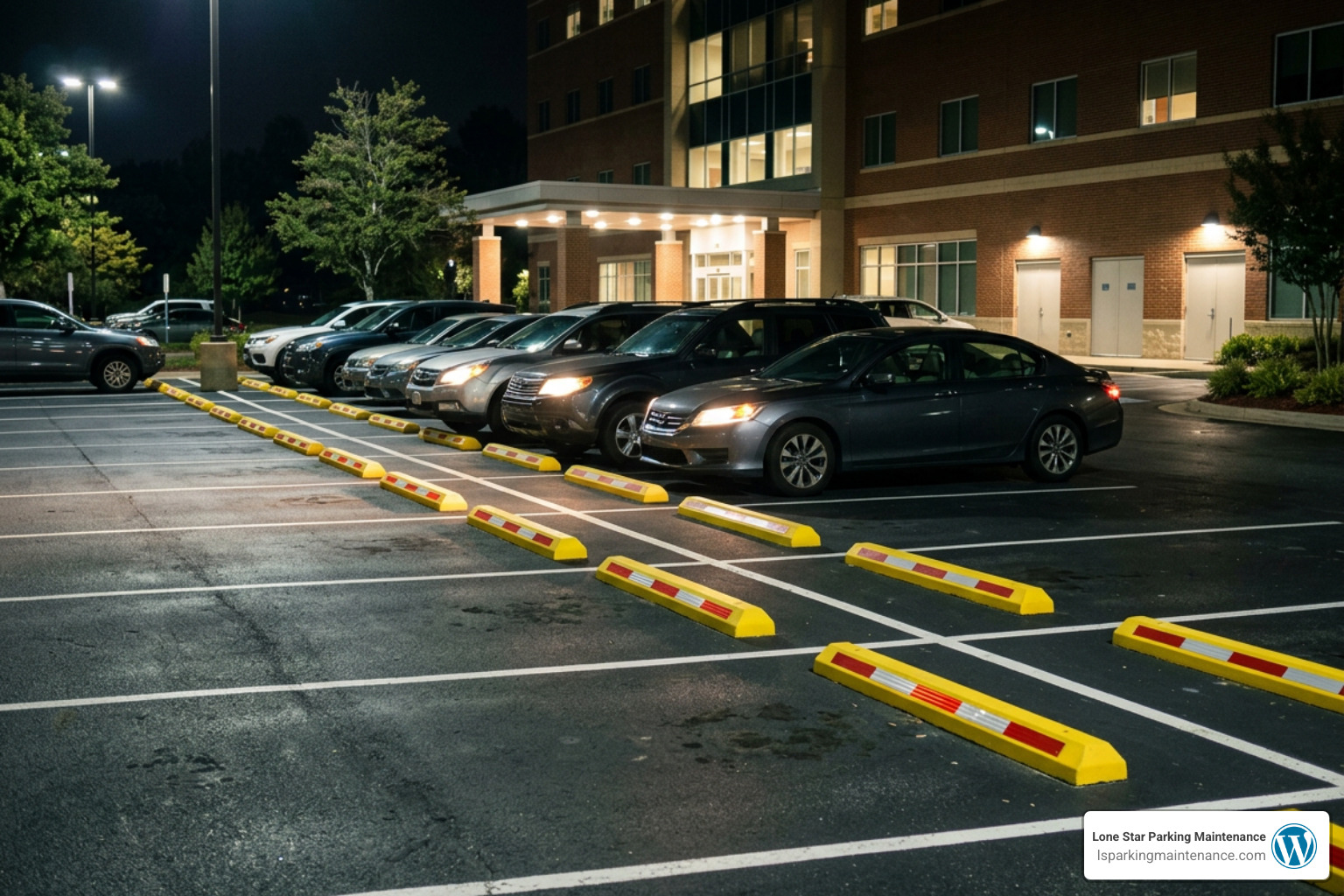
Standard grey concrete blends into asphalt, especially during rainy Texas nights. To make parking blocks stand out, they must be painted in highly contrasting colors. Bright safety yellow or brilliant white are the industry standards.
However, paint alone can fade or chip under the hot Texas sun. To ensure long-lasting visibility, we highly recommend utilizing parking bumpers equipped with bright yellow thermoplastic reflective road marking films. These films are embedded directly into the bumper’s surface, reflecting headlight beams back to drivers and offering clear visibility in low-light and adverse weather conditions. For high-performance options, you can explore these high-visibility composite parking bumpers.
Balancing Pedestrian Safety and Vehicle Control
The primary purpose of a wheel stop is to keep vehicles from encroaching on sidewalks, landscaping, or storefronts. But how do we achieve this without turning our parking lot into an obstacle course for patients?
The key is strategic placement. A wheel stop should only be used when there is a critical need to protect a physical structure or maintain a clear pedestrian path. If a sidewalk is wide enough (e.g., 6 feet or more), a vehicle hanging over the edge by 18 inches will not block wheelchair access. In these cases, you may not need wheel stops at all.
However, if your sidewalks are narrow, or if a parking space faces a glass entryway, physical barriers are essential. The goal is to place the wheel stop far enough back in the stall so that the vehicle’s tires hit the block before the front bumper can strike the sidewalk or building, while still ensuring the block is covered completely by the car when the stall is occupied. This eliminates hidden tripping hazards for people walking between parked vehicles. Learn more about the mechanics of vehicle containment in our wheel stoppers 101 guide.
Recommended Alternatives to Traditional Wheel Stops
Because safety standards increasingly advise avoiding traditional wheel stops in pedestrian paths whenever possible, medical centers should consider modern, safer alternatives.
The Power of Bollards
When it comes to preventing vehicle encroachment onto sidewalks or protecting fragile storefronts, standard 6-inch high concrete curbs are simply not effective barriers. A distracted driver can easily roll right over a standard curb.
Instead, safety standards state that bollards at least 3 feet 6 inches (3′-6″) high may be centered at the heads of parking stalls as an alternative to wheel stops. Because bollards stand at eye level, they are highly visible to both drivers and pedestrians, completely eliminating the tripping hazard associated with low-lying concrete blocks.
Flexible TPU Bollards for Shared Zones
In high-traffic shared zones — such as patient drop-off areas, ambulance bays, and accessible parking zones — flexible Thermoplastic Polyurethane (TPU) bollards are an outstanding choice.
Unlike rigid steel bollards, which can cause severe damage to vehicles and require expensive foundation repairs after a minor collision, flexible TPU bollards flex on contact and return to their upright position. High-quality options, like the shared zone impact bollards, are rated for public car park resilience and can withstand repeated vehicle impacts, keeping your shared spaces safe and compliant with modern accessibility standards.
Selecting Alternative Parking Bumpers for Medical Centers
If your facility layout requires the use of parking blocks rather than bollards, moving away from traditional, heavy concrete is a smart operational move.
Modern composite and rubber wheel stops offer several advantages for medical environments:
- Impact Absorption: Flexible rubber and composite materials absorb impacts, reducing the risk of vehicle damage and preventing the block from shifting or tearing out of the pavement.
- No Toxic Odors: High-quality composite blocks undergo specialized treatment to eliminate the harsh chemical smell of recycled rubber, making them safe and pleasant for enclosed indoor parking garages.
- Bariatric and Heavy-Vehicle Zones: For areas serving bariatric transport vehicles or delivery trucks, heavy-duty composite stops provide the durability of concrete without the risk of cracking, chipping, or fading.
To compare these modern materials with traditional precast options, read our article on precast concrete wheel stoppers.
Maintenance, Inspections, and Parking Guidance Systems
Even the best parking lot infrastructure will fail without a proactive maintenance and technology plan. In the DFW Metroplex, our intense summer heat and occasional freezing winter weather can take a toll on physical parking assets.
Routine Inspection Protocols
Wheel stops should be routinely inspected — at least monthly and immediately after snow or severe weather events — to look for any signs of corrosion, cracking, misalignment, and other deterioration.
During these inspections, look for:
- Loose Anchors: Over time, repeated vehicle impacts can loosen the metal pins or epoxy securing the block. If a wheel stop is epoxied directly to the parking lot, being knocked loose can pull up chunks of the asphalt or concrete surface.
- Pavement Damage: Mechanically anchored wheel stops can damage the surrounding pavement upon impact, creating water penetration paths that lead to potholes, cracks, and further tripping hazards.
- Snow Plow Damage: Winter snow plowing operations frequently strike and misalign wheel stops, turning them into unexpected diagonal hazards in your driving lanes.
Smart Parking Guidance and Clear Signage
Integrating technology into your parking facility can drastically reduce the stress of patient arrivals while improving safety. Real-time parking guidance systems utilize wireless sensors to track occupied spaces and display availability on digital boards at your garage entrances. This prevents drivers from circling endlessly, reducing distracted driving and minimizing the risk of parking lot collisions.
Additionally, highly visible, reflective signage is crucial for designating visitor, patient, and disabled parking zones. Utilizing MUTCD-compliant, durable signs — such as eco-friendly hospital parking signs made from recycled aluminum with Engineer Grade Prismatic reflective sheeting — ensures your lot remains organized, easy to navigate, and safe 24/7.
To keep your entire parking surface in top shape, explore our comprehensive guide on concrete and asphalt maintenance.
Frequently Asked Questions about Medical Center Parking Bumpers
Are standard 6-inch concrete curbs effective vehicle barriers?
No. Standard 6-inch concrete curbs are not effective vehicle barriers. A vehicle can easily mount a standard curb, especially at low speeds. To prevent vehicles from encroaching onto sidewalks, pedestrian plazas, or crashing into buildings, you should install heavy-duty bollards that stand at least 3.5 feet high.
How often should medical centers inspect their parking bumpers?
Medical centers should inspect their parking bumpers at least once a month and immediately following any major weather events (such as winter freezes or snow plowing operations). Regular checks help identify loose anchors, cracked blocks, or faded paint before they lead to a pedestrian trip-and-fall incident.
What are the ADA requirements for wheel stops in accessible spaces?
Under the ADA, wheel stops must be positioned so they do not obstruct the required clear width of accessible routes (which must be at least 36 inches wide). If a wheel stop is placed in an accessible parking space, it must be installed so that the parked vehicle’s bumper does not overhang and narrow the adjacent sidewalk or access aisle. For a complete breakdown of ADA layout rules, read our guide on mastering ADA compliance for parking lots.
Conclusion
Selecting and maintaining the right parking bumpers for medical centers is a critical component of healthcare facility management. By prioritizing high-visibility materials, ensuring compliant installation spacing, and conducting routine monthly inspections, you can protect your patients from painful injuries and protect your organization from costly premises liability claims.
At Lone Star Parking Maintenance, we specialize in keeping parking lots and garages across the DFW Metroplex safe, clean, and fully compliant with all local and federal regulations. From high-quality thermoplastic striping and reflective signage to professional concrete repairs and durable wheel stop installations, we are committed to delivering top-quality materials and unparalleled customer satisfaction.
Ready to upgrade your medical center’s parking safety? Contact us today to learn more about our protective pole covers and curb stop installation services.