
What Does Asphalt Parking Lot Resurfacing Actually Cost in 2026?
The asphalt parking lot resurfacing cost in 2026 typically falls between $1 and $7 per square foot, depending on lot size, pavement condition, and local market rates in your area.
Here’s a quick snapshot to help you budget:
| Lot Size | Typical Cost Range | Notes |
|---|---|---|
| Small (under 10,000 sq ft) | $5 – $7 per sq ft | Higher unit cost due to mobilization |
| Mid-size (10,000 – 50,000 sq ft) | $3 – $5 per sq ft | Most common commercial range |
| Large (50,000+ sq ft) | $1 – $3 per sq ft | Economies of scale kick in |
| 10,000 sq ft lot (example) | $10,000 – $45,000 total | Varies by prep work needed |
For most DFW commercial properties, plan for $2.50 to $4.50 per square foot as a realistic baseline before factoring in extras like drainage repairs or ADA updates.
If your parking lot is showing cracks, fading stripes, rough patches, or pooling water, you’re probably already wondering whether it’s time to resurface — and what that’s going to cost. It’s a fair question, and the honest answer is: it depends on more variables than most contractors will tell you upfront.
A property manager recently received three quotes for the same 10,000 square foot lot that ranged from $35,000 to $72,000. Same lot. Same basic scope. The gap came down to how each contractor assessed site conditions, prep requirements, and overlay thickness. That kind of spread can catch any property owner off guard.
This guide breaks down exactly what drives those numbers — so you can budget accurately, spot low-ball bids, and get real value from your resurfacing investment.
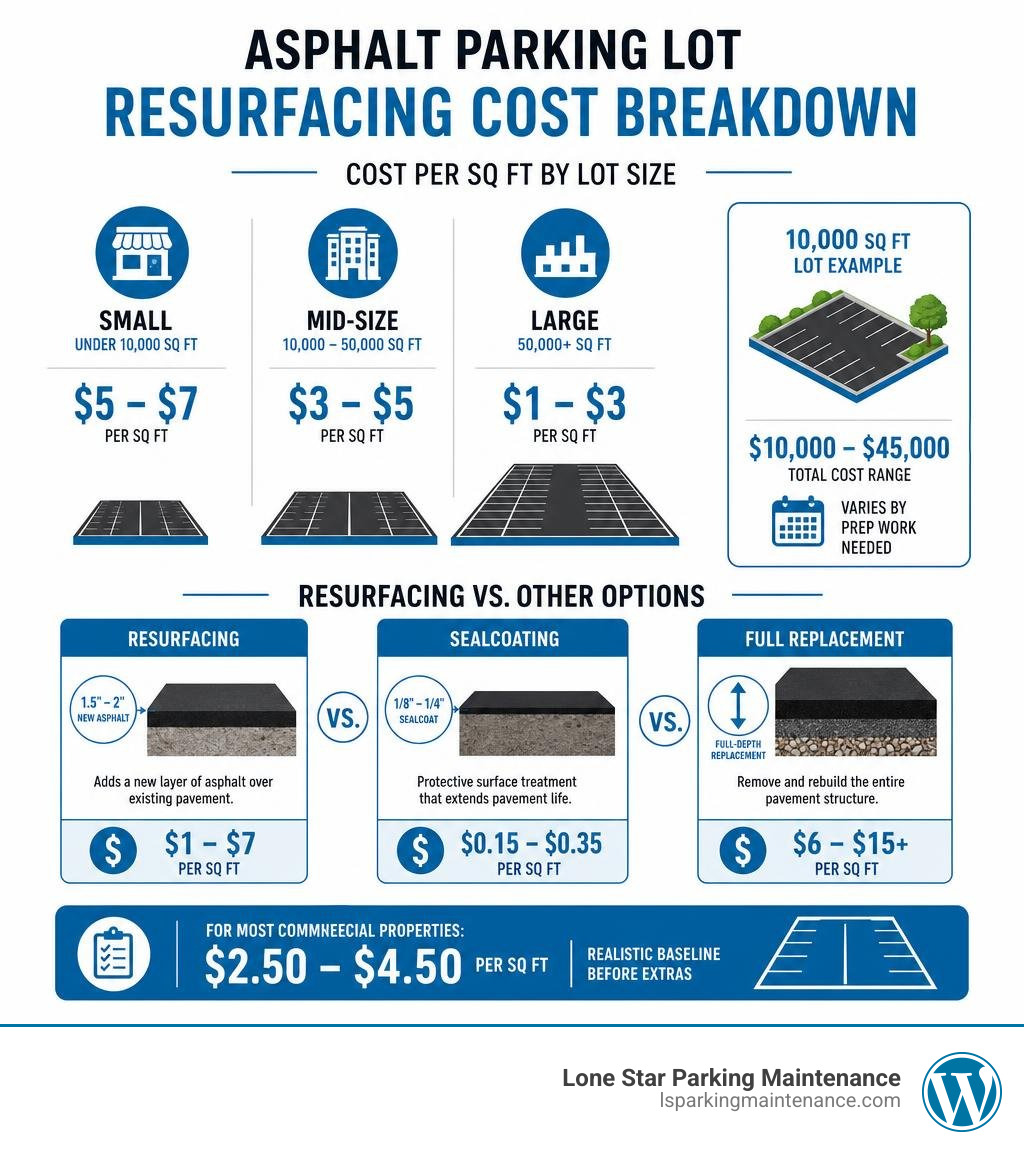
Asphalt parking lot resurfacing cost terms simplified:
What is the Average Asphalt Parking Lot Resurfacing Cost in 2026?
When planning a commercial property upgrade in 2026, understanding national and local pricing averages is the first step toward building an accurate budget. Across the industry, the average asphalt parking lot resurfacing cost ranges from $2.50 to $4.50 per square foot for standard commercial projects.
According to National cost benchmarks, this pricing typically covers the key phases of a standard resurfacing project: cleaning the surface, milling down the top layer of deteriorated asphalt, patching minor structural areas, applying a tack coat adhesive, laying down a fresh 1.5- to 2-inch asphalt overlay, and restriping the parking stalls.
However, a raw square-foot number only tells part of the story. In our experience working throughout the DFW Metroplex, we find that proper budget planning requires looking at the total lifecycle cost of your pavement. In The Ultimate Guide to Resurfacing Asphalt Parking Lots, we outline how resurfacing (often called a mill-and-overlay) acts as a powerful middle ground. It delivers a brand-new driving surface and adds 8 to 15 years of service life without requiring you to pay for a full subgrade reconstruction.
To put these numbers into context, let’s look at how resurfacing stacks up against other common pavement management strategies:
| Service Type | Average Cost Per Sq. Ft. (2026) | Expected Lifespan | Primary Purpose |
|---|---|---|---|
| Asphalt Sealcoating | $0.25 – $0.75 | 2 – 4 Years | Preventative maintenance, UV protection, and aesthetic refresh |
| Asphalt Resurfacing (Overlay) | $2.50 – $4.50 | 8 – 15 Years | Restoring structural integrity to worn but stable pavement |
| Full-Depth Replacement | $4.00 – $10.00 | 15 – 25 Years | Complete excavation and rebuild due to base failure |
As you can see, resurfacing delivers a 40% to 60% cost savings compared to a full-depth replacement. This makes it an incredibly attractive option for property owners who want to maximize their capital improvement budgets while completely reviving their property’s curb appeal.
Breaking Down Resurfacing Costs by Parking Lot Size
The physical footprint of your property is one of the most powerful drivers of your overall estimate. Paving is a heavy-equipment-intensive industry, which means the logistics of moving machinery to your site play a massive role in how contractors calculate their bids.

How Lot Size Influences Your Asphalt Parking Lot Resurfacing Cost
It all comes down to a fundamental economic principle: economies of scale.
For small parking lots (typically under 10,000 square feet, such as small retail strips, fast-food restaurants, or stand-alone offices), unit pricing is almost always higher. Contractors must factor in fixed mobilization costs. Moving massive milling machines, asphalt pavers, and heavy rollers to a job site requires specialized transport permits, fuel, and crew travel time. Whether a crew paves 2,000 square feet or 20,000 square feet, those mobilization costs remain relatively constant.
Consequently, resurfacing a small parking lot often costs $5 to $7 per square foot. Many commercial paving companies also enforce minimum project charges (typically ranging from $2,500 to $5,000) to cover these baseline operational expenses.
Conversely, once a project exceeds 10,000 square feet, the price per square foot drops dramatically. The crew can work continuously without stopping to reload equipment, allowing them to maximize daily material yields. For very large commercial lots, the price can fall to $1 to $3 per square foot.
Cost Expectations for Mid-Size and Large Commercial Lots
To help you visualize how these economies of scale translate to real-world budgets, let’s look at typical size brackets for commercial properties:
- Mid-Size Lots (10,000 to 50,000 sq. ft.): This bracket represents the vast majority of neighborhood retail centers, medical offices, and corporate office parks in the DFW area. Resurfacing costs in this range typically sit between $3 and $5 per square foot. A standard 30,000-square-foot lot (which accommodates roughly 100 parked cars) will generally cost between $75,000 and $120,000 depending on the prep work required.
- Large Commercial Lots (50,000+ sq. ft.): These are major shopping malls, large industrial parks, warehouse distribution centers, and regional hospitals. Because of the sheer volume of materials used, contractors can negotiate steep discounts at local asphalt plants. This drops the average asphalt parking lot resurfacing cost to $1 to $3 per square foot. A 60,000-square-foot lot (holding about 200 cars) can often be resurfaced for $120,000 to $180,000.
Additionally, large-scale projects allow for strategic phasing. Instead of closing your entire business, we can complete the project in sections over 2 to 3 days, minimizing disruption to your customers and tenants.
Key Factors That Influence Your Resurfacing Estimate
If you have ever wondered why two seemingly identical parking lots across the street from one another can receive wildly different paving bids, the secret lies in site-specific variables.
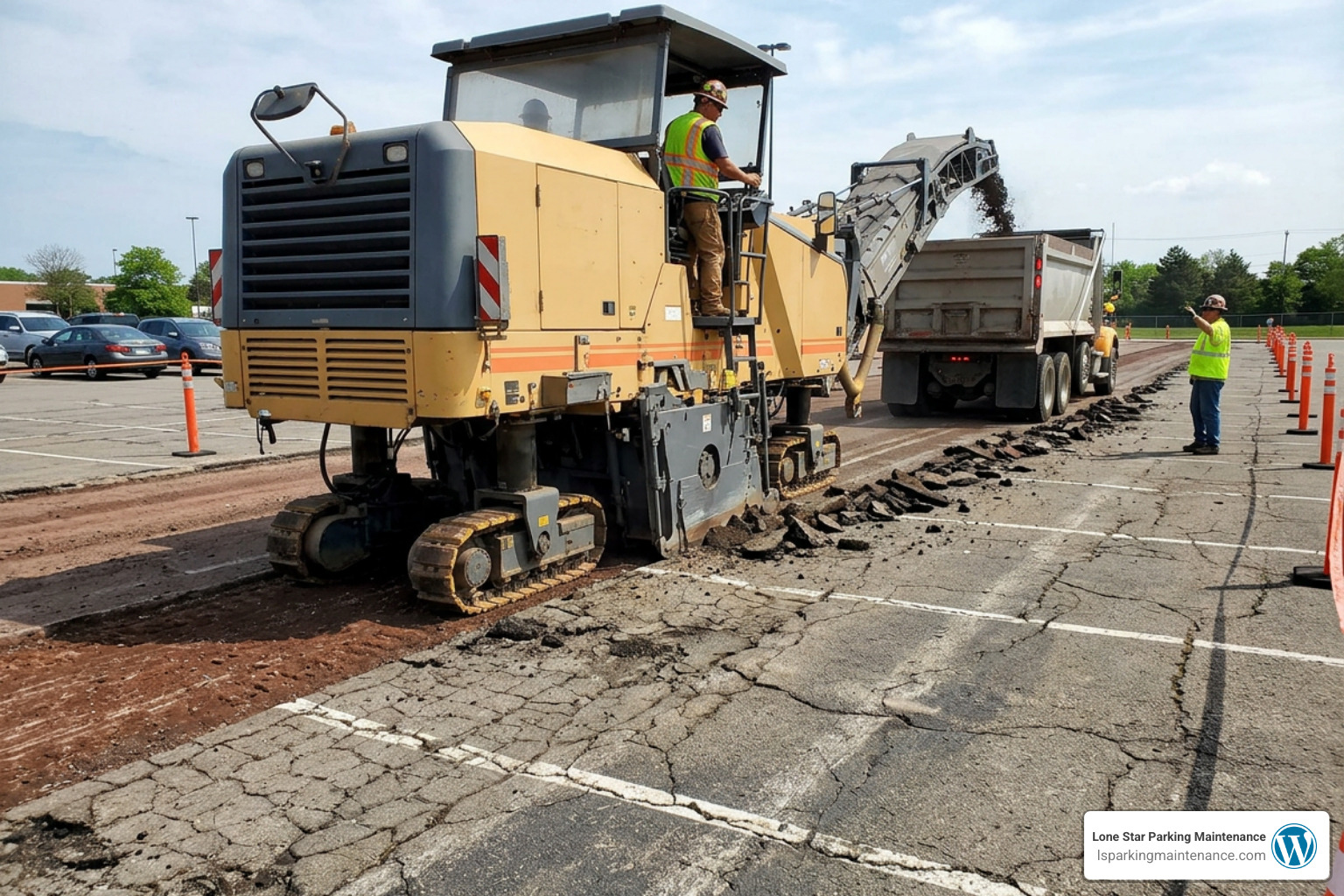
According to regional Texas cost reports, local material pricing, municipal regulations, and structural base integrity are highly variable across the Lone Star State. When we draft an estimate for a client, we look closely at the technical nuances of the lot. You can read more about these structural dynamics in our guide, Everything You Need to Know About DFW Asphalt Overlays.
Here are the primary factors that dictate your final quote:
- Overlay Thickness: The standard overlay depth for commercial parking lots is 1.5 to 2 inches. However, if your lot experiences heavy truck traffic (such as delivery bays or garbage truck routes), we may recommend a thicker 3-inch overlay. Every additional inch of asphalt typically adds $0.50 to $1.00 per square foot to your estimate.
- Site Accessibility and Complexity: A wide-open, rectangular warehouse lot is incredibly easy to pave. A complex retail lot with tight drive-thrus, multiple islands, decorative concrete medians, and heavy utility access points requires extensive hand-work and precision milling. This added labor complexity increases the overall cost.
- Asphalt Binder Volatility: Asphalt is a petroleum-based product. Fluctuations in crude oil prices directly impact the wholesale cost of hot-mix asphalt at the plant, which can cause regional paving quotes to shift throughout the year.
How Existing Damage Affects the Total Asphalt Parking Lot Resurfacing Cost
You cannot build a beautiful, long-lasting house on a crumbling foundation. The same rule applies to asphalt.
The structural integrity of your existing stone base is the single most important factor in determining your final project cost. If your lot is structurally sound but suffers from surface-level issues like fading, minor raveling, or shallow linear cracks, the prep work will be minimal.
However, if your lot has extensive structural damage, those areas must be repaired before the new overlay is applied. In our breakdown of All About Parking Lot Resurfacing, we emphasize that laying new asphalt over unaddressed structural failures is a recipe for disaster. The cracks underneath will quickly migrate upward in a process called “reflective cracking,” ruining your new surface within a year or two.
Common prep repairs that add to your total cost include:
- Alligator Cracking: Interlocking cracks that look like reptile skin indicate that water has penetrated the subgrade, causing the base to fail. These areas must be saw-cut, excavated, and patched with hot asphalt down to the base layer.
- Potholes: Deep depressions require full-depth patching to restore the load-bearing capacity of the pavement.
- Deep Linear Cracks: Cracks wider than a half-inch must be routed out, cleaned, and filled with a rubberized hot-pour crack sealant before the overlay process begins.
Hidden Costs: Permits, Drainage, and ADA Compliance
When budgeting for a parking lot upgrade, it is easy to focus solely on the asphalt itself. However, several “hidden” costs can quickly inflate your final bill if they aren’t accounted for in your contractor’s initial scope of work.
- Drainage Repairs: Standing water is asphalt’s worst enemy. If your parking lot has low spots where water pools, we must adjust the slope during the milling process or install new catch basins and concrete valley gutters. Neglecting drainage issues to save a few dollars upfront will dramatically shorten the lifespan of your new surface.
- ADA Compliance: In Texas, when you perform significant alterations to a parking facility (which includes resurfacing), you are legally required to bring your accessible parking stalls and pedestrian pathways up to current Americans with Disabilities Act (ADA) standards. This may involve regrading handicap stalls to meet strict slope requirements (no more than a 2% slope in any direction), installing new concrete ramps, and applying highly specific blue-and-white painted markings.
- Municipal Permits: Depending on your city within the DFW Metroplex, you may need to secure right-of-way, grading, or general construction permits before work can begin.
Here is a quick checklist of common hidden fees to watch out for when reviewing bids:
- Permit filing and acquisition fees
- Towing fees for vehicles left on-site after hours
- Off-hours or weekend labor surcharges (if you require night work to keep your business open)
- Concrete curb and wheel stop replacement
- Utility adjustment fees (raising manhole covers and water valves to match the new pavement height)
Resurfacing vs. Replacement vs. Sealcoating: Which is Right for You?
Choosing the right pavement management strategy is a balance between your current cash flow and the long-term return on investment (ROI) of your property.
To help you make an informed decision, we recommend evaluating your lot using a structured decision framework. You can read more about industry-wide pricing standards in this Commercial paving cost guide.
When to Choose Asphalt Resurfacing
Resurfacing is the ideal choice when your parking lot is aesthetically worn out and showing signs of age, but remains structurally sound.
Pavement engineers use a metric called the Pavement Condition Index (PCI) to grade parking lots on a scale of 0 to 100.
- PCI Score of 40 to 60: This is the “sweet spot” for resurfacing. The lot has visible surface distress, widespread hairline cracking, and minor potholes, but less than 25% to 30% of the total surface area has suffered deep subgrade failure.
- Base Stability: If the stone base underneath the asphalt is dry, compacted, and stable, milling off the top 1.5 to 2 inches of old asphalt and laying a fresh overlay is highly effective. It restores the pavement’s structural strength, improves rideability, and completely refreshes the look of your property.
If your lot only has light fading and very minor hairline cracks, you likely don’t need to resurface yet. Instead, you can save money by choosing a professional sealcoating and crack-filling program. Learn more about budgeting for this preventative service in our guide: How Much to Seal the Deal on Your Asphalt.
When Full-Depth Replacement is Unavoidable
Unfortunately, resurfacing cannot save a parking lot that has completely failed.
If your lot has a PCI score below 40, or if more than 30% of the area is covered in severe alligator cracking and deep ruts, the subgrade has lost its load-bearing capacity. Paving over a failed base is like putting a fresh coat of paint on dry-rotted wood. The underlying movement of the unstable soil will cause the new asphalt to crack and sink almost immediately.
In these scenarios, full-depth replacement is unavoidable. This process involves stripping away all the old asphalt, excavating and re-compacting the underlying stone base (or treating the subgrade soil with lime/cement stabilization), and laying down a completely new asphalt foundation. While the upfront cost is higher, it is the only way to guarantee a safe, durable surface that will last another 20 to 25 years.
To learn more about how to spot early warning signs of base failure and protect your pavement, check out 10 Reasons Why You Will Love Asphalt Repair Services.
Frequently Asked Questions About Parking Lot Resurfacing
Managing a commercial property comes with endless details. Here are clear, direct answers to the most common questions we hear from property managers and owners across the DFW Metroplex:
How long does a resurfaced asphalt parking lot typically last?
A professionally installed asphalt overlay typically lasts 8 to 15 years.
Its actual lifespan depends heavily on three factors:
- Traffic Load: Lots that handle heavy delivery trucks or constant bus traffic will naturally wear out faster than standard office parking lots.
- DFW Climate: The extreme Texas summer heat can soften asphalt binders, making the surface vulnerable to scuffing and rutting, while sudden heavy rains can exploit unsealed cracks.
- Proactive Maintenance: You can extend the life of your resurfaced lot by 5 to 10 years simply by sealing cracks annually and applying a professional sealcoat every 2 to 3 years.
What is included in a standard parking lot resurfacing project?
A comprehensive, professional resurfacing project should always include:
- Site Prep and Power Sweeping: Removing all dirt, debris, and vegetation from the pavement.
- Asphalt Milling: Shaving off 1.5 to 2 inches of the old, oxidized asphalt to maintain proper drainage slopes and prevent elevation issues at sidewalks and entryways.
- Subgrade Repairs: Excavating and patching any localized areas of alligator cracking or base failure.
- Tack Coat Application: Spraying a liquid asphalt emulsion that acts as a high-strength glue, bonding the old pavement base to the new overlay.
- Hot-Mix Asphalt Overlay: Laying down and compacting a fresh layer of commercial-grade asphalt.
- Line Striping: Restriping parking stalls, fire lanes, directional arrows, and ADA-compliant spaces to maximize parking efficiency and safety.
How can property owners get accurate and competitive paving quotes?
To ensure you are getting an apples-to-apples comparison when reviewing bids:
- Request Itemized Quotes: Make sure every contractor lists the exact square footage of the lot, the depth of the milling, the thickness of the new asphalt layer (compacted, not loose), the exact scope of subgrade repairs, and the specific brand of materials they plan to use.
- Verify Licenses and Insurance: Ensure the contractor carries comprehensive general liability and workers’ compensation insurance to protect your property from liability.
- Check Local DFW References: Ask for a list of completed commercial projects in the local area so you can inspect their work firsthand.
Conclusion
Investing in your parking lot is one of the most effective ways to protect your property’s value, ensure visitor safety, and instantly boost your curb appeal. While the asphalt parking lot resurfacing cost in 2026 represents a significant capital expense, partnering with an experienced, transparent contractor ensures you get a beautiful, long-lasting surface without paying for unnecessary repairs.
At Lone Star Parking Maintenance, we are proud to serve property owners and managers throughout the DFW Metroplex. We use only top-quality, industry-standard materials and are deeply committed to safety, clear communication, and absolute customer satisfaction. Whether you need complete resurfacing, structural repairs, or preventative care, we are here to help you protect your investment.
Ready to extend the life of your pavement and give your property a clean, professional look?
Schedule professional sealing and crack filling with our expert team today, or contact us for a detailed, transparent resurfacing estimate tailored to your property.