
Why Concrete Sealing in Garages Is More Important Than You Think
Concrete sealing in garages is one of the most cost-effective ways to protect a high-traffic surface from oil stains, water damage, road salt, and long-term cracking — but choosing the wrong product can cost you more in repairs down the road.
Quick answer: Which garage floor sealer or coating is right for you?
| Your Situation | Best Option |
|---|---|
| Want natural look, no film on surface | Penetrating sealer (e.g., silane-siloxane or lithium silicate) |
| Need maximum durability and a decorative finish | Polyurea or polyaspartic coating |
| Mid-range budget, DIY-friendly | 1-part or 2-part epoxy coating |
| Floor exposed to welding slag or heavy abrasion | Penetrating sealer (no surface film to damage) |
| Heavy road salt or de-icing chemical exposure | Penetrating sealer with salt defense technology |
Garage floors take a beating. Oil drips, hot tires, freeze-thaw cycles, and de-icing chemicals slowly break down bare concrete. Left unprotected, even a solid slab can start to pit, dust, and crack within just a few seasons.
The good news? The right sealer or coating can reduce water absorption by up to 95% and extend the life of your floor by decades.
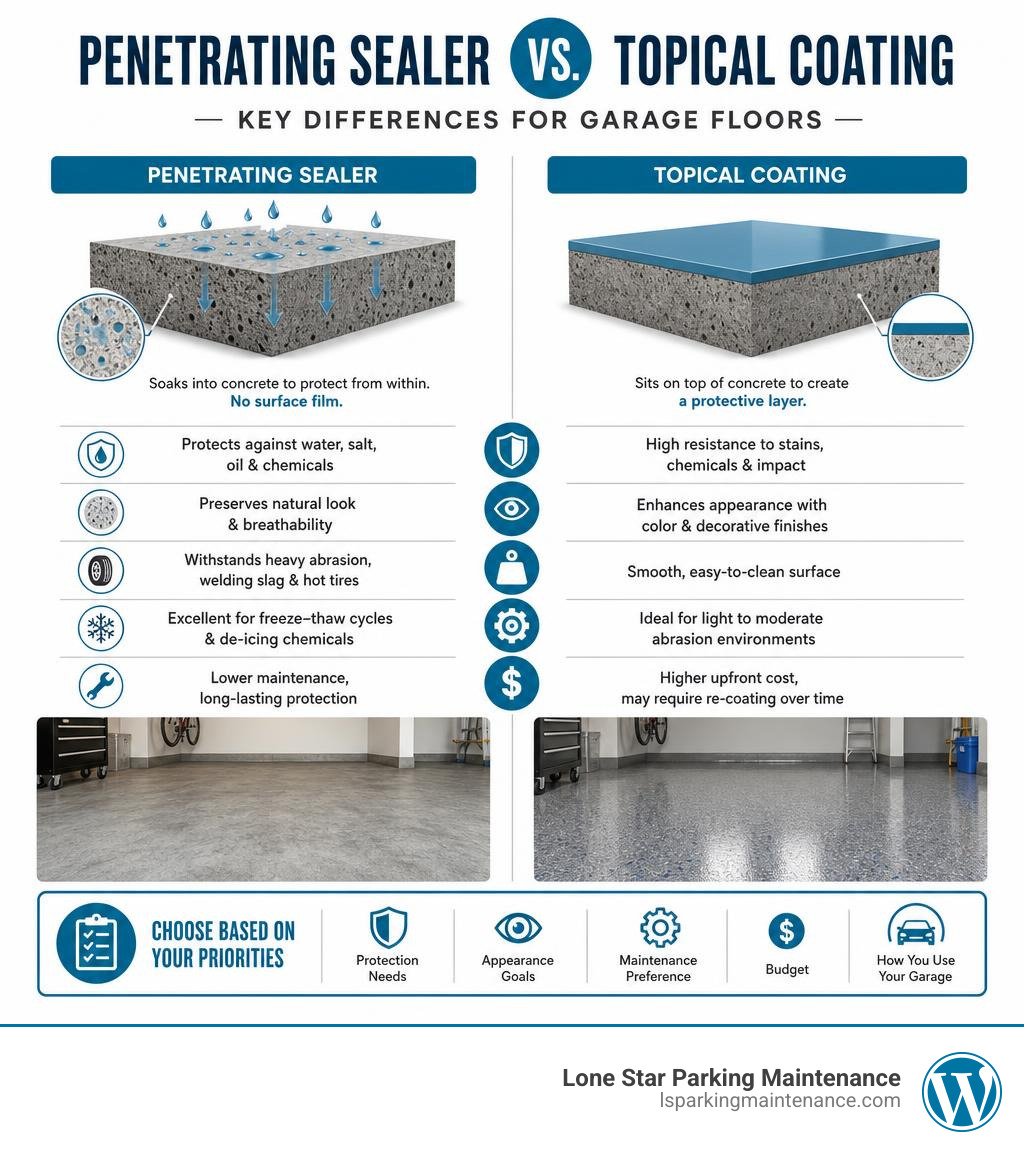
But here’s where most people get tripped up: not all garage floor products work the same way. A penetrating sealer soaks into the concrete and protects it from within — no visible film, no change in appearance. A topical coating sits on top of the surface, adding a protective layer that can also improve looks.
Choosing between them depends on your floor’s use, your budget, and how much prep work you’re willing to do.
Concrete sealing garages terms at a glance:
The Ultimate Guide to Concrete Sealing Garages: Penetrating vs. Topical Solutions
Understanding the difference between a penetrating sealer and a topical garage floor coating is the first step toward a successful floor project. These two product categories protect your concrete in fundamentally different ways, and choosing the wrong one can lead to premature wear, peeling, or a look you didn’t actually want.
Penetrating Sealers: Invisible Protection
Penetrating sealers do not form a layer or film on top of the concrete. Instead, they are formulated with small molecular structures—typically silanes, siloxanes, or silicates—that easily sink deep into the concrete’s open pores.
Once inside, these active ingredients chemically react with the free lime and calcium hydroxide present in the concrete. This reaction forms an internal hydrophobic barrier that repels water, de-icing salts, and automotive fluids from the inside out.
Because they cure entirely below the surface, penetrating sealers:
- Do not change the color, texture, or slip resistance of the concrete.
- Cannot peel, flake, or wear away from tire traffic.
- Allow the concrete to remain breathable, meaning moisture vapor from beneath the slab can escape without causing the sealer to bubble.
Topical Coatings: Heavy-Duty Shields
Topical coatings, such as epoxies, polyureas, and polyurethanes, are film-forming products. They sit directly on top of the concrete surface, creating a continuous, protective barrier. These coatings are much thicker than sealers and are often paired with decorative color flakes or slip-resistant aggregates.
For a deeper look into the chemistry of these high-performance materials, you can read the Polyurea Coating Guide | The Garage Floor Company.
Topical coatings act as a physical shield against impact, heavy abrasion, and harsh chemicals. However, because they rely on a mechanical bond to the concrete’s surface, they require extensive preparation (like diamond grinding) to prevent the coating from peeling under the heat of car tires.
How Concrete Densifiers Work and Alter Appearance
If you have ever noticed a fine white powder on your garage floor that keeps returning no matter how many times you sweep, you are dealing with “concrete dusting.” This is caused by the slow breakdown of weak concrete at the surface.
Concrete densifiers are a specific type of penetrating sealer designed to solve this exact problem. Typically formulated with lithium silicate or sodium silicate, densifiers work by reacting chemically with the calcium hydroxide in the concrete to produce calcium silicate hydrate (CSH) barrier gel. This gel fills the microscopic voids and pores within the concrete matrix, crystallization-hardening the surface from within.
[Active Silicates] + [Free Lime / Calcium Hydroxide] = [Calcium Silicate Hydrate (CSH) Gel]
(Fills microscopic pores -> Increases density & eliminates dusting)
Do Densifiers Change the Appearance?
No. Because they react entirely beneath the surface and leave no film, concrete densifiers do not alter the appearance of your garage floor. Your concrete will look exactly as it did before application—just significantly harder and completely dust-free.
If your garage serves as a workshop where you deal with heavy machinery, welding slag, or metal fabrication, a densifier is an excellent choice. Since there is no plastic or epoxy film on the surface, hot metal sparks (welding slag) will not melt or burn the floor.
Choosing the Right Formula for Concrete Sealing Garages
When selecting a product for concrete sealing garages, you will quickly find that sealers are categorized by their carrier agent: water-based or solvent-based.
Water-Based Sealers
Water-based sealers use water to carry the active protective ingredients into the concrete. As the water evaporates, the active ingredients bond inside the pores.
- Odor: Extremely low to no odor. This makes them highly suitable for attached residential garages where solvent fumes could easily seep into the home.
- VOC Compliance: Water-based formulas easily comply with strict environmental regulations across the United States.
- Appearance: They dry completely clear and leave a natural, matte finish.
To find a durable, low-odor option designed to prevent dusting in residential spaces, consider a dedicated Concrete Floor Sealer | Garage Floor Sealer | Floor Sealer for Concrete.
Solvent-Based Sealers
Solvent-based sealers use industrial solvents to carry the active ingredients.
- Odor: Strong, pungent chemical odor during application and curing. Excellent ventilation and respirators are mandatory.
- Appearance: Solvent-based formulas tend to darken the concrete slightly, giving it a rich “wet look” or a semi-gloss finish. They can also highlight the natural variations and aggregate in the concrete.
- Performance: They generally offer slightly better resistance to oil and grease pooling on the surface compared to standard water-based sealers, but they require careful handling.
Evaluating the Best Products for Extreme Garage Environments
A garage floor is a unique, transitional space. It is protected by walls and a roof, but it is constantly subjected to outdoor elements brought in by your vehicles.
In the DFW Metroplex, our garage floors must withstand extreme summer heat, sudden temperature drops, high humidity, and whatever chemicals drip from our cars.
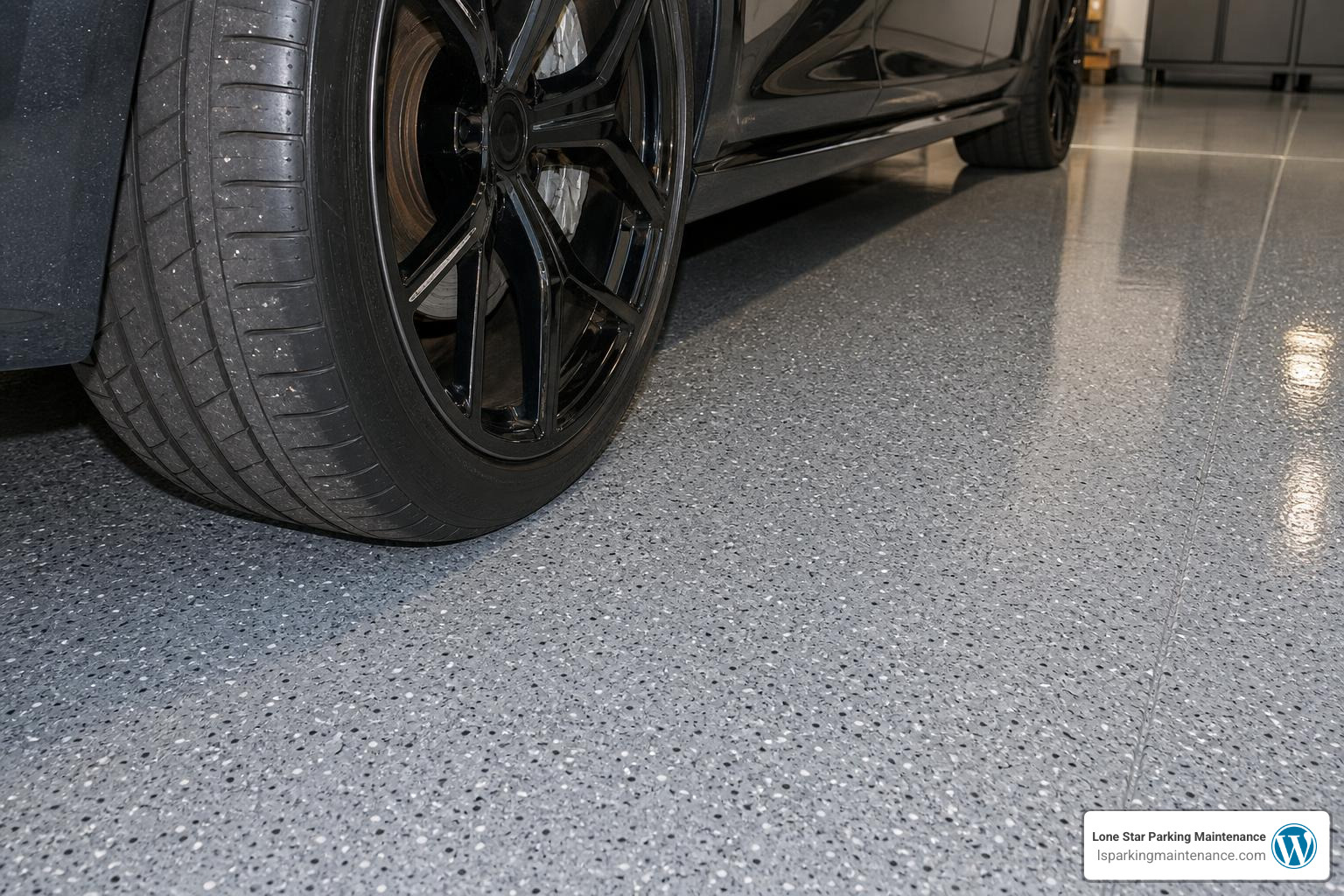
When selecting a product, you must consider the specific environmental pressures your floor will face:
- Hot Tire Pickup: When you drive your car, the tires heat up from road friction. When you park in the garage, the cooling tires contract, creating a strong vacuum effect. Low-quality paints and cheap DIY epoxy kits will literally be pulled off the floor by the tires.
- Road Salt and De-icing Chemicals: If you travel out of the DFW area during winter or park a vehicle that has traveled through treated winter roads, road salts can cause severe pitting and spalling on bare concrete.
- UV Stability: If your garage gets a lot of natural sunlight from windows or open doors, non-UV-stable coatings (like standard epoxies) will yellow and degrade over time.
- Chemical Resistance: Motor oil, brake fluid, gasoline, and antifreeze can quickly soften and dissolve low-grade retail floor paints.
For commercial garages or private workshops looking for professional-grade polyurethane-reinforced protection that resists tire marking and chemical spills, products like the PU Garage Coating | Remmers offer industrial durability.
Penetrating Sealers for Oil and Water Resistance
If you want to keep the natural, clean look of concrete but need defense against oil drips and water intrusion, look for professional-grade penetrating sealers.
Products like GhostShield 8510 and Siloxa-Tek 8510 are premier choices in the industry. These are solvent-based, deep-penetrating silane-siloxane sealers specifically engineered to resist oil stains, water penetration, and de-icing salts.
They work by altering the surface tension of the concrete pores. Instead of drawing fluids in like a sponge, the treated concrete forces oil, grease, and water to bead up on the surface, allowing you hours to wipe up spills before they can leave a permanent stain.
If you are looking for a clear, protective barrier that seals out dust and moisture without the heavy price tag of multi-coat systems, a high-quality Clear Garage Floor Paint Sealer – Concrete Garage Floor Paint | TA Paints can provide an efficient, light-to-medium duty protective layer.
High-Performance Coatings: Polyurea vs. Epoxy
If you want a complete transformation—such as a glossy showroom floor with decorative color flakes—you will want to choose a high-performance topical coating. The two primary options are epoxy and polyurea (often finished with a polyaspartic topcoat).
| Performance Feature | Traditional Epoxy Coating | Polyurea / Polyaspartic Coating |
|---|---|---|
| Tensile Strength | Good (Rigid) | Excellent (Elastomeric – 4x stronger) |
| Flexibility | Low (Can crack with concrete movement) | High (Expands & contracts with the slab) |
| Cure Time | 5 to 7 days before driving | 24 hours before driving |
| UV Resistance | Poor (Yellows and chalks in sunlight) | Excellent (Aliphatic formulas will not yellow) |
| Hot Tire Resistance | Moderate (Slight risk of peeling) | Outstanding (Virtually immune to hot tire pickup) |
| Average Lifespan | 5 to 10 years | 15 to 20+ years (with professional install) |
While professional 2-part polyurea systems offer the highest durability, homeowners looking for a simpler, self-priming DIY project often turn to user-friendly options like the Interior & Exterior Concrete Garage Self-Priming 1-Part Epoxy Coating | BEHR PREMIUM | Behr Pro, which provides solid DIY resistance against oil and gasoline stains.
Preparation, Application, and Long-Term Maintenance
No matter how expensive or advanced a sealer or coating is, it will fail if the concrete is not prepared correctly. In fact, over 90% of all garage floor coating failures are caused by poor surface preparation.
Before you apply any product, the concrete must be clean, free of existing coatings, dry, and porous enough to absorb the material.
Surface Preparation Methods
1. Diamond Grinding (The Gold Standard)
For topical coatings like epoxy and polyurea, mechanical diamond grinding is essential. We use walk-behind grinding machines equipped with diamond-segmented discs to shave off the top micro-layer of the concrete. This process:
- Removes stubborn oil stains, cures, and old paints.
- Opens up the closed pores of hard-troweled concrete.
- Creates a rough surface profile (similar to 150-grit sandpaper) that allows the coating to form a permanent mechanical bond.
2. Acid Etching
Often used for DIY projects, acid etching involves applying a diluted mixture of muriatic acid to clean concrete. The acid reacts with the calcium in the concrete, eating away a micro-layer to open the pores.
- Caution: Acid etching must be done with extreme care, using proper safety gear. Additionally, the concrete must be thoroughly neutralized with baking soda and water, rinsed multiple times, and allowed to dry completely (often 24 to 48 hours) before sealing.
3. Moisture Testing
Concrete may look dry on the surface, but moisture vapor is constantly traveling upward from the ground. If you trap this moisture under a non-breathable topical coating, the hydrostatic pressure will eventually cause the coating to bubble and peel.
Before coating, we always recommend performing a simple calcium chloride test or a plastic sheet test to measure the moisture emission rate of your slab.
To learn more about how professional deep cleaning and high-pressure washing can prepare your concrete surfaces for maintenance, check out our guide on Why Your Garage Needs a High Pressure Makeover.
Step-by-Step Preparation for Concrete Sealing Garages
To achieve a flawless, long-lasting finish, follow this professional preparation sequence:
- Clear the Space: Remove all vehicles, storage, and equipment from the garage.
- Deep Clean and Degrease: Apply an industrial concrete degreaser to oil spots. Scrub vigorously with a stiff-bristle brush and rinse thoroughly.
- Repair Cracks and Divots: Fill any active cracks, pits, or spalls with a high-strength epoxy or polyurea crack filler. Once cured, grind the patches flush with the rest of the floor.
- Profile the Concrete: Perform diamond grinding or acid etching to achieve the required surface profile.
- Vacuum Thoroughly: Use an industrial HEPA vacuum to remove every speck of concrete dust. Any leftover dust will prevent the sealer or coating from bonding.
- Apply a Moisture Vapor Barrier (If Coating): If moisture levels are high, apply a specialized moisture-blocking epoxy primer before your main color coat.
Keeping your concrete clean and repaired is essential not just for looks, but for safety. Explore our tips on Concrete and Asphalt Maintenance Keeping Your Lot Safe to understand the importance of overall facility upkeep.
Lifespan, Maintenance, and Overcoating Existing Sealers
Once your garage floor is sealed or coated, how do you keep it looking brand new? Fortunately, maintenance is simple:
- Routine Cleaning: Sweep or dust-mop the floor weekly to remove abrasive dirt and grit.
- Washing: For topical coatings, mop with warm water and a mild, pH-neutral detergent (like simple dish soap). Avoid ammonia, citrus-based cleaners, or vinegar, as highly acidic or alkaline cleaners can dull the finish over time.
- Oil Spills: Wipe up oil, gasoline, and chemical spills immediately. While sealers and coatings provide excellent stain resistance, they are designed to buy you time to clean up—leaving fluids sitting on the floor for weeks can still cause damage.
Lifespan Expectations
- Penetrating Sealers: Typically last 5 to 10 years before requiring a simple reapplication.
- Professional Polyurea Coatings: Can easily last 15 to 20+ years in a residential setting without peeling or fading.
- Standard Epoxy DIY Kits: Usually require touching up or replacing every 2 to 5 years due to wear and hot tire pickup.
If you are curious about how these sealing processes compare to asphalt maintenance and parking lot care, you can read about What Types of Sealants Do You Use for Parking Lot Sealing and learn How Much to Seal the Deal on Your Asphalt.
Frequently Asked Questions about Garage Floor Sealing
Can a penetrating sealer be applied over an existing garage floor coating?
No. Penetrating sealers must sink into the open pores of bare concrete to work. If there is an existing paint, sealer, or epoxy coating on the floor, it will block the penetrating sealer from absorbing. The product will simply pool on top of the old coating and dry into a sticky, ruined mess.
If you want to apply a penetrating sealer, any old coatings must be completely removed via mechanical grinding down to bare concrete.
How long does a typical garage floor sealer or coating last?
It depends entirely on the product type and traffic levels:
- Penetrating Sealers (Silane-Siloxane): 5 to 10 years. They wear down only as the concrete surface itself physically wears away.
- Epoxy Coatings: 3 to 10 years depending on the quality of the epoxy (1-part vs. 100% solids 2-part) and whether it was professionally installed.
- Polyurea/Polyaspartic Coatings: 15 to 20+ years. Their high flexibility prevents cracking and peeling, making them the longest-lasting topical option available.
Why is UV stability so important for garage floor coatings?
Most standard epoxy resins are highly sensitive to ultraviolet (UV) light. When exposed to sunlight—even just the sun coming through an open garage door—epoxy will undergo a chemical reaction that causes it to yellow, fade, and become brittle.
To prevent this, high-quality garage systems use aliphatic polyaspartic topcoats. Aliphatic chemistry is inherently UV-stable, meaning your floor will retain its bright, high-gloss color and clear finish for decades without yellowing.
Conclusion
Protecting your garage floor from cracking, staining, and dusting is one of the smartest investments you can make for your property. Whether you choose the natural, invisible protection of a penetrating sealer or the high-gloss, showroom-quality finish of a polyurea coating, proper surface preparation is the key to success.
At Lone Star Parking Maintenance, we bring years of experience, top-quality materials, and industry-standard safety practices to every project we touch in the DFW Metroplex, Texas. From commercial parking structures to residential garages, we understand the unique demands that Texas heat and traffic place on concrete.
Don’t let your concrete crack under pressure. Schedule a professional garage floor evaluation with Lone Star Parking Maintenance today, and let our team help you choose and apply the perfect sealing solution for your space.
For more insights on the long-term benefits of surface sealing, read our detailed guide on Why is Parking Lot Sealing Important.