
Curb Painting Directional Arrows That Improve Safety and Compliance
Clear curb painting directional arrows help drivers follow the right path through a parking lot, garage, fire lane, or loading area. For a durable, compliant result, use a layout approved for the site, clean and dry the curb, apply traffic-grade paint with a stencil, and protect the fresh marking until it cures.
Before painting, confirm the local code and the purpose of the marking. The MUTCD allows curb colors to support parking regulations and curb visibility, but local agencies set many of the specific rules. Directional arrows should also match nearby signs, lane striping, and pedestrian routes so drivers receive one clear message.
Faded, misplaced, or conflicting arrows create avoidable risk. Professional installation starts with surface prep and traffic control, then uses sharp stencil work, high-visibility coatings, and a maintenance plan that keeps markings easy to see in Texas sun, rain, and daily traffic.
I’m Cason, and this guide will help you understand what compliant curb and directional-arrow work should include before you hire a contractor.
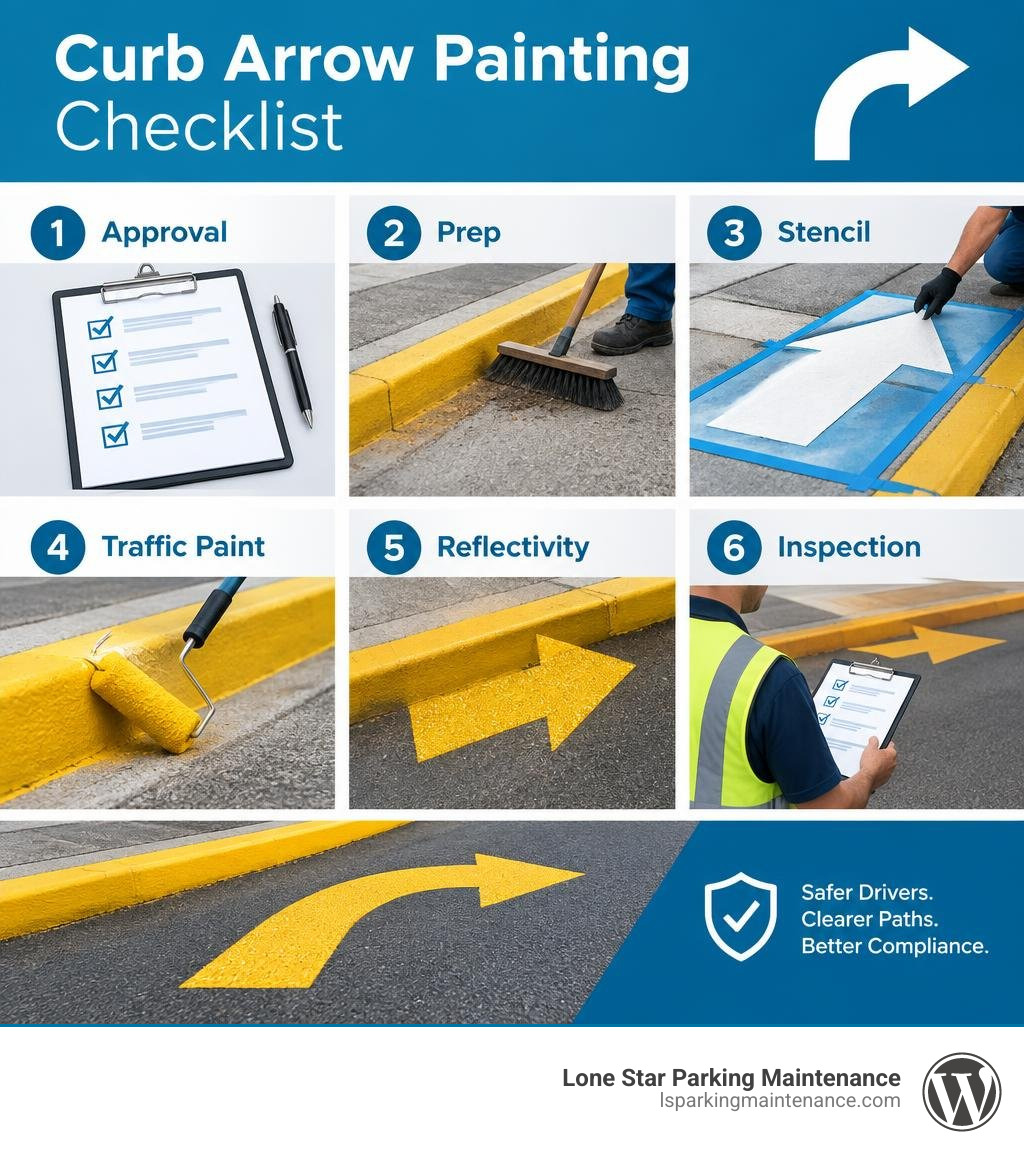
Curb painting directional arrows terms to learn:
Regulatory Standards for Curb Painting Directional Arrows
Maintaining a commercial parking lot or garage requires strict adherence to federal, state, and municipal roadway standards. Property owners across the DFW Metroplex must navigate traffic safety ordinances to ensure their parking facilities remain safe, efficient, and legally compliant.
The primary benchmark for all roadway markings across the United States is the Manual on Uniform Traffic Control Devices (MUTCD), administered by the Federal Highway Administration. While state guidelines such as PennDOT curb marking technical guidelines illustrate how regional DOTs adapt national standards for statutory distances, Texas municipalities similarly adopt these core engineering frameworks.
Under national standards, curb markings are not universally mandatory on every foot of concrete, but when installed, they serve as vital regulatory devices. They supplement ground-level striping, reinforce vehicular right-of-way, and delineate restricted zones. Furthermore, curb delineation must coordinate seamlessly with ADA parking standards to guarantee unobstructed access routes for individuals with disabilities, as well as strict municipal fire lane markings to ensure emergency vehicle access.
| Curb Marking Color | Primary Meaning & Function | Standard Application Area | Regulatory Reference |
|---|---|---|---|
| Solid White | Flow delineation; parking permitted (unless signed otherwise) | Island curbs where traffic passes on either side; one-way directional indicators | MUTCD Section 3A.05 / 3B.20 |
| Solid Yellow | Separation of opposing traffic; median delineation | Approach ends of raised medians; traffic island noses in line of flow | MUTCD Section 3A.05 / 3B.23 |
| Red | Strict No Parking; dedicated emergency access | Designated fire lanes; clearance zones adjacent to fire hydrants (15 ft) | Municipal Fire Codes / Local Ordinances |
| Blue | Accessible parking designation | Curbs adjacent to designated accessible parking stalls and access aisles | ADA Standards / MUTCD Section 3A.05 |
| Green / Purple | Short-term loading zones / electronic tolling delineation | Customer pick-up areas; specialized transit lanes | Local Highway Agency Discretion |
Color Coding and Legal Delineations
Color selection is not a matter of aesthetic preference—it is a matter of law. Applying the wrong color to a curb can confuse motorists, create liability risks, and result in code violations.
- Retroreflective Solid White: Used on curb faces and channelizing islands where traffic is permitted to pass on either side of the island in the same general direction, or to denote one-way flow patterns in private drive aisles.
- Retroreflective Solid Yellow: Mandated on the approach ends (noses) of raised medians and curbs of islands that sit directly in the line of oncoming traffic flow. When used along longitudinal curb faces, yellow indicates two-way traffic separation or restricted stopping zones.
- Red Zones: Strictly reserved for fire lanes and emergency vehicle operations. Red curbs prohibit parking, standing, or stopping at all times.
- Blue Curbs: Exclusively allocated to supplement accessible parking spaces and access aisles, providing high-contrast visual cues for motorists requiring ADA-compliant facilities.
Retroreflectivity and Visibility Mandates
Directional indicators on curbs must remain visible under all atmospheric and lighting conditions. Faded, flat paint disappears after dusk, turning raised medians and channelizing islands into vehicle-damaging collision hazards.
The MUTCD mandates retroreflective properties for curb markings positioned within the line of traffic flow. On active roadways with speed limits of 35 mph or higher, pavement and curb markings must maintain a minimum retroreflectivity threshold of 50 mcd/m² (millicandelas per square meter per lux), increasing to 100 mcd/m² or higher on higher-speed arterials.
To achieve this level of nighttime luminance, professional line-striping crews embed premium glass spheres (beads) directly into the wet paint film during application. When vehicle headlights strike the curb face, these spherical optical elements reflect the light directly back toward the driver’s eyes. On light-colored concrete curbs or faded asphalt bases, applying a contrasting black border behind or around white directional arrows significantly enhances daylight and nighttime legibility.
Surface Preparation and Professional Materials for Curb Markings
A flawless curb painting job is only as durable as the surface beneath it. Concrete curbs endure punishing environmental conditions, including vehicle tire scrub, motor oil drippings, standing rainwater, and intense ultraviolet radiation. Applying premium paint over unprepared concrete guarantees premature blistering, flaking, and total adhesion failure within months.

Industry engineering specifications, such as the NYCHA painted pavement marking specifications, establish strict requirements for surface preparation, moisture control, and chemical adhesion before any traffic-bearing coating is applied.
Substrate Cleaning and Priming Protocols
Our professional installation workflow always starts with extensive mechanical and chemical surface preparation:
- High-Pressure Washing: Curbs are power washed using commercial-grade equipment running at 3,500+ PSI to remove caked-on dirt, mildew, road grime, and loose efflorescence.
- Degreasing and Decontamination: Heavy oil and grease deposits from vehicle exhaust or engine leaks are treated with industrial citrus degreasers and stiff wire brushes. For severe petroleum penetration, applying cut shellac or specialized barrier primers seals the oil spots and prevents them from bleeding through new paint.
- Moisture and Cure Testing: Concrete must be completely dry before coating application. New concrete curbs require a minimum 30-day cure time, while freshly applied asphalt sealcoat requires a full 48-hour cure window before line-striping paints can be safely applied.
- Crack Repair: Deep spalls, cracks, and chipped curb edges are filled with high-strength elastomeric compound or rapid-setting concrete patch material to restore a smooth, structural surface for stencil work.
Commercial Paint Systems and Reflective Additives
Standard exterior house paints or low-grade DIY latex formulas will quickly peel when applied to commercial concrete curbs. Parking facility maintenance demands heavy-duty, fast-drying traffic zone marking formulations designed specifically for high-abrasion environments.
- 100% Acrylic Waterborne Zone Marking Paint: The modern commercial standard (such as Benjamin Moore M58 or Sherwin-Williams Pro-Park). These formulations offer rapid dry times (under 15 minutes to touch), outstanding UV resistance against the Texas sun, low VOC emissions, and exceptional adhesion to both concrete and asphalt.
- Solvent-Based / Alkyd Traffic Paints: Frequently utilized in colder temperatures or specialized industrial settings where rapid chemical bonding is required under adverse weather conditions.
- Drop-On Glass Spheres: Type I or AASHTO-grade glass beads distributed at a rate of 6 to 8 pounds per gallon of wet paint to ensure high retroreflective performance throughout the coating’s lifespan.
Application temperature is a critical operational variable: paint should never be applied when the ambient or substrate temperature falls below 50°F (10°C) or rises above 95°F (35°C), as extreme heat can flash-dry the paint prematurely and compromise film durability.
How to Execute Compliant Curb Painting Directional Arrows
Precision layout and expert mechanical application separate amateur paint jobs from compliant commercial traffic installations. Whether painting lane guidance arrows on a parking garage ramp or directional navigation arrows on raised drive-thru medians, strict geometric tolerances must be maintained.
State transportation guidelines, including the Caltrans traffic control marking manual, emphasize that pavement symbols must present uniform geometry, proportional stroke widths, and consistent spacing across the entire property. Integrating these elements requires coordinating curb arrows with comprehensive professional parking lot striping across all drive aisles.
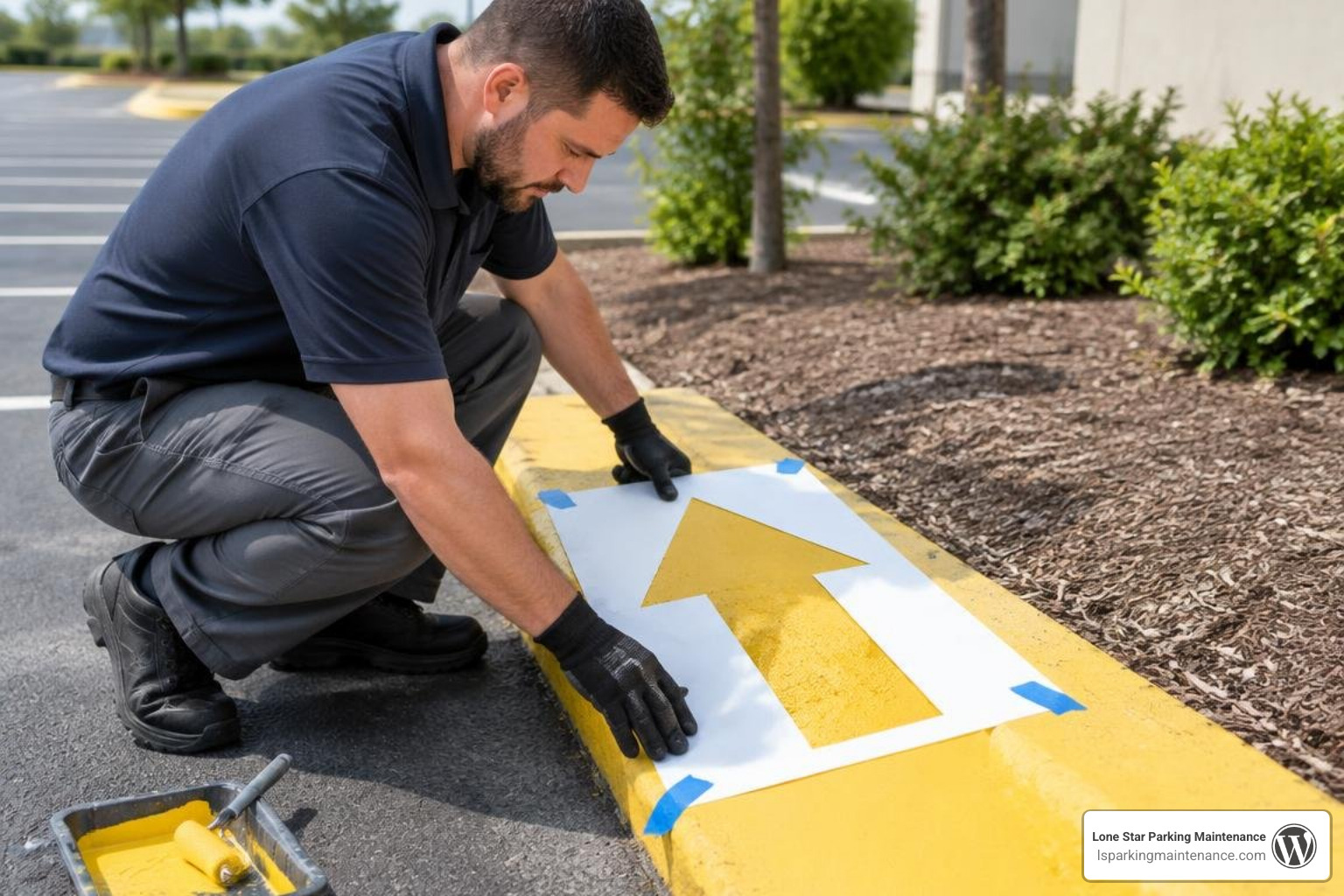
Step-by-Step Installation of Curb Painting Directional Arrows
Executing crisp, code-compliant directional arrows on a vertical or angled curb face follows a strict sequence:
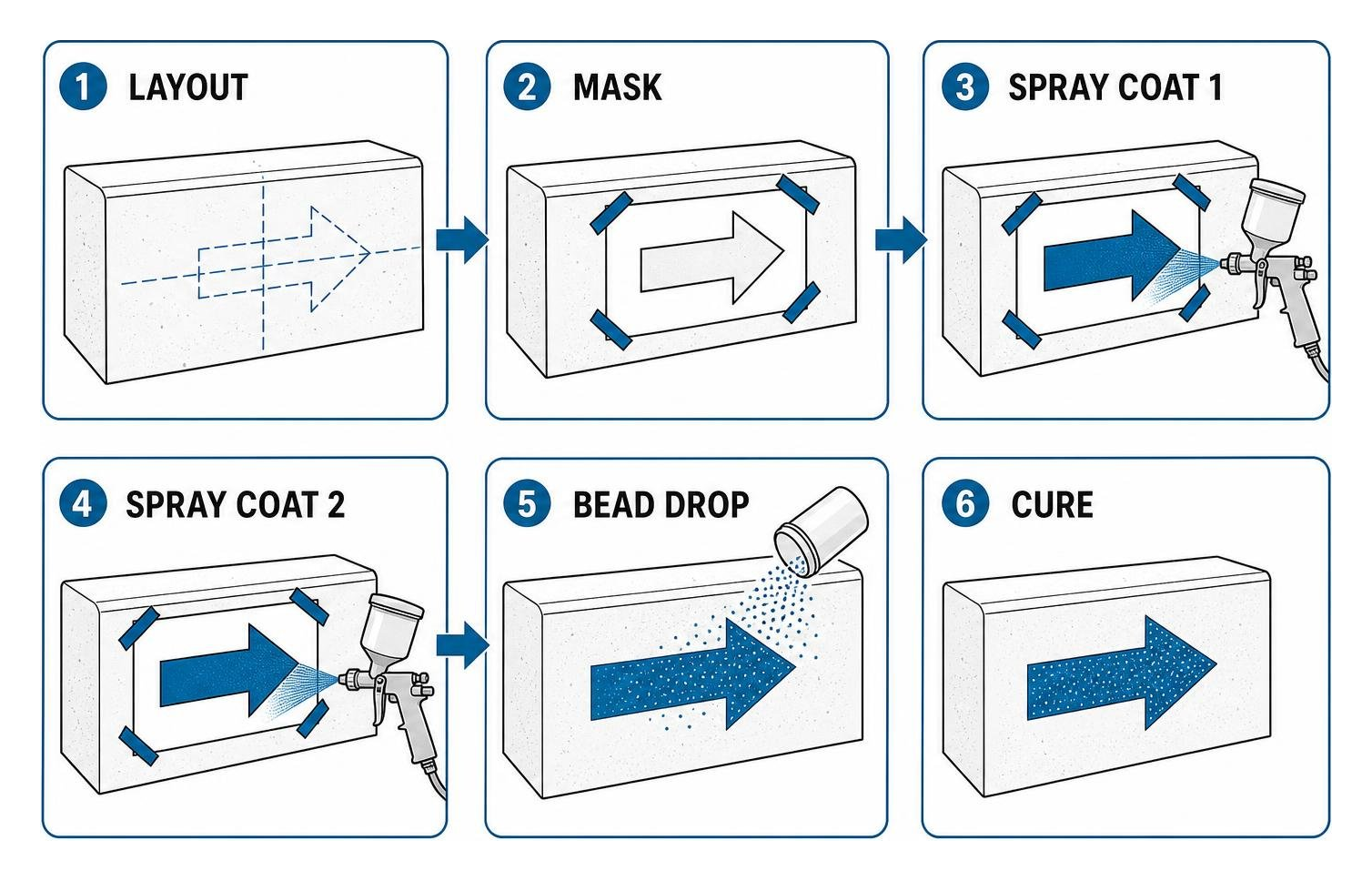
- Traffic Control and Site Safety: Secure the work zone using high-visibility 28-inch traffic cones, delineators, and warning signs to reroute vehicles away from technicians and wet paint lines.
- Measuring and Stencil Alignment: Measure curb segments using laser measuring tools and chalk lines. Position commercial-grade polycarbonate or aluminum directional arrow stencils. Ensure the arrow stroke is perfectly centered on the curb face or top chamfer, pointing accurately in the intended direction of traffic flow without tilt.
- Border Masking: Secure the stencil tightly against the concrete profile using heavy-duty painter’s tape or weighted magnets to prevent overspray and eliminate fuzzy, bleeding edges.
- First Coat Application: Apply the first coat of traffic-grade marking paint using an airless striping machine or high-pressure pneumatic spray applicator at a wet film thickness (WFT) of 12 to 15 mils.
- Second Coat & Retroreflective Drop-On: Allow the first pass to tack dry, then apply a uniform second coat to achieve maximum opacity and mil thickness. Immediately broadcast reflective glass beads evenly across the wet surface before skin formation occurs.
- Curing and Demobilization: Allow the paint system to cure undisturbed for 30 to 60 minutes before reopening the drive aisle to vehicular traffic.
Integrating Curb Markings with Site Signage and Striping
A directional arrow painted on a curb cannot function in a vacuum. To create an intuitive, accident-free parking facility, curb markings must directly reinforce all surrounding visual assets:
- Ground-Level Pavement Markings: Curb arrows should match the direction, angle, and cadence of painted turn arrows, lane dividers, and stop bars across the pavement surface.
- Post-Mounted Signage: Ensure painted curb indicators mirror nearby parking lot signage, such as “One Way,” “Do Not Enter,” “Right Turn Only,” and speed limit signs.
- Pedestrian Pathways and Crosswalks: Guide vehicles away from pedestrian-heavy entrance plazas, ADA access ramps, and designated walking corridors with clear curb arrow channelization.
Maintenance Protocols for Painted Curb Markings
Commercial parking lots in the Dallas–Fort Worth region experience blistering summer heat, seasonal storms, heavy vehicle traffic, and constant tire friction. Even top-tier traffic paints inevitably degrade over time. Maintaining safety compliance requires structured preventative maintenance rather than waiting for markings to vanish entirely.
Property managers can establish baseline upkeep schedules that deliver dependable curb painting results year after year.
Inspection and Maintenance for Curb Painting Directional Arrows
We recommend establishing a semi-annual inspection routine to evaluate curb markings before minor wear escalates into significant safety hazards:
- Nighttime Luminance Audits: Conduct visual audits after dark using standard vehicle headlights to verify that glass-bead retroreflectivity remains sharp and legible.
- Physical Abrasion Checks: Inspect high-impact zones, such as tight turn radii, loading dock entrances, and drive-thru islands, where tire scrub frequently abrades paint coatings.
- Routine Sweeping and Cleaning: Prevent loose gravel, dirt, and road grime from acting as abrasive sandpaper against painted curbs by scheduling regular parking lot power sweeping.
- Compliant Paint Debris Removal: When old paint begins flaking or spalling, employ proper environmental containment and curb paint debris removal to prevent paint chips from entering municipal storm drains.
Obliteration and Removal of Obsolete Markings
Whenever traffic patterns change, property layouts are reconfigured, or parking stalls are restriped, outdated directional arrows must be permanently eliminated. According to MUTCD Section 3A.04, markings that are no longer applicable and might cause driver confusion must be completely removed or obliterated as soon as practicable.
Never simply paint black latex paint over old white or yellow curb arrows. As the top black coat weathers away, the original arrow will ghost through, disorienting motorists and creating liability issues.
Approved removal techniques include:
- Ultra-High-Pressure Water Blasting: Eradicates paint deep within the concrete pores without damaging the structural matrix of the curb.
- Mechanical Diamond Grinding or Shot Blasting: Smoothly shaves the paint layer off vertical concrete surfaces.
- Temporary Masking Tape: Specialized heavy-duty, non-reflective roadway masking tape matched to the curb color can be used strictly as an interim solution until permanent removal is completed.
Frequently Asked Questions About Directional Curb Markings
What are the standard dimensions for curb directional arrows?
While standard highway pavement arrows specified in MUTCD Section 3B.20 measure 8 to 12 feet in length, curb-face directional arrows are engineered to fit the vertical and angled geometry of concrete curbs. Standard curb arrow stencils range from 4 to 6 inches in height and 12 to 24 inches in length, featuring a bold stroke width of 2 to 4 inches. Spacing between repeated directional arrows along a channelizing median typically ranges from 10 to 20 feet depending on vehicle approach speeds and site line-of-sight.
What paint is best suited for concrete curb painting?
The gold standard for commercial concrete curbs is 100% acrylic waterborne traffic and zone marking paint (meeting federal specification TT-P-1952). It provides rapid drying times, high flexural strength against seasonal temperature expansion, superior resistance to alkali burn from concrete, and excellent UV stability. For maximum longevity, it should be applied in a two-coat system with embedded retroreflective glass spheres.
How often should directional arrows on curbs be repainted?
In high-traffic commercial environments across Texas, curb directional arrows and safety markings should be evaluated annually and typically restriped every 12 to 24 months. Facilities with heavy commercial truck traffic, drive-thru lanes, or intense 24/7 vehicle circulation may require touch-ups every 6 to 12 months to maintain full code compliance and sharp visual definition.
Conclusion
Crisp, properly engineered curb directional arrows are fundamental to commercial traffic safety, parking efficiency, and municipal code compliance. From choosing approved MUTCD colors and retroreflective materials to executing meticulous surface prep and sharp stencil application, every step demands professional expertise.
Don’t let faded, confusing curb markings expose your business to liability or traffic bottlenecks. At Lone Star Parking Maintenance, we deliver premium parking lot striping, curb painting, surface repairs, power washing, and curb stop and protective installation services tailored specifically to properties across the DFW Metroplex. Contact our team today to schedule an on-site safety and code compliance audit for your facility.