
What Are Parking Wheel Stops — And Why Does Choosing the Right One Matter?
Parking wheel stops are low barriers placed at the front of parking stalls to prevent vehicles from rolling too far forward. Here’s a quick overview of everything you need to know:
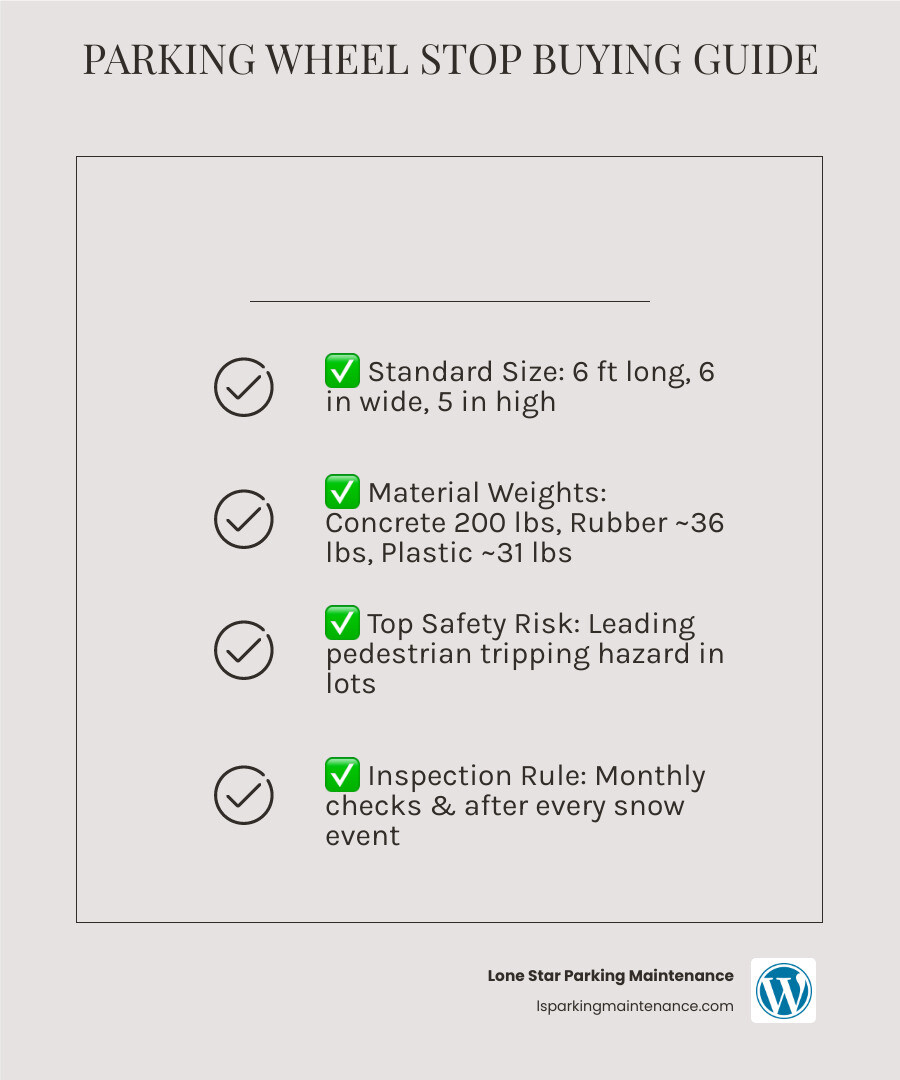
- What they do: Stop vehicle tires before they hit curbs, walls, pedestrians, or landscaping
- Common materials: Concrete (200 lbs), rubber (~36 lbs), and recycled plastic (~14 kg / 31 lbs)
- Standard size: 6 feet long, 6 inches wide, 5 inches high
- Key safety concern: Wheel stops are a leading pedestrian tripping hazard in parking lots
- Best alternative: Bollards at least 3’6″ high, when wheel stops aren’t appropriate
- Inspection schedule: At minimum monthly, and after every snow event
They sound simple. But pick the wrong one — or install it poorly — and you’re looking at cracked pavement, slip-and-fall liability, and unhappy tenants.
For property managers in the DFW Metroplex, these decisions carry real consequences. A wheel stop that shifts out of alignment, fades into the pavement, or sits directly in a pedestrian path isn’t just an eyesore. It’s a liability waiting to happen. Safety experts have consistently flagged wheel stops as one of the most common causes of trip-and-fall injuries in commercial parking lots — and that risk only grows when stops are poorly maintained or improperly placed.
I’m Cason with Lone Star Parking Maintenance, and in this guide I’ll walk you through everything you need to make a confident, safe, and cost-effective decision when buying parking wheel stops.
Understanding Materials: Concrete vs. Rubber vs. Plastic Parking Wheel Stops
Selecting the right material for your parking lot is the first and most critical decision in the buying process. Each material behaves differently under the intense North Texas heat, occasional winter ice storms, and heavy vehicle traffic.
To help you visualize the differences, here is a quick comparison of the three primary materials used for modern parking wheel stops:
| Material Feature | Concrete | Recycled Rubber | Recycled Plastic |
|---|---|---|---|
| Average Weight | ~200 lbs (90 kg) | ~36 lbs (16 kg) | ~31 lbs (14 kg) |
| Durability | High compressive strength, but prone to cracking/spalling | Excellent flexibility; won’t chip, crack, or crumble | High impact resistance; won’t warp or splinter |
| Installation Effort | High (requires heavy lifting, often a forklift for delivery) | Low (can be easily installed by a single person) | Low (lightweight, simple mechanical anchoring) |
| Environmental Impact | High carbon footprint during manufacturing | Excellent (diverts scrap tires from landfills) | Excellent (uses post-consumer/industrial plastics) |
| Best Suited For | Heavy commercial vehicles, industrial zones, permanent lots | Uneven pavement, retail storefronts, residential garages | High-traffic commercial lots, color-coded zones (EV, ADA) |
When deciding what fits your budget and property needs, you must weigh the upfront purchase price against the long-term maintenance costs. While traditional options have been the default for decades, modern composite alternatives are rapidly gaining ground due to their ease of handling and impressive lifespan. For a deeper dive into how these options function on a daily basis, check out our guide on Wheel Stoppers 101: Keep Your Vehicles Safely in Place.
Concrete Wheel Stops
Traditional precast concrete wheel stops remain a staple in commercial parking lots across Dallas-Fort Worth. Standard commercial concrete stops are 6 feet long, 6 inches wide, 5 inches high, and are manufactured using 3,500 psi rated concrete reinforced internally with two pieces of steel rebar.
Because they weigh a hefty 200 lbs each, they offer incredible structural resistance. However, their weight also means that large deliveries require a forklift onsite for unloading, which increases initial logistics costs.
Over time, concrete is highly susceptible to the elements. North Texas freeze-thaw cycles, combined with vehicle impacts, can lead to spalling, cracking, and crumbling. Once the internal rebar is exposed to moisture, it corrodes, accelerating the breakdown of the block. If you are leaning toward concrete for its classic durability, you can learn more about proper selection in our article Precast Concrete Wheel Stoppers: Stop Cars in Their Tracks.
Recycled Rubber Parking Wheel Stops
If your parking lot has minor surface imperfections, dips, or an older asphalt base, recycled rubber is an exceptional choice. Made from 100% compressed recycled car and truck tires, these stops weigh approximately 36 lbs, making them light enough for a single technician to install without heavy machinery.
Products like the TireBoss Rubber Parking Wheel Stop, Yellow Strips Signs showcase the flexibility of rubber. Unlike rigid concrete, rubber naturally flexes to conform to the contours of uneven pavement. It will not chip, crack, crumble, or fade in the blistering 110°F Texas summer heat.
Furthermore, rubber stops are highly visible. Premium models feature molded-in reflective tape or chevrons, such as the Rubber Parking Wheel Stop – 65 in – Yellow Chevron | HERMEQ , which ensures they remain highly visible at night. For tight spaces or low-clearance sports cars, low-profile rubber stops (standing only 3 to 3.5 inches tall) provide excellent safety without scraping low front bumpers. You can also explore options like the Wheel Stop – Rubber Vehicle Parking 1650mm (L) Black/Yellow – Buy Kiwi or the TRAFFIC-LINE Park-AID Wheel Stop – 900mmL – Black/Yellow – Complete with Fixings – [MV-284.25.716] for smaller bay profiles.
Recycled Plastic Parking Wheel Stops
Recycled plastic wheel stops are engineered from high-density post-consumer and post-industrial plastics (often an 80/20 blend). Weighing in at approximately 14 kg (about 31 lbs), they are incredibly lightweight yet offer outstanding impact resistance.
A major advantage of recycled plastic is its solid, molded-in color-coding. Unlike concrete, which requires frequent repainting, plastic stops never need paint. They are available in standard colors to organize your parking facility:
- Safety Yellow: Standard commercial parking spaces.
- Handicap Blue: Dedicated ADA-accessible parking spaces.
- EV Green: Electric vehicle charging stations.
- Emergency Red: Fire lanes and restricted zones.
High-quality models, such as the Enforcer Wheel Stop – Long-Lasting Recycled Plastic | Enforcer Group , are designed to resist UV degradation and chemical spills (like motor oil or gasoline). For compact spots or specific architectural designs, shorter lengths like the Wheel Stop 900mm long — Car Parks and Roads offer excellent flexibility without cluttering the lot.
Safety Standards, Dimensions, and Proper Placement Guidelines
Improperly placed parking wheel stops are one of the leading causes of premises liability lawsuits. If a pedestrian trips over a wheel stop in your lot, you could be held liable for their injuries. Understanding placement standards is the best way to keep your visitors safe and protect your business from legal risk.
Dimensions and Spacing Standards
According to standard parking lot design guidelines (including references like the AS/NZS 2890.1:2004 standard for physical dimensions and US ANSI/OSHA recommendations), standard wheel stops should be limited to a maximum length of 6 feet and a maximum height of 6.5 inches (typically 5 inches is preferred).
When positioning wheel stops, they must be placed so that they are completely covered by the front of the vehicle when the stall is occupied. This prevents the ends of the blocks from sticking out into adjacent walkways.
Additionally, you must maintain an adequate walkway of at least 3 feet of clear space between the front of the wheel stop and any pedestrian path or building structure. This ensures that wheelchair users and pedestrians have plenty of room to navigate around the vehicles. For precise layout specifications tailored to different parking angles, refer to Stop Right There: A Guide to Safe Wheel Stop Placement.
Pedestrian Safety and Tripping Hazards
To minimize tripping hazards, wheel stops must contrast sharply with the surrounding pavement. Dark grey or unpainted concrete stops can blend invisibly into aged asphalt, especially during rainstorms or at night.
We highly recommend using bright, safety-colored finishes (yellow, blue, or white) and incorporating reflective elements. Many modern rubber and plastic stops feature molded-in reflective panels or chevrons that bounce headlight beams back to the driver. If you manage a healthcare or senior living facility, safety is even more critical; you can read our specialized guide on How to Choose the Right Parking Bumpers for Medical Centers to learn how to accommodate vulnerable pedestrians.
When to Avoid Wheel Stops and Best Alternative Devices
Safety standards are clear: wheel stops should be avoided whenever possible in pedestrian walkways or foreseeable pedestrian paths. If visitors must regularly walk across the front of parking stalls to access your building, installing wheel stops creates an unacceptable tripping hazard.
In these high-traffic areas, you should use alternative protective devices:
- Bollards: Heavy-duty steel or concrete-filled bollards standing at least 3 feet 6 inches (3.5 feet) high are the industry standard for protecting storefronts and walkways from vehicle encroachment.
- Standard Curbs: A continuous 6-inch concrete curb can help define the parking lot boundary, though it should not be relied upon as a high-speed vehicle barrier.
- Landscaped Buffers: Creating a wide grass or mulch buffer between the parking stalls and the pedestrian sidewalk eliminates the need for wheel stops entirely.
Installation Methods and Preventing Common Failure Modes
A wheel stop is only as reliable as its installation. If it is not anchored properly, vehicle impacts will quickly dislodge it, creating a dangerous obstacle for both drivers and pedestrians.
Anchoring Hardware for Asphalt and Concrete
The anchoring hardware you choose must match your parking lot surface material:
- Asphalt Installation: Asphalt is a flexible pavement. For older asphalt (more than 2 years old), we use 12-inch to 14-inch galvanized steel rebar spikes driven through pre-drilled holes into the sub-base. For fresh, soft asphalt, lag bolts with expansion shields are preferred to prevent the anchors from pulling loose over time.
- Concrete Installation: Concrete is highly rigid. We use heavy-duty lag bolts (typically 1/2-inch wide by 8 inches long) with expansion anchors or Large Diameter TapCons (LDT) driven into precisely drilled holes.
- Post-Tension Parking Decks: Drilling into post-tension concrete decks can rupture the structural steel cables inside, compromising the building’s integrity. In these sensitive structures, drilling is strictly prohibited. Instead, we use a heavy-duty, two-part structural epoxy adhesive to bond the wheel stops directly to the surface.
For a complete walkthrough of the physical installation process, read our step-by-step guide on How to Install Wheel Stops in 5 Simple Steps.
Routine Inspection and Maintenance Checklist
Over time, minor, repeated impacts from vehicle tires will degrade even the best-installed wheel stops. Mechanically anchored stops can loosen, cracking the surrounding pavement and allowing water to seep into the sub-base. In North Texas, this water penetration leads to sub-base erosion and severe pavement damage.
To mitigate liability and protect your investment, we recommend performing routine inspections at least monthly and immediately after any snow or ice events (when snow plows may accidentally strike and misalign the blocks).
Use this quick maintenance checklist during your inspections:
- [ ] Check for cracking, chipping, or crumbling (especially on concrete blocks).
- [ ] Verify that all anchoring pins or bolts are flush with the top of the wheel stop (protruding bolts can damage tires and trip pedestrians).
- [ ] Ensure the stop is perfectly aligned and has not rotated or shifted.
- [ ] Confirm that reflective tape, paint, or markings are bright and free of dirt or oil buildup.
- [ ] Inspect the surrounding pavement for cracks or water penetration near the anchors.
Frequently Asked Questions about Parking Lot Barriers
What are the standard dimensions of a commercial wheel stop?
For standard passenger vehicles, the industry standard dimension is 6 feet long, 6 inches wide, and 5 inches high. For heavy-duty industrial applications, such as commercial truck bays or 18-wheeler parking, heavy-duty truck blocks are available in lengths of 8 feet and stand up to 8 inches high to accommodate massive commercial tires.
How do you install wheel stops on post-tension concrete parking decks?
To protect the structural integrity of post-tension parking decks, drilling is prohibited. We install these wheel stops using a commercial-grade, two-part structural epoxy adhesive. This adhesive creates an incredibly strong bond between the bottom of the rubber or plastic wheel stop and the concrete surface without breaching the deck’s surface.
How often should parking lot wheel stops be inspected?
Wheel stops should be inspected at least monthly. They should also be inspected immediately following heavy storms, freeze events, or snow-clearing operations. Regular inspections help you identify shifted blocks, loose anchors, or cracked materials before they lead to vehicle damage or personal injury lawsuits.
Conclusion
At Lone Star Parking Maintenance, we help commercial property owners throughout the DFW Metroplex design, install, and maintain safe, compliant, and attractive parking facilities. Whether you need traditional concrete stops, flexible recycled rubber barriers, or vibrant color-coded recycled plastic stops, our team has the local expertise to get the job done right.
Do not let a loose, faded, or poorly placed wheel stop turn into an expensive liability claim. From precise layout planning to flawless anchoring, we ensure your parking lot meets the highest safety standards.
Ready to upgrade your property’s safety and curb appeal? Contact us today for professional installation and maintenance services by visiting our Protective Pole Covers and Curb Stop Installation page. Let’s make your DFW parking lot safer, one stall at a time!