
Why a Parking Space Concrete Stop Is Essential in Commercial Lots
A parking space concrete stop is a low, reinforced concrete barrier placed at the front of a stall to stop a vehicle’s tires before it reaches a sidewalk, storefront, landscape bed, wall, or another hazard. For most commercial lots, a 6-foot steel-reinforced stop is the standard choice for regular passenger spaces. It should be properly anchored and placed far enough back to keep parked-car overhang out of pedestrian paths.
Concrete wheel stops are also called parking blocks, car stops, parking bumpers, and wheel stops. They bring order to parking rows while helping protect people, pavement, buildings, and site features from low-speed vehicle impacts.
The right stop is more than a heavy block. A quality precast unit uses high-strength concrete and internal rebar to withstand repeated tire contact, lot sweepers, weather, and years of daily use. Poor placement or loose anchors, however, can create trip hazards and liability issues instead of preventing them.
I’m Cason, and this guide will help you choose, place, and maintain concrete parking stops for a safer commercial property.
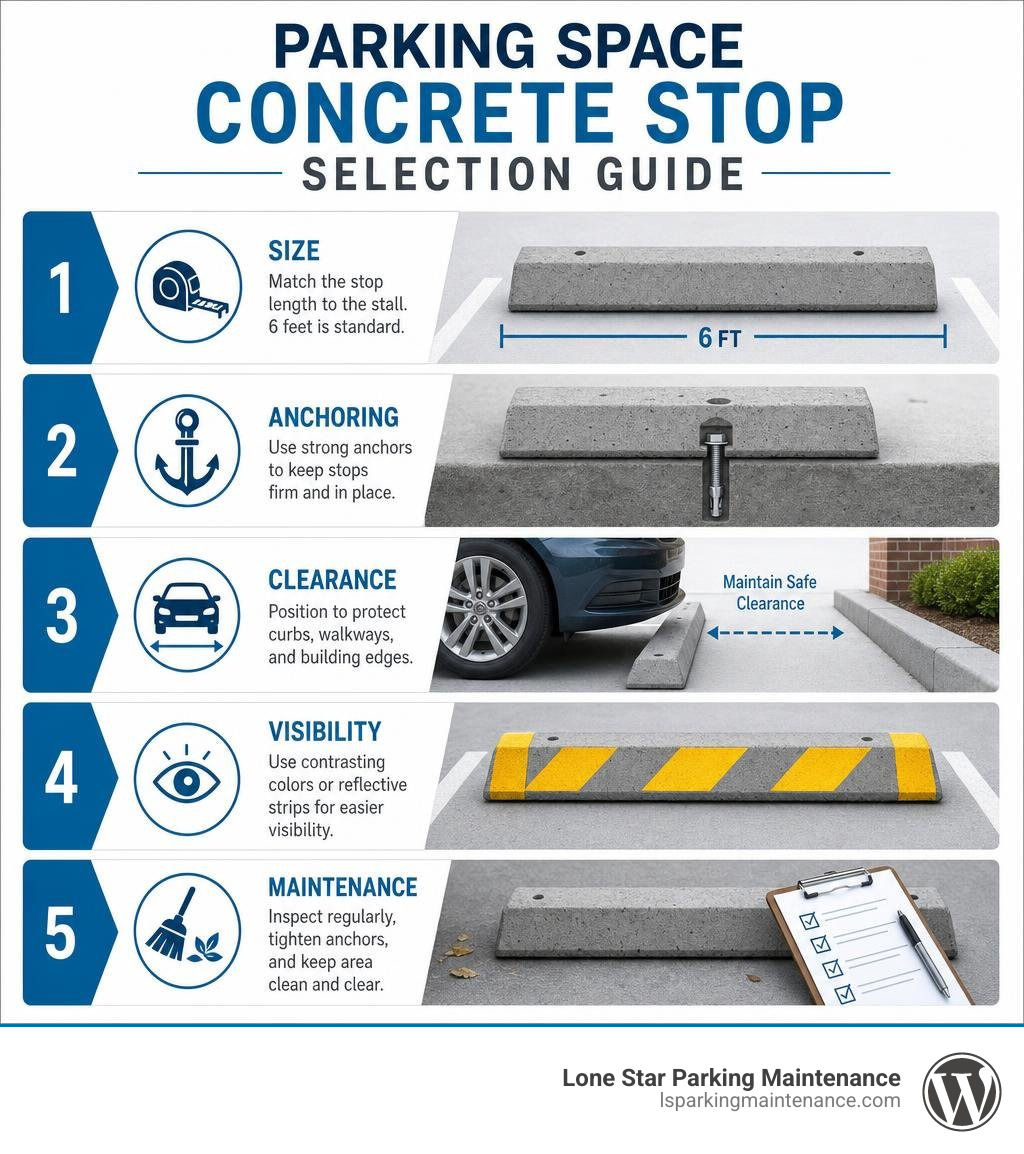
Common parking space concrete stop vocab:
Engineering Specifications of a Parking Space Concrete Stop
A parking bumper might look simple, but its internal construction determines whether it lasts twenty years or shatters within its first winter. Concrete has immense compressive strength, meaning it handles downward squeezing forces exceptionally well. However, it is naturally weak in tensile strength. When a moving SUV bumps against an unreinforced curb, the stopping force creates bending stress. Without steel reinforcement inside, tension fractures quickly turn a solid block into crumbling rubble.
Commercial precast stops are cast under strict factory conditions to eliminate internal air voids through vibration settling. Standard specifications call for a compressive strength rating between 3,500 and 5,000 PSI, verified by standard ASTM C39 cylinder testing. Premium commercial models, such as 4,500 PSI precast parking stops, incorporate two strands of #4 steel rebar (ASTM A615 Grade 60) running the entire length of the casting.
This internal skeleton distributes the impact load, keeping the block intact even when struck repeatedly by passenger cars, heavy service trucks, or parking lot maintenance sweepers.
Standard Dimensions and Sizing for a Passenger Parking Space Concrete Stop
For typical 9-foot-wide commercial parking stalls across the DFW Metroplex, the universal standard is a 6-foot (72-inch) concrete block. A standard 6-foot passenger car stop stands between 5 and 5.5 inches tall, spans 8 to 9 inches across its base, and tapers to a top width of roughly 4.75 to 5 inches.
This trapezoidal profile provides a low center of gravity and a sloped front face that prevents vehicle tires from climbing over the block.
Depending on the exact cross-section and concrete density:
- 3-Foot / 4-Foot Units: Measure 36 to 48 inches long, stand 5 inches high, and weigh between 70 and 105 pounds. These are ideal for compact parking spaces, dedicated motorcycle stalls, and residential garages.
- 6-Foot Units: Measure 72 inches long, stand 5 to 5.5 inches high, and weigh between 155 and 225 pounds (with 200 lbs being standard). These provide ample stopping mass while leaving roughly 18 inches of clearance on either side in a 9-foot stall.
- 7-Foot / 8-Foot Passenger Units: Measure 84 to 96 inches long and weigh between 210 and 325 pounds. They are frequently specified for oversized parking stalls, auto dealerships, and wide perimeter spaces where maximum visual boundary lines are required.
When organizing high-traffic commercial lots, many property managers install precast concrete wheel stoppers to ensure that drivers stop cleanly within their demarcated lines.
Heavy-Duty Commercial and Truck Stop Profiles
Standard passenger car stops are not designed to halt loaded 18-wheelers, delivery box trucks, or heavy construction vehicles. Commercial loading docks, distribution facilities, and industrial bays require heavy-duty truck stops engineered with vastly higher structural tolerances.
An industrial truck parking block measures 8 feet (96 inches) in length, stands a full 12 inches high, and extends 12 inches deep at the base. These monolithic units weigh between 1,150 and 1,185 pounds each. Rather than relying on standard two-strand rebar, heavy-duty truck stops feature a welded four-strand 1/2-inch structural steel cage and a minimum concrete compressive strength of 5,000 PSI.
Because of their immense weight, precast manufacturers cast them with built-in forklift knockouts at the base, allowing crews to safely rig, transport, and place them across industrial logistics yards without damaging the edges.
Material Comparison: Concrete vs. Rubber and Plastic Alternatives
Choosing the right parking block material comes down to balancing initial material costs, equipment requirements, and long-term durability. While recycled rubber and solid plastic curbs have entered the market as lightweight alternatives, traditional precast concrete remains the industry benchmark for permanent commercial installations across North Texas.
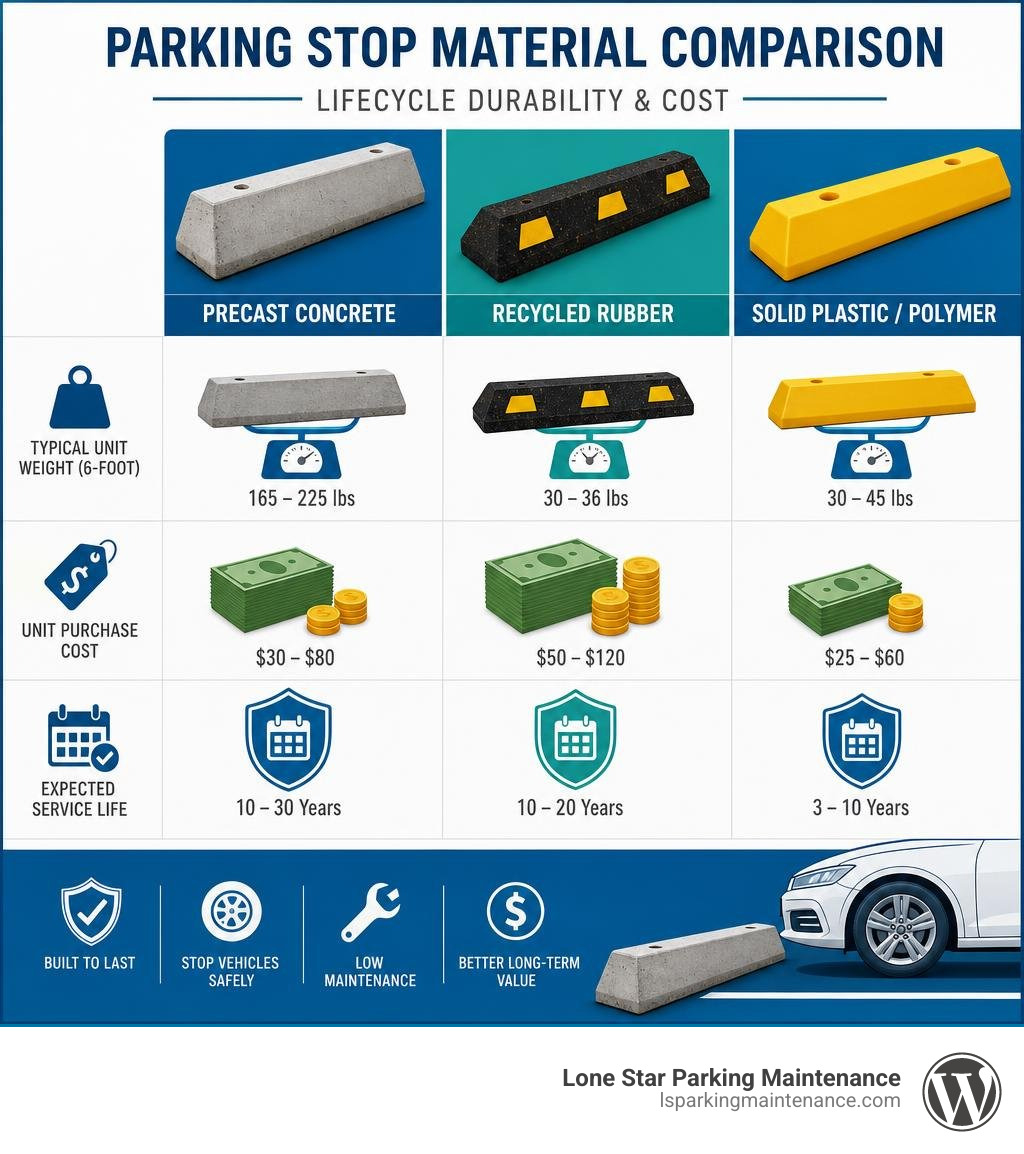
| Performance Factor | Precast Concrete | Recycled Rubber | Solid Plastic / Polymer |
|---|---|---|---|
| Typical Unit Weight (6-Foot) | 165 – 225 lbs | 30 – 36 lbs | 30 – 45 lbs |
| Unit Purchase Cost | $30 – $80 | $50 – $120 | $25 – $60 |
| Expected Service Life | 10 – 30 Years | 10 – 20 Years | 3 – 10 Years |
| Internal Reinforcement | (2) #4 Steel Rebar | None (Flexible Matrix) | None (Solid or Hollow) |
| Resistance to Summer Heat Warping | Excellent (Rigid) | Moderate (Softens) | Poor (Prone to Curving) |
| Snowplow / Sweeper Resistance | High (Heavy Mass) | Moderate (Can Tear) | Low (Can Crack/Dislodge) |
| Installation Hardware | 1/2″ to 3/4″ Rebar Pins / Bolts | Lag Bolts or Spikes | Lag Bolts or Spikes |
| Primary Failure Point | Unsealed anchor cracking | Tearing at bolt holes | UV brittleness and warping |
When planning out your facility’s layout, reviewing technical installation guidelines alongside local municipal building codes ensures you select the exact material rated for your lot’s traffic volume.
Longevity and Impact Durability in High-Traffic Lots
Precast concrete parking blocks offer an expected service life of 10 to 30 years under normal commercial operating conditions. Their sheer mass gives them an unmatched advantage: even before considering anchoring hardware, a 200-pound block resists shifting when tapped at low parking speeds.
In commercial parking lots where commercial sweepers and utility equipment operate regularly, concrete stops hold their ground without gouging or tearing.
By comparison, lightweight plastic blocks can curl up at the edges under intense Texas summer sun exposure, creating severe tripping hazards. Rubber stops, while gentle on low-slung vehicle fascias, can tear at their anchor points when struck by heavy delivery vehicles or commercial plows.
When properly sealed against water penetration, high-density concrete resists seasonal moisture expansion and maintains its structural integrity through decades of vehicle turnover.
Total Cost of Ownership and Replacement Cycles
From a financial standpoint, concrete remains the most cost-effective solution for permanent facilities. At an average initial price point of $30 to $80 per unit, concrete is considerably cheaper than premium recycled rubber stops ($50 to $120). While freight handling costs are higher for concrete due to its weight, its total lifecycle cost is significantly lower because it eliminates the routine replacement cycles associated with plastic units.
Property managers who try to save on freight by installing lightweight plastic blocks often find themselves replacing warped or cracked units every 3 to 5 years. Utilizing an ultimate checklist for buying parking wheel stops allows facility teams to calculate true long-term value, factoring in installation labor, material longevity, and contractor callback prevention.
Pavement Anchoring Methods for Asphalt and Concrete Surfaces
A common misconception is that a 200-pound parking bumper is heavy enough to sit unanchored. In reality, repeated vehicle impacts cause unanchored blocks to “walk” across the asphalt over time. Within a few months, unanchored stops end up crooked, encroaching on pedestrian lanes, or scraping undercarriages.
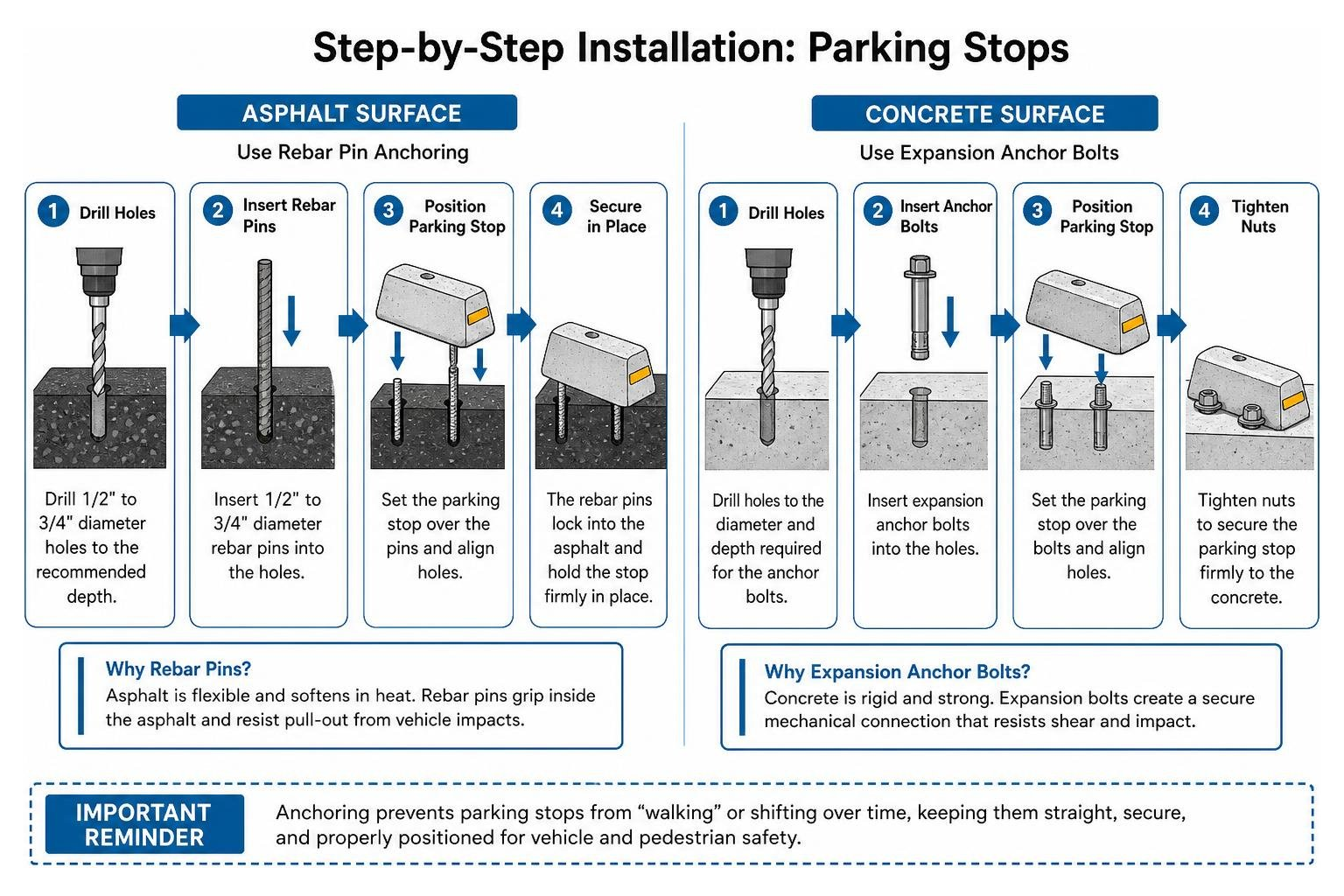
Choosing the correct fastening method depends entirely on the pavement substrate beneath the stop.
Rebar Pin Anchoring for Asphalt Lots
Asphalt is a flexible pavement material composed of aggregate bound by bituminous asphalt cement. Because asphalt softens under sustained summer heat and lacks the rigid shear strength of concrete, mechanical expanding anchors will pull free under impact.
The gold standard for anchoring concrete wheel stops into asphalt is driving long steel rebar pins through the stop’s precast holes directly into the ground:
- Alignment: Snap a chalk line across the stalls to establish a uniform setback distance from the curb or sidewalk edge.
- Placement: Set the concrete stops in place, checking for level alignment across the stall width.
- Drilling Substrate: Using a heavy-duty rotary hammer drill with a 1/2-inch or 5/8-inch masonry bit, drill down through the precast receiver holes into the asphalt to a depth matching the pin.
- Driving Pins: Drive 1/2-inch (#4) or 5/8-inch (#5) steel rebar pins measuring 14 to 18 inches in length directly through the block and asphalt into the underlying compacted sub-base using a small sledgehammer or demolition driver.
- Countersinking: Ensure the top of the rebar pin is driven flush or slightly recessed below the precast chamfered hole. A protruding pin head can easily slash a low-profile tire or trip a pedestrian.
- Sealing: Fill the receiver hole recess with exterior polyurethane sealant or non-shrink grout to block water and dirt intrusion.
Property owners should follow a detailed parking wheel stops installation manual to verify proper drilling depths and ensure pins penetrate deep into the compacted aggregate subgrade.
Caution: Never rely solely on industrial adhesives to secure concrete parking stops to asphalt surfaces. In high temperatures, asphalt binder softens; vehicle impact forces will simply tear the adhesive away, ripping up chunks of the asphalt surface layer with it.
Adhesive and Lag Bolt Fastening for Concrete Decks
Installing parking stops onto rigid concrete pavement or multi-level parking garages requires a completely different approach. Drilling deep into elevated parking deck slabs is strictly prohibited if the facility utilizes post-tensioned cables, as severing an internal tensioned steel tendon can cause catastrophic structural failure.
For elevated parking garages and post-tensioned slabs:
- Two-Part Epoxy Bonding: Thoroughly clean and degrease the concrete surface using a wire brush and vacuum. Apply a heavy 1/2-inch bead of high-strength structural epoxy or moisture-cure polyurethane adhesive across the entire underside contact surface of the precast stop. Lower the block into position and allow it to cure for a minimum of 24 to 48 hours before allowing vehicle traffic.
For ground-level concrete slabs (non-post-tensioned):
- Lag Bolts and Expansion Anchors: Drill 4 to 6 inches into the concrete slab using a rotary hammer drill. Insert concrete anchor shields, position the stop, and torque down 6-inch by 1/2-inch galvanized lag bolts fitted with heavy washers. This provides exceptional shear resistance without relying on surface bonding alone.
ADA Compliance and Layout Best Practices for Parking Stalls
A parking space concrete stop serves two primary safety functions: preventing physical property damage and keeping accessible pedestrian pathways clear of vehicle encroachment.

Under the Americans with Disabilities Act (ADA) accessibility guidelines, accessible routes along sidewalks and building frontages must maintain a continuous, unobstructed clear width of at least 36 inches (or 48 inches for high-traffic public walkways).
When a driver pulls into a stall without a parking stop, the front bumper of an average passenger car overhangs the curb by 18 to 24 inches. On a standard 4-foot or 5-foot sidewalk, this overhang narrows the usable walking space down to less than 24 inches, trapping wheelchair users and creating significant trip hazards for visually impaired visitors.
Consulting a comprehensive wheel stop placement guide will help you calculate vehicle front overhang allowances based on your specific stall depth.
How to Position a Parking Space Concrete Stop for Walkway Clearance
To prevent vehicle encroachment while maximizing parking stall efficiency, follow these standard layout measurements:
- Setback Distance: Position the front edge of the 6-foot concrete stop between 2.5 and 3 feet (30 to 36 inches) back from the head of the stall or the edge of the adjacent sidewalk. This halts the front tires at a distance that keeps the front bumper from extending over the walkway.
- Centering in the Stall: Center a 6-foot stop within a standard 9-foot parking space. This leaves roughly 18 inches of clear pavement on each side of the block, giving pedestrians an unobstructed path between parked cars and preventing tripping accidents when passengers exit their vehicles.
- Drainage Gaps: In outdoor surface lots where storm runoff flows across parking rows, select concrete stops manufactured with bottom drain slots. These notches allow water to pass underneath without damming runoff, preventing stagnant water pooling around vehicle tires.
Reviewing industry specifications for concrete parking stops can help you confirm exact dimensions and drainage slot options prior to site layout.
High-Visibility Markings and Accessibility Stalls
Unpainted gray concrete stops blend into weathered asphalt, creating severe tripping hazards for pedestrians walking through parking aisles at night. Applying traffic-grade coatings enhances overall lot safety and clearly designates space usage:
- Safety Yellow / Reflective White: Standard for general commercial stalls to maximize contrast against dark asphalt surfaces and guide drivers into stalls under low-light conditions.
- Handicap Blue: Mandatory for designated accessible stalls and van-accessible spaces. Applying traffic-grade blue paint with high-contrast ADA stencils provides clear visual cues that protect reserved spaces from unauthorized use.
- Safety Orange / Custom Colors: Used to delineate dedicated motorcycle stalls, electric vehicle (EV) charging stations, emergency lanes, or loading docks.
For an overview of basic parking facility hardware, check out wheel stoppers 101 to see how proper paint striping and bumper placement work hand-in-hand.
Frequently Asked Questions About Parking Stops
How many concrete parking stops does a commercial lot need?
You do not necessarily need a wheel stop in every single parking stall. In large interior bays where stalls face each other head-to-head, painted stall lines are often sufficient.
However, parking stops are strongly recommended—and frequently required by municipal building codes—in the following high-risk zones:
- Every designated ADA-accessible and van-accessible stall.
- All perimeter stalls bordering pedestrian sidewalks, entrance walkways, and ramps.
- Stalls facing building walls, glass storefronts, structural columns, or utility enclosures.
- Spaces directly adjacent to delicate landscape beds, tree planters, or irrigation equipment.
- Sloped parking stalls where gravity could cause parked vehicles to roll into traffic lanes.
What maintenance is required to prevent concrete wheel stops from cracking?
Precast concrete parking blocks require minimal ongoing maintenance, but regular inspections help prevent premature failure:
- Seal Anchor Holes: Ensure top pin holes remain sealed with grout or polyurethane to prevent rainwater from entering. In freezing temperatures, trapped water freezes and expands, fracturing the concrete core.
- Check Pin Tightness: Inspect pins annually. If a pin begins working its way up, drive it back down flush to eliminate tire damage risks.
- Clean and Re-stripe: Power wash accumulated oil and grime every 12 to 24 months, and re-coat with reflective traffic paint to maintain high visual contrast.
- Replace Fractured Units: If a concrete stop breaks in half due to heavy impact, replace it immediately. A half-broken stop only arrests one tire, which can cause an arriving vehicle to unexpectedly twist sideways into an adjacent car or walkway.
Why do concrete parking stops have chamfered edges and sloped faces?
Quality precast parking curbs feature chamfered (beveled) top edges and a trapezoidal sloped face rather than sharp 90-degree corners.
This design serves three critical engineering purposes:
- Tire and Wheel Protection: The sloped face provides a gentle contact angle that deflects tire impact without gouging the rubber or scratching expensive alloy wheel rims.
- Pedestrian Safety: Chamfered corners reduce sharp strike edges, minimizing the risk of severe cuts or injuries if a pedestrian accidentally trips across the block in the dark.
- Chipping Resistance: Sharp square edges on concrete are brittle and chip away easily upon minor contact. Chamfered bevels disperse impact energy, significantly extending the life of the precast unit.
Conclusion
A well-planned commercial parking facility balances driver convenience, pedestrian safety, and long-term asset protection. Installing heavy-duty, steel-reinforced concrete parking stops is one of the most cost-effective investments a property owner can make to prevent storefront collisions, protect landscaped boundaries, and maintain full ADA walkway compliance.
Whether you are restriping a retail shopping center, retrofitting an office park, or managing a multi-level parking garage in the DFW Metroplex, our team at Lone Star Parking Maintenance provides complete layout design, precision drilling, and top-tier precast installations.
Explore our protective pole covers and curb stop installation services today to keep your commercial property clean, organized, and fully protected against vehicle damage.