
Can You Put Up a No Parking Without Permission Sign?
Yes. If you manage a private lot in the DFW Metroplex, you can generally post a no parking without permission sign on property you control. The sign tells drivers they need your consent to park there. It does not, by itself, let you issue a city parking ticket or tow a vehicle without following Texas law.
Before installing a sign, confirm your property boundaries, make the rule easy to see, and check Texas requirements if you plan to tow unauthorized vehicles. Those steps help protect access to your lot without creating a new problem for your business.
I’m Cason, and I’ll walk you through what to check before you put up a sign.
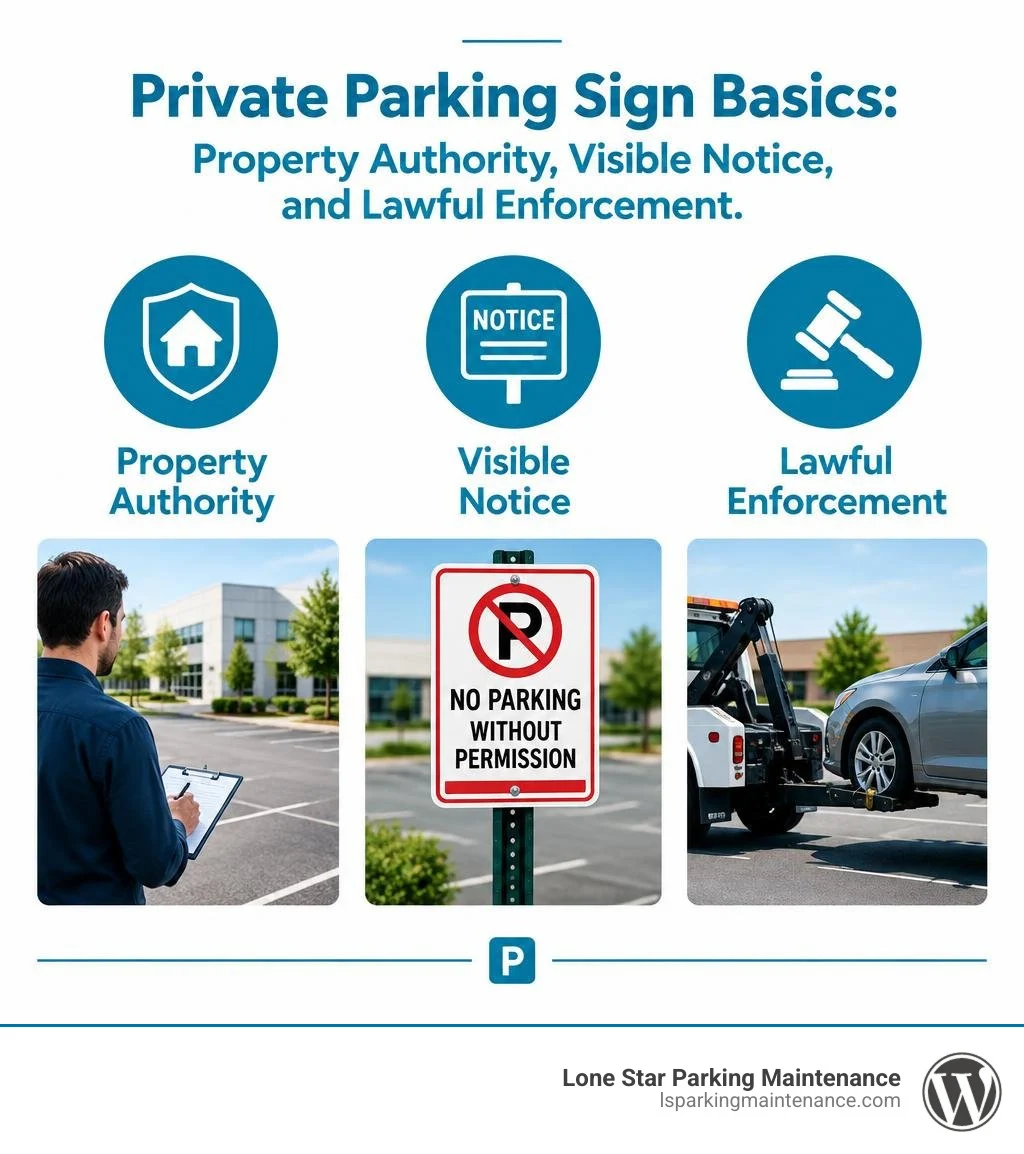
No parking without permission definitions:
Understanding No Parking Without Permission on Private and Public Property
When you own or manage real estate, control over your parking spaces is vital to maintaining daily business operations and customer satisfaction. However, the legal rules governing unauthorized vehicles vary dramatically depending on whether a vehicle is stopped on your private land or situated on a public street.
Under Texas law, parking on private property without authorization is treated primarily as a civil matter connected to trespassing and property rights, rather than an automatic criminal traffic citation. Municipal police do not spend their days patrolling private commercial lots to issue municipal parking citations unless a specific statutory violation occurs—such as blocking a marked fire lane or occupying a designated accessible stall without a valid placard. For standard stalls, property managers must establish clear rules and implement lawful civil remedies.
Statewide statutory rules govern public roadways under the Texas Transportation Code parking regulations, while municipalities exercise local police power through regulations like chapter 601 municipal authority relating to parking. Understanding where public jurisdiction ends and private authority begins is the first step toward reclaiming control of your lot.
Legal Rights of Private Property Owners
As a commercial property owner or facility manager, your legal authority over your physical real estate is comprehensive. You have the right to determine who uses your parking facilities, how long they remain, and what business purpose justifies their presence.
Whether you operate an office park in Plano, a retail strip in Fort Worth, or an industrial warehouse in Dallas, unauthorized vehicles create genuine liabilities:
- They consume valuable spaces intended for paying customers and staff.
- They impede delivery trucks, waste management access, and emergency response routes.
- They can expose you to liability if poorly parked vehicles obscure sightlines or cause pedestrian accidents.
To exercise your right to remove unauthorized vehicles, you must provide proper visual notice. Installing private no parking signs and legal enforceability safeguards ensures that any subsequent towing action complies fully with state statutes, protecting you from wrongful-towing claims.
Public Street Restrictions vs. Private Land Rules
A common point of confusion arises when property owners attempt to regulate the street curb directly outside their facility or residence. The asphalt road and adjacent curb in front of your building are almost always part of the public right-of-way.
Even if you maintain the grass on the parkway strip, you do not own the street curb. You cannot legally paint public curbs red, erect homemade warning posts, or install commercial tow-away signs along the city street. In fact, municipal guidelines clarify that posting your own “No Parking” sign isn’t a solution on public streets and can lead to code compliance fines against the property owner.
If public street parking is causing severe congestion or blocking your commercial entrance, relief must come through official municipal channels, such as applying for parking permits and licenses or petitioning the city traffic engineering department for formal curbside restrictions.
Essential Signage Rules and Regulatory Standards
To make any parking restriction legally binding and easily understood by drivers, your signs must meet specific regulatory and physical standards. In the United States, sign design, color coding, and reflectivity follow the Manual on Uniform Traffic Control Devices (MUTCD). Adhering to these engineering standards guarantees that your signs remain legible in all lighting conditions and withstand scrutiny if a vehicle owner challenges a towing fee.
Signs must be fabricated from durable, rust-free aluminum and faced with retroreflective sheeting so headlights illuminate the message clearly at night. For outdoor lots, engineer-grade or high-intensity prismatic reflective materials ensure longevity against intense Texas sunlight and summer heat.
Mounting height is equally critical: signs along pedestrian walkways or parking stalls must be mounted at a clear height of 7 feet from the bottom of the sign to the ground. This prevents pedestrian head injuries and ensures the sign remains visible over the hoods of parked SUVs and pickup trucks.
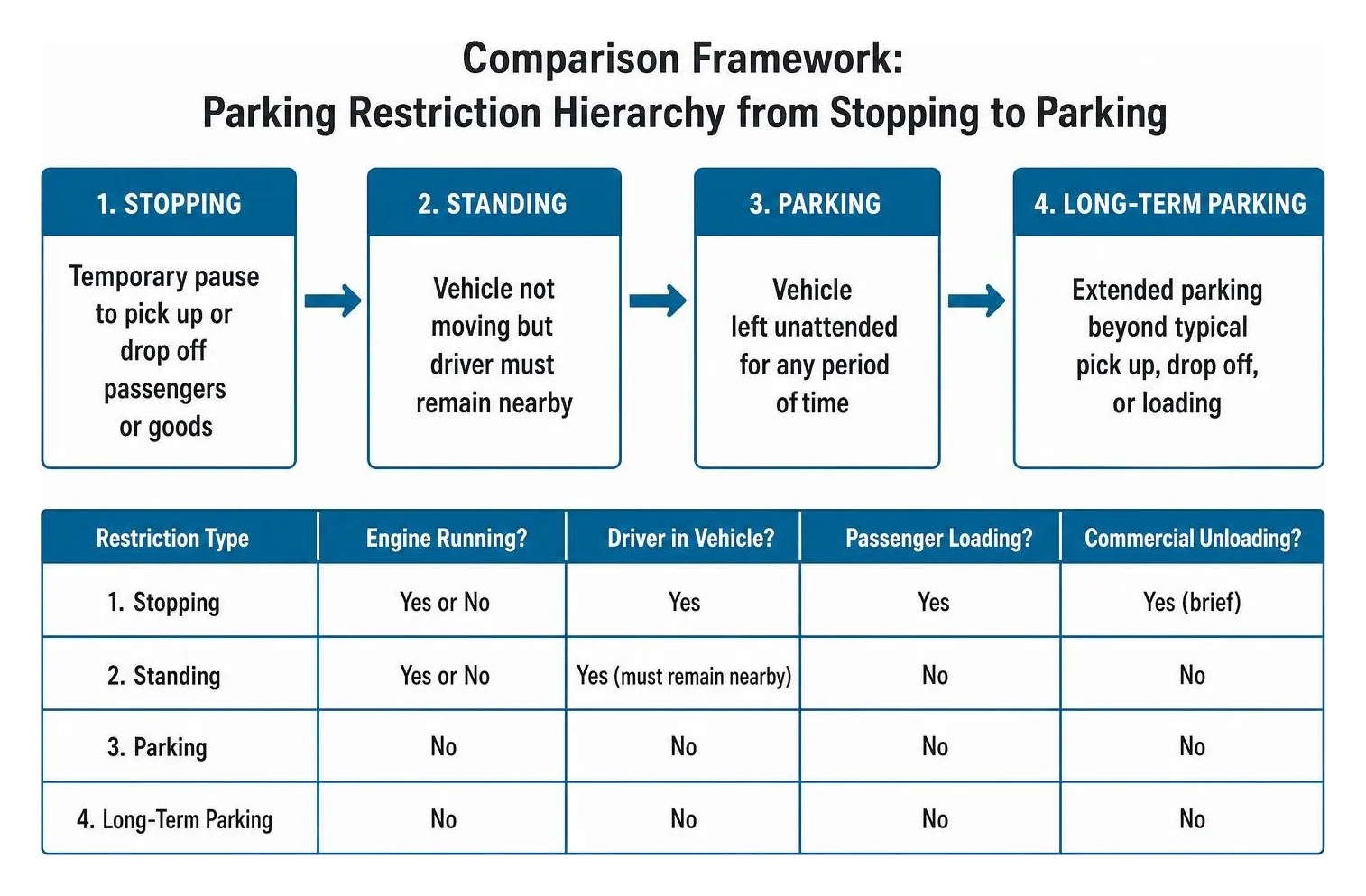
| Restriction Type | Engine Running? | Driver in Vehicle? | Passenger Loading? | Commercial Unloading? |
|---|---|---|---|---|
| No Parking | Allowed Briefly | Allowed | Allowed (Quick drop-off) | Prohibited |
| No Standing | Prohibited | Prohibited | Allowed (Immediate entry/exit) | Prohibited |
| No Stopping | Prohibited | Prohibited | Prohibited | Prohibited |
Enforcing No Parking Without Permission with Compliant Signage
If you want the legal ability to tow unauthorized vehicles from a private parking facility in Texas, your signs must follow strict statutory guidelines outlined in the Texas Occupations Code (Chapter 2308, commonly known as the Texas Towing Act). A generic cardboard notice or hand-painted wooden sign does not give a licensed towing operator the legal authority to remove a vehicle.
To be fully compliant, your signs must:
- Feature a conspicuous, bright red international towing symbol at the top.
- Clearly display the exact words “TOWING ENFORCED” or “UNAUTHORIZED VEHICLES WILL BE TOWED AT OWNER’S OR OPERATOR’S EXPENSE.”
- State the precise restriction (e.g., “CUSTOMER PARKING ONLY,” “RESERVED 24/7,” or “NO PARKING WITHOUT PERMISSION”).
- Provide the name and current telephone number of the licensed towing company or the property management dispatch service responsible for vehicle retrieval.
- Be posted at every vehicle entrance to the property or along individual designated stalls.
Reviewing a comprehensive guide to buying compliant parking lot signs will help ensure your lot layout meets every statutory detail before enforcement begins.
Decoding Sign Arrows and Boundary Markers
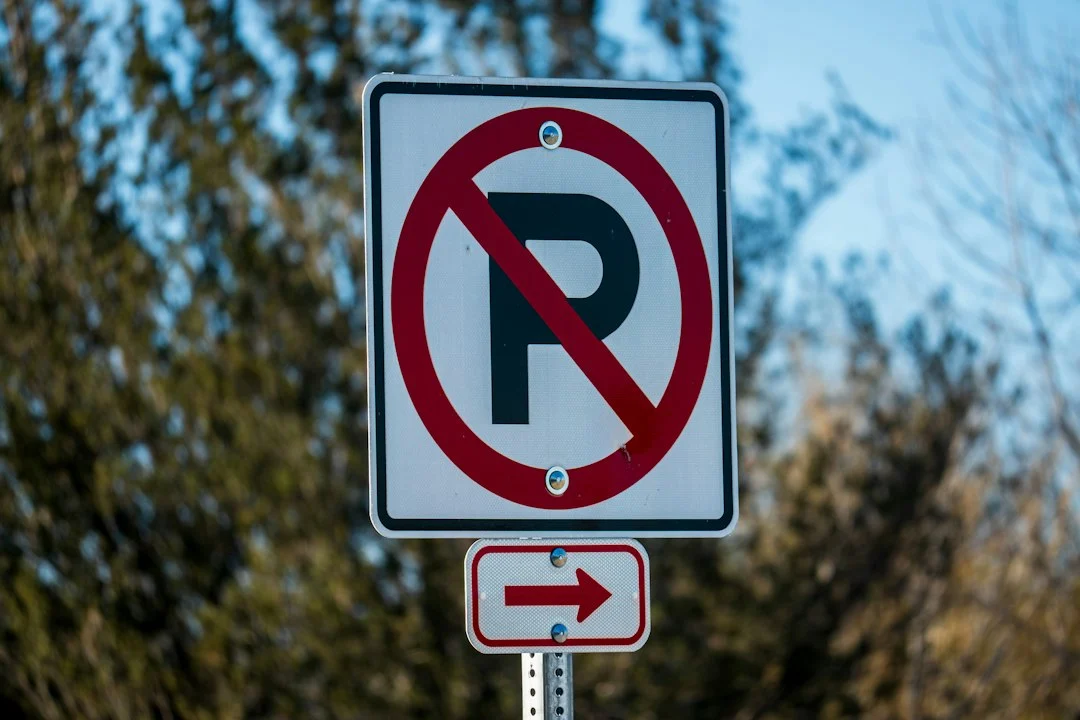
Directional arrows on parking restriction signs act as curbside navigators, establishing the exact spatial boundaries where a rule applies:
- Single Right-Pointing Arrow: Indicates that the stated parking restriction begins at the sign post and extends forward along the curb or lane.
- Single Left-Pointing Arrow: Signals that the restriction applies to the curb space behind the sign post, terminating at that marker.
- Double-Headed Arrow (Left & Right): Establishes that the restriction is active in both directions along that curb line or stall bank until another sign or physical boundary alters the regulation.
When paired with stenciled pavement markings, painted curb colors, or stall striping, these arrows eliminate any ambiguity for visiting motorists.
No Parking vs. No Standing vs. No Stopping
Drivers frequently confuse the legal definitions of parking, standing, and stopping. Remembering the simple rule of thumb—”freedoms disappear in the order of Park, Stand, and Stop”—clarifies what is permitted at the curb:
- No Parking: You cannot leave your vehicle unattended. However, you are generally permitted to stop momentarily to pick up or discharge a passenger, or quickly load/unload personal belongings, provided the driver remains with the vehicle and leaves promptly.
- No Standing: A stricter restriction. You may briefly halt your vehicle solely to receive or discharge passengers. You may not halt the vehicle to load or unload merchandise, packages, or freight, even if you remain behind the wheel.
- No Stopping: The most restrictive designation. Drivers are completely forbidden from halting their vehicle for any reason, whether idling, dropping off a passenger, or waiting, except when required by a police officer, traffic signal, or to avoid an immediate collision.
For facilities that manage executive stalls, patient drop-offs, or tenant-allocated spaces, pairing these designations with proper reserved parking signage rules keeps traffic moving smoothly.
Mandatory Buffer Distances and Prohibited Parking Zones
State traffic safety laws establish mandatory clear zones around critical infrastructure to preserve emergency access and visibility. Even on properties with minimal signage, statutory rules restrict vehicles from parking within designated buffer distances.
These safety distances are not arbitrary; urban planning data indicates that illegal curb use accounts for roughly 20% to 25% of downtown traffic congestion, while blocked emergency access can add up to two critical minutes to emergency response times. Safety codes nationwide, including detailed provisions like Maryland traffic codes on parking prohibitions, emphasize these baseline buffer zones to keep transit corridors clear.
Statutory Clearances for Fire Hydrants and Crosswalks
Under the Texas Transportation Code, drivers may not stop, stand, or park a vehicle within 15 feet of a fire hydrant. This buffer gives fire engines room to access the water valve and lay high-pressure hoses without obstruction.
Similarly, parking is strictly prohibited within 20 feet of a crosswalk at an intersection. This clearance ensures approaching motorists have an unobstructed view of pedestrians stepping off the curb. Around traffic control devices—such as stop signs, yield signs, or flashing beacons—drivers must maintain a minimum buffer of 30 feet on the approach. In commercial parking centers, maintaining these parameters requires dedicated fire lane compliance and visible curb striping to keep first responders unobstructed.
Driveway Clearance and Intersection Visibility
Blocking a commercial or residential driveway is illegal across Texas. A parked vehicle cannot overhang or obstruct any portion of a driveway curb cut or apron.
Near intersections, parked vehicles must not impede the sight triangle required for safe turning maneuvers. Furthermore, state law prohibits parking within 50 feet of the nearest rail of a railroad crossing, where a stalled or queued vehicle poses catastrophic collision risks. To maintain clear sightlines and smooth traffic flow on your commercial property, follow practical driveway parking laws to safeguard entrances, exits, and interior drive aisles.
Property Owner Action Plan for Unauthorized Vehicles
Discovering unauthorized vehicles parked on your property is frustrating, but taking a systematic, professional approach protects your business from unnecessary disputes. Avoid emotional confrontations, blocking vehicles in with other cars, or using homemade immobilization devices, all of which can expose you to property damage claims or civil liability.

Step-by-Step Response to No Parking Without Permission Violations
When an unauthorized car or truck enters your private lot, follow a structured process to resolve the issue:
- Verify Signage Visibility: Ensure your posted no-parking signs are clearly visible, unobstructed by overgrown tree branches or landscaping, and fully legible.
- Document the Infraction: Take clear, time-stamped photographs of the vehicle. Capture the license plate, the vehicle make and model, the vehicle’s position relative to your posted signs, and the wider parking area showing the absence of an authorized permit.
- Log Vehicle Records: Maintain a private digital log detailing the date, arrival time, make, model, license plate, and any previous violation history for repeat offenders.
- Issue a Notice or Contact Towing: For first-time or minor infractions, placing an adhesive-free warning notice under the windshield wiper often resolves the issue. For habitual violators or vehicles obstructing fire routes, contact your contracted towing provider.
Installing and installing clear parking area signs across your lot prevents misunderstandings and establishes firm legal grounds for removal.
Towing Protocols, Time Limits, and Municipal Notification
Under the Texas Towing Act, private property non-consent towing requires a pre-existing written agreement with a licensed, insured towing operator. Once you contact your towing partner to remove an unauthorized vehicle, the towing operator is legally mandated to notify local police dispatch (such as the municipal police department or county sheriff) within a strictly defined statutory window—typically 45 minutes to one hour after hook-up.
This mandatory police notification ensures that when the vehicle owner calls emergency services reporting their car stolen, dispatch can immediately direct them to the licensed vehicle storage facility (VSF) where the car is securely held. All impound fees, daily storage fees, and administrative charges are regulated by state and local caps, and are assessed directly against the vehicle owner upon retrieval.
Frequently Asked Questions About Parking Restrictions
Can I put up a No Parking sign on the street in front of my house?
No. You cannot legally install your own “No Parking” sign on a public residential street or city curb. The street and public right-of-way are municipal property governed by city traffic codes. Erecting unauthorized signs on city-owned parkways or utility poles is a code violation and can result in municipal fines.
If vehicles regularly block your residential driveway or congest your neighborhood street, you must contact your city’s 311 service line or transportation department to request official signage, sightline assessments, or residential parking permit zone evaluations. In areas with high nightlife or retail traffic, local authorities handle enforcement directly, as seen with Dallas PD enforcing ‘No Parking’ restrictions in popular neighborhoods.
What are the typical fines and towing fees for unauthorized parking?
Municipal parking citations in Texas cities typically range from $45 to $250, depending on the severity of the infraction (such as standard meter overtime versus parking in an accessible stall or blocking a fire hydrant).
For private property impounds, non-consent towing rates are regulated by state and municipal fee schedules. Standard private property light-duty towing fees generally range from $150 to $250, with licensed storage facilities adding daily storage fees of $20 to $40 per day, plus applicable administrative and impound notification fees. If a vehicle is booted rather than towed, municipal and private boot removal fees commonly range from $45 to $100.
What are the exceptions for loading zones and emergency vehicles?
Designated commercial loading zones permit short-term parking strictly for actively loading or unloading cargo, freight, or merchandise, typically restricted to a 15- to 30-minute window. Passenger vehicles may only use commercial zones for brief passenger drop-offs if they do not interfere with commercial carriers.
Emergency response vehicles (police cruisers, fire apparatus, and ambulances) are universally exempt from curbside parking restrictions when actively responding to calls or conducting official duties. Vehicles displaying valid state-issued disability placards or license plates are granted exemptions from municipal parking meter fees and time restrictions in many public jurisdictions, but they must still obey absolute safety prohibitions (such as fire zones, loading zones, and red curbs) and must possess appropriate authorization on private commercial properties.
Conclusion
Enforcing parking rules on your commercial property protects your business, your tenants, and your customers. By understanding the distinction between public rights-of-way and private land, adhering to MUTCD physical signage standards, maintaining required buffer clearances, and strictly complying with Texas towing regulations, you can eliminate unauthorized parking while minimizing legal liability.
At Lone Star Parking Maintenance, we help facility managers and property owners throughout the DFW Metroplex maintain safe, compliant, and pristine parking facilities. From high-durability sign installation and precision fire lane striping to sealcoating and power washing, our team delivers industry-leading solutions tailored to your property. If your facility is struggling with unauthorized parking, consider upgrading entrance and parking lot signs for organized property management to take back control of your lot today.