
Why Parking Lot Audits Prevent Bigger Problems
Parking lot audits are structured inspections of your pavement, striping, drainage, lighting, signs, and space use. They help property managers find small issues early, before they become safety risks, costly repairs, tenant complaints, or lost revenue.
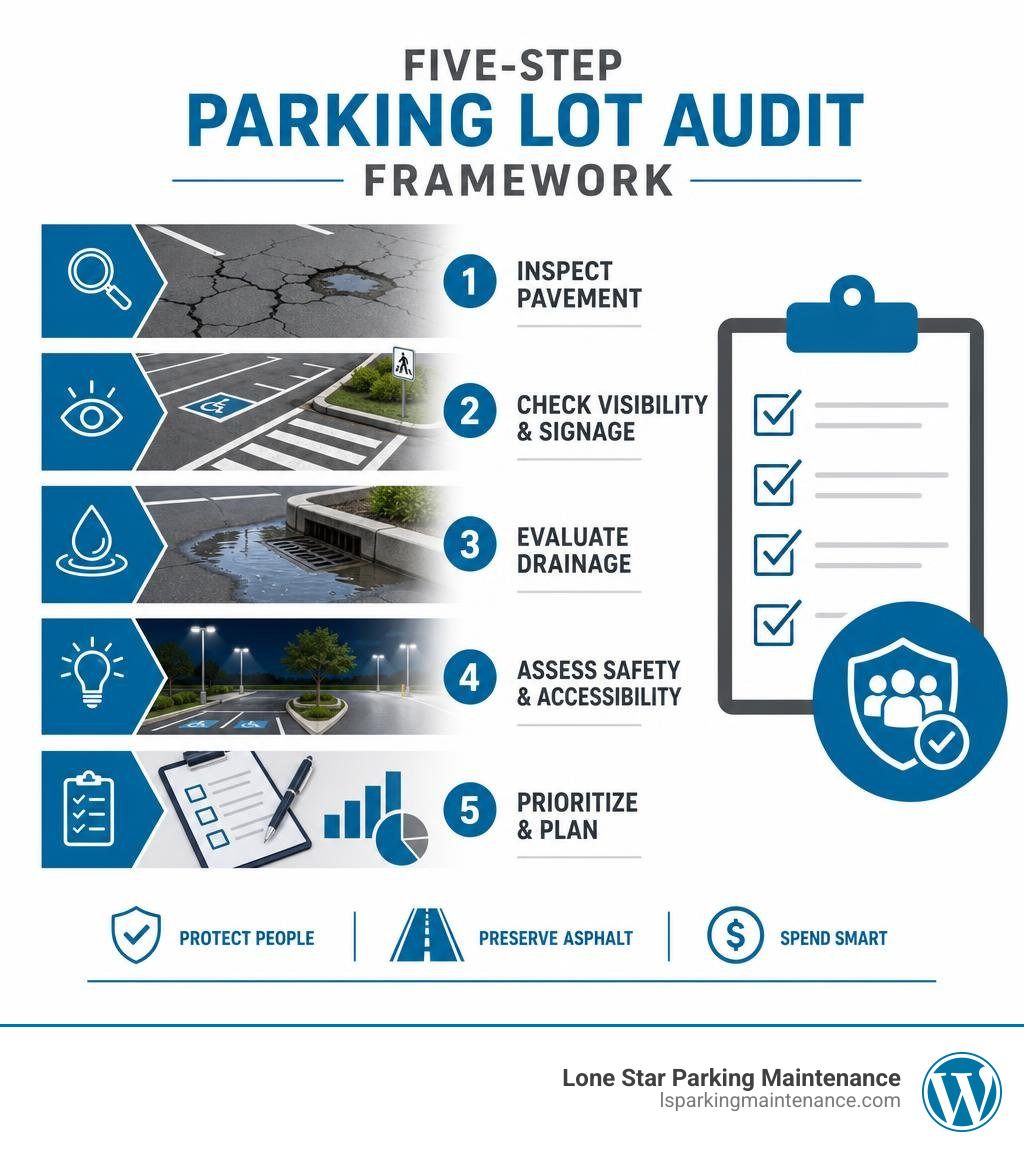
A basic audit should answer five questions:
- Is the asphalt cracked, uneven, stained, or developing potholes?
- Can drivers and pedestrians clearly see striping, crosswalks, signs, and curbs?
- Does water drain away from the lot instead of pooling near entrances or low spots?
- Are lighting, accessible spaces, and traffic routes safe and usable?
- Which repairs need immediate action, and which can be planned for later?
This matters because parking lots are not just places to store cars. They are active walking and driving areas. Research cited by the National Safety Council finds that one in five traffic accidents occurs in parking lots, while 60% of slip-and-fall claims happen outdoors. A faded crosswalk, shallow pothole, blocked drain, or poorly lit walkway can create a problem far beyond its apparent size.
For DFW property owners, regular audits create a clear record of conditions and turn reactive patchwork into a practical maintenance plan. The goal is simple: protect people, preserve asphalt, and spend repair dollars before damage piles up.
I’m Cason, and this guide will show you what to inspect, measure, document, and prioritize during a parking lot audit.
Quick parking lot audits terms:
Core Types and Strategic Benefits of Parking Lot Audits
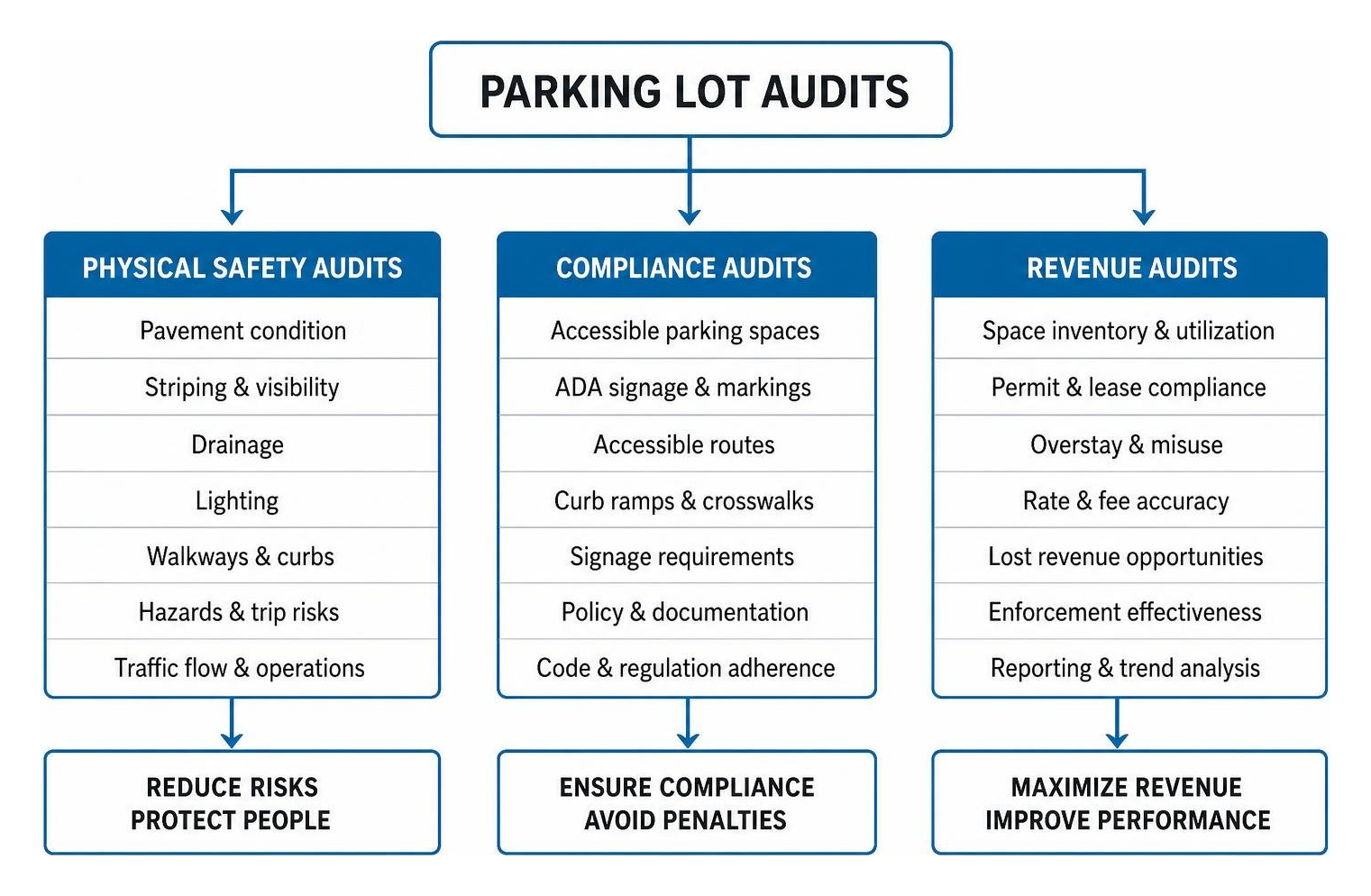
To manage a parking facility effectively across the DFW Metroplex, property managers cannot rely on a single surface-level walkthrough. Comprehensive parking lot audits span multiple categories—including physical risk control, statutory accessibility compliance, and operational financial control. Bridging the gap between written facility policy and daily real-world practice is where true risk mitigation occurs. For a deeper look into premises risk management, review this guide on Parking Lot and Sidewalk Audits.
Safety and Liability Audits: Mitigating Slip-and-Fall Risks
Safety audits focus directly on premises liability, hazard reduction, and worker safety. Under OSHA guidelines, employee parking areas are explicitly classified as part of the employer’s premises. Consequently, worker injuries occurring in your lot count as recordable workplace incidents.
When you consider that 60% of all personal injury slip-and-fall claims occur outdoors, and National Safety Council data confirms that 20% of motor vehicle accidents happen in parking environments, a proactive physical safety audit becomes your primary defense.
Key liability mitigation strategies uncovered during safety audits include:
- Pothole and Trip Hazard Spotting: A minor asphalt depression or 1-inch edge drop-off might feel negligible to a moving car, but it poses an immediate severe trip risk to a pedestrian carrying groceries or walking at night.
- Traffic Speed Management: Traffic control measures must alert drivers without introducing pedestrian trip points. Parking facility experts increasingly prefer engineered rumble strips over aggressive, steep speed bumps, which can create physical trip hazards for walking visitors.
- Landscaping Sightlines: Overgrown shrubbery or untrimmed low-hanging branches near lot exits blind drivers to oncoming street traffic and pedestrian crosswalks. Trimming sightlines at property intersections prevents needless vehicular collisions.
To learn more about keeping your asphalt surfaces smooth and hazard-free, explore our resource on keeping your lot safe.
Operational and Compliance Audits: Safeguarding ADA Standards
Operational and compliance audits evaluate whether your physical space meets rigorous federal Americans with Disabilities Act (ADA) accessibility guidelines and local municipal building codes. Beyond avoiding costly federal lawsuits, keeping your accessible stalls up to code ensures your property remains open and welcoming to every member of the community.
Using a structured Parking Operations Audit Checklist allows facility managers to verify essential dimensions and structural features:
- Accessible Space Allocation: At least 1 out of every 6 accessible spaces must be designated as van-accessible.
- Stall and Aisle Dimensions: Standard accessible stalls require a minimum width of 8 feet alongside a 5-foot marked access aisle. Van-accessible stalls require an 11-foot width with a 5-foot aisle (or an 8-foot stall with an 8-foot aisle).
- Signage Mounting Heights: Universal International Symbol of Accessibility (ISA) signs must be mounted at a minimum height of 60 to 66 inches measured from the pavement surface to the bottom of the sign so they remain visible when a vehicle is parked in the bay.
- Cross Slope Standards: Slope and cross slope within accessible parking spaces and adjoining access aisles must never exceed 2.0% in any direction. Asphalt settling, rutting, or unaddressed surface wear over time frequently pushes slopes past this 2% legal threshold, making periodic re-auditing vital after any resurfacing or restriping work.
For a comprehensive breakdown of statutory parking requirements and budgeting considerations, see our guide on ADA compliance and calculating ADA costs.
Step-by-Step Execution: Conducting a Physical Surface and Safety Assessment
Conducting a physical audit requires a structured walkaround of every square foot of pavement, perimeter zone, and entry structure. Rather than conducting casual visual checks, facility teams should follow a systematic methodology to catch surface defects before they escalate into major capital expenditures.
Physical Checklist for Surface Asphalt and Pavement Markings
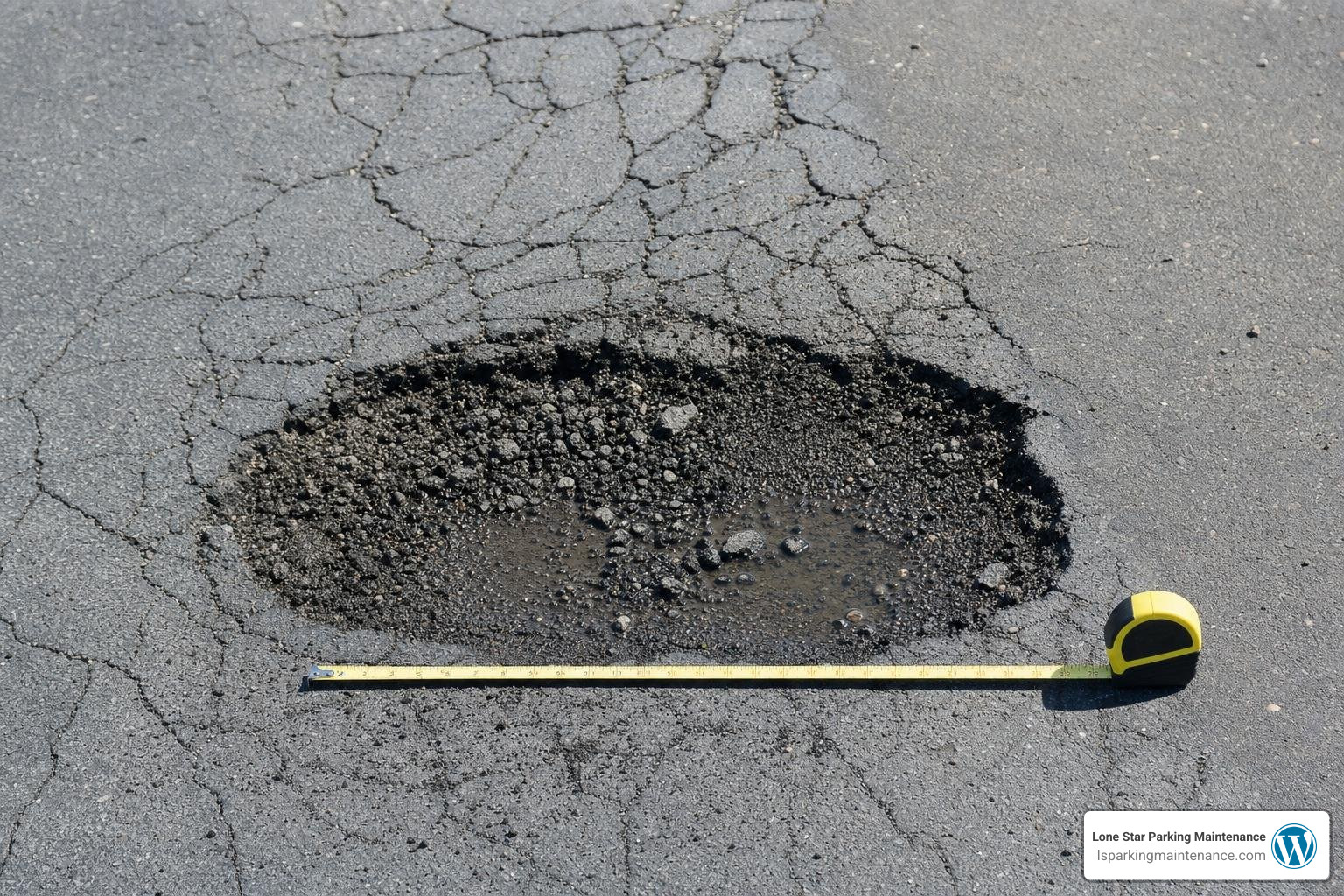
Catching asphalt distress early prevents minor maintenance items—such as $50 crack sealing jobs—from deteriorating into $5,000 full-depth pavement failures. During your physical audit walkaround, evaluate the following essential surface elements:
- Asphalt Distress Profiling: Inspect for hairline longitudinal cracks, alligator cracking (interlocking fatigue cracks resembling reptile skin), depressions, surface raveling, and active potholes.
- Pavement Striping and Line Contrast: Ensure directional arrows, fire lane red curbs, loading zones, and individual stall lines remain bright, crisp, and high-contrast. Faded pavement markings lead to disorganization, wing-mirror scrapes, and unauthorized parking.
- Crosswalk Visibility: High-visibility marked crosswalks must be clearly defined across active drive aisles to establish pedestrian right-of-way.
- Drainage Structures and Catch Basins: Verify that storm grates are flush with surrounding asphalt and free of debris accumulation. Standing water rapidly weakens asphalt subbases, accelerating structural failure.
- Lighting and Fixture Uptime: Perform night audits to identify burned-out LED heads, damaged light poles, or shadowy spots. Defective fixtures should be flagged for replacement within 48 hours to preserve security and pedestrian safety.
For detailed instructions on executing surface remediation, check out the complete guide to me parking lot repairs.
Seasonal Protocol Variations: Freeze-Thaw Cycles and Storm Prep
In North Texas, dynamic weather swings—from extreme summer heat spells to winter freeze-thaw events—dictate how often and when you must audit your property. Physical condition inspections should shift dynamically based on seasonal conditions.

During autumn and early winter, audits must concentrate on drainage clearing. Falling autumn leaves frequently plug storm drain grates. When torrential rain hits, blocked grates lead to standing surface water. During freeze-thaw cycles, trapped water expands inside fine pavement micro-cracks, breaking apart the aggregate and spawning fresh potholes overnight.
Furthermore, as daylight hours shorten during winter months, inspect automatic exterior lighting timers and photo sensors monthly to ensure security lighting turns on promptly before twilight. During periods of severe winter ice storms or active precipitation, shift your inspection schedule from monthly or quarterly walks to daily visual condition checks.
Financial Optimization: Measuring Key Revenue Metrics
A comprehensive audit does more than check physical pavement—it evaluates whether your commercial asset is generating its full financial potential. Uncovering financial leakage and aligning rate structures allows commercial lot owners to turn parking operations into reliable profit centers. To dive deeper into financial tracking models, review How to Conduct a Parking Revenue Audit.
Core Data Metrics: Occupancy, Turnover, and Rate Realization
Evaluating commercial parking performance requires tracking three central operational key performance indicators (KPIs):
- Occupancy Ratio: The percentage of total available parking spaces occupied by vehicles during specific daily time blocks (e.g., morning peak, midday, evening).
- Turnover Rate: The number of distinct vehicles that utilize a single parking space over a designated 24-hour period. High turnover rates indicate efficient asset utilization in retail corridors.
- Rate Realization: The ratio of actual collected average revenue per space against your published rack rate.
| Audit Metric | Operational Definition | Target Benchmark | Primary Optimization Focus |
|---|---|---|---|
| Occupancy Ratio | In-use spaces divided by total space capacity | 80%–85% peak utilization | Rebalancing capacity and congestion |
| Turnover Rate | Daily vehicle transactions divided by total stall count | High for retail; Low for long-term garages | Pricing adjustments and time-limit enforcement |
| Rate Realization | Actual average collected rate divided by posted rack rate | 72%–88% for healthy operations | Closing validation gaps and override leaks |
If your audit reveals a rate realization below 65%, your facility is experiencing severe revenue leakage due to excessive validation comps, unrecorded manager overrides, or uncollected fees. Conversely, a rate realization exceeding 95% indicates that your pricing may be overly rigid, potentially discouraging local retail foot traffic. In Parking Revenue Control Systems (PARCS), monitor system transaction void rates; a healthy operation maintains a void baseline below 1% to 2%.
Uncovering Hidden Revenue Leaks and Underutilized Capacity
Financial leaks frequently hide in plain sight within paper records or outdated software databases. A classic example encountered in commercial property management involves discovering unbilled parking spaces—such as residential or commercial tenants parking for free for months or years due to poor record-keeping. In real-world property evaluations, correcting inaccurate parking rosters frequently uncovers over $10,000 per year in unbilled, ready-to-use parking spaces.
Property managers can also optimize lot layout by comparing current space allocation against actual urban demand. While historical municipal planning benchmarks (such as rigid mandates requiring 1.5 spaces per residential dwelling unit or 3 spaces per 1,000 square feet of commercial office space) often created bloated, overparked lots, modern audits help identify underutilized capacity. Property managers can reallocate excess parking spaces for valet zones, paid visitor parking, or dedicated fleet storage. Learn more about community space evaluation from Smart Growth America.
Technology Integration and Avoiding Common Audit Pitfalls
Modern digital inspection tools have transformed how property managers assess physical facilities and track maintenance issues across multiple locations.
Best Practices for Executing Digital Parking Lot Audits
Replacing paper clipboards with dedicated mobile inspection software streamlines the entire audit workflow:
- Timestamped Photo and GPS Logging: Field inspectors capture photos of pavement defects, fading striping, or damaged signs, complete with automatic GPS tagging and time stamps.
- Instant Corrective Task Assignment: Defects captured in the field instantly generate maintenance work orders assigned to internal repair crews or exterior maintenance contractors with target completion dates.
- Closed-Loop Audit Trails: Built-in task tracking maintains an unbroken legal trail demonstrating that a defect was identified, assigned, and successfully repaired—providing crucial documentation to defend against future premises liability claims.
- Automated PDF Distribution: Modern audit applications instantly generate formatted PDF summary reports sent directly to property leads upon walkaround completion.
When augmented with technology like License Plate Recognition (LPR) patrol cameras and time-lapse video analysis, property teams can gather precise occupancy stay data without manual counting.
Why Traditional Manual Parking Lot Audits Fail and How to Avoid Pitfalls
Traditional manual parking lot audits fail primarily because paper data entry invites human error, manual records become obsolete quickly, and audits often begin without clear operational goals. Furthermore, attempting to conduct physical audits by relying on tenant survey responses creates massive delay.
Property managers can avoid common audit pitfalls by adopting four best practices:
- Establish Clear Audit Goals: Define whether the audit aims to solve asphalt deterioration, prepare for sealcoating, correct ADA non-compliance, or fix revenue discrepancies before stepping foot on the lot.
- Standardize Naming Conventions: Ensure every parking lot section, stall row, and gate structure follows a consistent naming format across accounting, billing, and maintenance tools.
- Reconcile Discrepancies within 30 Days: Document flagged defects with specific location measurements and photos, requiring a mandatory follow-up audit within 30 days of the correction deadline.
- Avoid Aggressive Enforcement Friction: Inaccurate internal parking records frequently cause management teams to accidentally issue tickets or tow authorized tenant vehicles. Using real-time digital databases prevents friction and protects community goodwill.
Frequently Asked Questions About Parking Lot Audits
What is a parking lot audit and how often should it be conducted?
A parking lot audit is a comprehensive evaluation of a parking facility’s physical pavement condition, safety hazards, ADA compliance, lighting, signage, and revenue controls. Facility management teams should conduct routine physical self-audits monthly or quarterly, while high-stakes or high-traffic commercial properties benefit from annual third-party independent audits. Additionally, an ADA accessibility re-audit must be performed whenever a lot undergoes resurfacing, restriping, or layout alterations.
How do seasonal weather changes impact audit schedules?
Seasonal shifts require flexible inspection intervals. During clear weather, monthly or quarterly physical walkarounds are sufficient. However, during periods of severe winter freeze-thaw cycles, heavy downpours, or extreme temperatures, audit frequency should increase to daily visual inspections. Fall audits should focus on clearing leaf debris from storm drains, while winter checks prioritize prompt snow/ice clearing and verification of automatic exterior lighting timers.
What key performance indicators are evaluated in a parking revenue audit?
Primary financial KPIs include occupancy ratio (percentage of capacity used across time blocks), turnover rate (how many distinct vehicles occupy a stall per day), rate realization percentage (collected average rate versus published rack rate), PARCS void/override rates (which should remain under 1%–2%), and permit utilization ratios.
Conclusion
Conducting regular, structured parking lot audits is the single best way to protect your physical asset, prevent costly trip-and-fall liability claims, maintain total ADA compliance, and eliminate hidden revenue leaks. By replacing reactive patchwork with structured daily, monthly, and quarterly inspections, DFW property owners can fix minor surface issues before they turn into major structural repairs.
At Lone Star Parking Maintenance, we deliver top-quality pavement solutions across the DFW Metroplex—specializing in high-precision lot striping, asphalt repairs, sealcoating, power washing, custom signage, and exterior lighting. Whether you need to fix active potholes, restripe faded crosswalks, or bring your property up to full ADA accessibility standards, our team delivers superior materials, commitment to safety, and unmatched customer care.
Ready to preserve your asphalt and keep your property safe? Contact us today for professional parking facility maintenance services!