
Why Your Parking Lot Is Your Property’s First Impression
Texas lot maintenance services are the foundation of a safe, professional, and high-value commercial property — and if you manage a parking lot in the DFW Metroplex, you already know how fast heat, traffic, and neglect can turn a clean lot into a liability.
Here’s a quick overview of what’s covered under professional Texas lot maintenance:
| Service | What It Does |
|---|---|
| Asphalt crack repair & sealcoating | Fills cracks, seals the surface against UV damage and water |
| Parking lot striping | Repaints faded lines, ADA spaces, fire lanes, and curbs |
| Lot sweeping & power washing | Removes debris, oil, and pollutants that degrade pavement |
| Pothole patching | Fixes surface failures before they spread |
| Drainage solutions | Prevents standing water that causes subgrade erosion |
| ADA & fire lane compliance | Keeps your property up to code and avoids heavy fines |
Texas has over 1.2 million commercial properties that need regular parking lot upkeep. And with an average of 85 days above 90°F every year, the state’s climate is unusually hard on asphalt and concrete surfaces.
The damage adds up fast. Cracks let water in. Water weakens the base. Then you’re looking at potholes, resurfacing, or full replacement — costs that dwarf what a simple maintenance plan would have run.
A well-maintained parking lot isn’t just functional. It’s the first thing a customer sees before they ever walk through your door.
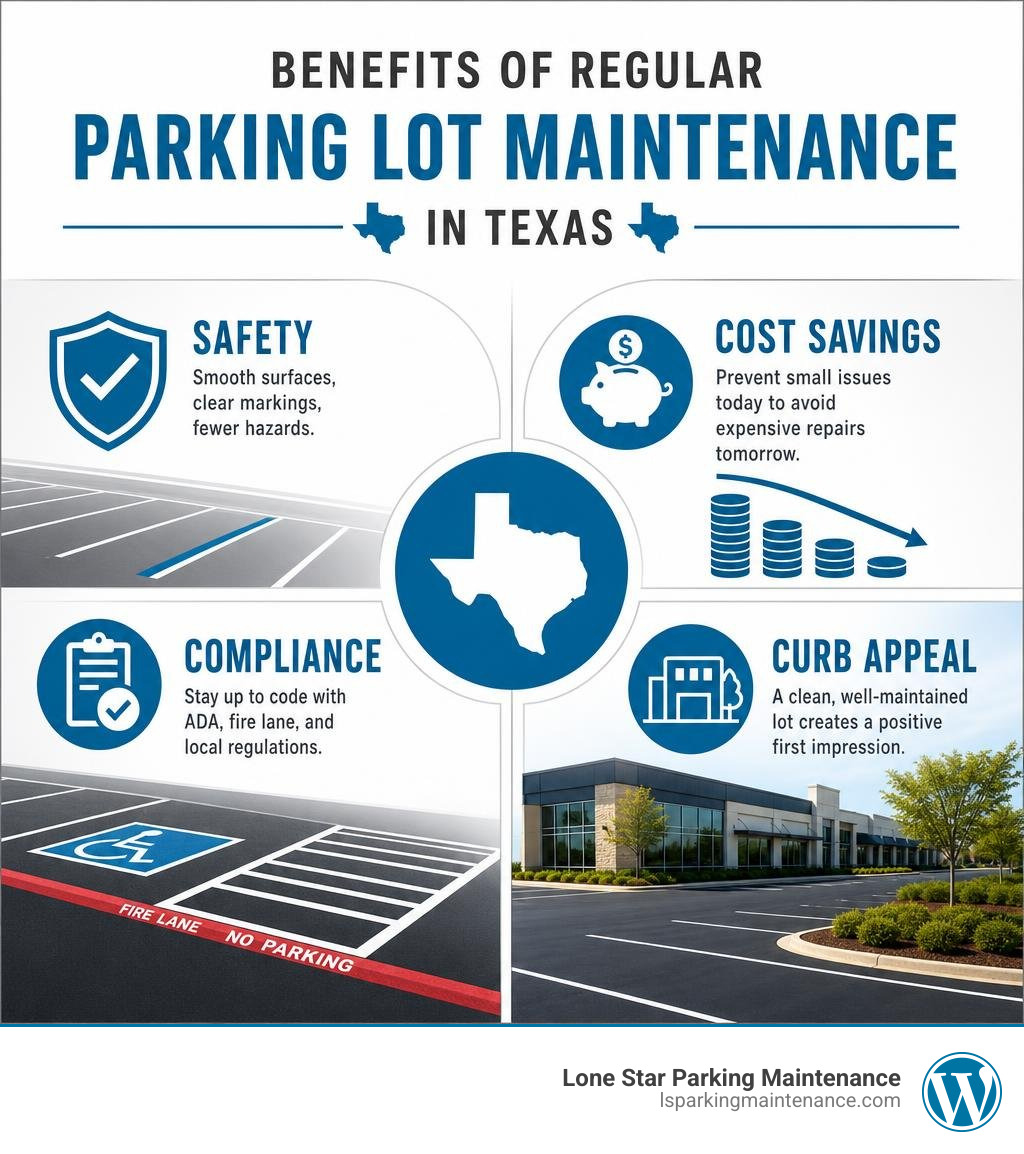
Texas lot maintenance services vocabulary:
Core Texas Lot Maintenance Services for Commercial Properties
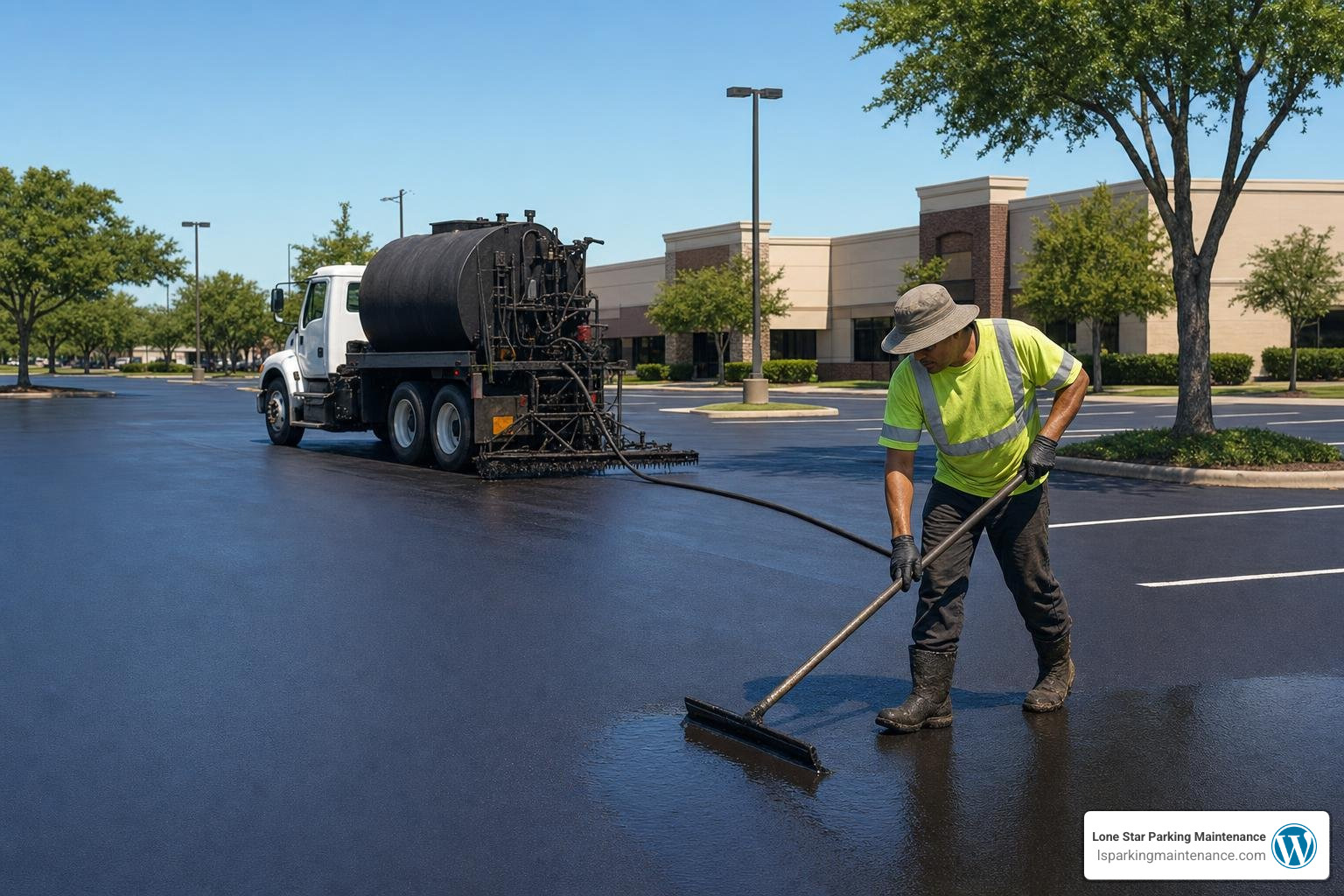
When you look at a commercial parking lot, you might just see a flat sheet of blacktop or concrete. But beneath that surface is a complex, engineered system designed to handle thousands of pounds of rolling metal every single day. To keep this system from breaking down, we rely on a comprehensive suite of Lone Star Parking Maintenance Services designed specifically for the extreme conditions of the Lone Star State.
Whether you manage an office park in Plano, a retail strip in Fort Worth, or a multi-level parking garage in downtown Dallas, your property requires a targeted approach. Comprehensive care means combining structural repairs, surface protection, and aesthetic detailing to instantly elevate your business’s curb appeal.
Let’s break down the core services that keep DFW properties safe, beautiful, and fully functional.
Asphalt Crack Repair and Sealcoating
Think of sealcoating as sunscreen and armor for your pavement. Because asphalt is a petroleum-based material, exposure to the blistering Texas sun causes it to dry out, oxidize, and turn from a rich charcoal black to a brittle, dusty gray. Once asphalt loses its flexibility, cracks are inevitable.
When cracks form, they allow water to seep beneath the pavement surface, softening the crushed stone base. If you do not address these cracks early, traffic will quickly collapse the weakened areas, creating expensive potholes.
We utilize advanced rubberized hot-pour crack sealants to seal those open wounds, preventing water intrusion. Following crack repair, we apply a premium commercial-grade sealcoat. This process shields the asphalt from UV rays and automotive fluid spills while restoring that deep, dark “like-new” finish. For a deeper dive into this preventative shield, check out our guide on Parking Lot Sealing and Crack Filling and learn why you should partner with Texas Asphalt Crack Repair Experts.
Professional Parking Lot Striping and Marking
A parking lot without clear markings is an invitation for chaos. Faded lines lead to dented fenders, blocked fire lanes, and frustrated visitors. Professional Parking Lot Striping is about much more than just painting straight lines; it is about maximizing your parking capacity, guiding traffic flow safely, and ensuring your property remains fully compliant with local and federal laws.
Our striping services cover everything from standard parking stalls, crosswalks, and directional arrows to custom curb painting and stencil work. We use high-durability, fast-curing traffic paints that stand up to both heavy tire wear and intense heat. Bright, highly visible markings ensure that drivers know exactly where to go, reducing your liability and improving the overall user experience.
Parking Lot Sweeping and Power Washing
Even the sturdiest pavement will deteriorate prematurely if it is constantly buried under dirt, trash, and chemical runoff. A buildup of sand and gravel acts like sandpaper under vehicle tires, grinding away your sealcoat and striping. Furthermore, oil, grease, and gasoline spills eat directly into asphalt, softening it until it crumbles.
Regular sweeping using regenerative air sweepers is the first line of defense. These specialized machines don’t just push dirt around; they use a powerful vacuum system to lift the tiniest abrasive dust and grit particles out of the pavement’s pores.
For stubborn stains, chewing gum, and deep-seated grime, we follow up with professional Parking Lot Power Washing. High-pressure hot water blasting lifts away unsightly automotive fluids and pollutants, restoring the clean, bright appearance of your concrete and asphalt surfaces while protecting our local DFW watersheds from toxic runoff.
Weather and Climate Challenges Affecting Texas Lots

Texas weather is legendary for its extremes. In the DFW Metroplex, our pavement must survive everything from triple-digit summer heatwaves to sudden winter ice storms. These rapid swings in temperature place incredible physical stress on both asphalt and concrete, making regular Concrete and Asphalt Maintenance an absolute necessity for property managers who want to avoid premature pavement failure.
How Extreme Heat Impacts Texas Lot Maintenance Services
As we established, Texas averages roughly 85 days above 90°F each year, with the DFW Metroplex frequently seeing weeks of consecutive 100-degree days. Under these conditions, the ambient temperature is only half the story. Dark asphalt surfaces can easily absorb enough solar radiation to reach surface temperatures exceeding 140°F!
At these extreme temperatures, asphalt begins to soften. This softening makes the pavement highly susceptible to “rutting” (depressions formed by heavy vehicle tires) and “shoving” (ripples that occur where vehicles brake or turn sharply).
Furthermore, extreme heat accelerates the evaporation of the essential oils within the asphalt binder. This process, known as oxidation, leaves the pavement brittle and prone to widespread cracking. To combat this rapid deterioration, we recommend regular applications of protective coatings. You can read all about these protective measures in our comprehensive article on DFW Metro Asphalt Sealing.
Winter Freeze-Thaw Cycles and Water Damage
While summer heat does the cooking, winter moisture does the carving. Even though North Texas winters are relatively short, they feature highly destructive freeze-thaw cycles.
When rain or melting ice enters open cracks in your parking lot, it settles into the subgrade base. When the temperature drops below freezing, that trapped water expands by about 9%. This expansion exerts immense upward pressure on the pavement above.
When the ice melts, it leaves behind an empty void. The next heavy vehicle that drives over this hollow spot will cause the surface to collapse, instantly creating a pothole. Proper joint sealing, crack filling, and routine inspections are the only way to prevent water from gaining a foothold in your pavement’s foundation.
Regulatory Compliance: ADA Standards and Fire Lanes
As a commercial property owner, your parking lot is legally considered private property, but it is still subject to strict federal, state, and municipal regulations. Failing to maintain compliant markings is not just a safety hazard; it can expose your business to devastating lawsuits and massive government fines.
ADA Parking Requirements in Texas
The Americans with Disabilities Act (ADA) outlines very specific rules for commercial parking lots. For national guidance on accessible parking, property managers can review ADA.gov’s accessible parking requirements. These regulations dictate:
- The exact number of designated accessible parking spaces required based on your lot’s total capacity.
- The mandatory inclusion of van-accessible spaces with wider adjacent access aisles.
- Strict slope requirements to ensure safe wheelchair transfers.
- Highly visible blue and white pavement markings paired with correct, R7-8 compliant upright signage.
The financial stakes here are incredibly high. First-time ADA violations can carry civil penalties of up to $75,000, with subsequent violations climbing to $150,000. Additionally, non-compliant properties are prime targets for predatory accessibility lawsuits. Keeping your ADA striping bright and properly configured is one of the cheapest insurance policies your business can buy.
Texas Fire Lane Marking Regulations
In the DFW Metroplex, municipal fire marshals do not play games when it comes to emergency access. Fire lanes must be clearly marked and completely unobstructed at all times.
While specific codes can vary slightly between cities like Dallas, Fort Worth, or Frisco, standard Texas fire lane requirements generally include:
- A continuous, solid red stripe painted along the curb or pavement edge of the designated fire lane.
- Highly visible stenciled warnings reading “NO PARKING FIRE LANE” or “FIRE LANE – TOW AWAY ZONE” in bold, white, 6-inch lettering.
- Stencils spaced at specific intervals (usually every 25 to 50 feet) along the red curb.
If your fire lane markings are faded, chipped, or improperly spaced, you risk failing your annual fire inspection, receiving hefty municipal citations, or worse – delaying emergency vehicles during a crisis. We make sure your fire lanes are painted to the exact municipal codes of your specific DFW city.
Maximizing Lifespan and Managing Costs of Your Pavement
Your parking lot is a major capital asset. Like any valuable asset, it requires proactive management to ensure you get the maximum possible return on your investment. Property managers who treat parking lot maintenance as an afterthought end up spending thousands of dollars more over the life of the pavement compared to those who practice preventative maintenance.
To put this in perspective, let’s look at the financial reality of pavement management over a 15-year period:
| Strategy | Year 1–3 | Year 4–7 | Year 8–12 | Total 15-Year Cost | Pavement Condition at Year 15 |
|---|---|---|---|---|---|
| Proactive Maintenance (Crack sealing, sweeping, sealcoating) | Minor crack sealing & sweeping ($) | Sealcoat & restripe ($$) | Minor patching & fresh sealcoat ($$) | Low to Moderate | Excellent (Smooth, dark, safe) |
| Reactive Maintenance (Do nothing until failures occur) | $0 | $0 | Major pothole repairs & structural patching ($$$) | High | Poor (Raveling, cracked, failing) |
| Full Replacement (No maintenance, total neglect) | $0 | $0 | $0 (Letting it crumble) | Astronomical (Full rip-out & repave) | Failed (Needs total reconstruction) |
Cost Factors for Texas Lot Maintenance Services
When we provide a customized quote for your commercial property, several key variables come into play:
- Size of the Lot: Naturally, a massive fulfillment center parking lot in Fort Worth will require more materials and labor than a boutique retail lot in McKinney.
- Severity of Damage: Catching cracks when they are under a quarter-inch wide is incredibly cost-effective. If those cracks have already evolved into deep alligator cracking or structural potholes, the repair scope shifts from simple filling to deep asphalt patching.
- Material Quality: We refuse to cut corners. We use premium, commercial-grade sealants and high-performance traffic paints that are engineered to survive the Texas sun. While cheaper materials might save a few pennies upfront, they will flake and fade in half the time.
- Mobilization and Scheduling: To minimize business disruptions, we often perform our work in phases or overnight. Phasing a project allows your customers to keep parking while we work on designated sections of your lot.
Extending Asphalt and Concrete Lifespan
With a consistent maintenance plan, a standard asphalt parking lot can easily last 20 to 25 years, while a solid concrete surface can endure for 30 to 40 years.
Beyond basic sealcoating and sweeping, there are advanced techniques we use to revive worn surfaces. For example, if the topmost layer of your asphalt is heavily damaged but the underlying stone base remains structurally sound, we can perform an asphalt milling and overlay. This process involves grinding away the damaged top inch of asphalt and laying down a fresh, smooth wearing course directly over the stable base. This gives you a brand-new driving surface at a fraction of the cost of full excavation and reconstruction.
Ongoing professional care is the key to preventing minor surface flaws from turning into structural nightmares, ensuring your pavement remains safe and visually appealing for years to come.
Frequently Asked Questions about Texas Lot Maintenance
We believe in keeping our clients educated. Here are some of the most common questions DFW property managers ask us about keeping their parking structures and surface lots in peak condition.
How often should a commercial parking lot be swept in Texas?
The ideal sweeping frequency depends entirely on your property type and traffic volume.
- High-Traffic Retail Centers & Grocery Stores: These busy hubs generate rapid trash buildup, food spills, and abrasive grit. They generally require sweeping 2 to 7 times per week to maintain a clean, welcoming appearance.
- Office Parks & Industrial Warehouses: These properties experience more predictable, lower-intensity traffic. Sweeping bi-weekly or monthly is usually sufficient to keep debris under control.
- Seasonal Adjustments: Regardless of your property type, you will want to schedule extra sweepings during the autumn leaf-drop and immediately after heavy spring storms to clear out clogged drainage grates.
What is the difference between parking lot sweeping and power washing?
Think of sweeping as dry dusting, while power washing is a deep scrub.
- Sweeping uses mechanical brushes and vacuum systems to lift loose debris, leaves, gravel, and trash. It is a rapid, surface-level maintenance task.
- Power Washing uses pressurized, heated water combined with specialized detergents to lift deep-seated stains, embedded dirt, mold, chewing gum, and oily automotive residues. Power washing is essential for restoring the bright, clean look of concrete sidewalks, dumpster pads, and parking garages.
How long does sealcoating take to dry in the Texas heat?
While the intense Texas sun helps speed up the evaporation process, sealcoat still requires adequate time to cure properly.
- Dry to the Touch: In hot, dry weather, the sealer will usually dry to the touch within 2 to 4 hours.
- Ready for Foot Traffic: Pedestrians can typically walk on the surface after 8 to 12 hours.
- Ready for Vehicle Traffic: We strongly recommend keeping vehicles off the newly sealed surface for a full 24 to 48 hours. Driving on the lot too early can cause tire scuffing, tracking, and premature wear on the fresh sealcoat.
Conclusion
Your parking lot is far more than just a place for cars to sit. It is a critical asset that directly impacts your property’s value, safety, compliance, and first impressions. Neglecting your pavement is a costly mistake that leads to rapid deterioration, safety hazards, and potential legal liabilities.
At Lone Star Parking Maintenance, we are proud to serve the entire DFW Metroplex with top-quality materials, strict adherence to industry standards, and an unwavering commitment to safety and customer satisfaction. Whether you need precision striping, protective sealcoating, deep power washing, or structural repairs, we have the expertise to get the job done right, on time, and with minimal disruption to your business.
Don’t let minor cracks turn into major financial headaches. Schedule your consultation with Lone Star Parking Maintenance today, and let’s work together to keep your Texas property safe, compliant, and looking its absolute best!